401(k) InvestSense: Focus on Fiduciary Process Over Product

By James W. Watkins, III, J.D., CFP Board Emeritus™, AWMA®

People often ask me what is the most common mistake that plan sponsors make, The answer is simple-assuming unnecessary fiduciary liability exposure by focusing on product rather than process. Actually, that answer applies to investment fiduciaries in general.

The courts have recognized that ERISA is essentially the codification of the common law of trusts, which in turn sets out various standards of conduct for fiduciaries. Part of the problem is that few plan sponsors have ever read or talked with an ERISA attorney about ERISA or the applicable standards. Too many plan sponsors have simply chosen to blindly follow the advice of conflicted third parties, such as mutual funds and insurance/annuity salesmen.

The courts have warned plan sponsors that reliance on third parties must be both reasonable and justified. As the court shave warned plan sponsors, reliance on commissioned sales people is rarely reasonable or justified due to the inherent conflict of interests that exists with such advisers.

We have explained that the fiduciary duties enumerated in § 404(a)(1) have three components. The first element is a “duty of loyalty” pursuant to which “all decisions regarding an ERISA plan `must be made with an eye single to the interests of the participants and beneficiaries.'” Second, ERISA imposes a “prudent man” obligation, which is “an unwavering duty” to act both “as a prudent person would act in a similar situation” and “with single-minded devotion” to those same plan participants and beneficiaries.1

Finally, an ERISA fiduciary must “`act for the exclusive purpose'” of providing benefits to plan beneficiaries.2

“[T]he duties charged to an ERISA fiduciary are `the highest known to the law.'” When enforcing these important responsibilities, we “focus[] not only on the merits of the transaction, but also on the thoroughness of the investigation into the merits of the transaction.”’3

One extremely important factor is whether the expert advisor truly offers independent and impartial advice.4 

FPA and Pescitelli, therefore, are not independent analysts. FPA does not work for TWU; rather, insurance companies like Transamerica pay Pescitelli’s salary. As a broker, FPA and its employees have an incentive to close deals, not to investigate which of several policies might serve the union best. A business in FPA’s position must consider both what plan it can convince the union to accept and the size of the potential commission associated with each alternative. FPA is not an objective analyst any more than the same real estate broker can simultaneously protect the interests of both buyer and seller or the same attorney can represent both husband and wife in a divorce. 841-842  5

So, what does ERISA actually say with regard to the fiduciary duties of a plan sponsor? Section 404(a) of ERISA provides that

(a) a fiduciary shall discharge that person’s duties with respect to the plan solely in the interests of the participants and beneficiaries; for the exclusive purpose of providing benefits to participants and their beneficiaries and defraying reasonable expenses of administering the plan; and with the care, skill, prudence, and diligence under the circumstances then prevailing that a prudent person acting in a like capacity and familiar with such matters would use in the conduct of an enterprise of a like character and with like aims.

(b) Investment prudence duties.

(1) With regard to the consideration of an investment or investment course of action taken by a fiduciary of an employee benefit plan pursuant to the fiduciary’s investment duties, the requirements of section 404(a)(1)(B) of the Act set forth in paragraph (a) of this section are satisfied if the fiduciary:

(i) Has given appropriate consideration to those facts and circumstances that, given the scope of such fiduciary’s investment duties, the fiduciary knows or should know are relevant to the particular investment or investment course of action involved, including the role the investment or investment course of action plays in that portion of the plan’s investment portfolio or menu with respect to which the fiduciary has investment duties; and

(ii) Has acted accordingly.

(2) For purposes of paragraph (b)(1) of this section, “appropriate consideration” shall include, but is not necessarily limited to:

(i) A determination by the fiduciary that the particular investment or investment course of action is reasonably designed, as part of the portfolio (or, where applicable, that portion of the plan portfolio with respect to which the fiduciary has investment duties) or menu, to further the purposes of the plan, taking into consideration the risk of loss and the opportunity for gain (or other return) associated with the investment or investment course of action compared to the opportunity for gain (or other return) associated with reasonably available alternatives with similar risks; 

(c) Investment loyalty duties.

(1) A fiduciary may not subordinate the interests of the participants and beneficiaries in their retirement income or financial benefits under the plan to other objectives, and may not sacrifice investment return or take on additional investment risk to promote benefits or goals unrelated to interests of the participants and beneficiaries in their retirement income or financial benefits under the plan.

(2) If a fiduciary prudently concludes that competing investments, or competing investment courses of action, equally serve the financial interests of the plan over the appropriate time horizon, the fiduciary is not prohibited from selecting the investment, or investment course of action, based on collateral benefits other than investment returns. A fiduciary may not, however, accept expected reduced returns or greater risks to secure such additional benefits. 6

So, where do plan sponsors usually get in trouble with regard to such legal obligations?

“[W]ith the care, skill, prudence, and diligence under the circumstances then prevailing that a prudent person acting in a like capacity and familiar with such matters would use in the conduct of an enterprise of a like character and with like aims.”

First, notice that Section 404(a)does not expressly require that a plan offer any specific investment within a plan. As is the case with most laws and regulations, ERISA is written in broad general terms in order to provide regulators with maximum flexibility to address violations on an “as needed” basis.

With the passage of SECURE and SECURE 2.0, I have been receiving calls and emails from both InvestSense clients and non-clients saying that annuity representatives have been falsely telling them that both SECURE acts require plans to offer annuities within their 401(k) plans. Simply not true. Same goes for crypto.

I have even had annuity and crypto advocates tell me that is morally wrong not to offer such investments in a plan if the plan participants wish to invest in such investments. Morally wrong…seriously?

I have been involved in fiduciary law in one way or the other since 1996. I have advised fiduciaries to use the same two question fiduciary risk management technique that I use in performing forensic analyses of actively managed funds.

1. Does ERISA expressly require that the specific investment be offered within a 401(k) or 403(b) plan? From the previous discussion, we know the answer to that question will always be “no.”
2. Would/Could inclusion of the specific investment in the plan potentially result in unnecessary fiduciary liability exposure for the plan sponsor?

The second question requires an analysis of an investment pursuant to ERISA’s prudent person standard. I am often asked to provide expert analyses with regard to actively managed mutual funds and, recently, annuities. The proper question is whether a plan sponsor’s investment selections measure up under ERISA’s prudent person standard, from a process versus product viewpoint.

Actively Managed Mutual Funds
The cornerstone of my analysis of actively managed mutual funds is based on my metric, the Active Management Value Ratio (AMVR). The AMVR is simply a modified version of the well-known cost/benefit metric commonly used in numerous businesses and professions.

In this case, the AMVR is simply a visual presentation of the research of investment experts such as Nobel Laureate Dr. William F. Sharpe, Charles D. Ellis, and Burton G. Malkiel.

[T]he best way to measure a manager’s performance is to compare his or her return with that of a comparable passive alternative.7

So, the incremental fees for an actively managed mutual fund relative to its incremental returns should always be compared to the fees for a comparable index fund relative to its returns.

When you do this, you’ll quickly see that that the incremental fees for active management are really, really high—on average, over 100% of incremental returns! 8

Past performance is not helpful in predicting future returns. The two variables that do the best job in predicting future performance [of mutual funds] are expense ratios and turnover. 9  

These three opinions formed the basis for the initial iteration of the AMVR. Further research led to the current version of the AMVR – AMVR 3.0 – which incorporates the research of Ross Miller and his Active Expense Ratio (AER) metric. Miller explains the importance of the AER as follows:

Mutual funds appear to provide investment services for relatively low fees because they bundle passive and active funds management together in a way that understates the true cost of active management. In particular, funds engaging in ‘closet’ or ‘shadow’ indexing charge their investors for active management while providing them with little more than an indexed investment. Even the average mutual fund, which ostensibly provides only active management, will have over 90% of the variance in its returns explained by its benchmark index.10

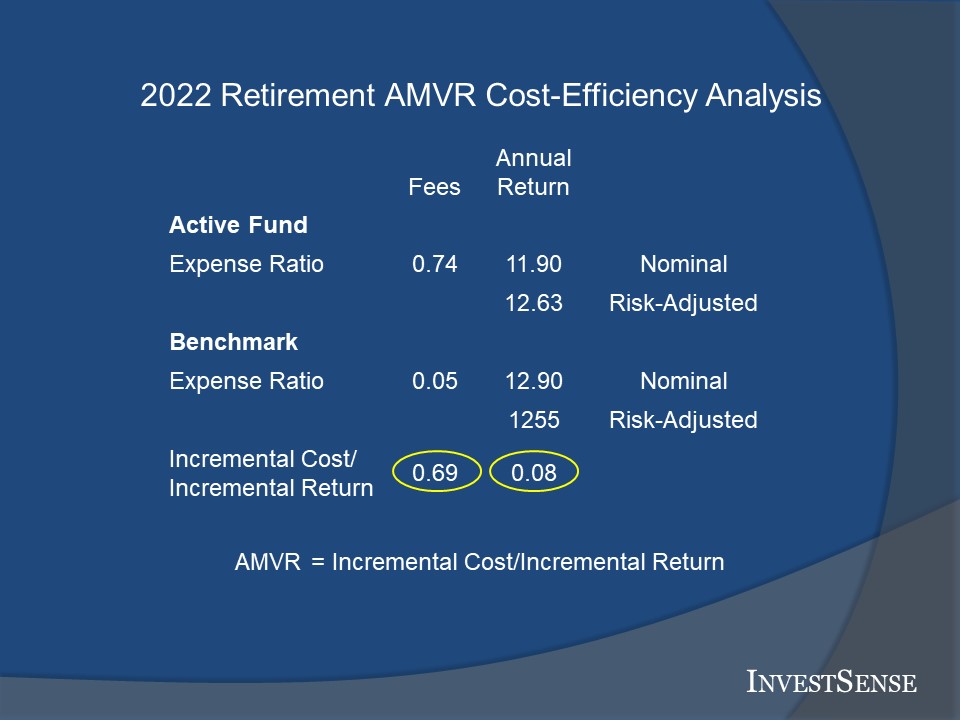
An example of the end result – AMVR 3.0 – is shown below.

An AMVR analysis can be calculated for any time period. In this case, a five-year analysis comparing an actively managed fund and a comparable index fund shows that the actively managed fund is cost-inefficient, as it fails to provide a positive incremental return (1.33), so naturally the incremental costs exceed the incremental returns. A cost-inefficient fund is an imprudent investment under the Restatement (Third) of Trusts.

The cost-inefficiency in the example is even more serious if measured using the AER, In this case, the high incremental costs of the funds combined with the fund’s high correlation of return to the benchmark (98) results in an AER of 5.67.

The example show above is far from an anomaly. Research has consistently shown that the overwhelming majority of actively managed funds are cost-inefficient.


99% of actively managed funds do not beat their index fund alternatives over the long term net of fees.11  

Increasing numbers of clients will realize that in toe-to-toe competition versus near–equal competitors, most active managers will not and cannot recover the costs and fees they charge.12

[T]here is strong evidence that the vast majority of active managers are unable to produce excess returns that cover their costs.13

[T]he investment costs of expense ratios, transaction costs and load fees all have a direct, negative impact on performance….[The study’s findings] suggest that mutual funds, on average, do not recoup their investment costs through higher returns.14

Perhaps the best advice on selection of mutual funds was offered by John Langbein, who served as the Reporter on the committee that wrote the Restatement (Second) of Trusts over fifty years ago. Shortly after the release of the revised Restatement, Langbein wrote a law review article on the new Restatement. At the end of the article, he made a bold prediction:

When market index funds have become available in sufficient variety and their experience bears out their prospects, courts may one day conclude that it is imprudent for trustees to fail to use such accounts. Their advantages seem decisive: at any given risk/return level, diversification is maximized and investment costs minimized. A trustee who declines to procure such advantage for the beneficiaries of his trust may in the future find his conduct difficult to justify.15   

The AMVR provides a quick and simple process that plan sponsors can uses to reduce their risk of unnecessary and unwanted fiduciary liability exposure by ensuring the prudence of their investment choices of their plan.

Annuities
The current attempt to convince plan sponsors to include annuities inn their plans is a perfect example of the psychological tactic known as “framing.” Framing refers to how an idea is presented in order to convince someone to agree with idea.

In the case of annuities, the pitch is “guaranteed income.” However, that hardly presents all of the variables that a plan sponsor needs to consider before deciding to include annuities in their 401(k) or 403(b) plan. As usual, the devil is in the details. As the late insurance advisor Peter Katt used to warn, “at what cost?”

Key risks with annuities include excessive fees, purchasing power risk, the risk that inflation will reduce the value of annuity payments, and single equity credit risk, the risk that the annuity issuer will not be able to make the payments called for by the annuity contract. Chris Tobe, one of the co-founders of otherthis blog’s sister site, the CommonSense 401(k) Project has written some excellent posts explaining some of the risks inherent in annuities. I highly recommend that you review his posts.

And with annuities, there are other serious costs that fiduciaries have to consider, most notably the commensurate return/windfall issue If the annuity requires that the annuity owner “annuitize” the annuity contract in order to receive the promised benefit of “guaranteed income,” the annuity owner has to surrender control of both the annuity and its accumulated value, with no guarantee of a commensurate return for the surrendered value, creating the potential windfall for the annuity issuer at the expense of the annuity owner and their heirs.

Plan sponsors often overlook the potential fiduciary liability issues created by the commensurate return/windfall issue. Fiduciary law is a combination of trust law, agency law and the law of equity. A basic tenet of equity law is that “equity abhors a windfall

Annuity advocates usually respond to the commensurate return issue by pointing out that some annuities address such shortcomings by offering the annuity owner a rider that guarantees the return of the premiums they paid…for yet another fee. Studies by both the Department of Labor and the General Accountability Office have stated that each additional 1 percent in fees/costs reduced an investor’s end-return by approximately 17 percent over a period of twenty years.16 So, the recommendation to “just add a rider” is not a simple solution to the commensurate return issue.

While these issues present obvious potential fiduciary liability concerns for plan sponsors, there is a simple way to avoid them altogether. Remember, ERISA does not require that a plan offer any specific investment within a plan. Given the potential fiduciary liability issues discussed herein, we advise our clients not to offer annuities within their plan.

ERISA does not require plan participants to assume unnecessary fiduciary liability risk. Annuities are often complex and confusing. For example, “indexed” annuities deliberately mislead investors into believing that they may achieve the returns of a market index. However, they quickly learn that the annuity issuer will significantly reduce their actual realized return by imposing restrictions such as caps on return and “participation rates.” Artificial and arbitrary restrictions and the various methods of computing and crediting returns simply increase the potential for fiduciary mistakes/misunderstandings and, thus, the potential for increased fiduciary liability exposure. Plan participants that wish to invest in annuities would still be free to do so outside the plan.

Going Forward
Far too often, plan sponsors and other investment fiduciaries unknowingly assume unnecessary and unwanted fiduciary liability exposure. This mistake is often due to a lack of knowledge and understanding as to what ERISA or trust law requires of them.

Hopefully, this post has helped plan sponsors and other investment fiduciaries realize how simple ERISA and fiduciary compliance can be by focusing on fiduciary process rather than investment products. An ERISA compliant fiduciary process will both simplify the selection of investment options and help reduce fiduciary liability exposure by ensuring the selection of prudent investment products.

Hopefully, this post has also convinced the reader to further explore the AMVR metric and learn how simple it is to use the AMVR to

> reduce potential fiduciary liability exposure,
> improve the quality of plan investment options.
> potentially simplify their plan in order to reduce administrative costs and increase employee > participation in the plan.

Bottom line-A proper fiduciary process will help ensure the prudence of the plan’s investment options.

.Notes
1. Gregg v. Transportation Workers of Am. Intern, 343 F.3d 833, 841-842 (6th Cir. 2003).
2. Gregg, Ibid.
3. Gregg, Ibid.
4. Gregg, Ibid.
5. Gregg, Ibid.
6. 29 C.F.R. § 2550.404-1; 29 U.S.C. § 1104(a)
7. William F. Sharpe, “The Arithmetic of Active Investing,” available online at https://web.stanford.edu/~wfsharpe/art/active/active.htm
8. Charles D. Ellis, “Letter to the Grandkids: 12 Essential Investing Guidelines,” available online at https://www.forbes.com/sites/investor/2014/03/13/letter-to-the-grandkids-12-essential-investing-guidelines/#cd420613736c
9. Burton G. Malkiel, “A Random Walk Down Wall Street,” 11th Ed., (W.W. Norton & Co., 2016), 460.
10. Ross Miller, “Evaluating the True Cost of Active Management by Mutual Funds,” Journal of Investment Management, Vol. 5, No. 1, 29-49 (2007) https://papers.ssrn.com/sol3/papers.cfm?abstract_id=746926
11. Laurent Barras, Oliver Scaillet, and Russ Wermers, False Discoveries in Mutual Fund Performance: Measuring Luck in Estimated Alphas, 65 J. FINANE 179, 181 (2010)
12. Charles D. Ellis, The Death of Active Investing, Financial Times, January 20, 2017, https://www.ft.com/content/6b2d5490-d9bb-eb37a6aa8e
13. Mark Carhart, On Persistence in Mutual Fund Performance, 52 J. FINANCE 57-58 (1997)
14. Philip Meyer-Braun, Mutual Fund Performance Through a Five-Factor Lens, Dimensional Funds Advisors, L.P., August 2016
15. John H. Langbein and Richard A. Posner, Measuring the True Cost of Active Management by Mutual Funds, Journal of Investment Management, Vol 5, No. 1, First Quarter 2007 http://digitalcommons.law.yale.edu/fss_papers/498
16. Pension and Welfare Benefits Administration, “Study of 401(k) Plan Feess abd Expenses,” (“DOL Study”). http://www.DepartmentofLabor.gov/ebsa/pdf; “Private Pensions: Changes needed to Provide 401(k) Plan Participants and the Department of Labor Better Information on Fees,” (GAO Study”),

Copyright InvestSense, LLC 2023. All rights reserved.

This article is for informational purposes only, and is neither designed nor intended to provide legal, investment, or other professional advice since such advice always requires consideration of individual circumstances.  If legal, investment, or other professional assistance is needed, the services of an attorney or other professional advisor should be sought.

Posted in 401k, 401k compliance, 401k investments, 401k plan design, 401k risk management, 403b, Active Management Value Ratio, AMVR, Annuities, best interest, closet index funds, compliance, cost consciousness, cost efficient, cost-efficiency, ERISA, ERISA litigation, fiduciary, fiduciary compliance, fiduciary duty, fiduciary law, fiduciary liability, fiduciary liability, Fiduciary prudence, fiduciary prudence, fiduciary responsibility, fiduciary risk management, fiduciary standard, investment advisers, investments, Mutual funds, pension plans, plan advisers, plan sponsors, prudence, retirement plans, risk management, wealth management, wealth preservation | Tagged , , , , , , , , , , , , , , , , , | Leave a comment

Brotherston Revisited: Will the 10th Circuit Court of Appeals “Fix” the Ongoing 401(k) SNAFU?

“Facts do not cease to exist because they are ignored” – Aldous Huxley 

In 2018, the First Circuit handed down its decision in Brotherston v. Putnam Investments, LLC.1 The decision is arguably the best analysis of the applicable fiduciary standards in 401(k) litigation. Among the court’s best points: 

The Restatement calls “for determining whether and in what amount the breach has caused a `loss’ . . . by reference to what the results `would have been if the portion of the trust affected by the breach had been properly administered.’”2  

Finally, the Restatement specifically identifies as an appropriate comparator for loss calculation purposes “return rates of one or more. . . suitable index mutual funds or market indexes (with such adjustments as may be appropriate).”3 (citing § 100 cmt. b(1) 

ERISA itself is not so specific. Rather, it states that a breaching fiduciary shall be liable to the plan for “any losses to the plan resulting from each such breach.” Certainly this text is broad enough to accommodate the total return principle recognized in the Restatement. Behind the text, too, stands Congress’s clear intent “to provide the courts with broad remedies for redressing the interests of participants and beneficiaries when they have been adversely affected by breaches of fiduciary duty.”4 (cjtes omitted) 

And as the Supreme Court has instructed, when we confront a lack of explicit direction in the text of ERISA, we often find answers in the common law of trusts. (citing Varity Corp. v. Howe, 516 U.S. 489, 496-97, 502, 506-07 (1996) (relying on “ordinary trust law principles” to fill gaps created by ERISA’s lack of definition regarding the scope of fiduciary conduct and duties).5

[T]he burden of showing that a loss would have occurred even had the fiduciary acted prudently falls on the imprudent fiduciary. By allowing its analysis on loss to be driven by its concern regarding the objective prudence of the Putnam funds, the district court in essence required plaintiffs to show causation as part of its case on loss-even as it correctly sought to reserve that requirement to defendants.6 

So to determine whether there was a loss, it is reasonable to compare the actual returns on that portfolio to the returns that would have been generated by a portfolio of benchmark funds or indexes comparable but for the fact that they do not claim to be able to pick winners and losers, or charge for doing so. Restatement (Third) of Trusts, § 100 cmt. b(1) (loss determinations can be based on returns of suitable index mutual funds or market indexes).7

In concluding, Judge Kayatta made two significant points: 

The Supreme Court has time and again adopted ordinary trust law principles to construe ERISA in the absence of explicit textual direction.8 

[T]he Supreme Court has made clear that whatever the overall balance the common law might have struck between the protection of beneficiaries and the protection of fiduciaries, ERISA’s adoption reflected “Congress'[s] desire to offer employees enhanced protection for their benefits…. In other words, Congress sought to offer beneficiaries, not fiduciaries, more protection than they had at common law, albeit while still paying heed to the counterproductive effects of complexity and litigation risk.9 

Putnam applied for certiorari so SCOTUS would review the First Circuit’s decision. SCOTUS invited the Solicitor General to file an amicus brief with the Court, which it eventually. While the Solicitor General agreed with both the First Circuit’s decision and its reasoning behind the decision, the Solicitor General advised the Court not to grant cert since Putnam’s application since it was technically an interlocutory appeal, meaning the case was still ongoing. SCOTUS ultimately denied Putnam’s request for review. 

Post-Brotherston 401(k) Litigation 
While both SCOTUS’ and the Solicitor General’s decisions are understandable, it still left left a significant void in 401(k) litigation, one that has arguably resulted in questionable and inconsistent interpretations of ERISA and unnecessary harm to 401(k) plan participants. At a time when the public’s perception of the American legal system is at one of its all-time lows, plan participants are openly questioning why courts can have such divergent interpretations on the same piece of legislation, knowing the harmful impact that such inconsistencies have created. 

ERISA plaintiff’s attorneys have the same question in light of SCOTUS’ decision in Tibble v. Edison International. In Tibble10, SCOTUS specifically noted that the courts often turn to the Restatement for guidance in resolving questions involving fiduciary law, including questions involving ERISA. 

Some have tried to dismiss the 401(k) cases filed as nothing more than “Monday-morning quarterbacking,” complaints about the ultimate performance of a plan’s investment options. That complaint rings hollow for several reasons. First, neither financial advisors nor plan sponsors are generally held liable for the ultimate performance of their recommendations/selections, as neither can control the performance of the financial markets. Second, ERISA claims of fiduciary imprudence are based on the prudence of a plan sponsor’s investment decisions as of the time such decisions were made. 

Despite SCOTUS’ endorsement of the Restatement as a resource in ERISA cases, some courts continue to refuse to accept the objective and equitable established by the Restatement. As the First Circuit noted, Section 100 of the Restatement expressly approves of the use of comparable index funds as comparators in 401(k) litigation. Yet, numerous courts continue to dismiss 401(k) actions using index funds, describing them as “unacceptable comparators” and as trying to compare “apples and oranges.” 

The fact that SCOTUS passed on the opportunity to expose the disingenuousness of the “apples and oranges” argument is especially troubling. As the First Circuit pointed out, the Restatement’s support for index funds establishes that denial of the use of index funds based solely on the active/passive characterization has no merit.  

That said, the Restatement does condition the use of index funds as comparators to comparable index funds. Some courts have seized upon this requirement to argue that actively managed funds may have different strategies and/or different goals that resuklt in the extra costs and extra risks typically associated with actively managed funds and active strategies. 

Said court rarely address the other side of argument, the fact that the ultimate goal of ERISA and its stated purpose is to provide for and protect the plan participants’ best interests. An actively managed plan has the same opportunity as a comparable index fund to meet such goals. If the actively managed fund fails to do so, the fact remains that a plan participant is better served by the comparable index fund. 

Facts are stubborn things. Studies have consistently established that the overwhelming majority of actively managed mutual funds are not cost-efficient relative to comparable index funds. 

  • 99% of actively managed funds do not beat their index fund alternatives over the long-term net of fees.10 
  • Increasing numbers of clients will realize that in toe-to-toe competition versus near–equal competitors, most active managers will not and cannot recover the costs and fees they charge.11 
  • [T]here is strong evidence that the vast majority of active managers are unable to produce excess returns that cover their costs.12 
  • [T]he investment costs of expense ratios, transaction costs and load fees all have a direct, negative impact on performance….[The study’s findings] suggest that mutual funds, on average, do not recoup their investment costs through higher returns.13 

Furthermore, as some courts try to justify the use of cost-inefficient active funds in 401(k) plans, an often-unaddressed issue involves the fundamental issue of just how much active management do “actively” managed funds, both in terms of absolute return, i.e., “closet indexing,” and cost-efficiency.  

Closet indexing is an international issue that continues to demand additional attention…except in the U.S. The financial implications of closet indexing for investors are well-known.  

[A] large number of funds that purport to offer active management and charge fees accordingly, in fact persistently hold portfolios that substantially overlap with market indices….Investors in a closet index fund are harmed by paying fees for active management that they do not receive or receive only partially….14 

The issue of closet indexing was a key issue in the Caterpillar 401(k) case.15 Closet indexing was a significant factor in the plaintiffs’ ability to defeat a motion to dismiss, which quickly led to a settlement of the action. 

Costs matter. When the Securities and Exchange Commission (SEC) announced and implemented Regulation “Best Interest” (Reg BI), then SEC chairman Jay Clayton acknowledged the importance of cost-efficiency of investments: 

rational investor seeks out investment strategies that are efficient in the sense that they provide the investor with the highest possible expected net benefit, in light of the investor’s investment objective that maximizes utility.16  

[A]n efficient investment strategy may depend on the investor’s utility from consumption, including…(4) the cost to the investor of implementing the strategy.17  

The situation becomes even worse if the costs are adjusted for the correlation between the active suite funds and the comparable index funds, shown here based on Miller’s Active Expense Ratio (AER). Miller described the importance of the AER: 

Mutual funds appear to provide investment services for relatively low fees because they bundle passive and active funds management together in a way that understates the true cost of active management. In particular, funds engaging in ‘closet’ or ‘shadow’ indexing charge their investors for active management while providing them with little more than an indexed investment. Even the average mutual fund, which ostensibly provides only active management, will have over 90% of the variance in its returns explained by its benchmark index.18 

The fact that more ERISA plaintiff’s attorneys do not incorporate a closet indexing claim into their complaints is surprising to me, especially given its proven effectiveness and available research. An additional arrow in one’s quiver can never hurt.

Brotherston Revisited in the 10th Circuit? 
Could the frustrations resulting from SCOTUS’ refusal grant cert in Brotherston and the ongoing misinterpretations of ERISA and unnecessary harm to plan participants potentnially be coming to an end?  
 
A case is currently pending in the 10th Circuit Court of Appeals involves many of the same issues that were in Brotherston, specifically the “apples and oranges” argument and the issue of whose has the burden of proving causation in 401(k) actions.19 The district court ruled against the plan participants on both questions and dismissed the action.  

The questions before the Court have already been addressed herein. However, an amicus brief filed with the Court deserves special mention. One argument raised by the amicus brief was that the plaintiffs failed to establish the imprudence of the process used by the plan sponsors. The brief conveniently fails to mention that the plaintiffs were never provided to learn of the process used, as no discovery had been allowed. Without discovery, any argument would have been pure speculation.  

This case is a perfect example of how some courts are improperly confusing the two distinct stages of pleading and proof of causation.  The First Circuit noted the impropriety of combining the two stages for the purpose of prematurely dismissing meritorious 401(k) actions.  

Some courts have attempted to justify combining the two stages by alleging the costs of discovery if plan participants are permitted to have discovery. The amicus brief made a similar argument. Fortunately, the Sixth Circuit recently exposed the lack of legal merit to such arguments and premature dismissals based on same. 

This wait-and-see approach also makes sense given that discovery holds the promise of sharpening this process-based inquiry. Maybe TriHealth ‘investigated its alternatives and made a considered decision to offer retail shares rather than institutional shares’ because ‘the excess cost of the retail shares paid for the recordkeeping fees under [TriHealth’s] revenue-sharing model….’ Or maybe these considerations never entered the decision-making process. In the absence of discovery or some other explanation that would make an inference of imprudence implausible, we cannot dismiss the case on this ground. Nor is this an area in which the runaway costs of discovery necessarily cloud the picture. An attentive district court judge ought to be able to keep discovery within reasonable bounds given that the inquiry is narrow and ought to be readily answerable.20 

Common sense supports this argument. If in fact the plan sponsors conducted the legally required objective and thorough independent investigation and evaluation of the funds selected for a plan, discovery could easily be limited to producing any and all materials used and relied on by the plan sponsor. The time and costs involved in such controlled discovery should be minimal. Then again, as the Sixth Circuit points out, such controlled discovery would also expose plan sponsors who did not comply with ERISA’s fiduciary requirements.  

Going Forward 
The unresolved issues from Brotherston need to be addressed and resolved in order that the federal courts operate under a universal and consistent interpretation of ERISA in enforcing the rights and protections guaranteed under ERISA. The 10th Circuit will have the opportunity to do so. If they fail to do so, one can only hope that SCOTUS will be given an opportunity to revisit Brotherston and the Solicitor General’s excellent analysis of fiduciary law and ERISA.

Notes 
1. Brotherston v. Putnam Investments, LLC, 907 F.3d 17 (2018) (Brotherston)
2. Brotherston, 31.
3. Brotherston, 31.
4. Brotherston, 31.
5. Brotherston, 33.
6. Brotherston, 34.
7. Brotherston, 36.
8. Brotherston, 36.
9. Brotherston, 37.
10. Tibble v. Edison International, 135 S. Ct 1823 (2015).
11.Laurent Barras, Olivier Scaillet and Russ Wermers, False Discoveries in Mutual Fund Performance: Measuring Luck in Estimated Alphas, 65 J. FINANCE 179, 181 (2010).
12. Charles D. Ellis, The Death of Active Investing, Financial Times, January 20, 2017, available online at https://www.ft.com/content/6b2d5490-d9bb-11e6-944b-eb37a6aa8e. 
13. Philip Meyer-Braun, Mutual Fund Performance Through a Five-Factor Lens, Dimensional Fund Advisors, L.P., August 2016.
14. Mark Carhart, On Persistence in Mutual Fund Performance,  52 J. FINANCE, 52, 57-8 (1997).
15. Martijn Cremers and Quinn Curtis, Do Mutual Fund Investors Get What They Pay For?:The Legal Consequences of Closet Index Fundshttps://papers.ssrn.com/sol/papers.cfm?abstract_id=2695133 (Cremers), 5, 42.
16. Martin v. Caterpillar, Inc., (not reported) 2008 WL 5082981 (C.D. Ill. 2008), 453,
17. SEC Release 34-86031, “Regulation Best Interest: The Broker-Dealer Standard of Conduct” (Reg BI), 279. (2020)
18. Reg BI, 279.
19.  Ross Miller, “Evaluating the True Cost of Active Management by Mutual Funds,” Journal of Investment Management, Vol. 5, No. 1, 29-4.
20. Matney v. Barrick Gold of N. Am., Inc. 2022 WL 1186532 (D.Ut. April 21, 2022)
21. Forman v. TriHealth, Inc., 40 F.4th 443, 453 (2022).

Copyright InvestSense, LLC 2023. All rights reserved.

This article is for informational purposes only, and is neither designed nor intended to provide legal, investment, or other professional advice since such advice always requires consideration of individual circumstances.  If legal, investment, or other professional assistance is needed, the services of an attorney or other professional advisor should be sought.

Posted in 401k, 401k compliance, 401k investments, 401k plan design, 401k risk management, 403b, closet index funds, compliance, cost consciousness, cost efficient, cost-efficiency, Cost_Efficiency, ERISA, ERISA litigation, fiduciary, fiduciary compliance, fiduciary duty, fiduciary law, fiduciary liability, fiduciary liability, Fiduciary prudence, fiduciary prudence, fiduciary responsibility, fiduciary risk management, fiduciary standard, Mutual funds, pension plans, plan advisers, plan sponsors, prudence, Reg BI, retirement planning, retirement plans, SCOTUS, Supreme Court | Tagged , , , , , , , , , , , , , , , | Leave a comment

4Q 2022 AMVR “Cheat Sheets”: Correlation of Returns, “Closet Indexing,” and Fiduciary Liability

James W. Watkins, III, J.D., CFP Board EmeritusTM, AWMATM

First, note the new URL address. After years of having to explain the old “iainsight.wordpress.com” URL, we finally worked with WordPress to accomplish the re-branding. Kudos to WordPress for working with us and for their patience in helping us to accomplish the “fiduciaryinvestsense.com” re-branding and increase the InvestSense franchise.

Now, as for the “cheat sheets,” no real surprises here, as the six non-index-based funds in “Pensions & Investments” annual survey of the top mutual funds in U.S. defined contribution plans, based on total investment by plan participants, remain the same.

Just a reminder, InvestSense provides information based on the funds’ nominal numbers, or public reported performance numbers. These are the numbers see in the public ads and reports.

InvestSense uses the risk-adjusted returns (RAR) and correlation-adjusted costs numbers (CAC), as those numbers provide a more accurate picture of performance and costs. We advise plan sponsors, trustees and other investment fiduciaries, as well as attrorneys, to do the same for that reason as well.

None of the six funds qualified for an AMVR rating using either the nominal or adjusted numbers, as none were able to produce a scenario where the active fund’s incremental costs exceeded its incremental returns. Only two were even able to outperform a comparable Vanguard index fund.

Same story when analyzing the 10-year numbers. None of the six funds qualified for an AMVR rating using either the nominal or adjusted numbers, as none were able to produce a scenario where the active fund’s incremental costs exceeded its incremental returns. Only three were even able to outperform a comparable Vanguard index fund.

However, both charts provide a potentially significant lesson in connection with fiduciary risk management. Note the significant increase in effective incremental costs (AER column) for both Fidelity Contrafund and T. Rowe Price Blue Chip Growth when correlation of returns is factored in. Actively managed funds with a combination of high nominal incremental costs and a high r-squared. correlation of returns, number can expect to see similar high CACs and a failure to qualify as prudent investment options under AMVR standards.

Active Expense Ratio and Closet Indexing
I recently posted an article addressing the issue of closet and the poor response of the United States in general general in addressing the issue when compared to the response of other countries in recognizing and addressing both the issue and its negative impact on investors.

The AMVR uses Miller’s Active Expense Ratio (AER) to help expose potential cases of closet-indexing and evaluate the negative impact on 401(k) and 403(b) plan participants. People often ask me why we even calculate AER. Miller explained the value of the AER as follows

Mutual funds appear to provide investment services for relatively low fees because they bundle passive and active funds management together in a way that understates the true cost of active management. In particular, funds engaging in ‘closet’ or ‘shadow’ indexing charge their investors for active management while providing them with little more than an indexed investment. Even the average mutual fund, which ostensibly provides only active management, will have over 90% of the variance in its returns explained by its benchmark index.1

The AER supports Miller’s claim that the performance of most actively managed funds is overwhelmingly attributable to the it’s benchmark rather than the fund’s active management team. Part of the AER’s methodology requires that the user calculate the Active Weight (AW) of the mutual fund, the percentage of actual management provided by the active fund.

To calculate an actively managed fund’s AW only requires two pieces of data, the active fund’s correlation of returns to the comparable index fund and the fund’s incremental returns. For example, Contrafunds incremental cost is 69 basis point. (basis points is a term commonly used in the financial world. You do not need to understand it in calculating AW or AER.)

Contrafund’s r-squared, or correlation of returns0 number is 98 out of a possible 100. AW is then calculated as follows:

AW = SQRT(1 minus R-squared)/[(SQRT(R-squared) + (SQRT(1 minus R-squared.)]

Using our data, Contrafund’s AW is .1250, or an active weight of only 12.50%. Wonder how investors would react if they are only getting 12.50% of actual active management while actually underperforming the less expensive index funds and paying a fee approximately thirteen times higher for the privilege of receiving such underperformance.

To calculate an actively managed fund’s AER, simply divide the fund’s incremental costs by the fund’s AER. Here, Contrafund’s AER would equal 5.52 (0.69/.1250). Such a significant difference in the fund’s implicit expense ratio drastically reduces the fund’s relative cost-efficiency.

A high r-squared number is often a sign of a possible closet index fund. So why is so much international discussion and concern over closet-indexing? Martijn Cremers, co-creator of the Active Share metric, explains the reason for such concern.

[A] large number of funds that purport to offer active management and charge fees accordingly, in fact persistently hold portfolios that substantially overlap with market indices….Investors in a closet index fund are harmed by paying fees for active management that they do not receive or receive only partially….2

So should U.S. investors be concerned about possible closet-indexers? Most U.S. domestic equity-based funds are reporting r-squared of 90 or above, with many of the best-known funds reporting r-squared number of 95 and above. Both the 5 and 10-year cheat sheets demonstrate that trend.

The AMVR and Fiduciary Prudence: A One-Act Pla
y
I love working with my fiduciary risk management clients. During an initial meeting with a perspective client, I make my presentation using the famous InvestSense Fiduciary Liability Circle and several AMVR forensic analysis charts.

I often use an AMVR slide analyzing Fidelity Contrafund K shares since they are a common investment option within 401(k) and 403(b) plans.

I ask three simple questions:

1. Did the actively managed fund provide a positive incremental return, i.e., outperform the benchmark?
2. If so, did the actively managed fund’s incremental return exceed the fund’s incremental costs?
3. In accordance with the Restatement of Trusts’ Prudent Investor Rule (PIR), did the actively managed fund provide the highest level of return for the lowest level of costs and risks or, in the alternative, the lowest level of risk and costs for a given level of return?

If the answer to any of the three questions is “no,” then the actively managed is imprudent relative to the benchmark under the PIR standards. A quick check of the answers using the fund’s AER will often suggest that the fund may qualify as a imprudent closet-index fund.

At some point, the results of the three-question test usually results in something similar to the following scenario:

CEO: So, we are paying annual costs that are 8-10 times higher than the comparable index fund and essentially getting no commensurate return for the extra costs and risks of the actively managed fund? Why are we invested in this fund?
Investment Committee Member: Because our plan adviser recommended the fund.
CEO: Then why are we paying the plan adviser for such poor advice?
Investment Committee Member: They were highly recommended.
CEO: Just how much are we paying the plan adviser?
Investment Committee Member: $$$$$$$$$$$$$$$$$
CEO: Mr. Watkins, can we sue them?
Me: Yes and no. You agreed to a fiduciary disclaimer clause in the advisory contract, so they arguably have no fiducairy duty to you, the plan, or the plan participants. That said, the Supreme Court has ruled that you may be able to sue them based on common law grounds such as negligence, breach of contract and fraud.

At that point, the CEO asks how much potentially liability exposure they have and what their options are to address/”fix” the situation.

The SEC, Finra and the DOL have essentially buried their heads in the sand and have avoided discussing both the topic of closet-indexing and its harmful effects on plan participants. While there may not be any universally accepted standards for categorizing a fund as a closet-index fund, the quantitative analysis provided by an AMVR analysis can provide numbers reflecting the damage being inflicted on both plan participants and investors in general.

Notes

1. Ross Miller, “Evaluating the True Cost of Active Management by Mutual Funds,” Journal of Investment Management, Vol. 5, No. 1, 29-4.
2. Martijn Cremers and Quinn Curtis, Do Mutual Fund Investors Get What they Pay For?:The Legal Consequences of Closet Index Funds, https://papers.ssrn.com/sol/papers.cfm?abstract_id=2695133 (Cremers), 5, 42.

Copyright InvestSense, LLC 2023. All rights reserved.

This article is for informational purposes only, and is neither designed nor intended to provide legal, investment, or other professional advice since such advice always requires consideration of individual circumstances.  If legal, investment, or other professional assistance is needed, the services of an attorney or other professional advisor should be sought

Posted in 401k, 401k compliance, 401k investments, 401k plan design, 401k risk management, Active Management Value Ratio, AMVR, closet index funds, compliance, consumer protection, cost consciousness, ERISA, fiduciary, fiduciary compliance, fiduciary duty, fiduciary law, fiduciary liability, fiduciary liability, Fiduciary prudence, fiduciary prudence, fiduciary responsibility, fiduciary risk management, fiduciary standard, investment advisers, investments, Mutual funds, pension plans, plan advisers, plan sponsors, prudence, retirement plans, risk management, SEC, securities, securities compliance, trust realtionships, wealth management, wealth preservation | Tagged , , , , , , , , , , , | Leave a comment

401(k) Litigation Trends to Watch in 2023

I am often asked what I see as the current trends in 401(k) and what fiduciary risk management steps plan sponsors should consider in order to reduce any potential fiduciary risk exposure. With the end of the year approaching, now seems like an appropriate to post my opinions and forecasts

Five issues in particular have often been relied on plans and some courts to dismiss 401(k) cases:

1. The requirement that plaintiff properly plead plausibility.
2. The questions as to which party has the burden of proof regarding causation of the alleged damages.
3. The “menu of options” defense.
4. The “apples and oranges” defense.
5. Dismissal of cases based on presumed cost of discovery.

Pleading Plausibility 
There is no issue here. Under the Federal Rules of Civil Procedure, a plaintiff must plead their case in such a way as to establish the plausibility of the wrongdoing and the resultant damages.

The Solicitor General’s office did an excellent job of addressing the plausibility pleading requirement in the amicus brief that it filed with SCOTUS in connect with the Hughes v. Northwestern University case.

Petitioners state a plausible claim for relief in part of Count V by alleging that respondents selected investment options for the Plans “with far higher costs than were and are available for the Plans based on their size.”1

That is not to say that an ERISA plaintiff could state a claim for relief by alleging merely that alternative investment funds with lower management fees than those included in a plan were available in the marketplace.2

Petitioners did not merely present a conclusory assertion that the Plans’ recordkeeping fees were too high; they substantiated their claim with specific factual allegations about 15 market conditions, prevailing practices, and strategies used by fiduciaries of comparable Section 403(b) plans.3

This is a message that runs consistently through 401(k) litigation, the need to support allegations with supporting factual evidence. At the same time, as both the Solicitor General and several SCOTUS justices pointed out in oral arguments in Hughes v. Northwestern University4, at the pleading stage, the level of proof need not be at the same level as needed at the proof of causation stage.

Under the law, at the pleading stage, a court is required to accept all allegations as true. The general rule of pleading under the federal rules is simply that the plaintiff provide enough information so that the defendant understand the nature of the plaintiff’s claims.

Burden of Proving Causation
The party charged with the burden of proof on the issues involved in the case has to meet a higher level of providing specific information as to the alleged fiduciary violations and the damages resulting from such violations. The party facing the burden of proof has a challenging responsibility.

The general rule is that the plaintiff must prove its case. However, in Brotherston v. Putnam Investments, LLC5 (Brotherston),the First Circuit pointed out that under trust law, that burden is typically shifted due to the involvement of fiduciary duties and the fact that the necessary information is solely within the trustee. The Solicitor General subsequently supported that position in an amicus brief to SCOTUS.

There is currently a split within the federal courts as to whom carries the burden of proof in 401(k) litigation. As a result, there are employees that are being inequitably denied the rights and protections guaranteed to them under ERISA.

ERISA does expressly resolve the issue. In the Tibble v. Edison International6 decision, SCOTUS stated that the courts often look to the Restatement Third of Trusts (Restatement) to resolve fiduciary issues. The Solicitor General’s amicus brief in Hughes noted several relevant provisions of the Restatement:

The judgment and diligence required of a fiduciary in deciding to offer any particular investment fund must include consideration of costs, among other factors, because a trustee must “incur only costs that are reasonable in amount and appropriate to the investment responsibilities of the trusteeship.”7 (citing Restatement § 90(c)(3))

[C]ost-conscious management is fundamental to prudence in the investment function.”8 (citing Restatement § 90 cmt. b(1))

Trustees, like other prudent investors, prefer (and, as fiduciaries, ordinarily have a duty to seek) the lowest level of risk and cost for a particular level of expected return.”9 (citing Restatement § 90 cmt. f(1)).

For mutual funds specifically, trustees should pay “special attention” to “sales charges, compensation, and other costs” and should “make careful overall cost comparisons, particularly among similar products of a specific type being considered for a trust portfolio.”10 (citing Restatement § 90 cmt. m)

Other federal courts adhere to the general rule and seemingly disregard the Restatement’s positions. Placing the burden of proof on the plan participants becomes even more inequitable when some courts refuse to recognize the fact that the pleading stage and the proof of causation are two separate and distinct stages. Furthermore, combining the pleading and proof stages denies plaintiffs an opportunity for discovery to learn how, or even whether, the plan conducted its legally required independent investigation and evaluation of the plan’s investment options.

Reading the First Circuit’s Brotherston decision and the Solicitor General’s amicus brief together, it seems likely that SCOTUS will either hold that the burden of proof on causation will be shifted to the plan in 401(k)/403(b) litigation, or that the pleading and proof of causation stages will be clearly separated to ensure that the plan participants will have an opportunity for discovery going forward. The question is clearly ripe, in fact well overdue, to ensure an equitable decision in ERISA litigation.

“Menu of Options” Question
This is no longer an issue, as SCOTUS ruled in Hughes that such provisions violate ERISA’s clear requirement that each investment option within a plan must be separately prudent under applicable fiduciary laws.

“Apples and Oranges” Question
The First Circuit did an excellent legal analysis on this issue of whether actively managed funds can be compared to comparable index funds in assessing both a plan sponsor’s prudence in selecting investment options for a plan and the alleged damages for any fiduciary breaches.

Finally, the Restatement specifically identifies as an appropriate comparator for loss calculation purposes “return rates of one or more. . . suitable index mutual funds or market indexes (with such adjustments as may be appropriate).”11 (citing Restatement § 100 cmt. b(1)

a breaching fiduciary shall be liable to the plan for ‘any losses to the plan resulting from each such breach.’ Certainly, this text is broad enough to accommodate the total return principle recognized in the Restatement. Behind the text, too, stands Congress’s clear intent ‘to provide the courts with broad remedies for redressing the interests of participants and beneficiaries when they have been adversely affected by breaches of fiduciary duty….’ And as the Supreme Court has instructed, when we confront a lack of explicit direction in the text of ERISA, we often find answers in the common law of trusts.12 (cites omitted

More importantly, the Supreme Court has made clear that whatever the overall balance the common law might have struck between the protection of beneficiaries and the protection of fiduciaries, ERISA’s adoption reflected ‘Congress'[s] desire to offer employees enhanced protection for their benefits…. In other words, Congress sought to offer beneficiaries, not fiduciaries, more protection than they had at common law, albeit while still paying heed to the counterproductive effects of complexity and litigation risk.’3

To further emphasize the legitimacy of index funds as comparators in 401(k) actions, Judge Keyatta added the following observation:

Moreover, any fiduciary of a plan such as the Plan in this case can easily insulate itself by selecting well-established, low-fee and diversified market index funds. And any fiduciary that decides it can find funds that beat the market will be immune to liability unless a district court finds it imprudent in its method of selecting such funds, and finds that a loss occurred as a result. In short, these are not matters concerning which ERISA fiduciaries need cry ‘wolf.’14

Just like the burden of proof issue, the “apples and oranges” issue is ripe for discrediting, as it has absolutely no merit either factually or legally. As I have previously posted, the lack of the factual merit in the “apples and oranges” argument can be shown by the ERISA plaintiff’s bar shifting the legal paradigm from one that focuses on the antiquated active/passive argument to one that focuses on the proven cost-inefficiency between actively managed and index funds.

The research on the cost-efficiency of actively managed mutual funds suggest that plan sponsors face a daunting challenge in trying to justify the inclusion of actively managed mutual funds in a 401(k) plan:

  • 99% of actively managed funds do not beat their index fund alternatives over the long-term net of fees.15
  • Increasing numbers of clients will realize that in toe-to-toe competition versus near–equal competitors, most active managers will not and cannot recover the costs and fees they charge.16
  • [T]here is strong evidence that the vast majority of active managers are unable to produce excess returns that cover their costs.17
  • [T]he investment costs of expense ratios, transaction costs and load fees all have a direct, negative impact on performance….[The study’s findings] suggest that mutual funds, on average, do not recoup their investment costs through higher returns.18

The fact that most U.S. domestic-equity based actively managed mutual funds have an R-squared rating of 90 and above, many with 95 and above, relative to comparable index funds further weakens any argument that index funds are not meaningful comparators in 401(k) litigation. What some courts seemingly want to ignore is the inconvenient truth of the relative cost-inefficiency of actively managed funds.

Fortunately, this relative cost-inefficiency can be proven to the courts through the use of a simple metric I created, the Active Management Value Ratio (AMVR). The AMVR is based on the research and concepts of investment notables such as Nobel laureate Dr. William F. Sharpe and Charles D. Ellis. The AMVR is simply an adaptation of the well-known cost/benefit equation, using the incremental correlation-adjusted costs and the incremental risk-adjusted returns between an actively managed fund and a comparable index fund. As the sample charts below show, while the AMVR is simple to calculate, it can provide a powerful message.

By simply adding the cost-inefficiency evidence and supporting AMVR illustrations, I believe the ERISA plaintiff’s bar can easily discredit the “apples and oranges” argument and some courts continuing support of same.

Dismissal of 401(k) Actions Based on Cost of Discovery
Courts forcing the plan participants to assume both the pleading and proof of causation responsibilities have often tried to justify such actions on the need to avoid unnecessarily placing the costs of discovery on plans. Such courts have seemingly totally ignored the inequity of such decisions.

Fortunately, a recent Sixth Circuit Court of Appeals recognized the lack of fairness and merit in such arguments. In the TriHealth16 decision, Chief Judge Sutton addressed the issue, stating that

This wait-and-see approach also makes sense given that discovery holds the promise of sharpening this process-based inquiry. Maybe TriHealth “investigated its alternatives and made a considered decision to offer retail shares rather than institutional shares” because “the excess cost of the retail shares paid for the recordkeeping fees under [TriHealth’s] revenue-sharing model….” Or maybe these considerations never entered the decision-making process. In the absence of discovery or some other explanation that would make an inference of imprudence implausible, we cannot dismiss the case on this ground. Nor is this an area in which the runaway costs of discovery necessarily cloud the picture. An attentive district court judge ought to be able to keep discovery within reasonable bounds given that the inquiry is narrow and ought to be readily answerable.17

Hopefully, Judge Sutton’s insight will discredit the cost of discovery argument and result in a more equitable and fairer 401(k) litigation process.

Going Forward
Maybe it is just wishful thinking, but I believe that 2023 may actually be the year that the legal system agrees to “sing from the same ERISA hymnal,” to decide cases on a universal intrepretation of ERISA. If someone seeks cert for SCOTUS to address the “apples and oranges” and burden of proof issues. I believe the First Circuit’s Brotherston decision, and the amicus brief filed with SCOTUS by the Solicitor General in connection with Putnam’s appeal, together provide sufficient legal arguments and evidence to discredit both of said issues so that employees across America get equal and fair enforcement of the rights and protections guaranteed to them under ERISA. At the same time, I believe Judge Sutton’s endorsement of “controlled” discovery may reduce the number of 401(k) actions and allow more cases to be decided on the merits than on a questionable procedural basis.

In the Solicitor General’s amicus brief in Brotherston, the SG made a simple statement that still carries weight vis-a-vis the “apples and oranges” and the burden of proof as to causation issues:

The court of appeals correctly decided both questions.

Yes it did. Now time will tell if SCOTUS will have the opportunity to make ERISA meaningful and fair by revisiting those decisions in 2023.

Notes
1. Solicitor General’s Amicus Brief in Hughes v. Northwestern University, 9. (Hughes Amicus)
2. Hughes Amicus, 10.
3. Hughes Amicus, 14.
4. Hughes v. Northwestern Universsity, 142 S.Ct. 737 (2022).
5. Brotherston v. Putnam Investments, LLC, 907 F.3d 17 (2018).
6. Tibble v. Edison International, 135 S.Ct.1193 (2015).
7. Hughes Amicus, 12.
8. Hughes Amicus, 12.
9. Hughes Amicus, 12.
10. Hughes, Amicus 12.
11. Brotherston, 31.
12. Brotherston, 32.
13. Brotherston, 37.
14. Brotherston, 39.
15. Laurent Barras, Olivier Scaillet and Russ Wermers, False Discoveries in Mutual Fund Performance: Measuring Luck in Estimated Alphas, 65 J. FINANCE 179, 181 (2010).
16. Charles D. Ellis, The Death of Active Investing, Financial Times, January 20, 2017, available online at https://www.ft.com/content/6b2d5490-d9bb-11e6-944b-eb37a6aa8e. 
17. Philip Meyer-Braun, Mutual Fund Performance Through a Five-Factor Lens, Dimensional Fund Advisors, L.P., August 2016.
18. Mark Carhart, On Persistence in Mutual Fund Performance,  52 J. FINANCE, 52, 57-8 (1997).
19. Forman v. TriHealth, Inc., 40 F.4th 443 (2022) (TriHealth).
20. TriHealth, 453.

Copyright InvestSense, LLC 2022. All rights reserved.

This article is for informational purposes only, and is neither designed nor intended to provide legal, investment, or other professional advice since such advice always requires consideration of individual circumstances.  If legal, investment, or other professional assistance is needed, the services of an attorney or other professional advisor should be sought.

Posted in 401k, 401k compliance, 401k investments, 401k plan design, 401k risk management, Active Management Value Ratio, AMVR, compliance, cost consciousness, cost efficient, cost-efficiency, ERISA, ERISA litigation, fiduciary, fiduciary compliance, fiduciary duty, fiduciary law, fiduciary liability, fiduciary liability, Fiduciary prudence, fiduciary prudence, fiduciary responsibility, fiduciary risk management, fiduciary standard, investments, Mutual funds, pension plans, plan advisers, plan sponsors, prudence, retirement plans, risk management, SCOTUS, securities compliance, Supreme Court | Tagged , , , , , , , , , , , , , , , | Leave a comment

Annuities, SECURE 2.0, and Fiduciary Law

While there has been much speculation and anticipation about the possible passage of SECURE 2.0, the recent events involving cryptocurrency, reportedly a major component of SECURE 2.0, appears to make its passage before the end of the year doubtful. The extra time may actually benefit plan participants by allow for a more meaningful review of some of the Act’s more controversial provisions, including the expanded annuity provisions.

SECURE 2.0 will reportedly allow for an even more expanded offering of annuities within 401(k) plans. I have written several posts suggesting that plan sponsors proceed with caution in offering annuities within 401(k) and other pension plans.

My caution is based on ERISA’s provisions regarding a plan sponson’s fiduciary duties of prudence and loyalty. Annuities are often marketed with the promise of “guaranteed income for life.” However, the conditions required to obtain such income are usually not explained and/or understood.

As a former securities compliance director, I am familiar with the common marketing mantra in both the securities and insurance industries is to “sell the sizzle, not the steak.” In other words, push the supposed benefits, avoid discussing the actual product and any negatives.

In the cases of annuities, my experience has been that annuity salesmen stress the “guaranteed income” benefit, while avoiding any discussion of the costs an annuity owner must incur in order to receive such income.

The Fiduciary Duty of Loyalty
Such costs often include the generally high costs of annuities and the requirement that the annuity owner must give up ownership of the annuity and control of the balance in the annuity, with no guarantee of recovering either the principal or any other kind of commensurate return.

The implications of these conditions are significant for plan sponsors and other investment fiduciaries. Both ERISA and the Restatement of Trusts cite a fiduciary’s fiduciary duties of loyalty and prudence.

[T]he duty of loyalty requires a plan fiduciary to “discharge his duties with respect to a plan solely in the interest of the participants and beneficiaries,” with “the exclusive purpose” of “providing benefits to participants and their beneficiaries….1 (both external and internal quotation marks omitted) (emphasis provided)

I would be interested in hearing how a plan sponsor or any other investment fiduciary would attempt to justify offering any investment option that requires the owner to forfeit ownership of the investment, without any assurance of a commensurate return, qualifies as acting “solely in the interest of participants and beneficiaries.” That is even more true given the fact that in most cases annuities are structured so that (1) the likelihood that the annuity owner will ever breakeven on their investment, and (2) the annuity issuer stands to recover a windfall at some point once the annuity owner gives up ownership of the annuity, the windfall being the balance, if any, remaining in the annuity at some point in time, often upon the death of both the annuity owner and their spouse.

Annuity advocates often counter that there are options by which an annuity owner can guarantee a commensurate return, a recovery of the balance forfeited by the owner. That is generally true…but only if the owner pays an additional fee.

Annuity advocates often point out that there are benefits to annuities, such as annual withdrawals and deferred taxation. However, withdrawals are usually subject to restrictions and taxed when made. As for tax-deferral, there are plenty of other investment options that offer that same benefit without requiring the annuity owner to give up the value built up in the annuity without assurance of a commensurate return, thereby hurting the owner’s heirs.

Since a plan sponsor has a responsibility to conduct an independent, objective and thorough investigation and analysis of each investment option offered within their plan, they definitely should be aware of these disadvantages when considering annuities. If they are not, the courts will definitely point them out in any subsequent litigation.

Fiduciary Duty of Prudence

The duty of prudence requires a plan fiduciary to discharge its duties “with the care, skill, prudence, and diligence under the circumstances then prevailing that a prudent man acting in a like capacity and familiar with such matters would use….”2

In addition to the potential fiduciary prudence issues with annuities mentioned above, plan sponsors and other investment fiduciaries should be aware that fiduciary law is basically a combination of thrust, equity, and agency law. A basic tenet of equity law is that “equity abhors a windfall.” To the extent that any portion of an annuity, other than reasonable costs and fees, could potentially/foreseeably inure to the benefit of the annuity issuer at the cost of the original annuity owner and their beneficiaries, an argument could be made the inclusion of such annuity within a 401(k) constitutes a breach of the plan sponsor’s fiduciary duties of loyalty and prudence. 

Prohibited Transactions and Fiduciary Liability
Whenever I discuss these fiduciary liability issues with other attorneys, the question of potential fiduciary breaches based upon prohibited transactions comes up. I believe that the decision to offer annuities in 401(k) could raise a number of potentially interesting issues vis-a-vis the question of fiduciary liability.

ERISA expressly prohibits certain kinds of transactions between a plan and a “party in interest.”3 This provision “supplements the fiduciary’s general duty of loyalty … by categorically barring certain transactions deemed likely to injure the pension plan.”  

ERISA states that

A fiduciary with respect to a plan shall not cause the plan to engage in a transaction, if he knows or should know that such transaction constitutes a direct or indirect—(A) sale or exchange, or leasing, of any property between the plan and a party in interest;(B) lending of money or other extension of credit between the plan and a party in interest;(C) furnishing of goods, services, or facilities between the plan and a party in interest;(D) transfer to, or use by or for the benefit of a party in interest, of any assets of the plan; or(E) acquisition, on behalf of the plan, of any employer security or employer real property in violation of section 1107(a) of this title.4 (emphasis added) (emphasis added)

In turn, ERISA defines a “party in interest” of an employee benefit plan as:

(A) any fiduciary (including, but not limited to, any administrator, officer, trustee, or custodian), counsel, or employee of such employee benefit plan;(B) a person providing services to such plan; [or](C) an employer any of whose employees are covered by such plan;…5 (emphasis added)

The two fiduciary liability issues that come to mind in connection with the prohibited transaction rules are (1) the practice of some plan sponsors to agree to plan advisory contracts that contain fiduciary disclaimer clauses, and (2) the question of whether plan sponsors who include annuities in their plans are can possibly be deemed to be enablers to annuity issuers/plan advisors who recommend annuities that require annuitization and forfeiture of the annuity in order to receive the guaranteed income benefits, with no guarantee of even breaking even or any other form of commensurate returns.

The annuity issuer, whether personally or through authorized agents, would presumably be a co-fiduciary in recommending annuities to a plan sponsor. Therefore, a plan partiThe cipant victimized by such an annuity would presumably have recourse against both the plan sponsor and the annuity issuer and/or its agent.

However, if a plan sponsor agrees to the inclusion of a fiduciary disclaimer clause in their advisory contract, the plan sponsor has effectively denied a plan participant that right of recourse against the annuity issuer and/or agent, without any commensurate benefit to the plan participant. Many plan sponsors try to justify agreeing to such provisions by claiming the plan received other benefits, such as revenue sharing.

In my opinion, such arguments have no merit. First, revenue sharing usually only goes to administrative costs, and in no way makes up for the long-term impact of an otherwise unsuitable investment. Second, the idea that any amount of revenue sharing would adequately compensate a plan participant and their heirs for the impact of the losses discussed herein is absurd.

Going Forward
I fully expect the usual response from the annuity advocates: “You are unfair and biased” and “you did not even mention the other benefits annuities offer.” I just mass delete them, as my loyalties are to my clients and true investment fiduciaries.

What annuity advocates do not understand, or want to understand, is that fiduciary law is not a matter of balancing alleged advantages against proven disadvantages. In fiduciary law, you get one chance to get it right. There are mulligans or “do-overs” in fiduciary law. One mistake is all it takes.

I discussed the potential fiduciary risks associated with several types of annuities in an earlier post. Anticipating a negative response, I relied heavily on and cited noted industry experts throughout the post. In my opinion, the failure of the annuity industry to recognize and address the legitimate fiduciary issues that plan sponsors and other investment fiduciaries face is the primary reason why the annuity industry has never marketed successfully to fiduciaries.

I am a fiduciary risk management counsel to plan sponsors, trustees, and other investment fiduciaries. My sole concern is in identifying potential fiduciary risk “traps” and helping my clients ignore them.

I am not interested in the various bells and whistles that annuities may offer because they will not matter if an annuity is not otherwise prudent, for even one reason, under fiduciary law. Again, fiduciaries get one chance to get it right.

I tell my fiduciary risk management clients to always ask three questions as part of their required fiduciary investigation and evaluation process:

1. It the investment expressly required by ERISA?
2. Is the investment consistent with the fiduciary standards set out in the Restatement (Third) of Trusts?
3. Could/would the investment potentially expose the plan and plan sponsor to unnecessary fiduciary liability?

If the answer to the first two questions is “no,” or the answer is “yes” to the third question, then clients know my manta – “why go there?” As that great philosopher Forrest Gump once said, “stupid is as stupid does.” My experience has been that the majority of risk management/fiduciary liability mistakes made by plan sponsors and other investment fiduciaries is due to the fact that they do not truly understand their fiduciary responsibilities and they listen to advice from conflicted “advisers.”

Notes
1. 29 U.S.C. § 1104(a)(1)(A)
2. 29 U.S.C. § 1104(a)(1)(B)
3. 29 U.S.C. § 1106(a)(1)
4. 29 U.S.C. § 1106(a)(1)
5. 29 U.S.C. § 1002(14)

Copyright InvestSense, LLC 2022. All rights reserved.

This article is for informational purposes only, and is neither designed nor intended to provide legal, investment, or other professional advice since such advice always requires consideration of individual circumstances.  If legal, investment, or other professional assistance is needed, the services of an attorney or other professional advisor should be sought.

Posted in 401k, 401k compliance, 401k investments, 401k plan design, 401k risk management, 403b, Active Management Value Ratio, Annuities, compliance, cost-efficiency, elderly investment fraud, ERISA, ERISA litigation, fiduciary, fiduciary compliance, fiduciary duty, fiduciary law, fiduciary liability, fiduciary liability, Fiduciary prudence, fiduciary prudence, fiduciary responsibility, fiduciary risk management, fiduciary standard, pension plans, plan advisers, plan sponsors, prudence, retirement planning, retirement plans, risk management, wealth management, wealth preservation | Tagged , , , , , , , , , , , , , | 1 Comment

What If They Are Wrong?: How Court Decisions Impact 401(k) and 403(b) Plan Sponsors’ Fiduciary Risk Management Decisions

As an attorney and a fiduciary risk management consultant, my first thought when SCOTUS announced its decision in Hughes v. Northwestern University1 (Northwestern) was the renewed potential fiduciary risk liability for the plan sponsors. During the oral arguments, SCOTUS was able to get the plan’s own attorney to admit that the Seventh Circuits’ “menu of options” had no legal merit. So, it was a foregone conclusion that the plan would be found to have breached their fiduciary duties by offering both prudent and imprudent investment options within the plan.

Since then, I would argue that we have had a number of questionable decisions in both federal district and federal courts of appeal. In most of these cases, at least one point of contention has been the so-called “apples and oranges” argument.

The “apples and oranges” argument focuses on the use of index funds for benchmarking purposes in evaluating actively managed mutual funds. In one corner, we have the Brotherston2 decision, pointing to the Section 100, comment b of the Restatement (Third) of Trusts (Restatement), which clearly supports the use of index funds as comparators against comparable actively managed funds. Brotherston notes that in the Tibble3 decision, SCOTUS acknowledged that the courts often turn the Restatement for assistance in resolving fiduciary issues.

In the other corner, we have the courts who steadfastly ignore SCOTUS and Brotherson, arguing that actively managed funds can only be compared to similar actively managed funds. These courts argue that the different concepts, approaches, goals and strategies used by these types of funds preclude any meaningful comparison between active and index funds.

The Northwestern decision raises an interesting question. When SCOTUS vacates a decision of a lower court, in effect telling them “you made a mistake,” who pays for the lower court’s mistake? By that, I not only mean the party before SCOTUS, but other plans that may have relied on the lower court’s “mistake.” The lower court suffers no loss. They just take the case up again.

The same question applies to the plan provider who initially recommended the imprudent investments that the plan adviser ultimately chose for the plan. In many cases, the plan sponsor voluntarily agreed to give the plan adviser a fiduciary disclaimer clause, releasing the plan provider from any breach of fiduciary claims in connection with the advice it provided to the plan and its participants.

The importance of the fiduciary disclaimer clause preventing recourse by the plan against the plan adviser’s negligent or fraudulent actions cannot be overstated. As a result, I believe the grant of such a disclaimer should always be set out as a separate breach in any fiduciary breach action against the plan sponsor.

In many cases, the primary or sole reason a plan adviser was hired is because the plan lacked the knowledge and/or experience to independently select prudent investment options and otherwise manage the plan. In such cases, agreeing to a fiduciary disclaimer clause makes absolutely no sense.

So, a plan adviser arguably suffers no harm when SCOTUS or a federal court of appeals reverses a lower court’s adverse decision and reinstates the plan participants’ action. I say “arguably” because SCOTUS has upheld the right of plan sponsors to bring actions against plan providers on common law grounds such as negligence, fraud, and breach of contract.

Every time a court dismisses a 401(k)/403(b) action, the plan adviser industry celebrates on social media sites, often denouncing another “cookie cutter” case. I immediately look to the applicable law to determine if the court has ignored the standards set out in the Restatement and endorsed by SCOTUS. In most cases, I dismiss the erroneous decision and await the plaintiff’s decision as to whether they intend to appeal the decision.

One development we are seeing is more courts ignoring the “costs of discovery” argument as justification for dismissing otherwise meritorious 401(k)/403(b) actions. I have never understood that argument. simply because judges can properly address such concerns through “controlled” discovery, thereby avoiding the inequitable dismissal of an appropriate action. The Sixth Circuit recently provided an excellent analysis of this option in its TriHealth4 decision.

But at the pleading stage, it is too early to make these judgment calls. ‘In the absence of further development of the facts, we have no basis for crediting one set of reasonable inferences over the other. Because either assessment is plausible, the Rules of Civil Procedure entitle [the three employees] to pursue [their imprudence] claim (at least with respect to this theory) to the next stage….’ (citing Fabian, 628 F.3d at 281)

This wait-and-see approach also makes sense given that discovery holds the promise of sharpening this process-based inquiry….In the absence of discovery or some other explanation that would make an inference of imprudence implausible, we cannot dismiss the case on this ground. Nor is this an area in which the runaway costs of discovery necessarily cloud the picture. An attentive district court judge ought to be able to keep discovery within reasonable bounds given that the inquiry is narrow and ought to be readily answerable.

Going Forward
Increasingly, the decision dismissing meritorious 401(k)/403(b) actions eventually turns out to be nothing more than an act providing a plan with a temporary and false sense of security. Fortunately, there are simple risk management steps a plan sponsor can do in designing and maintaining a plan to reduce and/or eliminate a plan sponsor’s potential fiduciary liability exposure, including:

(1) Never agree to a plan advisory contract that contains a fiduciary disclaimer clause.
(2) Always require that a plan adviser provide the plan with an Active Management Value RatioTM (AMVR) forensic analysis for each product recommendation, using only the official AMVR format, as shown throughout this blog site.
(3) Consider having an independent and objective fiduciary risk management audit performed to ensure maximum protection against unnecessary fiduciary liability.
(4) Plan sponsors should learn how to personally prepare and evaluate an AMVR forensic analysis so that they can comply with ERISA’s requirement that a plan sponsor conduct a thorough, objective, and independent investigation and analysis of each investment option offered by a plan.

Fiduciary risk management need not be overly complicated or intimidating. The key is in properly designing a simple, cost-efficient and ERISA compliant fiduciary risk management system so that the plan sponsor can avoid the costs and hassles of litigation.

Notes
1. Hughes v. Northwestern University, 953 F.3d 980 (2020).
2. Brotherston v. Putnam Investments, LLC, 907 F.3d 17 (2018).
3. Tibble v. Edison International, 135 S. Ct. 1823 (2015).
4. Forman v. TriHealth, Inc., 40 F.4th 433, 453 (6th Cir. 2022)

Copyright InvestSense, LLC 2022. All rights reserved.

This article is for informational purposes only, and is neither designed nor intended to provide legal, investment, or other professional advice since such advice always requires consideration of individual circumstances.  If legal, investment, or other professional assistance is needed, the services of an attorney or other professional advisor should be sought.


Posted in 401k, 401k compliance, 401k investments, 401k plan design, 401k risk management, 403b, Active Management Value Ratio, AMVR, compliance, cost consciousness, cost efficient, cost-efficiency, ERISA, ERISA litigation, fiduciary compliance, fiduciary duty, fiduciary law, fiduciary liability, fiduciary liability, Fiduciary prudence, fiduciary prudence, fiduciary responsibility, fiduciary risk management, fiduciary standard, Mutual funds, pension plans, plan advisers, plan sponsors, prudence, retirement plans, risk management, SCOTUS, Supreme Court, wealth management, wealth preservation | Tagged , , , , , , , , , , , , , | Leave a comment

Who Will Tell the Plan Sponsors?: The Truth About the Looming Fiduciary Liability Trap in 401(k) and 403(b) Litigation

I have been reading a number of articles from some very impressive law firms suggesting that the attorneys for 401(k)/403(b) firms should file combine motions to dismiss with motions for summary judgment in order to deny plan participants from obtaining discovery. Fortunately, I believe most judges understand that such a move would simply ensure that SCOTUS would review the case and address the current state of 401(k)/403(b) litigation.

I have written two previous posts about the courts improperly confusing the plan participants’ duty to plausibly plead the elements of their case with a duty of one of the parties to prove what caused alleged losses. Plan participants can plausibly plead their breach of fiduciary duty claims by showing that a plan sponsor breached their fiduciary duties and the resulting losses. That is easily accomplished by using my simple Active Management Value Ratio (AMVR) metric, which allows attorneys, investment fiduciaries and investors to determine the cost-efficiency, i.e., prudence, of an actively managed fund relative to a comparable index fund.

The first forensic AMVR analysis compares the K shares of the well-known Fidelity Contrafund Fund (FCNKX) with the popular Fidelity Large Cap Growth Index Funds (FPSGX). As the analysis shows, not only does FCNKX underperform FSPGX by 237 basis points, but a plan participant would incur an even greater loss by having to pay an incremental fee of 70 basis points. Add the two losses together and, assuming similar annual results, a plan participant choosing FCNKX would suffer an annual loss of over 300 basis points.

Per the General Accounting Office (GAO), each additional one percent in costs and fees reduces an investors end-return by approximately seventeen over a twenty-year period. So, by choosing FCNKX instead of FSPGX, the plan sponsor essentially ensures that a participant in the plan may lose over half of their end return from FSPGX.

So, the obvious question is why would a prudent plan sponsor choose FCNKX over FSPGX as an investment option in their plan. One plan sponsor quickly pointed out that she chose FCNKX over FSPGX because Fidelity does not offer FSPGX to 401(k)/401(b) plans. As I explained to her, that still would not justify the choice of a cost-efficient and imprudent investment option.

So, how would FCNKX match up with the Admiral shares of Vanguard’s version of a Large Cap Growth Index Fund (VIGAX)? As the chart shows, FCNKX would still be an imprudent choice for a fiduciary, underperforming VIGAX by 96 basis points and forcing an investor to incur an incremental loss of 69 basis points, for a combined loss of 165 annually and Better, but still imprudent and a breach of the plan sponsor’s fiduciary duties.

American Funds’ Growth Fund of America (GFOA) is another investment option in 401(k)/403(b). Comparing the R-6 shares of GFOA (RGAGX) with VIGAX produce similar result to the FCNKX results.

Plan participants investing in RGAGX would suffer an opportunity loss of 210 basis points and 25 basis points in incremental costs, for total damages of 245 basis points annually. Using GAO’s formula, that means that a plan participant would suffer approximately a 41 loss in end-return over 20 years.

So, plan participants’ attorneys using the AMVR metric should have no problem satisfying the federal plausible pleading requirement. Having done so, plan participants should be allowed to proceed with full discovery in the action.

Who’s Responsible for Proving Causation of Damages
Once the plan participants have shown both a fiduciary breach and the resulting losses, the next question is who is responsible for causing such damages. Ah, there’s the rub.

ERISA itself does not expressly state who is responsible for proving causing the losses incurred. So naturally, we have a split between the federal Courts of Appeal on the issues.

Both the First Circuit Court of Appeals and the Solicitor Genral addressed this issue in connection with the Brotherston case. As mentioned earlier, I have written two posts addressing the proof of causation conundrum – “Brotherston v. CommonSpirit Health: An Opportunity, and a Need, to Shift the 401(k) Litigation Paradigm,” and “Game Changer-Why Hughes v. Northwestern University Matters.”

As both the First Circuit and the Solicitor General have pointed out, a number of the federal courts have exacerbated the problem by deliberately and improperly trying to force plan participants to prove causation in connection with motion to dismiss proceedings. In essence, by denying plan participants any discovery whatsoever, some courts are forcing the plan participants to speculate as to why the plan sponsor chose obviously imprudent investments and thereby breached their fiducairy duties, as that information is known only by the plan sponsor.

First, from the First Circuit and Judge Kayatta:

The Restatement calls “for determining whether and in what amount the breach has caused a `loss’ . . . by reference to what the results `would have been if the portion of the trust affected by the breach had been properly administered.’”1 

Finally, the Restatement specifically identifies as an appropriate comparator for loss calculation purposes “return rates of one or more. . . suitable index mutual funds or market indexes (with such adjustments as may be appropriate).”2 (citing § 100 cmt. b(1)

ERISA itself is not so specific. Rather, it states that a breaching fiduciary shall be liable to the plan for “any losses to the plan resulting from each such breach.” Certainly this text is broad enough to accommodate the total return principle recognized in the Restatement. Behind the text, too, stands Congress’s clear intent “to provide the courts with broad remedies for redressing the interests of participants and beneficiaries when they have been adversely affected by breaches of fiduciary duty.”3 (cjtes omitted)

And as the Supreme Court has instructed, when we confront a lack of explicit direction in the text of ERISA, we often find answers in the common law of trusts. (citing Varity Corp. v. Howe, 516 U.S. 489, 496-97, 502, 506-07 (1996) (relying on “ordinary trust law principles” to fill gaps created by ERISA’s lack of definition regarding the scope of fiduciary conduct and duties).4

[T]he burden of showing that a loss would have occurred even had the fiduciary acted prudently falls on the imprudent fiduciary. By allowing its analysis on loss to be driven by its concern regarding the objective prudence of the Putnam funds, the district court in essence required plaintiffs to show causation as part of its case on loss-even as it correctly sought to reserve that requirement to defendants.5

So to determine whether there was a loss, it is reasonable to compare the actual returns on that portfolio to the returns that would have been generated by a portfolio of benchmark funds or indexes comparable but for the fact that they do not claim to be able to pick winners and losers, or charge for doing so. Restatement (Third) of Trusts, § 100 cmt. b(1) (loss determinations can be based on returns of suitable index mutual funds or market indexes).6

As to the responsibility for proving causation, Judge Kayatta stated that

[T]here is what the Supreme Court has called the “ordinary default rule.” Under this rule, courts ordinarily presume that the burden rests on plaintiffs “regarding the essential aspects of their claims.” That normal rule, however, “admits of exceptions….” For example, “[t]he ordinary rule, based on considerations of fairness, does not place the burden upon a litigant of establishing facts peculiarly within the knowledge of his adversary,” although there exist qualifications on the application of this exception.7

That exception recognizes that the burden may be allocated to the defendant when he possesses more knowledge relevant to the element at issue…. Common sense strongly supports this conclusion in the modern economy within which ERISA was enacted. An ERISA fiduciary often — as in this case — has available many options from which to build a portfolio of investments available to beneficiaries. In such circumstances, it makes little sense to have the plaintiff hazard a guess as to what the fiduciary would have done had it not breached its duty in selecting investment vehicles, only to be told “guess again.” It makes much more sense for the fiduciary to say what it claims it would have done and for the plaintiff to then respond to that.8

In concluding, Judge Kayatta made two significant points:

The Supreme Court has time and again adopted ordinary trust law principles to construe ERISA in the absence of explicit textual direction.9

[T]he Supreme Court has made clear that whatever the overall balance the common law might have struck between the protection of beneficiaries and the protection of fiduciaries, ERISA’s adoption reflected “Congress'[s] desire to offer employees enhanced protection for their benefits…. In other words, Congress sought to offer beneficiaries, not fiduciaries, more protection than they had at common law, albeit while still paying heed to the counterproductive effects of complexity and litigation risk.10

Next, from the Solicitor General as to the issue of pleading plausibility:

Considering those allegations together and taking them as true at the pleading stage, the Amended Complaint plausibly states a claim that respondents acted imprudently….11

Petitioners did not merely present a conclusory assertion that the Plans’ recordkeeping fees were too high; they substantiated their claim with specific factual allegations about market conditions, prevailing practices, and strategies used by fiduciaries of comparable Section 403(b) plans.12

Going Forward
Full disclosure: I am, by nature, a plaintiff’s attorney. I fully support the federal rules requiring that plaintiffs establish the plausibility of their actions. I fully acknowledge that ERISA does not expressly provide that plan sponsors have the burden of proof with regards to causation of damages. However

However, I do agree with Judge Kayatta that since only plan sponsors know whether they fulfilled their fiduciary duties by conducting an independent investigation and evaluation of each investment option selected for a plan, as well as the methodology they employed in connection with such duties, it would make sense to shift the burden of proof on causation to the plan sponsor.

If a court is determined to force the plan participants to carry the burden of proof regarding causation, it is clearly inequitable and arguably a blatant violation of the spirit and purpose of ERISA to deny plan participants the opportunity to conduct meaningful discovery to determine whether a plan sponsor did in fact breach their fiduciary duties by not properly conducting their independent investigation and evaluation of the plan’s investment options, or not performing such duties at all. In many cases, the results of an AMVR analysis on each investment option in the plan results in strong circumstantial suggestions of the latter being true

One could argue, with merit, that by confusing the burden of proof with the duty of plausible pleading and denying plan participants the rights and protections provided for them under ERISA, some courts are guilty of the very same sort of abusive actions that ERISA was created to protect employees against. In this case, the only difference is that the legal system is the offending party.

But judges are smart people; they have to understand that the duty to plead plausibly and the burden of proof are properly two separate duties which, while related, are legally understood to be two distinct proceedings, primarily to allow the party carrying the burden of proof to gather the necessary information and evidence. So why are some courts seemingly determined to blatantly deny plan participants their ERISA rights and protections in order to protect plan sponsors who breach their fiduciary duties? My guess they will never allow us to discover the answer to that question.

In the meantime, I am advising my clients to ignore all the celebratory announcements, articles, and posts when a court dismisses a 401(k) or 403(b) action. Why? When SCOTUS eventually addressed these issues, just as in the Northwestern University case, and SCOTUS vacated the Seventh Circuit’s decision, it was neither the plan adviser, who provided the improper advice, nor the Seventh Circuit, who misinterpreted the plain language of ERISA, who faced renewed liability and damages. It was only the plan sponsor, Northwestern University, the faced the renewed liability exposure.

I try to read every decision handed down in connection with 401(k)/403(b) actions to determine whether the decisions are based on solid legal reasoning and consistent with applicable laws or regulations. As I tell my fiduciary clients, without those two foundations, a decision in favor of a plan sponsor often accomplishes nothing more than create a temporary and false sense of security, while the plan participants decide whether to appeal.

One final point. Thus far, the recent decisions dismissing 401(k)/403(b) actions have ignored both the First Circuit’s decision and the court’s reasoning and excellent analysis of the applicability of the common law of trusts and the Restatement (Third) of Trusts (Restatement). The decisions have ignored SCOTUS’ recognition of the Restatement as a resource in settling fiduciary disputes. More specifically, the decisions have ignored the commonsense standards of fiduciary prudence set forth in the Section 90 of the Restatement, otherwise known as the “Prudent Investor Rule,” such as comments b, f, and h(2).

SCOTUS had an opportunity to address these issues earlier when Putnam Investments asked the Court to review the case. It was the perfect case to resolve these issues. However, SCOTUS followed the Solicitor General’s advice and refused to hear the appeal, as the appeal was what is known as an interlocutory appeal, meaning the case was still in progress in the First Circuit Court of Appeals. The case eventually settled.

As the Solicitor has noted several times, ERISA is simply too important to not have the courts apply the law consistently and equitably. It has been estimated that approximately 30 percent of the nation’s wealth in tied up in 401(k) and 403(b) plans. The potential economic harm to both plan participants and plan sponsors from the current inconsistent and inequitable trends in 401(k)/403(b) litigation are just too important to continue to be unaddressed and unresolved.

Notes
1. Brotherston v. Putnam Investments, LLC, 907 F.3d 17, 31 (2018) (Brotherston).
2. Brotherston, 31.
3. Brotherston, 31.
4. Brotherston, 31.
5. Brotherston, 33.
6. Brotherston, 34.
7. Brotherston, 36.
8. Brotherston, 36.
9. Brotherston, 37
10. Brotherston, 31.
11. Brief for the United States as Amicus Curiae, Hughes v. Northwestern University, United States Supreme Court, No. 19-1401, 14. (Amicus Brief)
12. Amicus Brief, 14.

Copyright InvestSense, LLC 2022. All rights reserved.

This article is for informational purposes only, and is neither designed nor intended to provide legal, investment, or other professional advice since such advice always requires consideration of individual circumstances.  If legal, investment, or other professional assistance is needed, the services of an attorney or other professional advisor should be sought.
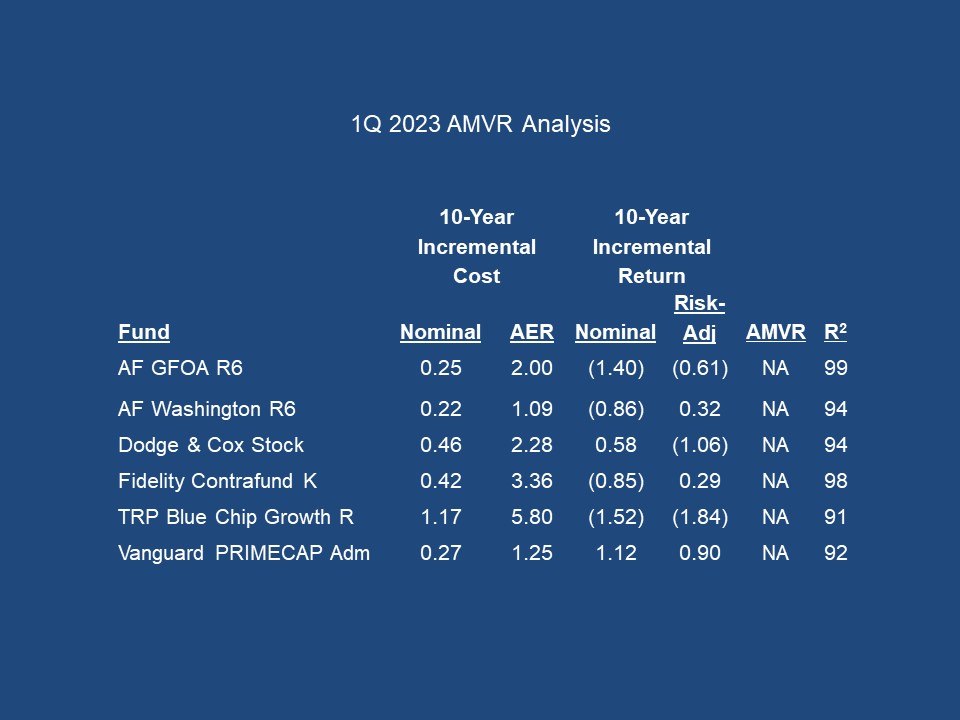
Posted in 401k, 401k compliance, 401k investments, 401k plan design, 401k risk management, 403b, Active Management Value Ratio, AMVR, compliance, consumer protection, cost consciousness, cost efficient, cost-efficiency, Cost_Efficiency, ERISA, ERISA litigation, fiduciary compliance, fiduciary duty, fiduciary law, fiduciary liability, fiduciary liability, Fiduciary prudence, fiduciary prudence, fiduciary responsibility, fiduciary risk management, fiduciary standard, investment advisers, pension plans, plan advisers, plan sponsors, prudence, retirement plans, risk management, SCOTUS, Supreme Court, wealth management, wealth preservation | Tagged , , , , , , , , , , , , , , , , , , , , , , , , , | Leave a comment

Target Date Funds Have Now Become the Targets of 401(k) Litigation (Part 2)

In my last post, I analyzed the popular Fidelity Freedom Active Suite and Fidelity Freedom Index target date funds. The Fidelity Freedom and TIAA-CREF Lifestyle target date funds are arguably the two most popular groups of target date funds in 401(k) and 403(b) defined contribution plans.

However, popularity does not necessarily equate to fiduciary and regulatory prudence. Many mutual funds are cost-inefficient when compared to comparable index funds. Many fiduciaries and investors alike choose mutual funds based on their publicly advertised, aka nominal, returns.

Nobel laureate Dr. William Sharpe has stated that

Properly measured, the average actively managed dollar must underperform the average passively managed dollar, net of costs…. The best way to measure a manager’s performance is to compare his or her return with that of a comparable passive alternative.1

Noted wealth management expert, Ellis, goes further, stating that

So, the incremental fees for an actively managed mutual fund relative to its incremental returns should always be compared to the fees for a comparable index fund relative to its returns. When you do this, you’ll quickly see that that the incremental fees for active management are really, really high—on average, over 100% of incremental returns.2

Ellis’ suggestion is a variation of the cost-benefit analysis commonly used by businesses every day. Several years ago, I created a simple metric based on Ellis’ studies, the Active Management Value Ratio (AMVR). The AMVR allows fiduciaries, attorneys, and investors to quickly assess the cost-efficiency of an actively managed mutual relative to a comparable index fund.

Most index funds have higher fees and expenses than comparable actively managed funds. Those higher fees and expenses effectively reduce an actively managed fund’s performance. As a result, studies have consistently shown that most actively managed mutual funds are cost-inefficient when compared to comparable index funds.

  • 99% of actively managed funds do not beat their index fund alternatives over the long-term net of fees.3
  • Increasing numbers of clients will realize that in toe-to-toe competition versus near–equal competitors, most active managers will not and cannot recover the costs and fees they charge.4
  • [T]here is strong evidence that the vast majority of active managers are unable to produce excess returns that cover their costs.5
  • [T]he investment costs of expense ratios, transaction costs and load fees all have a direct, negative impact on performance….[The study’s findings] suggest that mutual funds, on average, do not recoup their investment costs through higher returns.6

Such is the case when TIAA-CREF’s active and index target date funds are compared over the most recent ten-year and five-year periods.

In analyzing the TIAA-CREF Lifestyle TDFs over the most recent five and 10-year periods (ending September 30, 2022) all of the funds proved to be cost-inefficient, i.e., incremental costs greater than incremental returns, relative to their comparable index version. As a result, it can be said that the actively managed TIAA-CREF Lifestyle funds would be an imprudent investment choice relative to the indexed version of the same funds.

Going Forward
401(k) and 403(b) plan sponsors are legally fiduciaries. As such, they are held to “the highest duties known to law,” including the duties of prudence and undivided loyalty to the plan participants and their beneficiaries. Bottom line, a plan sponsor’s selection of cost-inefficient investment options for a plan is an unquestioned violation of their fiduciary duties.

A common risk management mistake I see made by plan spsonsors is agreeing to a plan advisory contract that contains a so-called “fiduciary disclaimer clause.” I have argued that agreeing to such a clause is a violation of both the plan sponsor’s fiduciary duties of prudence and loyalty.

Without a fiduciary disclaimer clause, a plan adviser would be subject to the same fiduciary duties that a plan sponsor is required to honor. I maintain that that would force a plan provider to offer all investments that their broker-dealer sells, not just the overpriced and consistently underperforming products of their so-called “preferred partners.”

Plan sponsors often agree to such fiduciary disclaimer clauses in exchange for revenue sharing payments from the broker’s/adviser’s broker-dealer. The plan sponsor then uses such revenue sharing payments to reduce the plan’s administration costs.

The legal issue with such fiduciary disclaimer clause/revenue sharing arrangements is that reducing administrative costs does not change the cost-inefficiency of imprudent investment options within the plan or otherwise reduce the ongoing financial impact of such imprudent investments. As the TIAA-CREF charts herein show, those costs and expenses can add up quickly and compound over time. Each additional one percent in costs and expenses reduces an investor’s end return by approximately seventeen percent over a period of twenty years.

My fiduciary consulting clients are very familiar fiduciary risk management sayings – “Why even go there” and “Don’t even go there.” Far too many plan sponsors fail to follow such advice and expose themselves to unnecessary and unwanted fiduciary liability.

Notes
1. William F. Sharpe, “The Arithmetic of Active Investing,” available online at https://web.stanford.edu/~wfsharpe/art/active/active.htm.
2. Charles D. Ellis, “Letter to the Grandkids: 12 Essential Investing Guidelines,” available online at https://www.forbes.com/sites/investor/2014/03/13/letter-to-the-grandkids-12-essential-investing-guidelines/#cd420613736c.
3. Laurent Barras, Olivier Scaillet and Russ Wermers, False Discoveries in Mutual Fund Performance: Measuring Luck in Estimated Alphas, 65 J. FINANCE 179, 181 (2010).
4. Charles D. Ellis, The Death of Active Investing, Financial Times, January 20, 2017, available online at https://www.ft.com/content/6b2d5490-d9bb-11e6-944b-eb37a6aa8e. 
5. Philip Meyer-Braun, Mutual Fund Performance Through a Five-Factor Lens, Dimensional Fund Advisors, L.P., August 2016.
6. Mark Carhart, On Persistence in Mutual Fund Performance,  52 J. FINANCE, 52, 57-8 (1997). 24.

Copyright InvestSense, LLC 2022. All rights reserved.

This article is for informational purposes only, and is neither designed nor intended to provide legal, investment, or other professional advice since such advice always requires consideration of individual circumstances.  If legal, investment, or other professional assistance is needed, the services of an attorney or other professional advisor should be sought.
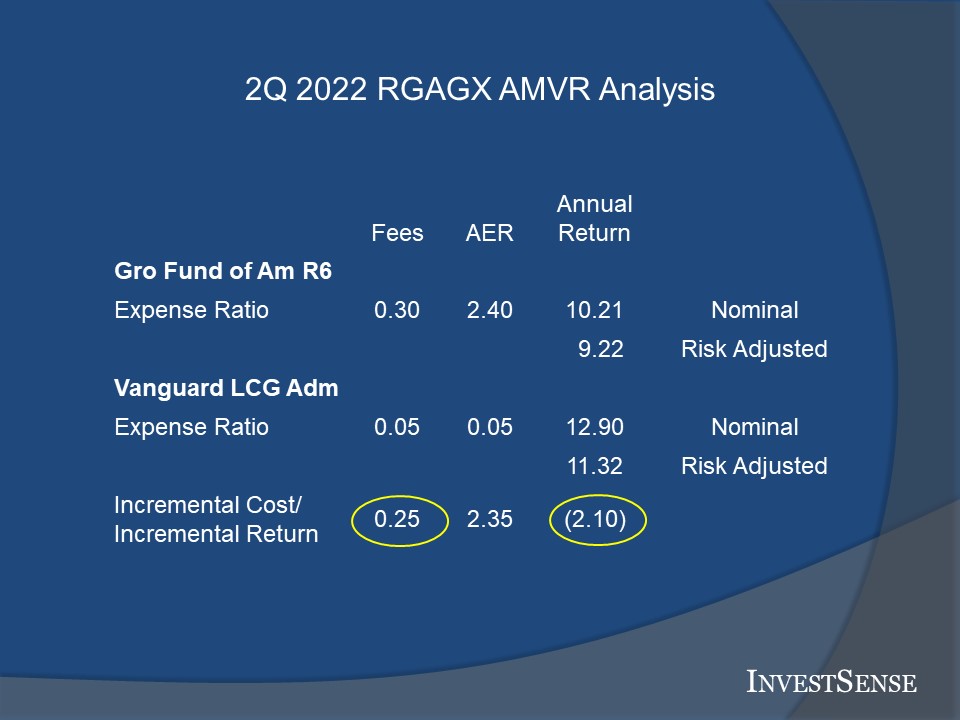

Posted in 401k, 401k compliance, 401k investments, 401k plan design, 401k risk management, 403b, Active Management Value Ratio, compliance, consumer protection, cost consciousness, cost efficient, cost-efficiency, Cost_Efficiency, ERISA, ERISA litigation, fiduciary compliance, fiduciary duty, fiduciary law, fiduciary liability, fiduciary liability, Fiduciary prudence, fiduciary prudence, fiduciary responsibility, fiduciary risk management, fiduciary standard, investment advisers, investments, Mutual funds, pension plans, plan sponsors, prudence, retirement planning, retirement plans, risk management, wealth management, wealth preservation | Tagged , , , , , , , , , , , , | Leave a comment

Target Date Funds Are Now the Targets

In my last post, I published the “cheat sheets” for six of the most commonly used non-index-based funds in U.S. defined contribution plans. However, those funds did not include any target date funds (TDFs).

TDFs are diversified asset allocation funds which supposedly provide a simple way for investors to work toward “retirement readiness” and “financial well-being.” However, questions have started to arrive as to the prudence of TDFs in terms of both safety and cost-efficiency. As a result. TDFs have become the targets themselves of 401(k) and 403(b) litigation.

Two of the largest litigation targets have been Fidelity’s Freedom TDFs and TIAA-CREF’s Lifecycle TDFs. One of the primary issues in litigation involving these two groups of TDFs has been the fact that both offer both active and passive versions of their TDFs.

In both cases, the active versions of the TDFs charge higher fees. Most 401(k) and 403(b) plans have chosen the active versions of the TDFs, despite their consistent underperformance over time relative to the less expensive passive, or index, versions of the funds.

Several courts have dismissed 401(k) and 403(b) cases citing the alleged failure of the plan participants to properly plead their cases. Under the federal rules of civil procedure, the plan participants are required to provide sufficient facts to show that it is plausible to believe that the plan’s sponsor failed to properly perform their fiduciary duties of loyalty and/or prudence.

Some courts have accepted evidence of the disparity between a fund’s costs and returns as providing sufficient evidence of the plausibility that a plan sponsors failed to properly perform their fiduciary duties. One such case is the Leber v. Citigroup 401(k) action1, where highly respected Judge Sidney Stein denied Citigroup’s motion to dismiss the case, citing the fact that the plan participants had shown that in some cases the expense ratios of the funds in question were 200 percent of more higher than the expense ratios of comparable Vanguard funds.

Judge Stein’s recognition of both the impact of a disparity in expense ratios and the legitimacy of Vanguard funds as comparators in 401(k) and 403(b) cases should not go unnoticed. Nevertheless, some courts continue to ignore and/or reject similar evidence as establishing the plausibility of a fiduciary breach, as required in 401(k) and 403(b) cases.

In my practice, I also calculate a “plausibility factor” based upon my Active Management Value Ratio (AMVR) analyses. In the case of the two charts shown above, the plausibility should be resolved for the five-year period by the fact that with the exception of two cases,none of the TDFs even managed to provide a positive incremental return at all. In the two cases where the funds did produce a positive incremental return, the funds’ incremental costs exceeded such returns, making them cost-inefficient.

The plausibility analysis for the ten-year AMVR analysis not only shows the significant percentage disparity in incremental costs and incremental returns, but also how important it is for a fiduciary to factor in risk in order to obtain a meaningful “apples to apples” assessment and to avoid unnecessary exposure to fiduciary liability.

Interestingly, while pension plans and the financial services that argue for “apples to apples” comparisons, they generally dismiss risk-adjusted analyses. This plausibility chart may help explain why.

Going Forward
I am on record as saying that plan participants should never lose a properly vetted 401(k)/403(b) case. My position is based on the ease with which plan participants and their attorneys can establish both the plausibility and the legitimacy of the damages in their case through the use of the AMVR metric and plausibility analysis. Both analyses require nothing more than simple math and provide compelling evidence of any fiduciary breach. As John Adams said, “facts are stubborn things.”

Notes
1. Leber v. Citigroup 401(k) Plan Inv. Committee, 2014 WL 4851816.

Posted in 401k, 401k compliance, 401k investments, 401k plan design, 401k risk management, 403b, Active Management Value Ratio, AMVR, consumer protection, cost consciousness, cost efficient, cost-efficiency, Cost_Efficiency, ERISA, ERISA litigation, fiduciary compliance, fiduciary duty, fiduciary liability, fiduciary prudence | Tagged , , , , , , , , | Leave a comment

3Q 2022 AMVR “Cheat Sheets”: What Mutual Funds and Plan Advisers Hope Plan Sponsors and Plan Participants Never Realize

James W. Watkins, III, J.D., CFP Board EmeritusTM, AWMA

Given the recent performance of the markets, it should come as no surprise that the 5 and 10-Year AMVR analyses of the six most popular non-index mutual funds in U.S. defined contribution plans remain relatively unchanged.

Interesting to note that for both the 5 and 10-year period, only Vanguard PRIMECAP Admiral shares managed to qualify for an AMVR ranking.

Also interesting to note the importance of factoring in a fund’s risk-adjusted returns. On the 5-year AMVR analyses, factoring in risk-adjusted returns turned AF’s Washington Mutual Fund’s incremental return from (0.90) on nominal returns, to a positive 0.13. Admittedly, a small positive number, but still a significant change.

On the 10-year AMVR analyses slide, factoring in the fund’s risk-adjusted returns turned their incremental return from (0.57) (nominal) to 0.57 (risk-adjusted.) Likewise for Fidelity Contafund, where an incremental return of (0.79) (nominal) turned into a small, yet positive, 0.09.

Overall, the song remains the same, with the majority of actively managed funds being unable to overcome the combination of the weight of higher fees and cost and high r-squared/correlation of returns number to beat the index of comparable index funds

And so, we continue to see 401(k) actions alleging a breach of fiduciary duties by plan sponsors. Of note, we are seeing an increasing number of cases focusing on target date funds (TDFs). I expect to see more actions involving TDFs, as the AMVR provides compelling evidence of the imprudence of the active versions of such funds. I will post an updated analysis of the active and index versions of both the Fidelity Freedom and TIAA-CREF Lifestyle TDFs next week

I have often noted SCOTUS’ recognition that an ERISA fiduciary’s duties are “derived from the common law of trusts. In determining the contours of an ERISA fiduciary’s duty, courts often must look to the law of trusts.”1

This statement from SCOTUS should not come as a surprise. Courts have often noted that ERISA is essentially a codification of the common law of trusts, as reflected in the Restatement of Trusts (Restatement). This similarity is especially noticeable in the fact that two consistent themes run throughout both of them-the importance of cost-consciousness and risk management.

As an ERISA attorney, I created the Active Management Value (AMVR) metric as a means of focusing on these topics in the context of fiduciary liability, specifically liability based on cost-inefficiency and ineffective risk management.

The basic AMVR is based primarily on the research of Charles D. Ellis and Nobel laureate Dr, William F. Sharpe. Dr. Sharpe has offered the following advice for analyzing the prudence of mutual funds:

Properly measured, the average actively managed dollar must underperform the average passively managed dollar, net of costs…. The best way to measure a manager’s performance is to compare his or her return with that of a comparable passive alternative.2

Noted wealth management expert, Ellis, goes further, stating that

So, the incremental fees for an actively managed mutual fund relative to its incremental returns should always be compared to the fees for a comparable index fund relative to its returns. When you do this, you’ll quickly see that that the incremental fees for active management are really, really high—on average, over 100% of incremental returns!3

The financial services industry and 401(k)/403(b) plan advisers like to avoid the issues of fiduciary duties, transparency, and cost-inefficiency by avoiding comparisons of fund performance and only discussing returns in terms of nominal, or publicly stated, returns. Unfortunately, nominal returns are often misleading when fiduciary duties and potential fiduciary liability is involved.

AMVR FAQs
As the basic AMVR has gained increased recognition and use by investment fiduciaries and attorneys, there has also been increased recognition of the potential for the power of the advanced version of the AMVR, aka AMVR+. The basic AMVR is simply the cost/benefit analysis many of us used in our Econ 101 class, with the inputs being incremental costs and incremental returns.

In analyzing an AMVR analysis, the user only needs to answer two simple questions:

(1) Did the actively managed fund provide a positive incremental return?
(2) If so, did actively managed fund’s positive incremental return exceed the fund’s incremental costs.

If the answer to either of these questions is “no,” then, under the Restatement’s standards, the actively managed fund is imprudent relative to the benchmark index fund.

Here, the active fund’s incremental costs (72 basis points) exceed the fund’s incremental returns (5 basis points). “Basis points” is a term used in the financial services industry. I often tell people to just monetize the results by thinking in terms of dollars. Would you give someone $72 in exchange for $5. The prosecution rests.

Sadly, this scenario is common in 401(k)/403(b) plans. As a result, the number of ERISA actions against 401(k)/403(b) plans continues to increase.

The AMVR could easily help 401(k)/403(b) plans avoid such unnecessary liability exposure. Most AMVR analyses can be accomplished in 1-2 minutes and require no more than what one judge described as “third grade math…but very persuasive third grade math,” as he denied a plan’s motion to prevent the use of the AMVR in a 401(k) action.

Advanced AMVR Analysis
A well-known saying in the investment industry is that “amateurs focus on returns; professionals focus on risk management.” Search “investment risk management Charles D. Ellis” and you will find his familiar statement that the secret of successful investing is the informed management of investment risk. Perform the same search using the names of investment icons Benjamin Graham and Paul Tudor Jones and you will find similar statements.

Plan sponsors and other investment fiduciaries are gradually recognizing the power of the AMVR as a risk management tool. The advanced version of the AMVR, AMVR+, addresses three types of risk:

1. The risk of cost-inefficiency,
2. The risk of underperformance, and
3. The risk of the investment risk, aka volatility.

The Risk of Cost-Inefficiency
The basic premise of cost-inefficiency is simple to express–costs exceeding benefits/returns. In connection with investing and the AMVR, it is incremental costs exceeding incremental benefits aka returns. An investment in a cost-efficient investment means an investor would actually be losing money. The fact that costs, like returns, compound over time only exacerbates the investment risk and resulting damage.

While many people continue to debate the relative merits of active management versus passive management, I maintain that issue is, and always has been, a meaningless debate. The more meaningful question is cost-efficiency versus cost-inefficiency.

A cost-inefficient investment can never be a prudent investment choice, especially for an investment fiduciary. Even the Restatement acknowledges this fact.

The cost-inefficiency of many actively managed funds may be even worse than it appears at first glance. Ross Miller’s Active Expense Ratio suggests that the effective expense ratio of many actively managed funds is often understated by as much as 400-500 percent. Miller explained the importance of the Active Expense Ratio and AW as follows:

Mutual funds appear to provide investment services for relatively low fees because they bundle passive and active funds management together in a way that understates the true cost of active management. In particular, funds engaging in ‘closet’ or ‘shadow’ indexing charge their investors for active management while providing them with little more than an indexed investment. Even the average mutual fund, which ostensibly provides only active management, will have over 90% of the variance in its returns explained by its benchmark index.4

The Risk of Underperformance
Again, a simple concept. An actively managed fund that fails to provide a positive incremental return when compared to a comparable index fund represents an opportunity cost equal to the incremental return that could have been realized by investing in the better performing index fund.

Studies have consistently shown that the overwhelming majority of actively managed funds underperform comparable index funds.5 Given the higher costs typically associated with active management, including higher management fees and trading costs, these findings should come as no surprise, especially given the high correlation of returns between most U.S. domestic equity funds and their index counterparts.

The high correlation of return, often 95 and above, raises the issue of potential “closet indexing.” Closet indexing refers to the practice of actively managed funds marketing the benefits of the active management they allegedly provide, only to provide similar, in many cases lower returns. than a comparable index fund

Correlations of 95 and above raise genuine issues of whether active management was provided at all, and the issue of exactly how much active management was provided. Ross Miller’s Active Expense Ratio metric calculates the Active Weight (AW), or the percentage of active management provided by a fund. AW can be calculated simply through the use of an actively managed fund’s expense ratio and its r-squared, or correlation of returns, number.

With so many active funds having a correlation of 95 and above to comparable index funds, it is interesting to note the estimated AW of such funds. Miller found that there is not a one-to-one correlation between r-squared to the percentage of active management provided. For instance, Miller found that active funds with a correlation number of 98 only provide an estimated 12.50 percent in active management.

Miller’s studies clearly demonstrate the value of factoring in correlations of return between actively managed funds and comparable index funds. This is why we use Miller’s Active Expense Ratio in calculating correlation-adjusted costs in order to provide a more meaningful cost-efficiency analysis in our AMVR+ analyses.

The Risk of Investment Risk/Volatility
Studies have consistently shown that investment returns are influenced by the level of investment risk assumed, the so-called risk-return equation.

Section 90, comment h(2). of the Restatement (Third) of Trusts is a fundamental principle of fiduciary law and prudent investing. Section 90(h)(2) states that the use of actively managed strategies is imprudent unless it can be reasonably predicted that the active strategy will provide a commensurate return for the additional costs and risks typically associated with active investing.

As mentioned previously, most actively managed funds simply cannot meet this requirement, due largely to the burden of higher management fees/expenses and trading costs. This is the reason InvestSense factors in a fund’s risk-adjusted return in our AMVR+ cost-efficiency analyses. While many advocates of active management dislike the use of risk-adjusted returns, the fact is that factoring in risk often improves the cost-efficiency numbers for actively managed funds since it is a factor that they can actually control.

Going Forward
The evidence clearly establishes the potential benefits of the AMVR and AMVR for investment fiduciaries, attorneys, and investors. Investment fiduciaries can avoid unnecessary and unwanted fiduciary liability exposure. Attorneys and easily establish the merits of their case and comply with applicable pleading standards. Investors can analyze the prudence of their investment and hopefully better protect their financial security.

Notes
1. Tibble v. Edison International, 135 S. Ct 1823 (2015)
2. William F. Sharpe, “The Arithmetic of Active Investing,” available online at https://web.stanford.edu/~wfsharpe/art/active/active.htm.
3, Charles D. Ellis, “Letter to the Grandkids: 12 Essential Investing Guidelines,” available online at https://www.forbes.com/sites/investor/2014/03/13/letter-to-the-grandkids-12-essential-investing-guidelines/#cd420613736c.
4. Ross Miller, “Evaluating the True Cost of Active Management by Mutual Funds,” Journal of Investment Management, Vol. 5, No. 1, 29-4.
5. Laurent Barras, Oliver Scaillet, and Russ Wermers, False Discoveries in Mutual Fund Performance: Measuring Luck in Estimated Alphas, 65 J. FINANCE 179, 181 (2010); Charles D. Ellis, The Death of Active Investing, Financial Times, January 20, 2017, https://www.ft.com/content/6b2d5490-d9bb-eb37a6aa8e; Mark Carhart, On Persistence in Mutual Fund Performance, 52 J. FINANCE 57-58 (1997); Philip Meyer-Braun, Mutual Fund Performance Through a Five-Factor Lens, Dimensional Funds Advisors, L.P., August 2016.

Posted in fiduciary compliance | Leave a comment