The Really Smart Experts Measure AMVR: Blueprint for 401(k)/403(b) Litigation and Design

In a recent post, I wrote (1) that plan participants should never lose a properly vetted 401(k)/403(b) litigation action, and (2) a properly designed and maintained 401(k)/403(b) plan should should never lose a breach of fiduciary duties action based on imprudent investment options. As anticipated, the statements drew some strong responses. The most frequent responses focused on “properly vetted” and “properly designed and maintained.”

In my practice, I serve as a fiduciary compliance counsel to both attorneys and 401(k)/403(b) plans. I believe the blueprint for fiduciary compliance for both sides already exists. To help my clients remember the blueprint, I tell them to remember the phrase, “The Really Smart Experts Measure AMVR.”

Studies have shown that people often remember information by using acronyms, with each letter representing an important fact. While the phrase I suggest is not technically an acronym due to AMVR at the end, the phrase serves the same purpose.

1. “The” – “T” stands for the Supreme Court case of Tibble v. Edison International.1 The key quote for our purpose is the Court’s statement that.

We have often noted that an ERISA fiduciary’s duty is ‘derived from the common law of trusts.’ In determining the contours of an ERISA fiduciary’s duty, court often must look to the law of trusts.1

2. “Really” – The “R” stands for the Restatement (Third) of Trusts. One of the key concepts throughout the Restatement is the importance of costs and cost-consciousness. Section 90 of the Restatement is commonly known as the Prudent Investor Rule. Comment b states that

[C]ost-conscious management is fundamental to prudence in the investment function,…2

Comments f, h(2) and m also reference the importance of cost-efficiency.

3. “Smart” – The “S” stands for Nobel laureate Dr. William F, Sharpe. Dr. Sharpe stated that in assessing the prudence of actively managed mutual funds,

Properly measured, the average actively managed dollar must underperform the average passively managed dollar, net of costs…. The best way to measure a manager’s performance is to compare his or her return with that of a comparable passive alternative.”3

4. “Experts” – The “E” stands for Charles D. Ellis. A well-known and highly respected expert on investing, Ellis suggested the following technique in assessing the prudence of actively managed funds.

So, the incremental fees for an actively managed mutual fund relative to its incremental returns should always be compared to the fees for a comparable index fund relative to its returns. When you do this, you’ll quickly see that that the incremental fees for active management are really, really high—on average, over 100% of incremental returns! 4

5. “Measure” – The “M” stands for Ross Miller, the creator of the Active Expense Metric (AER).

Mutual funds appear to provide investment services for relatively low fees because they bundle passive and active fund management together in a way that understates the true cost of active management. In particular, funs engaging in closet or shadow indexing charge their investors for active management while providing them with little more than an indexed investment. Even the average mutual fund, which ostensibly provides only active management, will have over 90% of the variance in its returns explained by its benchmark index.5

Miller recognized that given the current high R-squared/correlation of returns between actively managed U.S. domestic equity mutual funds and comparable index funds, most of the returns on actively managed can be properly attributed to underlying market indices rather than the active funds’ management teams. As a result, investors can receive comparable, in many cases better, returns at a much lower price using comparable index funds. As a result, the implicit costs that investors are paying for actively managed mutual funds are significantly higher than the funds’ stated expenses. Miller found that the implicit costs of an actively managed fund were often 4-6 times higher than their stated costs.

The Active Management Value RatioTM
All of these are fundamental concepts that form the foundation for the Active Management Value Ratio metric (AMVR). The AMVR is essentially nothing more that the well-known cost-benefit metric often used in the business world. The only difference is that AMVR uses incremental cost and incremental returns as the input data. More specifically, the AMVR compares an actively managed fund’s risk-adjusted incremental returns with the fund’s correlation-adjusted incremental costs, using a comparable index fund as a benchmark.

By using nothing more than “simple third grade math,” the AMVR provides a simple, yet powerful, analysis of an actively managed fund’s cost-efficiency relative to the comparable index fund benchmark. Back when I was developing the AMVR, I was introduced to a brilliant man, Bert Carmody, by some mutual friends. Bert quickly understood the concepts involved in the AMVR and decided to create a more sophisticated model.

My favorite memory of that day was Bert starting to write on the expensive white knapkins and the people next to us laughing as I quickly told Bert that I was not paying for the knapkins. Unfortunately, Bert passed away shortly after that infamous lunch. However, his friends continued his work, resulting in the patented PlanAnalyzer metric. Both metrics are being successfully used in both the legal and financial fields.

The AMVR addresses a simple question that every question should know.

Does the actively managed fund provide a commensurate return for the additional costs and risks an investor is asked to assume?

To answer that question, an investor and/or investment fiduciary simply has to answer two simple questions:

  1. Does the actively managed fund provide a positive incremental return relative to a comparable index fund?
  2. If so, does the actively managed fund’s positive incremental return exceed the actively managed fund’s incremental costs?

If the answer to either of these questions is “no,” then the actively managed fund is not a prudent investment choice relative to the benchmark index fund. The goal is an AMVR score that is greater than zero (indicating a positive incremental return), but less than one (indicating that incremental returns exceed incremental costs). As far as the actual formula for the AMVR,

AMVRTM = Incremental Correlation-Adjusted Costs/Incremental Risk-Adjusted Returns

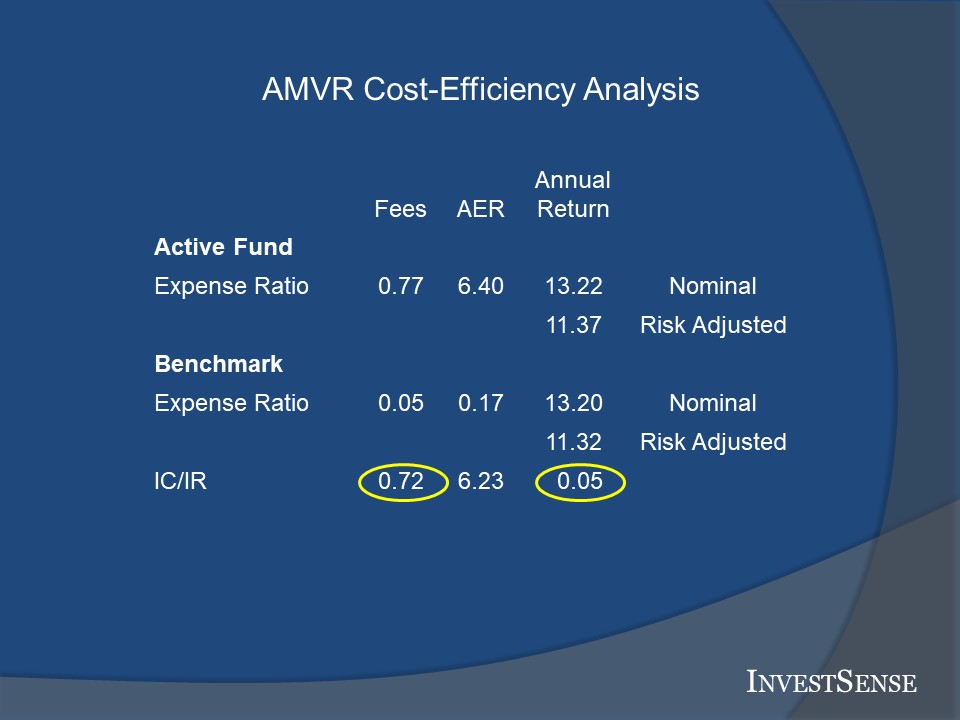
To illustrate the value and power of the AMVR in assessing cost-efficiency, let’s look at a well-known actively managed fund. In the first example, we will calculate cost-efficiency of the actively managed fund using both funds’ nominal returns and costs.

The chart shows that while the actively-managed fund does produce a small positive incremental return, the fund’s incremental costs significantly exceed the fund’s positive incremental return. Therefore, the actively-managed fund is deemed cost-inefficient relative to the benchmark fund. In this case, the actively-managed fund is classified as the retirement shares of a large cap growth fund. Therefore, the benchmark used in this example is the Admiral shares of Vanguard’s Large Cap Growth fund.

Because of the clients InvestSense serves, we calculate a fund’s AMVR based on risk-adjusted returns and AER-based correlation-adjusted costs. Note the dramatic increase in the actively-managed fund’s expense ratio (0.65) when the fund’s R-squared/correlation of returns number, in this case 98, is factored into the equation (5.44). The combination of high incremental costs and a high R-squared number basically ensures that a mutual fund will not be considered cost-efficient.

At the end of each calendar quarter, I prepare a “cheat sheet” on some of the more commonly used mutual funds in U.S. 401(k) plans. The five-year “cheat sheet for the 3Q of 2021 is shown below.

https://fiduciaryinvestsense.com/wp-content/uploads/2021/10/3q-2021-5y-amvr-cheat-sheet.jpg

A common question I get is how consistent are these numbers. Very consistent, as shown in the ten-year “cheat sheet.” as of the 3Q 2021.

Going Forward
John Langbein served as the Reporter on the committee that drafted the Restatement (Third) of Trusts. Once the Restatement was published, he made the following prediction:

When market index funds have become available in sufficient variety and their experience bears out their prospects, courts may one day conclude that it is imprudent for trustees to fail to use such accounts. Their advantages seem decisive: at any given risk/return level, diversification is maximized and investment costs minimized. A trustee who declines to procure such advantage for the beneficiaries of his trust may in the future find his conduct difficult to justify.6

The 1st Circuit suggested the same outcome in its Brotherston decision”

Moreover, any fiduciary of a plan such as the Plan in this case can easily insulate itself by selecting well-established, low-fee and diversified market index funds. And any fiduciary that decides it can find funds that beat the market will be immune to liability unless a district court finds it imprudent in its method of selecting such funds, and finds that a loss occurred as a result. In short, these are not matters concerning which ERISA fiduciaries need cry “wolf.”

The Restatement (Third) of Trusts, Section 90, comment h(2) states that active strategies are imprudent unless it can be objectively anticipated that such strategies will provide a commensurate return for the additional costs and risks typically associated with such strategies/funds. So, to return to my two earlier suggestions:

  • An ERISA plaintiff’s attorney who can present evidence of the underperformance and cost-inefficiency of a plan’s investment options should defeat a motion to dismiss and should prevail on the merits.
  • A plan sponsor who is able to present evidence of the positive incremental performance and cost-efficiency of their plan’s investment options should be able to defeat an allegation of imprudent investment options. Such evidence would also provide proof of a plan actually designed to promote their employee’s “retirement readiness” and “financial well-being.

Notes
1. Tibble v. Edison International, 135 S. Ct. 1823 (2015).
2. Restatement (Third) Trusts, Section 90, cmt. b. (American Law Institute. All rights reserved)
3. William F. Sharpe, “The Arithmetic of Active Investing,” available online at https://web.stanford.edu/~wfsharpe/art/active/active.htm.
4. Charles D. Ellis, “Letter to the Grandkids: 12 Essential Investing Guidelines,” available online at https://www.forbes.com/sites/investor/2014/03/13/letter-to-the-grandkids-12-essential-investing-guidelines/#cd420613736c.
5. Ross Miller, “Evaluating the True Cost of Active Management by Mutual Funds,” Journal of Investment Management, Vol. 5, No. 1, 29-4.
6. John H. Langbein and Richard A. Posner, “Market Funds and Trust Investment Law(1976). (Faculty Scholarship Series: Paper 498) available online at http://digitalcommons.law.yale.edu/fss_papers/498
7. Brotherston v. Putnam Investments, LLC, 907 F.3d 17 (1st Cir. 2018

© Copyright 2021 InvestSense, LLC. All rights reserved.

This article is for informational purposes only and is neither designed nor intended to provide legal, investment, or other professional advice since such advice always requires consideration of individual circumstances. If legal, investment, or other professional assistance is needed, the services of an attorney or other professional advisor should be sought.


Posted in 401k, 401k compliance, 401k investments, 403b, Active Management Value Ratio, AMVR, cost consciousness, cost efficient, cost-efficiency, Cost_Efficiency, ERISA, fiduciary compliance, fiduciary law, fiduciary liability, Fiduciary prudence, fiduciary responsibility, pension plans, prudence, retirement plans, wealth management, wealth preservation | Tagged , , , , | Leave a comment

Rethinking Costs in 401(k) Litigation

[C]ost-conscious management is fundamental to prudence in the investment function,…1

Two consistent themes of ERISA are cost-consciousness and risk management through diversification. With regard to cost-consciousness, studies have consistently shown that the overwhelming majority of actively managed mutual funds, the primary investment option in most 401(k) plans, are not cost-efficient.

  • 99% of actively managed funds do not beat their index fund alternatives over the long-term net of fees.2
  • Increasing numbers of clients will realize that in toe-to-toe competition versus near–equal competitors, most active managers will not and cannot recover the costs and fees they charge.3
  • [T]here is strong evidence that the vast majority of active managers are unable to produce excess returns that cover their costs.4
  • [T]he investment costs of expense ratios, transaction costs and load fees all have a direct, negative impact on performance….[The study’s findings] suggest that mutual funds, on average, do not recoup their investment costs through higher returns.5

The studies’ findings are presumably based on the funds’ nominal, or stated, returns. However, there is an increasing awareness among investors and within the legal community, that nominal returns may not accurately reflect the degree of cost-inefficiency of actively managed funds

R-squared has been explained by Morningstar as follows:

R-squared measures the strength of the relationship between a fund’s performance and a benchmark’s performance, specifically, the degree to which a fund’s performance can be explained by the performance of the benchmark.

A higher R-squared value indicates a higher correlation, or relationship, between a fund’s performance and the benchmark’s performance, whereas a lower R-squared value indicates that a fund’s performance hasn’t behaved like the benchmark’s [performance]. R-squared is expressed as a percentage and ranges from 0%, or no correlation, to 100%, or perfect correlation, where a fund’s performance has moved in lockstep with the benchmark’s [performance.

A word of caution though: If a fund’s R-squared is very close to 100%, there’s a chance it may be hugging its index too closely, and that its returns can be replicated by an inexpensive fund that tracks that benchmark.6

In fact, over the past decade or so, there has a noticeable trend of U.S. domestic actively managed equity funds with r-squared numbers of 90 and above, many of 95 and above. Such high r-squared numbers strongly suggest that such funds may be fairly classified as “closet index” funds.

Closet index funds are actively managed mutual funds that claim to be providing active management and charge higher annual fees based on such representations. However, history has shown that such funds usually provide returns that are essentially the same or lower than comparable, less expensive index funds.

Martijn Cremers, creator of the Active Share metric, goes further, stating that actively managed mutual funds are arguably guilty of investment fraud.

[A] large number of funds that purport to offer active management and charge fees accordingly, in fact persistently hold portfolios that substantially overlap with market indices….Investors in a closet index fund are harmed by for fees for active management that they do not receive or receive only partially….

Closet indexing raises important legal issues. Such funds are not just poor investments; they promise investors a service that they fail to provide. As such, some closet index funds may also run afoul of federal securities law.7

Based on the Morningstar definition of r-squared, it can be argued that r-squared provides a means for investors and investment fiduciaries to screen for closet index funds.

However, the value of r-squared as an analytical tool goes far beyond its use to screen for closet index funds. There is a growing trend within the legal community, in both ERISA and general securities litigation, to use r-squared to calculate the implicit damages from imprudent/unsuitable investment products.

One of the two thought leaders in this area has been Ross Miller. Miller is the creator of the Active Expense Ratio (AER) metric, which uses an actively managed fund’s r-squared number to calculate the fund’s implicit, and often excessive, expense ratio. Miller found that an actively managed fund’s AER was generally 4-6 times higher than its publicly stated expense ratio.

So why calculate an actively managed fund’s correlation-adjusted expense ratio? As Miller explains,

Mutual funds appear to provide investment services for relatively low fees because they bundle passive and active fund management together in a way that understates the true cost of active management. In particular, funds engaging in closet or shadow indexing charge their investors for active management while providing them with little more than an indexed investment. Even the average mutual fund, which ostensibly provides only active management, will have over 90% of the variance in its returns explained by its benchmark index.8

Although not widely known, another advocate of the use of r-squared to determine the cost-efficiency of actively managed mutual funds was the legendary John Bogle. Bogle explained the value of both r-squared and factoring in a fund’s implicit costs as follows:

As active management continues to morph into passive indexing-already approaching the commonplace in the large-cap fund category-managers will have to reduce their fess commensurately. After all, a correlation of 99 comes close to meaning that 99 percent of the [the fund’s] portfolio is effectively indexed. A 1.5 percent expense ratio on the remaining portfolio, therefore, represents an annual fee of 150 percent(!) on the actively managed assets.

Even if investors are willing to tolerate that cost at the moment, it is only a matter of time until they realize that their ongoing deficit to the stock market’s return is a reflection of the simple fact that they effectively own an index fund, but at a cost that is grossly excessive.9

Bogle’s comments are obviously equally applicable to plan sponsors and other investment fiduciaries. Whether by using the AER or Bogle’s methodology, it can be argued that a fiduciary’s duty of prudence and the duty to avoid unnecessary costs requires that a fiduciary factor in an investment’s implicit costs.

This is yet another reason that the #Northwestern403 action currently pending before SCOTUS is so important, not just for plan sponsors, but for any and all investment fiduciaries. Many expect SCOTUS to uphold the notice pleading rule generally applied in the courts. If so, it would make sense that the Court will also rule that plan sponsors, rather than plan participants, have the burden of proof with regard to causation, or the prudence of their plan’s investment options.

Many have asked me whether I believe that r-squared and cost-efficiency are the future of fiduciary litigation. While no one knows for sure, my experience with my Actively Managed Value Ratio, which incorporates the AER in part, would support such an argument.

As the 3Q 2021 quarterly AMVR “cheat sheet” shows, the cost-inefficiency of some frequently used actively managed funds within 401(k) plans remains a serious issue for plan sponsors. Note the disparity between a fund’s nominal expense ratio and the fund’s implicit expense using the AER. Also note the direct relationship between a fund’s incremental costs, r-squared number and its AER.

FWIW, I would strongly suggest that the evidence regarding the cost-inefficiency of actively managed mutual funds, both in terms of their nominal and its correlation-adjusted/r-squared expense ratio, could make the potential burden of proof for plan sponsors and other investment fiduciaries, that much more formidable. That burden may be made even more difficult as there are some ERISA plaintiff’s attorneys who are already successfully using AER and implicit costs in calculating damages.

Notes
1. “Introductory Note” to Restatement (Third) Trusts, Section 90. (American Law Institute. All rights reserved.)
2. Laurent Barras, Olivier Scaillet and Russ Wermers, False Discoveries in Mutual Fund Performance: Measuring Luck in Estimated Alphas, 65 J. FINANCE 179, 181 (2010).
3.. Charles D. Ellis, The Death of Active Investing, Financial Times,January 20, 2017, available online at https://www.ft.com/content/6b2d5490-d9bb-11e6-944b-eb37a6aa8e.
4. Philip Meyer-Braun, Mutual Fund Performance Through a Five-Factor Lens, Dimensional Fund Advisors, L.P., August 2016.
5. Mark Carhart, On Persistence in Mutual Fund Performance,  Journal of Finance, Vol. 52, No. 1, 57-8 (1997).
6.“The Morningstar Dictionary: R-Squared” https://www.morningstar.com/articles/873622/the-morningstar-dictionary-r-squared)
7. Martijn Cremers and Quinn Curtis, Do Mutual Fund Investors Get What they Pay For?:The Legal Consequences of Closet Index Fundshttps://papers.ssrn.com/sol/papers.cfm?abstract_id=2695133.
8. Ross Miller, “Evaluating the True Cost of Active Management by Mutual Funds,” Journal of Investment Management, Vol. 5, No. 1, 29-4.
9. John C. Bogle, “Don’t Count On It: Reflections on Investment Illusions, Capitalism, ‘Mutual’ FDuns, Indexing, Entrepreneurship, Idealism, and Her
oes,” (John Wiley & Sons: Hoboken, NJ, 2011), 432.

© Copyright 2021 InvestSense, LLC. All rights reserved.

This article is for informational purposes only and is neither designed nor intended to provide legal, investment, or other professional advice since such advice always requires consideration of individual circumstances. If legal, investment, or other professional assistance is needed, the services of an attorney or other professional advisor should be sought.



Posted in fiduciary compliance | Tagged , , , | Leave a comment

3Q 2021 Top Ten 401(k) AMVR “Cheat Sheet”

When InvestSense prepares a forensic analysis for a 401(k)/403(b) pension plan, a trust, an attorney, or an institutional client, we always do an analysis over five and ten-year time periods to analyze the consistency of performance. Since so many social media followers have asked this question, we are providing a forensic analysis for both time periods for our quarterly “cheat sheet” covering the third quarter of 2021.

At the end of each calendar quarter, we provide a forensic analysis of the top non-index mutual funds currently being used in U.S. 401(k) defined contribution plans. The list is derived from the annual survey conducted by “Pensions & Investments” and currently consists of six funds. Our forensic analysis is based on our proprietary metric, the Active Management Value Ratio™ 4.0 (AMVR).

The AMVR allows investors, fiduciaries and attorneys to determine the cost-efficiency of a fund relative to a comparable index fund. We typically use comparable Vanguard index funds for benchmarking purposes. People often ask why we do not use actual market indices like Morning star and actual funds. Actual market indices do not have costs, so they cannot be used to calculate a fund’s cost-efficiency.

In calculating a fund’s AMVR score, InvestSense compares a fund’s incremental risk-adjusted return to its incremental correlation adjusted costs. Five of the six funds do not qualify for an AMVR score, as they failed to provide a positive incremental return. While Dodge & Cost Stock did provide a positive incremental return, its, incremental correlation-adjusted costs exceeded its positive incremental risk-adjusted return. As a result, it would be deemed cost-inefficient under the AMVR.

Once again, five of the six funds do not qualify for an AMVR score, as they failed to provide a positive incremental return. While Dodge & Cost Stock did provide a positive incremental return, its, incremental correlation-adjusted costs exceeded its positive incremental risk-adjusted return. As a result, it would be deemed cost-inefficient under the AMVR.

People often ask about our uses of incremental risk-adjusted returns and incremental correlation-adjusted costs. As for our use of incremental returns, that is consistent with industry standards. While the financial services industry prefers to ignore risk-adjusted returns, “you can’t eat risk-adjusted returns,” it has no problem boasting about a good rating under Morningstar “star” system. I have to assume that the industry is not aware that Morningstar uses risk-adjusted returns in awarding its coveted stars.

The other justification for relying on risk-adjusted returns is that risk is generally thought to be a factor in return. As Section 90, comment h(2) 0f the Restatement (Third) of Trusts states, the use and/or recommendation of actively managed funds is imprudent unless it can be objectively determined that the active funds can be expected to provide investors with a commensurate return for the additional costs and risks associated with actively managed funds.

As for our use of correlation-adjusted costs, it allows us to use the AMVR to screen for “closet index” funds. Actively managed funds that have a high correlation to comparable, less-expensive are often referred to as “closet index” funds. Closet index funds are actively managed funds that tout the benefits of active management and charge higher fees than comparable index fund, but whose actual performance is actually similar to the comparable index funds. To be honest, “closet index” funds typically underperform comparable index funds.

Ross Miller created a metric, the Active Expense Ratio (AER), that allows investors and investment fiduciaries to determine the effective fee that they pay for actively managed mutual funds with high correlation, or R-squared, numbers. Miller explained the value of the AER:

Mutual funds appear to provide investment services for relatively low fees because they bundle passive and active fund management together in a way that understates the true cost of active management. In particular, funds engaging in closet or shadow indexing charge their investors for active management while providing them with little more than an indexed investment. Even the average mutual fund, which ostensibly provides only active management, will have over 90% of the variance in its returns explained by its benchmark index.

Martijn Cremers, creator of the Active Share metric, commented further on the importance of correlation of returns between actively managed mutual funds and comparable index funds, saying that

[A] large number of funds that purport to offer active management and charge fees accordingly, in fact persistently hold portfolios that substantially overlap with market indices…. Investors in a closet index fund are harmed by for fees for active management that they do not receive or receive only partially…. Such funds are not just poor investments; they promise investors a service that they fail to provide. 

With those quotes in mind, it is interesting to note that all six of the actively managed funds on the 3Q cheat sheet all have R-squared/correlation numbers in the mid to high 90s.

Going Forward
Those that follow me on Twitter and/or LinkedIn know that I have posted a lot on those sites regarding the upcoming Supreme Court hearings in the Hughes v. Northwestern University 401(b) case. The oral arguments in the case are scheduled for December 6, 2021.

I will be posting more about the case as we get closer to the oral arguments. However, for now, I will just say that if the Court rules in favor of the plaintiff, it would essentially require plans to prove that the investment options they chose for a plan were prudent when they chose them.

Based on my experience with the AMVR and numerous forensic analyses for clients, I believe plans would be hard pressed to carry that burden. While the simplicity of the AMVR is often credited for its growing acceptance and use, the AMVR is still a powerful tool in 401(k)/403(b) litigation and pension plan risk management.  

Posted in 401k, 401k investments, Active Management Value Ratio, AMVR, asset allocation, consumer protection, cost consciousness, cost-efficiency, Cost_Efficiency, Fiduciary prudence, fiduciary responsibility, financial planning, prudence, retirement planning, wealth management, wealth preservation | Tagged , , , , , , , , , , , | 1 Comment

Game Changer-Why Hughes v. Northwestern University Matters

People constantly ask me why I am so fixated on the Hughes v. Northwestern University case (Northwestern403b). Simply put, SCOTUS’ decision in this case will have a significant impact on 401(k)/403(b) plan sponsors and every other investment fiduciary.

The plan participants described the issue before the Court as follows:

Whether allegations that a defined-contribution retirement plan paid or charged its participants fees that substantially exceeded fees for alternative available investment products or services are sufficient to state a claim against plan fiduciaries for breach of the duty of prudence under the Employee Retirement Income Security Act of 1974, 29 U.S.C. § 1104(a)(1)(B).1

The Solicitor General described the issue before the Court as follows:

Whether participants in a defined-contribution ERISA plan stated a plausible claim for relief against plan fiduciaries for breach of the duty of prudence by alleging that the fiduciaries caused the participants to pay investment-management or administrative fees higher than those available for other materially identical investment products or services.2

In any type of civil litigation, the typical sequence of events is that the plaintiff files a document, known as the complaint, alleging the defendant’s wrongful acts. The defendant typically responds with a motion to dismiss the case, in essence claiming that they did nothing wrong.

In some cases, the defendant’s motion to dismiss also focuses on alleged technical deficiencies in the complaint which justify dismissing the legal action. In federal court, Rule 8 of the Federal Rules of Civil Procedure sets out the pleading requirements for complaints.

Rule 8 basically adopts what is known as “notice” pleading. Under notice pleading, a plaintiff is n0t required to provide detailed factual allegations, only enough information to allow the defendant to understand the general nature of the plaintiff’s allegations.

Northwestern is basically alleging that the plan participants did not provide enough information to them about their allegations. The plan participants essentially allege that the plan provided them with over expensive and underperforming mutual funds as investment options.

So essentially, Northwestern and the Seventh Circuit are attempting to force the plan participants to meet both the federal pleading requirements and the evidentiary requirements to prove causation, a requirement they arguably do not have under either ERISA or the common law of trusts. However, given the disparity in access to the essential details, a court would presumably place the burden of proof on a 401(k) plan.

Northwestern403b is made even more interesting from the First Circuit Court of Appeals’ decision in Putnam Investments, LLC v. Brotherston.3 Brotherston involved many of the same issues involved in the Northwestern403b case.  In one of the best written and well-reasoned decisions I have ever read, the First Circuit reviewed the basic principles of fiduciary law and ruled in favor of the plan participants, remanding the case back to the lower court for further litigation.

The First Circuit made the following observations:

[T]here is what the Supreme Court has called the “ordinary default rule.” Under this rule, courts ordinarily presume that the burden rests on plaintiffs “regarding the essential aspects of their claims.” That normal rule, however, “admits of exceptions….” For example, “[t]he ordinary rule, based on considerations of fairness, does not place the burden upon a litigant of establishing facts peculiarly within the knowledge of his adversary,” although there exist qualifications on the application of this exception.4

That exception recognizes that the burden may be allocated to the defendant when he possesses more knowledge relevant to the element at issue…. Common sense strongly supports this conclusion in the modern economy within which ERISA was enacted. An ERISA fiduciary often — as in this case — has available many options from which to build a portfolio of investments available to beneficiaries. In such circumstances, it makes little sense to have the plaintiff hazard a guess as to what the fiduciary would have done had it not breached its duty in selecting investment vehicles, only to be told “guess again.” It makes much more sense for the fiduciary to say what it claims it would have done and for the plaintiff to then respond to that.5

[T]he Supreme Court has made clear that whatever the overall balance the common law might have struck between the protection of beneficiaries and the protection of fiduciaries, ERISA’s adoption reflected “Congress'[s] desire to offer employees enhanced protection for their benefits.”6

By analogy, in cases involving a fiduciary relationship, requiring that plaintiffs provide detailed information given the disparity of access to such details, is untenable, inequitable and contrary to the stated purposes of ERISA and the basic principles of the common law of trusts. As a result, once a plaintiff establishes a fiduciary’s beach of their duties and a resulting loss, the First Circuit and the Solicitor says that the burden of proof with regard to causation of such losses should fall on the fiduciary.

One reason for such concern over the Northwestern403b case and SCOTUS’ decision among investment fiduciaries is the plans fear of having the burden of proof as to causation placed on them and having to prove the prudence of their investment selections and investment selection process. The reason for such concern is the numerous studies that have consistently shown that the overwhelming majority of actively managed mutual, still the primary investment option in most plans, are not cost-inefficient and, thus, a breach of their fiduciary duties.

And finally, to address that concern, the First Circuit offered some advice for plans concerned about the ability to carry the burden of proving that it was not guilty of wrongdoing.

In so ruling, we stress that nothing in our opinion places on ERISA fiduciaries any burdens or risks not faced routinely by financial fiduciaries Moreover, any fiduciary of a plan such as the Plan in this case can easily insulate itself by selecting well-established, low-fee and diversified market index funds. And any fiduciary that decides it can find funds that beat the market will be immune to liability unless a district court finds it imprudent in its method of selecting such funds, and finds that a loss occurred as a result. In short, these are not matters concerning which ERISA fiduciaries need cry “wolf.”7

The Solicitor General’s Analysis of Northwest403b

Petitioners’ Amended Complaint states at least two plausible claims for breach of ERISA’s duty of prudence, and the court of appeals’ decision reaching the opposite conclusion is incorrect in certain important respects. Taking petitioners’ factual allegations as true at the pleading stage, petitioners have shown that respondents caused the Plans’ participants to pay excess investment-management and administrative fees when respondents could have obtained the same investment opportunities or services at a lower cost.8

If petitioners succeed in proving those allegations, then respondents breached ERISA’s duty of prudence by offering higher-cost investments to the Plans’ participants when respondents could have offered the same investment opportunities at a lower cost. In Northwestern, the plan participants argued that there were lower cost institutional shares available. Based on the language in the Brotherston decision, I would suggest that in cases where institutional shares are not available, the same argument could be made for using comparable, lower-cost index funds.9

In language that I believe we may see incorporated into SCOTUS’ eventual decision, the Solicitor General stated that

Considering those allegations together and taking them as true at the pleading stage, the Amended Complaint plausibly states a claim that respondents acted imprudently….10

Petitioners did not merely present a conclusory assertion that the Plans’ recordkeeping fees were too high; they substantiated their claim with specific factual allegations about market conditions, prevailing practices, and strategies used by fiduciaries of comparable Section 403(b) plans.11

Last, the court of appeals stated that “plan participants had options to keep the expense ratios (and, therefore, recordkeeping expenses) low.” But that simply repeats the same error discussed above by wrongly suggesting that fiduciaries can avoid liability for offering imprudent investments with unreasonably high fees by also offering prudent investments with reasonable fee.”12

“Taking petitioners’ factual allegations as true at the pleading stage” and “plausible claims.” Remember those two terms. The first states a basic rule of law in considering a motion to dismiss given the draconian nature of the motion itself, denying a plaintiff their day in court and the opportunity for discovery.

The statement emphasizes the need to support a claim of fiduciary breach with some factual evidence of the harmful nature of the plan sponsors actions or failure to act. I have been advising some plaintiff’s attorneys that a simple way of satisfying that requirement would be to argue the cost-inefficiency of the actual investment options chosen of a plan.

So to determine whether there was a loss, it is reasonable to compare the actual returns on that portfolio to the returns that would have been generated by a portfolio of benchmark funds or indexes comparable but for the fact that they do not claim to be able to pick winners and losers, or charge for doing so. Restatement (Third) of Trusts, § 100 cmt. b(1) (loss determinations can be based on returns of suitable index mutual funds or market indexes);13

A simple metric I created, the Active Management Value Ratio™4.0 (AMVR), allows fiduciaries, investors and attorneys to quickly evaluate the cost-efficiency of an actively managed fund using low-cost index funds as benchmarks. While plan sponsors and the investment industry claim that using index funds as benchmarks is inappropriate, comparing “apples and oranges,” the First Circuit effectively discredited that argument in its Brotherston decision, referencing the Restatement and common law.

The concept of the AMVR is simple and the calculation only requires basic mathematics skills. The AMVR compares the costs and returns of an actively managed mutual funds with those of a a comparable index fund. If the actively managed fund’s incremental costs exceed the fund’s incremental returns, the actively managed fund is imprudent relative to the index fund.

The Court of Appeals’ “apples and oranges” argument is contrary to the requirements set out in ERISA Section 404(a), which states that each investment option within a plan must be prudent both individually and collectively.

The threshold question is whether a fiduciary’s duty to remove investments applies to individual investments or whether the decisions are judged on the basis of the investments in the aggregate. The trial court in DeFelice v. US Airways, Inc., applied an aggregate test. Based on that court’s reasoning, there is no need to remove an investment option, regardless of its individual merits, so long as there is an adequate number of investments to satisfy modern portfolio theory and to balance the risk and return characteristics of the portfolio. Put another way, if prudence is judged solely on the basis of the investment options in the aggregate, there is no need for a fiduciary to consider the prudence of an individual investment.

The court was wrong. The duty of fiduciaries is to select, monitor, and remove individual investments prudently, in addition to considering the portfolio as a whole. It is not an “either-or” scenario; both requirements must be satisfied.

The DOL made it clear in the preamble of a regulation that its view is that the prudent selection of investments incorporates both a consideration of the individual investments and the portfolio.14

Going Forward
The Solicitor General summed up the basic problem with the current inconsistent within the federal courts in interpreting ERISA and deciding such cases:

[I]f petitioners’ complaint had been filed in the Third or Eighth Circuit, [their complaint] would have survived respondents’ motion to dismiss.”15

The guarantees and protections provided to workers under ERISA are simply too important to be determined by where a worker resides. Likewise, the deliberate attempt by the courts and the defendants to force the plan participants to meet the applicable requirements for meeting the burden of proof regarding causation in order to defeat ERISA is equally unacceptable since the plaintiff in such fiduciary action arguably does not that burden.

Regardless of what SCOTUS’ ultimate decision is in the Northwestern403b action, their decision will have a significant impact on 401(k)/403(b) plans and, potentially, all investment fiduciaries. Hopefully, SCOTUS will further ERISA’s stated purp0ose by ensuring that all federal courts interpret and enforce ERISA using one set of uniform guidelines.

Notes
1. Hughes v. Northwestern University, Unites States Supreme Court, No. 19-1401.
2. Brief for the United States as Amicus Curiae, Hughes v. Northwestern University, United States Supreme Court, No. 19-1401.           
3. Brotherston v. Putnam Investments, LLC, 907 F.3d 17 (1st Cir. 2018).
4. Brotherston, 35-36.     
5. Brotherston, 37.
6. Brotherston, 38.
7. Brotherston, 39.
8. Brief for the United States as Amicus Curiae, Hughes v. Northwestern University, United States Supreme Court, No. 19-1401, 7 (Amicus Brief)
9. Amicus Brief, 9.
10. Amicus Brief, 14.
11. Amicus Brief, 14.
12. Amicus Brief, 16.
13. Brotherston, 31.
14. “Removal Spot: The Duty to Remove Investments” https://www.faegredrinker.com/en/insights/publications/2009/12/removal-spot-the-duty-to-remove-investments
15. Amicus Brief, 20.

© Copyright 2021 InvestSense, LLC. All rights reserved.

This article is for informational purposes only and is neither designed nor intended to provide legal, investment, or other professional advice since such advice always requires consideration of individual circumstances. If legal, investment, or other professional assistance is needed, the services of an attorney or other professional advisor should be sought.

Posted in 401k, 401k compliance, 401k investments, 403b, Active Management Value Ratio, ERISA, ERISA litigation, fiduciary compliance, fiduciary law, fiduciary liability, Fiduciary prudence, fiduciary responsibility, fiduciary standard, retirement plans, wealth management, wealth preservation | Tagged , , , , , , , | 1 Comment

Non-Commission Annuities: The “New” Fiduciary Annuity Trap

“Equity abhors a windfall.”

Fiduciary law is largely based on trust, agency and equity law, with an emphasis on fundamental fairness. Any situation in which a fiduciary benefits at a beneficiary’s expense is a potential breach of the fiduciary’s duties.

The law takes a fiduciary’s duties very seriously. There are no “mulligans” in fiduciary law

A trustee is held to something stricter than the morals of the market place. Not honesty alone, but the punctilio of an honor the most sensitive, is then the standard of behavior… the level of conduct for fiduciaries [has] been kept at a level higher than that trodden by the crowd.1

I have made no secret of my dislike for annuities. As an estate planning attorney, I have seen far too many well-designed estate plans destroyed by annuities.

Another problem I have with annuities dates back to my days as a compliance director. Yes, I did approve some annuity purchases because they were suitable, both in terms of amount and situational need.

My brokers quickly learned that my limit was approximately 25-30 percent of new worth, excluding one’s home. I am proud to say that I never approved an application for a fixed indexed annuity, and my brokerage firms supported me due to the liability exposure created by the misleading marketing connected with such products.

A final issue I have with annuities is the broker “greed” factor. Far too many times I had brokers submit applications for the purchase of annuity based purely on the amount of the projected commission. Brokers would submit an application proposing that a client put 50-70 percent of their new worth in an annuity.

Not going to happen on my watch.  My job as a compliance director was to protect the firm, the broker, and myself. Even today my compliance clients know my three favorite sayings about annuities:

  1. “You can put lipstick on a pig, but it’s still a pig.”
  2. “You can wrap an old fish in a new wrapper, but it will still stink.”
  3.  “All God’s children do not need an annuity.”

Annuity companies continue to try to convince RIAs and other investment fiduciaries to sell annuities. Smart fiduciaries ignore and will continue to ignore such sales pitches.

The Capital Gains (2) decision established that investment advisers are fiduciaries and covered under the Investment Advisers Act of 1940 (40 Act).(3) SEC Release IA-1092 established that anyone holding themselves as a “financial planner” or  as providing financial planning is generally considered to be covered under the 40 Act and its regulations.(4)

Annuity companies have recently been touting “no-commission” based annuities as way to get around the fiduciary issues involving annuities. (#2 above) What the annuity companies do not explain to investment fiduciaries is that the issue with fiduciaries recommending/selling annuities is not so much the commissions as it is the inherent “fundamental fairness” issues with annuities and the fiduciary duties of prudence and loyalty.

For example, VA issuers quickly respond to any suggestion of the adoption of a meaningful fiduciary standard, as they know VAs will never pass such a standard. First, the inverse pricing method that most VA issuers us to calculate a VA’s annual M&E, or death benefit, fee is clearly inequitable, as it is designed to produce a blatant windfall for the VA issuer. Even an insurance executive admitted to the inequitable nature of inverse pricing.

Even more troublesome is that some brokers admit to not understanding the concept of inverse pricing or how it produces a windfall for the VA issuer at the VA owner’s expense, i.e., results in a breach of a fiduciary’s duties of prudence and loyalty. VAs typically guarantee that the death benefit will never be less than the VA owner’s actual contributions into the policy. That is the extent of their legal obligation vis-a-vis the death benefit.

And yet, they base the annual M&E/death benefit fee on the accumulated value of the VA. Given the historical performance of the stock market, it is reasonable to assume that the accumulated value of the VA would significantly exceed the VA owner’s actual investment in the policy, resulting in a fee significantly higher than one based on the VA issuer’s actual legal exposure. That is a classic example of a windfall.

Furthermore, the actual value of the death benefit is open to debate. As Moshe Milevsky pointed out, given the historical performance of the stock market, and thus the VA’s subaccounts, the chances that a VA owner’s heirs would need to invoke the death benefit are minimal.(4) Miklevsky also points out that VA issuers are typically charging an annual M&E/death benefit fees 4-5 times higher than the benefit’s inherent value. All of which supports the sayings that “a VA owner needs the VA’s death benefit like a duck needs a paddle” and “VAs are sold, not bought.”

I realize that some RIAS and other investment fiduciaries are recommending immediate annuities…in reasonable amounts and with reasonable fees. The facts in each case will determine the reasonableness of such recommendations.

I will continue to advise my fiduciary clients to avoid annuities. I am on record as saying that I expect a heavy level of litigation in connection with Reg BI violations in connection in rollovers involving recommendations to buy annuities. To me, just not worth the risk.

Overall, the fact that annuity issuers and advocates go to such lengths to avoid the negativity associated with the term “annuities,” using such terms as “guaranteed income products” and “retirement wellness products” instead, says all I need to know.

 
Posted in 401k, 401k compliance, 401k investments, Annuities, compliance, consumer protection, cost-efficiency, ERISA, ERISA litigation, fiduciary compliance, fiduciary law, fiduciary liability, Fiduciary prudence, fiduciary responsibility, investment advisers, prudence, Reg BI, RIA Compliance, RIA marketing, securities compliance, wealth management, wealth preservation | Tagged , , , , , , , , , , , , , , , , , , , | Leave a comment

Modern Portfolio Theory, the Prudent Investor Rule and Fiduciary Investing

Given the volatility of today’s stock market, the subject of fiduciary investing is a timely topic.  A fiduciary relationship creates the highest duty imposed by law, requiring that a fiduciary always put a client’s interests first and act solely on the client’s behalf.[1]

The financial services industry often relies on Modern Portfolio Theory (“MPT”) and the Prudent Investor Rule (“Rule”)[2] in providing investment advice.  When advisers are questioned about the quality of their investment advice, they often invoke the “total portfolio” position adopted by MPT and the Rule as justification for their advice.  Many financial advisers use MPT-based asset allocation software programs to develop their asset allocation recommendations.

While most financial advisers are aware of the “total portfolio” approach of MPT and the Rule, they are often unfamiliar with other key tenets of MPT and the Rule.  Consequently, many financial advisers are unaware that their practices may be totally inconsistent with MPT and the Rule, leaving them exposed to liability for financial losses sustained by their clients.

MPT
MPT was introduced in 1952 by Dr. Harry Markowitz, who was awarded a Nobel Prize for his work with MPT.[3]  Prior to MPT, portfolios were constructed based upon the risk and return of investments.  With MPT, Markowitz suggested that covariance, or the correlation of returns between investments, should be considered in the construction of investment portfolios.

While MPT has been legitimately criticized for various reasons[4], consideration of the correlation of investment returns still remains a valuable factor in investment management.  By combining investments that have a low, or even negative, correlation of returns, a financial adviser can effectively provide downside protection for an investment portfolio.

The Prudent Investor Rule
The Rule is a part of the Restatement (Third) of Trusts.  The Rule establishes standards for the prudent investment of trust assets.  While the Rule itself is not law, forty-four states and the District of Columbia have adopted the Uniform Prudent Investor Act, the codification of the Rule.[5]  Even though the Rule speaks in terms of a trustee’s fiduciary duties, the Rule has basically been applied as the standard of conduct for all financial fiduciaries.

§ 90 [1992 § 227]. General Standard of Prudent Investment

The trustee has a duty to the beneficiaries to invest and manage the funds of the trust as a prudent investor would, in light of the purposes, terms, distribution requirements, and other circumstances of the trust.

(a) This standard requires the exercise of reasonable care, skill and caution, and is to be applied to investments not in isolation but in the context of the trust portfolio and as a part of an overall investment strategy, which should incorporate risk and return objectives reasonably suited to the trust.

(b) In making and implementing investment decisions, the trustee has a duty to diversify the investments of the trust unless under the circumstances,  it is prudent not to do so.

 (c) In addition, the trustee must:

 (1)  conform to fundamental fiduciary duties of loyalty and impartiality;

(2)  act with prudence in deciding whether and how to delegate authority and in the selection and supervision of agents; and

(3)  incur only costs that are reasonable in amount and appropriate to the investment responsibilities of the trusteeship.[6]

Three points emphasized by the Rule are the importance of acting prudently, the  importance of diversification, and the need to consider the contribution of each investment to the portfolio as a whole.  A fiduciary’s duties apply not only to the initial investment process, but also to the fiduciary’s ongoing duty to monitor the portfolio and make portfolio adjustments if and as appropriate.[7]  The duty to monitor also applies to situations where a fiduciary outsources actual management of a portfolio to a third party.[8] 

The Rule stresses that it is not intended to endorse or exclude any specific financial theory.[9]  Nevertheless, there are obvious similarities between the Rule and MPT, most notably the emphasis on diversification and the importance of the correlation of investment returns as a factor in portfolio management.

MPT and Fiduciary Status
The mere reliance on MPT in the diversification process raises potential liability issues for financial advisers.  Very few financial advisers know much more about MPT beyond how to use software programs.  Consequently, advisers generally cannot and do not attempt to explain to clients the methodology they used in preparing their asset allocation recommendations or the potential risks involved.

It is well established that investment advisers,[10] financial planners,[11] and stockbrokers handling discretionary accounts[12] are fiduciaries.  Some states impose fiduciary status on all stockbrokers, regardless of whether the customer’s account is discretionary or non-discretionary.  Other states base the determination of a stockbroker’s fiduciary status on non-discretionary accounts by considering the facts of each case.

A common theory for fiduciary liability on non-discretionary brokerage accounts is to assert that the stockbroker had de facto control of the account.  There is precedence holding that a broker has control over a non-discretionary account when a customer lacks the experience or knowledge to evaluate the broker’s recommendations and independently assess the suitability of same.[13]  Since very few investors are familiar with or understand the concept of MPT, it should be argued that a stockbroker who used MPT in connection with a non-discretionary account had control over the account.[14]

MPT and Risk Tolerance
Evaluating a client’s risk tolerance level is a critical step in the diversification process.  Errors in risk tolerance evaluation and unsuitability issues are common allegations in arbitration cases.

Financial advisers often base their risk tolerance analysis on questionnaires.  While these questionnaires may provide some useful information, reliance on such questionnaires can be dangerous due to the questionable quality of the questions on such questionnaires and the ease of manipulating and misinterpreting such questionnaires.[15]  Furthermore, such questionnaires typically only address a client’s willingness to assume investment risk.  Both MPT and current legal standards agree that a proper risk tolerance analysis requires an analysis of both a client’s willingness and ability to bear investment risk.[16]

MPT presents another risk tolerance issue.  MPT views a client’s risk tolerance level as a relative measurement, based on the assumption that investors are willing to assume greater risk as long as the potential reward compensates them for such additional risk.  Not only does this seem to be inconsistent with the “willingness and ability” tests, it is also contrary to current legal standards that view a client’s risk tolerance level as an absolute measurement.  For the courts to hold otherwise would deny an investor any meaningful way to ensure that their true risk tolerance desires and financial condition are respected.

The Duty to Diversify
For financial fiduciaries, diversification requires more than the common concept of diversification in terms of number of investments alone.  As Markowitz pointed out, effective diversification requires the “right kind” of diversification for the “right reason,” that “it is not enough to invest in many securities.  It is necessary to avoid investing in securities with high covariances among themselves.”[17]

The Rule agrees with this position, stating that

” [R]easonably sound diversification is fundamental to the management of risk,…”[18]

 ” Thus effective diversification depends not only on the number of assets in [an investment} portfolio but also on the ways and degrees in which their responses to economic events tend to cancel or neutralize one another….”[19]

” Failure to diversify on a reasonable basis in order to reduce uncompensated risk is ordinarily a violation of both the duty of caution and the duties of care and skill.” [20]

Both MPT and the Rule stress the importance of the correlation of returns of investments in the diversification process.  Factoring in the correlation of returns, however, presents challenges for financial advisers, as well as potential liability exposure.

Computerized Asset Allocation Liability
The use of asset allocation software programs (“software programs’) is pervasive in the financial services industry.  Most of these software programs are based on MPT or the Capital Asset Pricing Model (“CAPM”), a variation of MPT.  CAPM was developed by Dr. William F. Sharpe, who was awarded a Nobel Prize for his work with CAPM.[21]

Most commercial software programs only allow MPT-based calculations based on generic asset categories.  If a customer decides to implement the financial adviser’s asset allocation recommendations, most commercial software programs do not allow the adviser to go back and rerun the asset allocation calculations based on the client’s actual investments.  Consequently, neither the adviser nor the client knows whether the actual portfolio’s risk/return projections are consistent with the original asset allocation projections that convinced them to purchase the investment products.

As part of our forensic financial planning process, we go back and perform an asset allocation analysis based on the actual investment products sold to an investor.  Not surprisingly, we often find significant differences between the risk/return projections of the original asset allocation recommendations and the investment portfolio actually implemented.  This may further explain why financial advisers do not go back and perform a post-implementation portfolio analysis.

The fact remains that given MPT’s emphasis on the importance of diversification and the correlation of returns, the failure to perform a post-implementation analysis based on the investor’s actual investments leaves a financial adviser exposed to potential liability, especially when they relied on MPT in other phases of the advisory process. Depending on the level of inconsistency between the original projections and the post-implementation projections, it can be argued that the financial adviser’s acts are equivalent to fraud, a sophisticated form of bait-and-switch.[22]

Another issue with computerized asset allocation is the “black box” mentality of some financial advisers, with the financial adviser blindly accepting the recommendations of a software program.  While MPT proposes the concept of an “optimized” portfolio, Markowitz also warned that the “optimized” portfolio is not always suitable for a client in light of their financial needs and/or financial situation. [23]

Financial advisers and compliance personnel often try to defend computerized asset allocation recommendations by pointing to NASD Notice to Members 04-86, which approved the use of investment analysis tools by member firms.  While the Notice did allow use of such tools, the Notice is actually directed more to the disclosure requirements that are required when using such tools rather than the viability or value of such tools.  The Notice clearly states that any member using investment analysis tools remains responsible for ensuring compliance with all applicable securities law and regulatory rules, especially the suitability[24] and fair dealing/good faith rules[25].

As mentioned previously, MPT has been the target of legitimate criticism.  Most of the criticism of MPT has centered on issues such as the validity of the input data, the inherent bias of the calculation process toward certain types of investments, the tendency for counterintuitive recommendations and the overall inherent instability of the MPT process.  These issues have lead one asset allocation expert to refer to MPT-based software programs as “error-estimation maximizers.”[26]  The financial services industry is well aware of these issues.  They simply hope that the plaintiffs’ securities bar does not recognize and capitalize on them.

Static Asset Allocation Liability
Correlation of returns, like returns and risk measurements, are constantly changing.  Furthermore, recent studies have shown that in many cases the correlation of returns between asset classes has increased as volatility in the stock markets has increased, effectively negating the benefit of low or negative correlations.[27]

The relative instability of the correlation of returns suggests that asset allocation recommendations should be dynamic to protect investors by adjusting to changes in the economy and/or the stock market.  Markowitz never stated that asset allocations should be static.  Sharpe has stated that the asset allocation process must be dynamic to respond to changes in the market and the economy.[28]

The value of dynamic asset allocation is further supported by studies showing that avoiding the “worst” days of the market has a much greater impact on overall portfolio return than missing the “best” days of the market.  According to one recent study, missing the “best” 10, 20 and 100 days on the market, defined as the Dow Jones Industrial Average (“DJIA”), during the period 1990-2006 would have reduced an investor’s terminal wealth by 38%, 56.8% and 93.8% respectively.  Conversely, avoiding the worst 10, 20 and 100 days on the DJIA over the same period would have improved an investor’s terminal wealth by 70.1%, 140.6% and 1,619.1% respectively.  The study found similar results for the period 1900-2006.[29]

The concept of static asset allocation also contradicts the Rule’s standards for prudent fiduciary investing, which state that

“Asset allocation decisions are a fundamental aspect of an investment strategy….These decisions are subject to adjustment from time to time as changes occur in the portfolio, in economic conditions or expectations, or in the needs or investment objectives of the trust.  This is consistent with the trustee’s duty to monitor investments and to make portfolio adjustments if and as appropriate.”[30]

Nevertheless, the financial services industry has denounced dynamic asset allocation as “market timing” and has promoted the “buy-and-hold” approach to investing.  This “buy-and-hold” mentality is apparently based on an erroneous interpretation of the famous BHB study.[31]

The BHB study studied 91 pension plans and analyzed the impact of the plans’ allocation among three asset classes – stocks, bond and cash.   The BHB study concluded that, on average, asset allocation accounted for approximately 93.6% of the variability of the plans’ returns.[32]  Considering that historically stocks have been more volatile than bonds and bonds more volatile than cash, these findings are not surprising.

The BHB study focused on the variability of returns, not the returns themselves.  The financial services industry has repeatedly misrepresented the findings of the BHB study to insinuate that the BHB study proves that asset allocation accounts for 93.6% of an investor’s returns.  Financial advisers then use these misrepresentations to promote a “buy-and-hold approach,” since active asset allocation would theoretically add only a minor benefit.  Ironically, these same advisers often then turn around and recommend actively managed investments.

The findings of the BHB study have been the subject of numerous studies, with various results significantly reducing the purported impact of asset allocation.  A recent study suggests that market movement actually has the greatest impact on the variability of portfolio returns, with asset allocation and active management playing an equal, but much lesser, role.[33]

Conclusion
Current practices in the financial services industry, particularly in the financial planning and investment advisory industries, are prime areas for litigation by the plaintiffs’ securities bar.  The situation is so bad that Nobel Laureate Dr, William Sharpe has described the situation as “financial planning in fantasyland.”[34]

This paper has discussed various issues with current diversification practices within the financial services industry.  In many cases financial advisers are improperly using MPT and/or the Rule in the creation of asset allocation recommendations, resulting in questionable financial advice and unnecessary financial losses for investors.  While financial advisers and their counsel often attempt to use portions of MPT and the Rule in defending securities cases, the plaintiffs’ securities bar can actually use the core tenets of MPT and the Rule to prove clients’ claims.

Note: This a copy of a law review article that was originally published in the PIABA Bar Journal in 2010.  The article is copyrighted material of the Journal, with all rights reserved. This article is published with the permission of the both PIABA and the Journal.

Notes

1. In re Sallee, 286 F.3d 878, 891 (6th Cir. 2002)
2.  Restatement Third, Trusts § 90 (The Prudent Investor Rule). Restatement Third, Trusts, copyright 2007 by The American Law Institute. All excerpts from the Restatement herein are reprinted with permission. All rights reserved.
3. Harry M. Markowitz, “Portfolio Selection,” Journal of Finance, Vol. 7, No. 1 (1952); Harry M. Markowitz, Portfolio Selection, 2nd Ed. (Cambridge, MA: Basil Blackwood & Sons, Inc., 1991).
4. Richard O. Michaud, Efficient Asset Management: A Practical Guide to Stock Portfolio Optimization and Asset Allocation (Boston, MA: Harvard Business School Press, 1998) 36.
5.  Available online at http://www.nccusl.org/update/uniformact_factsheet/uniformacts-fs-upria.asp.
6. Restatement, § 90.
7. Restatement, §§ 80 comment d(2), 90 comment e(1).
8. Ibid.; Liss v. Smith, 991 F. Supp. 278, 312 (S.D.N.Y. 1998)
9.  Restatement, § 90 comment e(1).
10.  S.E.C. v. Capital Gains Research Bureau, Inc., 375 U.S. 180, 194, 84 S.Ct. 275, 11 L.Ed.2d. 237 (1963).
11.  Investment Advisers Act Rel. No. IA-1092 (October 8, 1987).
12. McAdam v. Dean Witter Reynolds, Inc., 896 F.2d 750, 766-67 (3d Cir. 1990); Leib v. Merrill Lynch, Pierce, Fenner & Smith, 461 F. Supp. 951 (E.D. Mich. 1978).
13.  Follansbee v. Davis, 681 F.2d 673, 677 (1982).
14. Roger W. Reinsch, J. Bradley Reich and Nauzer Balsara, “Trust Your Broker?: Suitability, Modern Portfolio Theory, and Expert Witnesses,” St. Thomas Law Review, Vol. 17, No. 2 (2004): 173-199, 187.
15. Michael E. Kitces, “Rethinking Risk Tolerance,” Financial Planning, March 2006, 54-59.
16.  Markowitz, Portfolio Selection, 6; In re James B. Chase, NASD Disciplinary Proceeding No. C8A990081 (September 25, 2000).
17. Markowitz, Portfolio Selection, 89.
18. Restatement, § 90 comment e(1).
19. Restatement, § 90 comment g.
20.  Restatement, § 90 comment e(1).
21. William F. Sharpe, Investors and Markets: Portfolio Choices, Asset Prices, and Investment Advice, (Princeton, NJ: Princeton University Press, 2006) 206-209.
22. Johnston v. CIGNA Corp., 916 F.2d 643 (Colo. App. 1996).
23. Markowitz, Portfolio Selection, 6.
24. NASD Conduct Rule 2310, Recommendations to Customers (Suitability); IM-2310-2, Fair Dealing with Customers
25. NASD Conduct Rule 2110, Standards of Commercial Honor and Principles of Trade; NASD Conduct Rule 2120, Use of Manipulative, Deceptive or other Fraudulent Devices.
26. Michaud, 36
27. William J. Coaker, II, “The Volatility of Correlation,” Journal of Financial Planning, Vol. 19, No. 2 (2006): 57-69; Rachel Campbell, Kees Koedijk and Paul Kofman, “Increased Correlation in Bear Markets,” Financial Analysts Journal, Vol. 58, No. 1 (2002): 87-93; Eric Jacquier and Alan J. Marcus, “Asset Allocation Models and Market Volatility,” Financial Analysts Journal, Vol. 57, No. 2 (2001): 16-30.
28. William F. Sharpe, “Adaptive Asset Allocation, “Financial Analysts Journal, Vol. 66, No. 3 (2010): 45-59; Sharpe, Investors and Markets, 206-209.
29. Javier Estrada, “Black Swans, Market Timing and the Dow,” available online at papers.ssrn.com/sol3/papers. cfm?abstract_id=1086300, 3-7.
30. Restatement, § 80 comment d(2).
31. Gary P. Brinson, L. Randolph Hood and Gilbert L. Beebower, “Determinants of Portfolio Performance,” Financial Analysts Journal, Vol. 42, No. 4 (1986): 39-48.
32. Brinson, 39.
33. James X. Xiong, Roger G. Ibbotson, Thomas M. Idzorek, Peng Chen, “The Equal Importance of Asset Allocation and Active Management,” Financial Analysts Journal, Vol. 66, No.2 (2010): 22-28.
34. W. Sharpe, “Financial Planning in Fantasyland,” available on the Internet at http://www.stanford.edu/~wfsharpe/art/fantasy/fantasy.htm.

© Copyright 2010-2021 InvestSense, LLC. All rights reserved.

This article is for informational purposes only and is neither designed nor intended to provide legal, investment, or other professional advice since such advice always requires consideration of individual circumstances. If legal, investment, or other professional assistance is needed, the services of an attorney or other professional advisor should be sought.

Posted in 401k, Active Management Value Ratio, AMVR, DOL fiduciary rule, DOL fiduciary standard, ERISA, fiduciary compliance, fiduciary law, fiduciary liability, Fiduciary prudence, fiduciary responsibility, fiduciary standard, prudence, wealth management, wealth preservation | Tagged , , , , , , | Leave a comment

Back to the Future, Investment Fiduciary Style

With the Supreme Court’s new term scheduled to begin in a few days, we move closer to the Court hearing the Northwestern University 403b case. I believe that this case has the potential to be a landmark case, not just regarding the future of 401(k) and 403(b) litigation, but also for fiduciary litigation in general.

For that reason, I cannot help but think of two relevant quotes:

Moreover, any fiduciary of a plan such as the Plan in this case can easily insulate itself by selecting well-established, low-fee and diversified market index funds. And any fiduciary that decides it can find funds that beat the market will be immune to liability unless a district court finds it imprudent in its method of selecting such funds, and finds that a loss occurred as a result. In short, these are not matters concerning which ERISA fiduciaries need cry “wolf.”1

When market index funds have become available in sufficient variety and their experience bears out their prospects, courts may one day conclude that it is imprudent for trustees to fail to use such accounts. Their advantages seem decisive: at any given risk/return level, diversification is maximized and investment costs minimized. A trustee who declines to procure such advantage for the beneficiaries of his trust may in the future find his conduct difficult to justify.2

The first quote is from the First Circuit’s 2018 Brotherston v. Putnam Investments, LLC decision. The second quote is from a 1976 article written by John H. Langbein and Richard A. Posner, published shortly after the release of the Restatement (Third) of Trusts. Langbein served as the Reporter on the Restatement committee.

These quotes will obviously gain greater importance if SCOTUS effectively shifts the burden of proof regarding causation to 401(k) and 403(b) plan sponsors, as well as investment fiduciaries in general.

Notes
1. Brotherston v. Putnam Investments, LLC, 907 F.3d 17, 39 (1st Cir. 2018).
2. John H. Langbein and Richard A. Posner, “Market Funds and Trust-Investment Law,” 1976 Am. Bar. Found. Res. J., Vol. 1, No. 1, 1 (1976) https://digitalcommons.law.yale.edu/cgi/viewcontent.cgi?article=1492&context=fss_papers.

Posted in 401k, 401k investments, 403b, Active Management Value Ratio, ERISA, ERISA litigation, fiduciary compliance, fiduciary law, fiduciary liability, Fiduciary prudence, fiduciary responsibility, fiduciary standard, pension plans | Tagged , , , , , , , , | Leave a comment

15 Quintessential Investment Quotes for Plan Sponsors and Investment Fiduciaries

On Investment Selection:
Properly measured, the average actively managed dollar must underperform the average passively managed dollar, net of costs…. The best way to measure a manager’s performance is to compare his or her return with that of a comparable passive alternative.”1
Nobel laureate Dr. William F. Sharpe

Past performance is not helpful in predicting future returns. The two variables that do the best job in predicting future performance [of mutual funds] are expense ratios and turnover.2 – Burton G. Malkiel

Your chances of selecting the top-performing funds of the future on the basis of their returns in the past are about as high as the odds that Bigfoot and the Abominable Snowman will both show up in pink ballet slippers at your next cocktail party. In other words, your chances are not zero—but they’re pretty close.3
Benjamin Graham

Most fund buyers look at past performance first, then at the manager’s reputation, then at the riskiness of the fund, and finally (if ever) at the fund’s expenses.8 The intelligent investor looks at those same things—but in the opposite order. Since a fund’s expenses are far more predictable than its future risk or return, you should make them your first filter.4
Benjamin Graham

Financial scholars have been studying mutual-fund performance for at least a half century, and they are virtually unanimous on several points: the average fund does not pick stocks well enough to overcome its costs of researching and trading them; the higher a fund’s expenses, the lower its returns; the more frequently a fund trades its stocks, the less it tends to earn; highly volatile funds, which bounce up and down more than average, are likely to stay volatile; funds with high past returns are unlikely to remain winners for long.5
Benjamin Graham

On Cost-Efficiency and Overall Prudence:

So, the incremental fees for an actively managed mutual fund relative to its incremental returns should always be compared to the fees for a comparable index fund relative to its returns. When you do this, you’ll quickly see that that the incremental fees for active management are really, really high—on average, over 100% of incremental returns!6
Charles D. Ellis

Mutual funds appear to provide investment services for relatively low fees because they bundle passive and active fund management together in a way that understates the true cost of active management. In particular, funs engaging in closet or shadow indexing charge their investors for active management while providing them with little more than an indexed investment. Even the average mutual fund, which ostensibly provides only active management, will have over 90% of the variance in its returns explained by its benchmark index.7
Ross Miller

a large number of funds that purport to offer active management and charge fees accordingly, in fact persistently hold portfolios that substantially overlap with market indices….Investors in a closet index fund are harmed by for fees for active management that they do not receive or receive only partially….Such funds  are not just poor investments; they promise investors a service that they fail to provide.8
Martijn Cremers

Active vs. Passive Investing:
“Prudent investment principles …allow the use of more active management strategies by trustees, “if the costs are ‘justified’ in comparison to ‘realistically evaluated return expectations’. 9
Restatement (Third) of Trusts, Section 90, cmt. h(2)

99% of actively managed funds do not beat their index fund alternatives over the long term net of fees.10
Laurent Barras, Olivier Scaillet and Russ Wermers

Increasing numbers of clients will realize that in toe-to-toe competition versus near–equal competitors, most active managers will not and cannot recover the costs and fees they charge.11
Charles D. Ellis

[T]here is strong evidence that the vast majority of active managers are unable to produce excess returns that cover their costs.12
Philip Meyer-Braun,

[T]he investment costs of expense ratios, transaction costs and load fees all have a direct, negative impact on performance….[The study’s findings] suggest that mutual funds, on average, do not recoup their investment costs through higher returns.13
Mark Carhart

Investment Litigation Risk Management:
When market index funds have become available in sufficient variety and their experience bears out their prospects, courts may one day conclude that it is imprudent for trustees to fail to use such accounts. Their advantages seem decisive: at any given risk/return level, diversification is maximized and investment costs minimized. A trustee who declines to procure such advantage for the beneficiaries of his trust may in the future find his conduct difficult to justify.14
John H. Langbein and Richard A. Posner

Note: This is exactly what the First Circuit Court of Appeals mentioned in its Brotherston v. Putnam Investments, LLC decision. As legendary ERISA attorney Fred Reish likes to say, “forewarned is forearmed.

And the one many judges love to cite:
“[A] pure heart and an empty head are not enough” to defeat a breach of fiduciary duty claim.15

Notes
1. William F. Sharpe, “The Arithmetic of Active Investing,” available online at https://web.stanford.edu/~wfsharpe/art/active/active.htm.
2. Burton G. Malkiel, “A Random Walk Down Wall Street,” 11th Ed., (W.W. Norton & Co., 2016), 460.
3. https://www.goodreads.com/author/quotes/755.Benjamin_Graham?page=4
4. https://www.goodreads.com/author/quotes/755.Benjamin_Graham?page=5
5. https://www.goodreads.com/author/quotes/755.Benjamin_Graham?page=3
6. Charles D. Ellis, “Letter to the Grandkids: 12 Essential Investing Guidelines,” available online at https://www.forbes.com/sites/investor/2014/03/13/letter-to-the-grandkids-12-essential-investing-guidelines/#cd420613736c
7. Ross Miller, “Evaluating the True Cost of Active Management by Mutual Funds,” Journal of Investment Management, Vol. 5, No. 1, 29-4.
8. Martijn Cremers and Quinn Curtis, Do Mutual Fund Investors Get What they Pay For?:The Legal Consequences of Closet Index Fundshttps://papers.ssrn.com/sol/papers.cfm?abstract_id=2695133.
9. Restatement (Third) Trusts, Section 90, cmt. h(2) (American Law Institute, 2007. All rights reserved.)
10. Laurent Barras, Olivier Scaillet and Russ Wermers, False Discoveries in Mutual Fund Performance: Measuring Luck in Estimated Alphas, 65 J. FINANCE 179, 181 (2010).
11. Charles D. Ellis, The Death of Active Investing, Financial Times, January 20, 2017, available online at https://www.ft.com/content/6b2d5490-d9bb-11e6-944b-eb37a6aa8e.
12. Philip Meyer-Braun, Mutual Fund Performance Through a Five-Factor Lens, Dimensional Fund Advisors, L.P., August 2016.
13. Mark Carhart, On Persistence in Mutual Fund Performance,  Journal of Finance, Vol. 52, No. 1, 57-8 (1997).
14. John H. Langbein and Richard A. Posner, Measuring the True Cost of Active Management by Mutual Funds, Journal of Investment Management, Vol 5, No. 1, First Quarter 2007 http://digitalcommons.law.yale.edu/fss_papers/49.
15. Donovan v. Cunningham, 716 F.2d 1455, 1467 (5th Cir. 1983).

© 2021 InvestSense, LLC. All rights reserved.

This article is for informational purposes only and is neither designed nor intended to provide legal, investment, or other professional advice since such advice always requires consideration of individual circumstances. If legal, investment, or other professional assistance is needed, the services of an attorney or other professional advisor should be sought.


Posted in fiduciary compliance | Leave a comment

Costs, Correlations, and Prudent Fiduciary Investing

The financial adviser tells you that a fund has a five-year compound return of 20 percent.

The fund’s advertisement tells you that the fund has a five-year compound return of 20 percent.

Morningstar tells you that the fund has a five-year compound return of 20 percent.

So why would I possibly tell you not to buy the fund? Because the fund might not be cost efficient, its incremental costs may exceed its incremental returns. Any investment whose incremental costs exceed its incremental returns is never a prudent investment.

[A] large number of funds that purport to offer active management and charge fees accordingly, in fact persistently hold portfolios that substantially overlap with market indices….Investors in a closet index fund are harmed by for fees for active management that they do not receive or receive only partially….

Closet indexing raises important legal issues. Such funds are not just poor investments; they promise investors a service that they fail to provide. As such, some closet index funds may also run afoul of federal securities laws.1

Closet indexing has become an international issue for the very reasons stated above. Closet indexing refers to a situation where a fund charges a high expense ratio, citing the benefits of the fund’s active management. However, the fund shows a high correlation of returns to a much less expensive, comparable index fund with the same, or better, returns.

Financial advisers and actively managed mutual funds do not like to talk about the costs associates with their funds. Research has consistently shown that the overwhelming majority of actively managed are not cost efficient.

  • 99% of actively managed funds do not beat their index fund alternatives over the long-term net of fees.7
  • Increasing numbers of clients will realize that in toe-to-toe competition versus near–equal competitors, most active managers will not and cannot recover the costs and fees they charge.8
  • [T]here is strong evidence that the vast majority of active managers are unable to produce excess returns that cover their costs.9
  • [T]he investment costs of expense ratios, transaction costs and load fees all have a direct, negative impact on performance….[The study’s findings] suggest that mutual funds, on average, do not recoup their investment costs through higher returns.10

Correlations Matter
Financial advisers and actively managed funds also do not like to discuss the relationship between a fund’s implicit expense ratio and its correlation of returns with comparable index funds.

Mutual funds appear to provide investment services for relatively low fees because they bundle passive and active fund management together in a way that understates the true cost of active management. In particular, funds engaging in closet or shadow indexing charge their investors for active management while providing them with little more than an indexed investment. Even the average mutual fund, which ostensibly provides only active management, will have over 90% of the variance in its returns explained by its benchmark index.2

This quote from Ross Miller, creator of the Active Expense Ratio metric (AER), is one of the three core foundations of my metric, the Active Management Value Ratio AMVR. Using only a fund’s r-squared/correlation data and the fund’s incremental costs relative to a comparable index fund, the AER provides investors and investment fiduciaries with both a fund’s percentage of active management and its implicit expense ratio.

This information is important given the recent trend of actively managed funds to show correlations of returns of 90 or above, many 95 or above, relative to comparable index funds. Many have theorized that the high correlation of return numbers reflects an attempt by actively managed funds to reduce the risk of underperforming comparable, less expensive index funds and possibly losing customers.

The bottom line is that actively managed mutual funds do not adjust their expense ratios in line with their correlation of returns numbers, even though the value of their active management is arguably less. For example, the effective, or implicit, expense ratio of a fund with an r-squared/correlation number of 95 is naturally higher since 95 percent of the fund’s return can be attributed to the market instead of the fund’s active management team.

Miller found that the correlation of return numbers do not reflect a one-to-one percentage of a fund’s active management weight. The AER provides a metric for calculating the percentage of active management provided by a fund, what Miller refers to as “active weight.” Miller then simply divides the incremental costs of an actively managed fund by its active weight number.

What Miller found is that an actively managed fund’s implicit expense ratio, its AER, is often 3-4 times higher, sometimes even higher, than its publicly advertised expense ratio. This obviously has potentially important implications for the cost-efficiency, and prudence, of an actively managed fund.

Putting It All Together

Properly measured, the average actively managed dollar must underperform the average passively managed dollar, net of costs…. The best way to measure a manager’s performance is to compare his or her return with that of a comparable passive alternative.

So, the incremental fees for an actively managed mutual fund relative to its incremental returns should always be compared to the fees for a comparable index fund relative to its returns. When you do this, you’ll quickly see that that the incremental fees for active management are really, really high—on average, over 100% of incremental returns!4

These two quotes, one from a Nobel laureate Dr. William F. Sharpe and the other from investment icon Charles D. Ellis, provide two of the core foundations for my metric, the Active Management Value Ratio (AMVR). The third core foundation for the AMVR is the AER and correlation-adjusted expense ratios. The AMVR provides investors and investment fiduciaries with a simple, but powerful, method of evaluating the cost-efficiency/prudence of an actively managed relative to a comparable index fund.

Cost-efficiency is a simple enough concept to understand. Do the projected costs of a project exceed the projected benefits of the project? In the case of the AMVR, the question is whether the investment’s incremental costs exceed the investment’s incremental returns. Even better, the AMVR only requires simple, basic math skills, what John Bogle referred to as “humble arithmetic.”:

This emphasis on cost consciousness and the cost-efficiency of investments is consistent with the fiduciary principles set out in the Restatement (Third) of Trusts. The importance of costs and cost-efficiency is also a core concept in the SEC’s Regulation Best Interest (Reg BI). In discussing Reg BI’s provisions regarding costs as a factor in recommending investments, former SEC Chairman Jay Clayton stated that

A rational investor seeks out investment strategies that are efficient in the sense that they provide the investor with the highest possible expected net benefit, in light of the investor’s investment objective that maximizes utility.5

[A]n efficient investment strategy may depend on the investor’s utility from consumption, including…(4) the cost to the investor of implementing the strategy.6

One comment about Reg BI by Clayton was particularly interesting regarding its applicability to the concept of InvestSense.

[W]hen a broker-dealer recommends a more expensive security or investment strategy over another reasonably available alternative offered by the broker-dealer, the broker-dealer would need to have a reasonable basis to believe that the higher cost is justified (and thus nevertheless in the retail customer’s best interest) based on other factors….7

When people ask me about the AMVR, I tell them that the AMVR addresses the basic question every investor should ask about an actively managed mutual fund:

Does the actively managed fund provide a commensurate return for the additional costs and risks an investor is asked to assume?

This is a key provision in the Restatement in determining the prudence of actively manageed investments.8 To answer that question, an investor and/or investment fiduciary simply has to answer two simple questions:

  1. Does the actively managed fund provide a positive incremental return relative to a comparable index fund?
  2. If so, does the actively managed fund’s positive incremental return exceed the actively managed fund’s incremental costs?

If the answer to either of these questions is “no,” then the actively managed fund is not a prudent investment choice relative to the benchmark index fund. As far as the actual formula for the AMVR,

AMVRTM = Incremental Correlation-Adjusted Costs/Incremental Risk-Adjusted Returns

To illustrate the value and power of the AMVR in assessing cost-efficiency, let’s look at two well-known actively managed funds, American Funds’ Growth Fund of America retail shares (AGTHX) and Fidelity Contrafund retirement K shares (FCNKX

AGTHX is an actively managed fund that is classified as a Large Cap Growth fund. Like most actively managed mutual funds AGTHX charges investors a front-end load/commission. The front-end load is assessed at the time of each initial purchase, effectively reducing the investor’s actual purchase/investment.

The chart below shows the results of an AMVR forensic analysis of the annualized compound return of AGTHX, using the Vanguard Large Cap Growth Index fund (VIGRX) as the benchmark. Two points to note are (1) the fact that AGTHX fails to provide a positive incremental return, indicating that it is not cost-efficient relative to VIGRX, and (2) the impact of the front-end in reducing AGTHX’s 3-year annualized compound return.

The final point to note is the dramatic increase in AGTHX’s expense ratio (0.65) when the fund’s R-squared/correlation of returns number, in this case 98, is factored into the equation (5.44). The combination of high incremental costs and a high r-squared number basically ensures that a mutual fund will not be considered cost-efficient.

The chart below shows the results of an AMVR forensic analysis of the annualized compound return of Fidelity Contrafund’s retirement/K shares, FCNKX, using the Vanguard Large Cap Growth Index fund retirement shares (VIGAX) as the benchmark. Once again, FCNKX fails to provide a positive incremental return, indicating that it is not cost-efficient relative to VIGAX, and (2) the dramatic increase in FCNKX’s expense ratio, from, 0.77 to 6.40, when the fund’s r-squared/correlation of returns number, 98, is factored into the equation.

Going Forward

Facts do not cease to exist because they are ignored – Aldous Huxley

As noted earlier, financial advisers, plan sponsors, and the financial services industry in general like to talk about returns, but not about correlation of returns and/or cost-efficiency. The evidence presented in this post demonstrates why this is so, as well as why the financial services adamantly opposes any suggestion of a true fiducairy standard and increased transparency in connection with their products.

However, the plaintiff’s bar is going to continue to press plan sponsors, plan advisers, and financial adviser on these issues since, realistically, these parties essentially have no valid defense to challenges based on cost-inefficiency issues, especially when confronted with simple and straightforward AMVR analyses.

As I tell plan sponsors and investment fiduciaries, the best defense is to be proactive in analyzing, selecting, and monitoring the investment options within your plan or investment account portfolios. With the increase in reliance on pre-packaged model portfolios by plan sponsors, plan advisers and other investment fiduciaries, that advice becomes even more valuable.

I always give my consulting clients the following advice based on the Oracle of Omaha’s well-known adage:

Rule No. 1 – With regard to actively managed mutual funds, only invest in funds that provide a commensurate return for the additional costs and risks an investor in such finds is asked to assume. (Restatement (Third) of Trusts, Section 90, cmt. h(2)

Rule No. 2 – Calculate such additional cost and risks based upon a fund’s incremental risk-adjusted returns and incremental correlation-adjusted costs. (Ellis, Sharpe, and Miller)

Rule No. 3 – Never forget Rules No. 1 and No. 2.

Very few actively managed mutual funds will ever pass this test using the “humble arithmetic” of the AMVR, simply because most actively managed funds are not cost-efficient. As a result, investors and plan participants will be directed back toward the relative safety and financial security of index funds, and investment fiduciaries will avoid unnecessary and unwanted fiduciary liability exposure.

Notes
1. Martijn Cremers and Quinn Curtis, Do Mutual Fund Investors Get What they Pay For?:The Legal Consequences of Closet Index Fundshttps://papers.ssrn.com/sol/papers.cfm?abstract_id=2695133.
2. Ross Miller, “Evaluating the True Cost of Active Management by Mutual Funds,” Journal of Investment Management, Vol. 5, No. 1, 29-4.
3. William F. Sharpe, “The Arithmetic of Active Investing,” available online at https://web.stanford.edu/~wfsharpe/art/active/active.htm.
4. Charles D. Ellis, “Letter to the Grandkids: 12 Essential Investing Guidelines,” available online athttps://www.forbes.com/sites/investor/2014/03/13/letter-to-the-grandkids-12-essential-investing-guidelines/#cd420613736c.
5. “Regulation Best Interest: The Broker-Dealer Standard of Conduct,” Release No. 34-86031; File No. S7-07-18, https://www.sec.gov/rules/final/2019/34-86031.pdf, 378.
6. Ibid., 378.
7. Ibid., 279.
8. Restatement (Third) of Trusts, Section 90, comment h(2). American Law Institute. All rights reserved.

Copyright InvestSense, LLC 2020, 2024. All rights reserved.

This article is for informational purposes only, and is neither designed nor intended to provide legal, investment, or other professional advice since such advice always requires consideration of individual circumstances.  If legal, investment, or other professional assistance is needed, the services of an attorney or other professional advisor should be sought.

Posted in 401k, 401k compliance, 401k investments, 403b, fiduciary compliance | Tagged , , , , , , , , , , | Leave a comment

Hughes v. Northwestern University and the Future of 401(k) Plans

I thoroughly enjoy reading a well-reasoned legal brief or decision. For instance, the Enron1 decision, while lengthy, is an excellent treatise on ERISA. The First Circuit’s decision in Brotherston v. Putnam Investments, LLC2 is one of the best decisions I have ever read from a technical perspective.

The amicus brief filed by the Solicitor General (SG) in Hughes v. Northwestern University3 (Northwestern) is both well-written and well-reasoned. The Northwestern case is a highly anticipated case, as SCOTUS’s decision will change the entire landscape of the 401(k) industry, regardless of what SCOTUS ultimately decides

Anyone who has taken the time to read the amicus brief filed the Solicitor General (SG) in the Northwestern case know that the SG relied heavily on the Restatement (Third) of Trusts (Restatement), which states the common law of trusts. Some people have asked me why the SG did so. My answer:

  • “We have often noted that an ERISA fiduciary’s duty is ‘derived from the common law of trusts.’ In determining the contours of an ERISA fiduciary’s duty, courts often must look to the law of trusts”.4
  • ERISA is essentially the codification of the common law of trusts.
  • The Restatement (Third) of Trusts (Restatement) is a restatement of the common law of trusts.

Whether participants in a defined-contribution ERISA plan stated a plausible claim for relief against plan fiduciaries for breach of the duty of prudence by alleging that the fiduciaries caused the participants to pay investment-management or administrative fees higher than those available for other materially identical investment products or services.5

That is the question before SCOTUS in the Northwestern case. In reading the amicus brief, a couple of the SG’s comments particularly stood out to me, as they may offer an insight into key factors in SCOTUS’s decision. The actual question presented to SCOTUS for consideration is simple and direct.

So, the question before the Court involves what level of pleading is required in order for the plan participant’s case to survive a defendant’s motion to dismiss. This is a crucial question, as once a case survives a motion to dismiss, the case goes forward and the plaintiff is entitled to discovery, the ability to requests documents and other evidence from the defendants. Defendants desperately want to avoid discovery, as it may reveal unfavorable evidence against them and result in expensive settlements or decisions.

Civil Litigation and the “Notice” Pleading Requirement
In civil litigation, the plaintiff is generally only required to provide “notice” pleading, sufficient information to inform the defendant of the general nature of the plaintiff’s claims. In many 401(k) cases, the defendants have argued that the plan participants needed to provide more specific information about their claims.

Unfortunately, in some cases the courts agreed and, in my opinion, prematurely dismissed the action. In other cases, the court granted the plan participants an opportunity to amend their complaints to provide such information.

However, the inequity in even requiring such specifics, in effect, to prove their case in its initial pleading without the benefit of discovery, was noted by the First Circuit’s in its decision in Brotherston, where the court stated that

More importantly, the Supreme Court has made clear that whatever the overall balance the common law might have struck between the protection of beneficiaries and the protection of fiduciaries, ERISA’s adoption reflected ‘Congress'[s] desire to offer employees enhanced protection for their benefits.’ 

In other words, Congress sought to offer beneficiaries, not fiduciaries, more protection than they had at common law, albeit while still paying heed to the counterproductive effects of complexity and litigation risk.

In short, when interpreting the application of ERISA in the absence of statutory guidance, the Supreme Court has usually opted for the common law approach except when rejection was necessary to provide enhanced beneficiary protections.6 

That exception recognizes that the burden may be allocated to the defendant when he possesses more knowledge relevant to the element at issue. Schaffer, 546 U.S. at 60, 126 S.Ct. 528. Trust law has long embodied similar logic. See Restatement (Third) of Trusts, § 100 cmt. f (noting that the general rule placing on the plaintiff the burden of proving his claim “is moderated in order to take account of . . . the trustee’s superior (often, unique) access to information about the trust and its activities”

An ERISA fiduciary often — as in this case — has available many options from which to build a portfolio of investments available to beneficiaries. In such circumstances, it makes little sense to have the plaintiff hazard a guess as to what the fiduciary would have done had it not breached its duty in selecting investment vehicles, only to be told “guess again.” It makes much more sense for the fiduciary to say what it claims it would have done and for the plaintiff to then respond to that.7

Now the issue in Brotherston was who carried the burden of proof regarding causation, not pleading per se. The SG’s amicus brief ultimately argued in favor of placing the burden of proof on plans given the superiority of knowledge argument. However, the quotations are included here because many in the legal profession view Brotherston and Northwestern as companion cases for purposes of 401(k) litigation.

The Seventh Circuit Court of Appeals handed down the Northwestern decision currently under review by SCOTUS. One of the key issues before the Seventh Circuit was whether a plan sponsor was insulated from fiduciary liability if a plan included investment options that included both prudent and imprudent investments. In denying the plan participants’ appeal, the Seventh Circuit stated that

[P]lans participants had options to keep the expense ratios (and, therefore, recordkeeping expenses) low (by choosing to) invest in various low-cost index funds….[P]lans may generally offer a wide range of investment options and fees without breaching any fiduciary duty.8

Compare that with the following statement from the Seventh Circuit in an earlier case. Hecker v. Deere & Co., or more commonly known as “Hecker II.”9 In Hecker I, the Seventh Circuit decided the case based largely on statements similar to the ones just referenced. The uproar was immediate, causing the Seventh Circuit to issue a “clarification” of its earlier statements.

The Secretary also fears that our opinion could be read as a sweeping statement that any Plan fiduciary can insulate itself from liability by the simple expedient of including a very large number of investment alternatives in its portfolio and then shifting to the participants the responsibility for choosing among them. She is right to criticize such a strategy. It could result in the inclusion of many investment alternatives that a responsible fiduciary should exclude. It also would place an unreasonable burden on unsophisticated plan participants who do not have the resources to pre-screen investment alternatives. The panel’s opinion, however, was not intended to give a green light to such “obvious, even reckless, imprudence in the selection of investments”10

Many legal experts construed the court’s “clarification” as, in fact, a “reversal.” And yet, now SCOTUS is about to review a Seventh Circuit decision arguing the same faulty logic, logic which is clearly inconsistent with ERISA Section 404(a), which requires that the investment options within a plan be prudent, both individually and collectively. Equally disturbing is that the Seventh Circuit’s position is inconsistent with that of the majority of other federal appellate courts.

The Solicitor General effectively discredited the Seventh Circuit’s argument, commonly referred to as the “menu of options” argument, including numerous references to sections of the Restatement and common law.

The court’s reasoning was unsound. Under the law of trusts, which informs ERISA’s fiduciary standards, fiduciaries are not excused from their obligations not to offer imprudent investments with unreasonably high fees on the ground that they offered other prudent investments. See, e.g., Davis, 960 F.3d at 484 (“It is no defense to simply offer a ‘reasonable array’ of options that includes some good ones, and then ‘shift’ the responsibility to plan participants to find them.”) And the Court made clear that this duty applies to each of the trust’s investments….

The judgment and diligence required of a fiduciary in deciding to offer any particular investment fund must include consideration of costs, among other factors, because a trustee must “incur only costs that are reasonable in amount and appropriate to the investment responsibilities of the trusteeship.” Restatement (Third) of Trusts § 90(c)(3), at 293 (2007) (Third Restatement); see id. § 90 cmt. b, at 295 (“[C]ost-conscious management is fundamental to prudence in the investment function.”). “Trustees, like other prudent investors, prefer (and, as fiduciaries, ordinarily have a duty to seek) the lowest level of risk and cost for a particular level of expected return.” Id. § 90 cmt. f(1), at 308. For mutual funds specifically, trustees should pay “special attention” to “sales charges, compensation, and other costs” and should “make careful overall cost comparisons, particularly among similar products of a specific type being considered for a trust portfolio.” Id. § 90 cmt. m, at 33211

In short, “[w]asting beneficiaries’ money is imprudent.” Tibble v. Edison Int’l, 843 F.3d 1187, 1198 (9th Cir. 2016) (en banc)12

The Solicitor General’s Analysis of ERISA’s Pleading Standards

Petitioners’ Amended Complaint states at least two plausible claims for breach of ERISA’s duty of prudence, and the court of appeals’ decision reaching the opposite conclusion is incorrect in certain important respects. Taking petitioners’ factual allegations as true at the pleading stage, petitioners have shown that respondents caused the Plans’ participants to pay excess investment-management and administrative fees when respondents could have obtained the same investment opportunities or services at a lower cost.(emphasis added)13

If petitioners succeed in proving those allegations, then respondents breached ERISA’s duty of prudence by offering higher-cost investments to the Plans’ participants when respondents could have offered the same investment opportunities at a lower cost. (emphasis added)14

In Northwestern, the plan participants argued that there were lower cost institutional shares available. I would suggest that in cases where institutional shares are not available, the same argument could be made for using comparable, lower-cost index funds.

In language that I believe we may see incorporated into SCOTUS’ eventual decision, the SG stated that

Considering those allegations together and taking them as true at the pleading stage, the Amended Complaint plausibly states a claim that respondents acted imprudently….15

Petitioners did not merely present a conclusory assertion that the Plans’ recordkeeping fees were too high; they substantiated their claim with specific factual allegations about market conditions, prevailing practices, and strategies used by fiduciaries of comparable Section 403(b) plans.16

Last, the court of appeals stated that “plan participants had options to keep the expense ratios (and, therefore, recordkeeping expenses) low.” But that simply repeats the same error discussed above by wrongly suggesting that fiduciaries can avoid liability for offering imprudent investments with unreasonably high fees by also offering prudent investments with reasonable fee”17

“Taking petitioners’ factual allegations as true at the pleading stage” and “plausible claims.” Remember those two terms. The first states a basic rule of law in considering a motion to dismiss given the draconian nature of the motion itself, denying a plaintiff their day in court and the opportunity for discovery.

The second emphasizes the need to support a claim of fiduciary breach with some factual evidence of the harmful nature of the plan sponsors actions or failure to act. I have been advising some plaintiff’s attorneys that a simple way of satisfying that requirement would be to argue the cost-inefficiency of the actual investment options chosen.

A simple metric I created, the Active Management Value Ratio™4.0 (AMVR), allows investors and attorneys to quickly evaluate the cost-efficiency of an actively managed fund using low-cost index funds as benchmarks. While plan sponsors and the investment industry claim that using index funds as benchmarks is inappropriate, comparing “apples and oranges,” the First Circuit effectively discredited that argument in its Brotherston decision, referencing the Restatement and common law.

So to determine whether there was a loss, it is reasonable to compare the actual returns on that portfolio to the returns that would have been generated by a portfolio of benchmark funds or indexes comparable but for the fact that they do not claim to be able to pick winners and losers, or charge for doing so. Restatement (Third) of Trusts, § 100 cmt. b(1) (loss determinations can be based on returns of suitable index mutual funds or market indexes); 

Going Forward

[I]f petitioners’ complaint had been filed in the Third or Eighth Circuit, [their complaint] would have survived respondents’ motion to dismiss.”18

That is the crux of the Northwestern case and why SCOTUS needed to hear the case. The rights and protections guaranteed to employees under ERISA are simply too important to be determined by the legal jurisdiction in which they reside. SCOTUS must establish one uniform standard applicable to all federal courts, both the U.S. Courts of Appeal and the lower federal courts.

I would also argue that the combination of the Northwestern and Brotherston decisions effectively discredit both the “apples and oranges” and the “menu of options” arguments that plan sponsors and others in the 401(k) industry have relied upon to convince courts to dismiss 401(k) actions.

While the SG’s Northwestern amicus brief cited the Restatement in support of its arguments, it failed to cite Section 90, comment h(2).19 The comment essentially states that before recommending or using a strategy that utilizes actively managed mutual funds, it must be objectively determined that the fund/strategy would provide an investor with a level of return commensurate for the additional cost and risk typically associated with such investments.

Research has consistently shown that very few actively managed mutual funds are cost-efficient. The AMVR metric provides a quick and simple means of determining cost-efficiency.

Regardless of what SCOTUS decides, the landscape of the 401(k) industry will be changed forever.

Notes
1. In Re Enron Corp. Securities, Derivatives and ERISA, 238 F.Supp.3d 799 (2017).
2. Brotherston v. Putnam Investments, LLC,, 907 F.3d 17, 39 (1st Cir. 2018).
3.. https://www.scotusblog.com/case-files/cases/hughes-v-northwestern-university/.
4. Tibble v. Edison Int’l, 843 F.3d 1187, 1198 (9th Cir. 2016) (en banc).
5. https://www.scotusblog.com/case-files/cases/hughes-v-northwestern-university/.  
6. Amicus Brief of the Solicitor General (AB), 37
7. AB, 38.
8. Hughes v. Northwestern University, 953 F.3d 980 (2020).
9. Hecker v. Deere & Co., 569 F.3d 708 (2009) (Hecker II).
10. Hecker II, 711.
11. AB, 11-12.
12. AB, 13.
13. AB, 8.
14. AB, 9.
15. AB, 14.
16. AB, 14-15.
17. AB, 16.
18. AB, 20.
19. Restatement (Third) Trusts, Section 90, cmt. h(2). American Law Institute. All rights reserved.

© 2021 InvestSense, LLC. All rights reserved.

This article is for informational purposes only and is neither designed nor intended to provide legal, investment, or other professional advice since such advice always requires consideration of individual circumstances. If legal, investment, or other professional assistance is needed, the services of an attorney or other professional advisor should be sought.

Posted in fiduciary compliance | Tagged , , , | Leave a comment