
James W. Watkins, III, J.D., CFP EmeritusTM, AWMA®
InvestSense, LLC
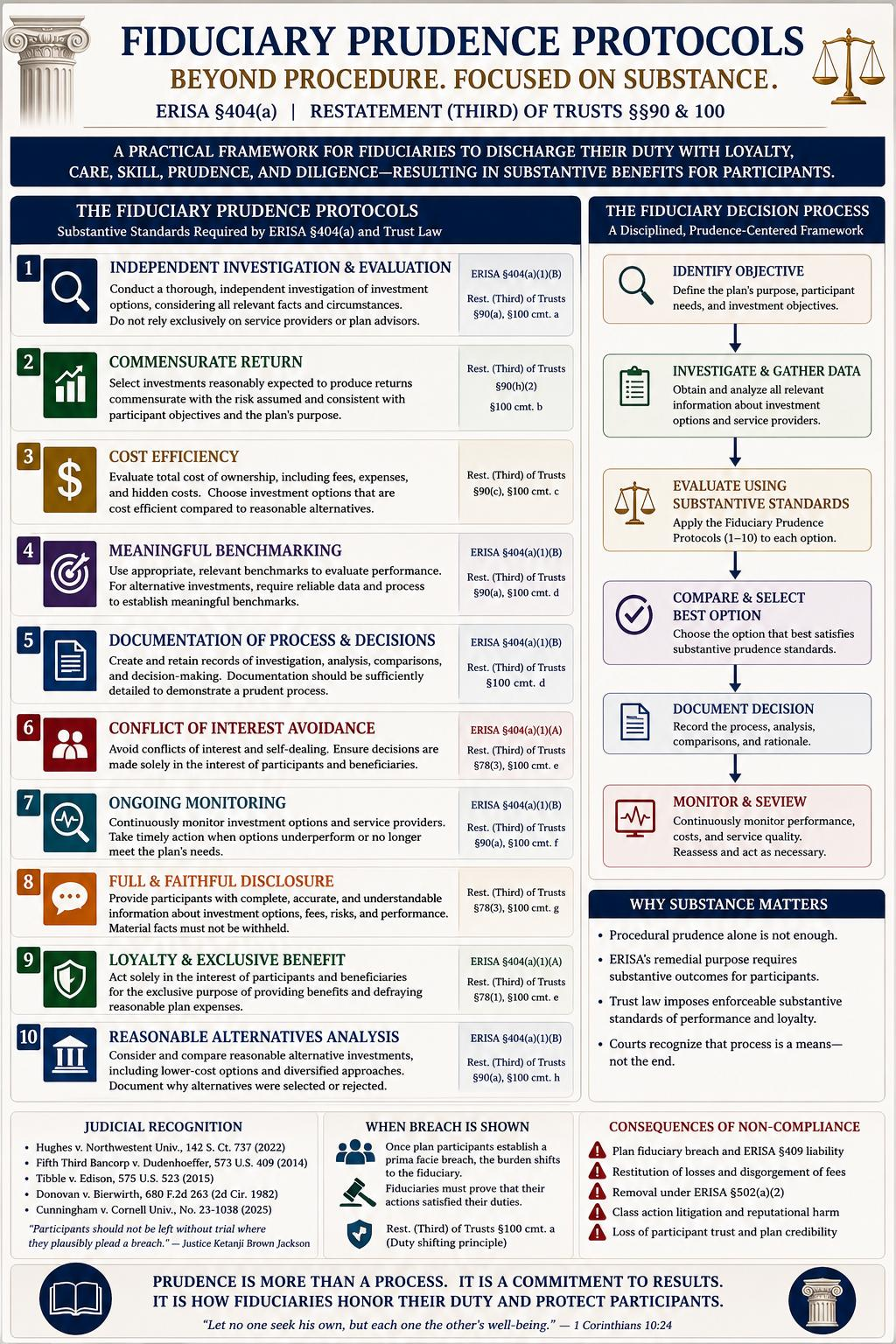
These protocols synthesize the fiduciary standards reflected in Supreme Court ERISA decisions and the Restatement (Third) of Trusts.
1. Loyalty Protocol
Every decision must be made solely in the interest of participants and beneficiaries.
- Eliminate conflicts of interest.
- Ignore employer, insurer, or service-provider interests.
- Document why the decision benefits participants.
Authorities: ERISA §404(a)(1)(A); John H. Langbein; Restatement (Third) of Trusts §78.
2. Independent Investigation Protocol
No investment may be selected or retained without an independent investigation.
The fiduciary should:
- identify reasonable alternatives;
- evaluate risks and expected returns;
- assess costs;
- compare available investments using objective data.
Authorities: Donovan v. Bierwirth; Restatement (Third) of Trusts §90.
3. Risk-Return Protocol
Each investment must be expected to provide a return commensurate with its risk.
Questions include:
- Does higher risk produce higher expected return?
- If lower return, is risk materially reduced?
- Is the investment economically justified?
This reflects the Restatement’s requirement of commensurate return.
4. Cost Efficiency Protocol
Every expense must be justified by measurable participant benefit.
Analyze:
- expense ratios;
- advisory fees;
- insurance costs;
- surrender charges;
- transaction costs.
Higher costs require demonstrable value.
Authorities: Restatement (Third) of Trusts §90; Tibble v. Edison International.
5. Benchmark Protocol
Every investment must be benchmarked against meaningful alternatives.
Benchmarks should compare:
- risk;
- return;
- volatility;
- liquidity;
- total cost;
- terminal wealth.
Opaque investments require documentation explaining benchmark methodology.
6. Ongoing Monitoring Protocol
Prudence is continuous.
Review periodically:
- performance;
- fees;
- benchmark results;
- manager changes;
- investment thesis.
Replace investments that no longer satisfy fiduciary standards.
Authority: Tibble v. Edison International.
7. Diversification Protocol
Evaluate each investment as part of the portfolio.
Avoid unnecessary concentration while ensuring diversification serves participants rather than marketing objectives.
Authority: Restatement (Third) of Trusts §90.
8. Documentation Protocol
Create a contemporaneous record showing:
- information reviewed;
- alternatives considered;
- analyses performed;
- expert advice received;
- reasons for the decision.
Good documentation supports—but does not replace—a prudent decision.
9. Participant Outcome Protocol
Focus on economic outcomes, not merely process.
Evaluate:
- retirement income;
- wealth accumulation;
- downside protection;
- inflation-adjusted purchasing power;
- terminal wealth.
A procedurally careful process cannot justify an economically imprudent result.
10. Disclosure Protocol
Participants should receive sufficient information to understand:
- material risks;
- fees;
- conflicts;
- limitations;
- assumptions.
Material omissions undermine informed decision-making.
Authority: Restatement (Third) of Trusts §82.
11. Evidentiary Protocol
Before selecting specialized or alternative investments, retain evidence sufficient to demonstrate:
- expected risk-adjusted returns;
- benchmark validity;
- valuation methodology;
- liquidity characteristics;
- cost justification.
Absent reliable evidence, prudence is difficult to establish.
12. Judicial Review Protocol
Assume every fiduciary decision will later be examined by a federal judge.
The record should enable the fiduciary to prove:
- loyalty;
- prudence;
- objective investigation;
- reasoned analysis;
- continuous monitoring;
- participant-focused decision-making.
Governing Supreme Court Principles
These protocols are consistent with key principles from:
- Firestone Tire & Rubber Co. v. Bruch — ERISA fiduciaries are informed by trust law.
- Fifth Third Bancorp v. Dudenhoeffer — Fiduciary decisions must satisfy ordinary standards of prudence.
- Tibble v. Edison International — Fiduciaries have a continuing duty to monitor investments.
- Hughes v. Northwestern University — Offering some prudent investments does not excuse retaining imprudent one.
- Cunningham .v, Cornelss University (see Note below)
13. Prohibited Transaction Protocol - Treat every transaction with a party in interest as presumptively prohibited unless a statutory exemption can be established.
- Before approving the transaction, document:
- necessity of the services;
- reasonableness of compensation;
- why the applicable §408 exemption is satisfied.
14. Burden-of-Proof Protocol
- Maintain contemporaneous evidence sufficient to prove every claimed exemption.
- Assume that if challenged, the fiduciary—not the participant—will bear the burden of establishing the exemption.
- Preserve benchmarking, fee analyses, RFP materials, committee minutes, and expert evaluations supporting the transaction.
Together, these protocols provide a litigation-grade framework for evaluating fiduciary conduct under ERISA §404(a) and the Restatement (Third) of Trusts, emphasizing both procedural rigor and substantive economic prudence.
In terms of litigation and the burden of proof protocol, the recent Supreme Court decision in Cunningham v. Cornell Univrresity deserves special attention. Cunningham is especially valuable because it reinforces a broader procedural principle: where the evidence regarding prudence or statutory exemptions is uniquely within the fiduciary’s possession, ERISA does not require participants to negate those matters before discovery. That dovetails with a recurring argument that fiduciaries should be required to produce the benchmarking and analytical materials underlying their decisions once a plausible claim is stated. While Cunningham arose under §406 rather than §404, its allocation of pleading and proof burdens supports that procedural framework.
Notes
1. Donovan v. Bierwirth, 680 F.2d 263 (2d Cir. 1982).
2. Tibble v. Edison, 575 U.S. 523 (2015).
3. Firestone Tire & Rubber v. Bruch, 573 U.S. 409 (2014).
4..Fifth Third Bancorp v. Dudenhoeffer, 573 573 U.S. 409 (2014)
5. Hughes v. Northwestern University, 595 U.s. 170 (2022).
6. Cunningham v. Cornell University, 604 U.S. ____ (2025).
© Copyright 2026 InvestSense, LLC. All rights reserved.
This article is for informational purposes only and is neither designed nor intended to provide legal, investment, or other professional advice since such advice always requires consideration of individual circumstances. If legal, investment, or other professional assistance is needed, the services of an attorney or other qulified professional advisor should be sought.


Pingback: Jim Watkins’ Fiduciary Protocols Expose the Real Problem with Fixed Annuities -a Prohibited Transaction | The CommonSense 401k Project