
James W. Watkins, III, J.D., CFP EmeritusTM, AWMA®
InvestSense, LLC
PREAMBLE & STATEMENT OF POLICY
The fundamental principle underlying this Act is simple:
A consumer should not be asked to surrender a known amount of present wealth in exchange for a promise of future lifetime income without being told, in writing, when that transaction is expected to economically break even—and whether the consumer is statistically likely to live long enough to reach that point.
Annuity recommendations frequently emphasize the certainty of future income while the economic costs of obtaining that certainty may be difficult for an ordinary consumer to identify.
The Act therefore does not prohibit annuities.
Nor does it presume that an annuity is unsuitable merely because it involves an exchange of principal for lifetime income.
Instead, the Act requires the person recommending the transaction to show the consumer the economics of the transaction before the transaction occurs.
That disclosure is intended to transform the annuity recommendation from a sales presentation into an informed economic decision.
It also creates a contemporaneous record of the recommendation, the assumptions underlying the recommendation, the compensation received by the recommender, the projected breakeven point, the consumer’s life expectancy, and the probability of surviving to the breakeven point.
That record serves two purposes:
First, consumer protection. The consumer receives information necessary to evaluate the transaction before committing retirement assets.
Second, accountability. If the transaction subsequently becomes the subject of litigation or regulatory review, the parties and the factfinder possess contemporaneous evidence showing what the consumer was told, what assumptions were used, what risks were disclosed, and whether the recommendation was supported by an objectively reasonable economic analysis.

The Act thus establishes a straightforward principle of financial consumer protection:
Before asking an American senior to exchange present wealth for lifetime income, show the senior the economic cost of the guarantee, the projected value at life expectancy, the projected breakeven age, and the probability of living long enough to reach it
A BILL, to be known as the “Seniors’ Anti-Financial Exploitation Act of 2026”
To protect senior citizens and retirement plan participants from financial exploitation through inadequate, misleading, or incomplete recommendations concerning annuity products, and for other purposes.
SECTION 1. SHORT TITLE.
This Act may be cited as the “Seniors’ Anti-Financial Exploitation Act of 2026.”
SEC. 2. CONGRESSIONAL FINDINGS AND PURPOSE.
(a) Findings.
Congress finds the following:
- Protection of retirement savings.
Millions of Americans rely upon accumulated retirement savings to provide income during retirement. The conversion of retirement savings into lifetime income therefore constitutes a transaction of substantial economic significance. - Complexity of annuity products.
Annuity contracts frequently contain complex provisions concerning guarantees, surrender charges, mortality credits, interest-crediting mechanisms, fees, riders, liquidity restrictions, death benefits, indexing formulas, and other contractual features that may materially affect the economic value of the transaction to the consumer. - Irreversibility and illiquidity.
Unlike many securities and deposit products, certain annuity transactions may substantially restrict a consumer’s ability to recover or redeploy principal without surrender charges, market-value adjustments, taxation, forfeiture of benefits, or other economic penalties. - Economic tradeoff.
The purchase of an annuity commonly involves an exchange of present financial assets for a stream of future payments. The economic merits of that exchange cannot be adequately evaluated merely by stating the amount of the periodic payment or by emphasizing the concept of “guaranteed lifetime income.” - Mortality risk.
The economic value of a lifetime annuity is materially affected by the purchaser’s probability of surviving to successive ages. A consumer who dies substantially before the economic breakeven point may receive substantially less in cumulative payments than the amount initially committed, depending upon the contractual death-benefit provisions. - Time value of money.
Comparisons between an annuity’s purchase price and future income payments that fail to account for the time value of money may materially overstate the economic attractiveness of the transaction. - Breakeven information.
A consumer cannot meaningfully evaluate a recommendation to exchange a present sum of money for future annuity payments without knowing, among other things, the age at which the cumulative economic value of the projected payments equals or exceeds the amount committed and the probability of surviving to that age. - Life expectancy.
A meaningful annuity analysis should disclose the projected economic value of the contract at the purchaser’s applicable life-expectancy age and compare that value with the amount committed to the contract. - Fear-based marketing.
Consumers, particularly older Americans, may be susceptible to marketing emphasizing the risk of outliving assets, market volatility, inflation, or financial insecurity while failing to provide equally prominent information concerning the economic costs, restrictions, risks, and tradeoffs associated with the recommended annuity. - Commissions and conflicts of interest.
Compensation arrangements involving commissions, bonuses, overrides, production incentives, or other economic benefits may create incentives to recommend annuity products that are not necessarily the most economically advantageous means of addressing a consumer’s stated retirement-income objective. - Existing regulatory gap.
The National Association of Insurance Commissioners’ Suitability in Annuity Transactions Model Regulation #275 establishes standards for annuity recommendations, but expressly exempts contracts used to fund employee pension or welfare benefit plans covered by the Employee Retirement Income Security Act of 1974 and certain other employer-sponsored retirement arrangements. - Limits of existing federal regulation.
The Department of Labor’s 2024 Retirement Security Rule sought to expand the circumstances under which investment advice concerning retirement assets would be subject to ERISA’s fiduciary framework. The rule was stayed by federal courts, the Department’s appeals were subsequently dismissed, and the rule was ultimately vacated in 2026. The Department has restored the prior five-part test for determining investment-advice fiduciary status. - Need for congressional action.
The existence of continuing uncertainty concerning the scope of fiduciary regulation demonstrates the need for Congress to establish an independent statutory disclosure requirement applicable to material annuity recommendations. - Evidence and accountability.
A contemporaneous written economic analysis provides consumers with information necessary to make an informed decision and creates an objective record that may subsequently be used to determine whether the recommendation was reasonable, misleading, negligent, or fraudulent.
(b) Purpose.
The purposes of this Act are—
- to protect senior citizens and retirement savers from financial exploitation arising from materially incomplete or misleading annuity recommendations;
- to ensure that a consumer is informed of the principal economic tradeoffs associated with an annuity before purchasing, exchanging, or replacing an annuity;
- to require meaningful disclosure of the relationship between the consumer’s present financial commitment, projected lifetime payments, time value of money, mortality risk, liquidity restrictions, surrender charges, and projected economic breakeven point;
- to provide a contemporaneous evidentiary record concerning the basis for an annuity recommendation;
- to supplement, and not diminish, existing protections under Federal and State law, including the Employee Retirement Income Security Act of 1974; and
- to ensure that the marketing of lifetime-income products does not rely upon fear of outliving assets while withholding material information concerning the economic consequences of the recommended transaction.
(a) Findings.
Congress finds the following:
Protection of retirement savings.
Millions of Americans rely upon accumulated retirement savings to provide income during retirement. The conversion of retirement savings into lifetime income therefore constitutes a transaction of substantial economic significance.
Complexity of annuity products.
Annuity contracts frequently contain complex provisions concerning guarantees, surrender charges, mortality credits, interest-crediting mechanisms, fees, riders, liquidity restrictions, death benefits, indexing formulas, and other contractual features that may materially affect the economic value of the transaction to the consumer.
Irreversibility and illiquidity.
Unlike many securities and deposit products, certain annuity transactions may substantially restrict a consumer’s ability to recover or redeploy principal without surrender charges, market-value adjustments, taxation, forfeiture of benefits, or other economic penalties.
Economic tradeoff.
The purchase of an annuity commonly involves an exchange of present financial assets for a stream of future payments. The economic merits of that exchange cannot be adequately evaluated merely by stating the amount of the periodic payment or by emphasizing the concept of “guaranteed lifetime income.”
Mortality risk.
The economic value of a lifetime annuity is materially affected by the purchaser’s probability of surviving to successive ages. A consumer who dies substantially before the economic breakeven point may receive substantially less in cumulative payments than the amount initially committed, depending upon the contractual death-benefit provisions.
Time value of money.
Comparisons between an annuity’s purchase price and future income payments that fail to account for the time value of money may materially overstate the economic attractiveness of the transaction.
Breakeven information.
A consumer cannot meaningfully evaluate a recommendation to exchange a present sum of money for future annuity payments without knowing, among other things, the age at which the cumulative economic value of the projected payments equals or exceeds the amount committed and the probability of surviving to that age.
Life expectancy.
A meaningful annuity analysis should disclose the projected economic value of the contract at the purchaser’s applicable life-expectancy age and compare that value with the amount committed to the contract.
Fear-based marketing.
Consumers, particularly older Americans, may be susceptible to marketing emphasizing the risk of outliving assets, market volatility, inflation, or financial insecurity while failing to provide equally prominent information concerning the economic costs, restrictions, risks, and tradeoffs associated with the recommended annuity.
Commissions and conflicts of interest.
Compensation arrangements involving commissions, bonuses, overrides, production incentives, or other economic benefits may create incentives to recommend annuity products that are not necessarily the most economically advantageous means of addressing a consumer’s stated retirement-income objective.
Existing regulatory gap.
The National Association of Insurance Commissioners’ Suitability in Annuity Transactions Model Regulation #275 establishes standards for annuity recommendations, but expressly exempts contracts used to fund employee pension or welfare benefit plans covered by the Employee Retirement Income Security Act of 1974 and certain other employer-sponsored retirement arrangements. Furthermore, the fact that the NAIC has no enforcement power reduces their releases to nothing more than aspirational suggestions.
Limits of existing federal regulation.
The Department of Labor’s 2024 Retirement Security Rule sought to expand the circumstances under which investment advice concerning retirement assets would be subject to ERISA’s fiduciary framework. The rule was stayed by federal courts, the Department’s appeals were subsequently dismissed, and the rule was ultimately vacated in 2026. The Department has restored the prior five-part test for determining investment-advice fiduciary status.
Need for congressional action.
The existence of continuing uncertainty concerning the scope of fiduciary regulation demonstrates the need for Congress to establish an independent statutory disclosure requirement applicable to material annuity recommendations.
Evidence and accountability.
A contemporaneous written economic analysis provides consumers with information necessary to make an informed decision and creates an objective record that may subsequently be used to determine whether the recommendation was reasonable, misleading, negligent, or fraudulent.
(b) Purpose.
The purposes of this Act are—
1. to protect senior citizens and retirement savers from financial exploitation arising from materially incomplete or misleading annuity recommendations;
2. to ensure that a consumer is informed of the principal economic tradeoffs associated with an annuity before purchasing, exchanging, or replacing an annuity;
3. to require meaningful disclosure of the relationship between the consumer’s present financial commitment, projected lifetime payments, time value of money, mortality risk, liquidity restrictions, surrender charges, and projected economic breakeven point;
4. to provide a contemporaneous evidentiary record concerning the basis for an annuity recommendation;
5. to supplement, and not diminish, existing protections under Federal and State law, including the Employee Retirement Income Security Act of 1974; and
6. to ensure that the marketing of lifetime-income products does not rely upon fear of outliving assets while withholding material information concerning the economic consequences of the recommended transaction.
SEC. 3. DEFINITIONS.
For purposes of this Act:
(1) ANNUITY.
The term “annuity” means any insurance contract under which consideration is paid or committed in exchange for a series of payments contingent upon or extending over a period of time, including fixed, fixed-indexed, variable, registered index-linked, immediate, deferred, qualified, and nonqualified annuity contracts.
(2) RECOMMENDATION.
The term “recommendation” means a communication or course of conduct that is reasonably likely to result in a consumer’s purchase, exchange, replacement, surrender, or material modification of an annuity.
(3) COVERED CONSUMER.
The term “covered consumer” means—
(A) an individual who has attained 60 years of age; or
(B) an individual who is the owner, participant, beneficiary, or prospective beneficiary of a retirement plan or individual retirement arrangement and who receives a recommendation concerning the use of retirement assets to purchase an annuity.
(4) COVERED ANNUITY RECOMMENDATION.
The term “covered annuity recommendation” means a recommendation involving—
(A) the purchase of an annuity;
(B) the exchange or replacement of an existing annuity;
(C) the surrender of an existing annuity for the purpose of purchasing another annuity;
(D) the transfer or rollover of retirement assets for the purpose of purchasing an annuity; or
(E) the allocation of assets within an ERISA-covered plan to an annuity or annuity-based investment.
SEC. 4. MANDATORY WRITTEN ANNUITY BREAKEVEN ANALYSIS.
(a) Requirement.
No person shall make a covered annuity recommendation to a covered consumer unless, before execution of the transaction, the consumer is provided with a Written Annuity Breakeven Analysis meeting the requirements of this section.
(b) Required contents.
The Written Annuity Breakeven Analysis shall disclose, in clear and understandable language:
1. the amount of the consumer’s proposed initial financial commitment;
2. all material fees, charges, commissions, surrender charges, market-value adjustments, rider charges, and other costs reasonably expected to affect the economic value of the transaction;
3. the guaranteed and non-guaranteed components of projected benefits;
4. the projected annual and cumulative payments under the annuity;
5. the assumed discount rate used to calculate present value;
6. the present value of projected payments;
7. the consumer’s projected life-expectancy age, determined using an actuarially appropriate mortality table prescribed by the Secretary;
8. the projected cumulative nominal value of payments at the consumer’s life-expectancy age;
9. the projected present value of payments at the consumer’s life-expectancy age
;
10. the projected age at which the transaction reaches economic breakeven;
11. the projected cumulative nominal value at the breakeven age;
12. the present value of the projected payments at the breakeven age;
13. the probability, based upon the applicable mortality table, that the consumer will survive to the projected breakeven age;
14, the economic value of the consumer’s retained assets under a reasonably comparable alternative, where such alternative is necessary to understand the material economic tradeoff presented by the recommendation;
15. the liquidity restrictions applicable to the recommended annuity;
16. the consequences of surrender, early withdrawal, exchange,or termination;
17. the amount and nature of compensation to be received by the person making the recommendation, including commissions and material non-cash compensation; and
18. any material assumptions necessary to reproduce the analysis.
(c) Dual presentation.
The analysis shall present projected values both in nominal dollars; and on a present-value basis
The analysis shall not characterize an annuity as having reached “breakeven” solely because cumulative nominal payments equal the original premium.
(d) Mortality disclosure.
The analysis shall expressly disclose the probability that the consumer will survive t o the consumer’s projected life-expectancy age, and the projected economic breakeven age.
(e) Alternative scenario.
Where the recommendation involves the transfer of retirement assets or other substantial financial assets, the analysis shall include a reasonably comparable alternative based upon the consumer’s stated objective, including, where appropriate, retention of the assets in a diversified investment portfolio, Treasury securities, certificates of deposit, or another reasonably comparable income-producing alternative.
Nothing in this subsection shall require a person to recommend a particular investment or asset class.
SEC. 5. SEPARATE DISCLOSURE OF ECONOMIC TRADEOFFS.
The Written Annuity Breakeven Analysis shall contain a separate section, in bold type and plain language, entitled:
“WHAT YOU GIVE UP AND WHEN YOU BREAK EVEN.”
The disclosure shall identify—
- the amount of money committed;
- the material rights and liquidity surrendered;
- the principal economic costs;
- the projected value at life expectancy;
- the projected breakeven age; and
- the probability of surviving to the breakeven age.
No statement describing an annuity as providing “guaranteed lifetime income,” “retirement security,” “protection from outliving your money,” or substantially similar language shall be permitted to substitute for the disclosures required by this section.
SEC. 6. PROHIBITION OF MATERIAL OMISSION OR MISREPRESENTATION.
A person making a covered annuity recommendation shall not—
- knowingly or recklessly omit a material fact concerning the economic consequences of the recommendation;
- represent that an annuity provides an economic benefit without reasonably disclosing material costs or limitations necessary to understand that representation;
- characterize a transaction as having reached economic “breakeven” solely on the basis of undiscounted cumulative payments;
- represent that a lifetime-income guarantee eliminates the economic risk associated with committing principal to an annuity;
- use projected longevity, mortality, or income figures selectively in a manner that materially misleads the consumer; or
- use fear of market losses, inflation, longevity, or depletion of retirement assets as a basis for recommending an annuity without providing the material economic disclosures required by this Act.
SEC. 7. RECORDKEEPING.
A person making a covered annuity recommendation shall retain, for not less than 7 years—
- the Written Annuity Breakeven Analysis;
- all assumptions used in preparing the analysis;
- the consumer information upon which the analysis was based;
- all compensation disclosures;
- the recommendation itself;
- material communications concerning the recommendation; and
- documentation demonstrating compliance with this Act.
Such records shall be made available to the appropriate Federal or State regulatory authority upon lawful request.
SEC. 8. ENFORCEMENT.
(a) Federal enforcement.
The Securities and Exchange Commission, the Department of Labor, the Consumer Financial Protection Bureau, and such other Federal agencies as the President may designate shall have enforcement authority under this Act with respect to persons and transactions falling within their respective statutory jurisdictions.
(b) ERISA plans.
Nothing in this Act shall be construed—
- to diminish any fiduciary duty imposed by ERISA;
- to preempt or displace ERISA’s fiduciary standards;
- to limit the authority of the Secretary of Labor under ERISA; or
- to establish a lesser standard of conduct than otherwise applicable under Federal law.
Where a covered annuity recommendation concerns an ERISA-covered plan or participant, compliance with this Act shall constitute a minimum statutory disclosure requirement and shall not constitute a safe harbor from any otherwise applicable fiduciary duty.
(c) State authority.
Nothing in this Act shall preempt a State law that provides greater protection to a consumer.
SEC. 9. PRIVATE RIGHT OF ACTION.
(a) Civil action.
A covered consumer who suffers economic loss as a result of a material violation of this Act may bring a civil action in an appropriate United States district court.
(b) Evidentiary significance.
Failure to prepare or provide a Written Annuity Breakeven Analysis required by this Act shall constitute evidence relevant to determining whether the recommendation was reasonable, prudent, negligent, deceptive, or fraudulent under otherwise applicable law.
A materially false, misleading, or materially incomplete Written Annuity Breakeven Analysis shall constitute evidence relevant to the same issues.
(c) No exclusive remedy.
Nothing in this section shall preclude a consumer from pursuing any other remedy available under Federal or State law, including remedies for fraud, negligent misrepresentation, breach of fiduciary duty, securities violations, insurance violations, or violations of ERISA.
SEC. 10. SPECIAL PROTECTION FOR ERISA PLAN PARTICIPANTS.
(a) Congressional policy.
Congress recognizes that participants in ERISA-covered retirement plans may encounter annuity recommendations in circumstances in which State annuity regulations do not apply.
The NAIC’s Model Regulation #275 expressly excludes contracts used to fund ERISA-covered employee pension or welfare benefit plans and certain employer-sponsored retirement arrangements.
(b) Federal minimum standard.
Accordingly, the requirements of this Act shall apply notwithstanding any exemption contained in a State insurance law or regulation based upon the status of the transaction as an ERISA-covered transaction.
(c) No diminution of ERISA.
Nothing in this section shall be interpreted to alter the substantive fiduciary standards established by ERISA.
SEC. 11. REGULATIONS.
Not later than 180 days after enactment, the appropriate Federal agencies shall promulgate regulations—
- establishing standardized actuarial assumptions and mortality tables;
- establishing standards for calculating present value;
- establishing standards for calculating economic breakeven;
- establishing standardized compensation disclosures;
- establishing model Written Annuity Breakeven Analysis forms;
establishing standards for comparing annuities with reasonably comparable alternatives; and
establishing procedures designed to ensure that disclosures are understandable to ordinary consumers, including senior citizens.
SEC. 12. EFFECTIVE DATE.
This Act shall apply to covered annuity recommendations occurring on or after the date that is 180 days after the date of enactment.
SEC. 13. SEVERABILITY.
If any provision of this Act, or the application of such provision to any person or circumstance, is held invalid, the remainder of this Act and the application of its remaining provisions shall not be affected.
Going Forward
The proposed Act thus establishes a straightforward principle of financial consumer protection:
Before asking an American senior to exchange present wealth for lifetime income, show the senior the economic cost of the guarantee, the projected value at life expectancy, the projected breakeven age, and the probability of living long enough to reach it.
bill impose any undue hardship on those recommending annuities . The bill
The bill force a decision as to whether annuities are good or bad. The bill simply requires the salesperson/adviser to expose the economic proposition of a proposed annuity recommendation as a consumer protection measure to allow inevstors to make informed decisions, a fair and equitable goal of consumer protection law.
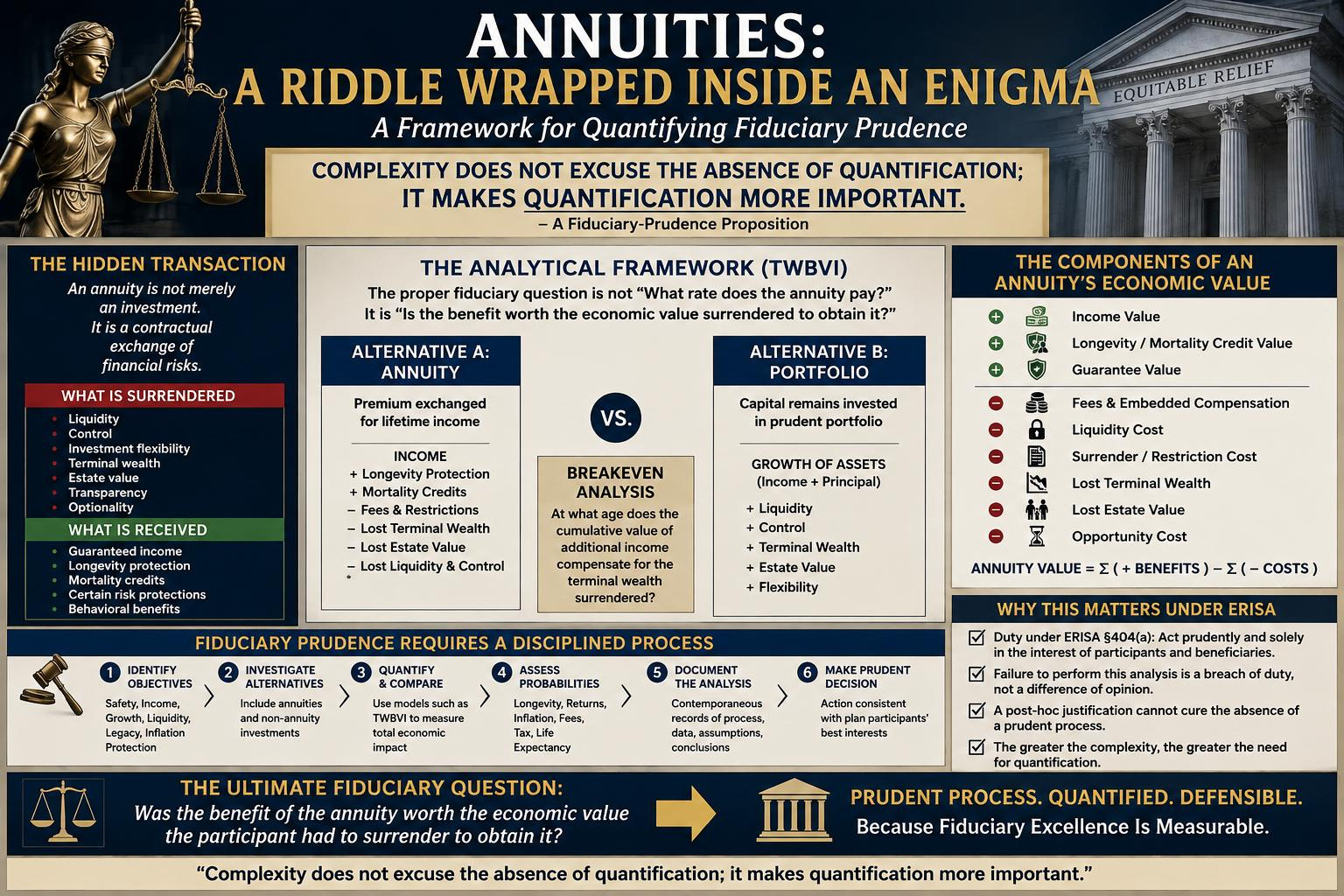
Nominal breakeven is not economic breakeven. If someone pays $100,000 and eventually receives $100,000 back in installments, that does not establish that the consumer has broken even. The consumer surrendered $100,000 today and received those dollars over a period of years. The statute therefore requires both nominal and present-value calculations.
And mortality adds the second dimension: it is not enough to know when breakeven occurs; the consumer needs to know the probability of surviving t breakeven.
An annuity recommendation should disclose not merely the income it promises, but the economic price of obtaining that promise and the probability that the purchaser will live long enough to recover that price.The proposed is therefore similar to the rules of the Securites and Exchange Commission and FINRA requiring that brokers observe “high standards of commercial honor and just and equitable principles of trade.”
The NAIC’s current Rule #275 expressly exempts ERISA-covered pension/welfare plans and several employer-sponsored arrangements. The NAIC itself describes Rule #275 as the foundation for state annuity best-interest regulation.
In short, the bill provides an opportunity for Congress to close existing regulatory “gaps” that can and do harm the public and their financial security. The recent failure of the DOL and EBSA to properly pursue an appeal of the Fifth Circuit Court of Appeals stay of their proposed retirement Security Rule, despite the support of two prominent federal judges, just shows that Congress cannot rely upon administrative rulemaking alone to close the gap.
Likewise, the current NAIC Rule #275, which expressly exempts contracts used to fund an ERISA-covered employee pension or welfare plan, and the NAIC’s lack of enforcement power, is a genuine regulatory “gap” that Congress can, and should, address directly to provide investors and plan participants with much needed and adequate consumer protection.
© Copyright 2026 InvestSense, LLC. All rights reserved.
This article is for informational purposes only and is neither designed nor intended to provide legal, investment, or other professional advice since such advice always requires consideration of individual circumstances. If legal, investment, or other professional assistance is needed, the services of an attorney or other qulified professional advisor should be sought.


You must be logged in to post a comment.