
James W. Watkins, III, J.D., CFP EmeritusTM, AWMA®
InvestSense, LLC
ERISA § 404(a)(1)(B)1, imposes upon plan fiduciaries a demanding but deliberately flexible standard: fiduciaries must act “with the care, skill, prudence, and diligence” that a prudent fiduciary acting in a like capacity and familiar with such matters would exercise “under the circumstances then prevailing.”
The statutory standard is necessarily contextual. It does not prescribe a particular investment, asset class, investment philosophy, or mathematical formula. But the absence of a prescribed formula does not mean that fiduciary prudence is incapable of objective analysis.
To the contrary, modern fiduciary law supplies substantive principles against which a fiduciary’s investment decision can be evaluated. The common law of trusts provides the relevant analytical foundation, and the Restatement (Third) of Trusts § 90 identifies cost-consciousness, risk, expected return, diversification, and the relationship among those factors as central components of prudent investing.
The Fiduciary Prudence Trinity (Trinity) provides a practical synthesis of those principles. The Trinity identifies three interrelated inquiries:
- Cost-efficiency: Is the investment or strategy reasonably efficient in relation to the costs imposed upon participants?
- Risk management: Is the additional risk assumed by the fiduciary reasonably justified under the circumstances?
- Commensurate return: Does the investment or strategy provide a reasonably supportable expectation of return commensurate with its additional costs and risks?
This framework does not replace § 404(a)’s prudence standard. It operationalizes it.
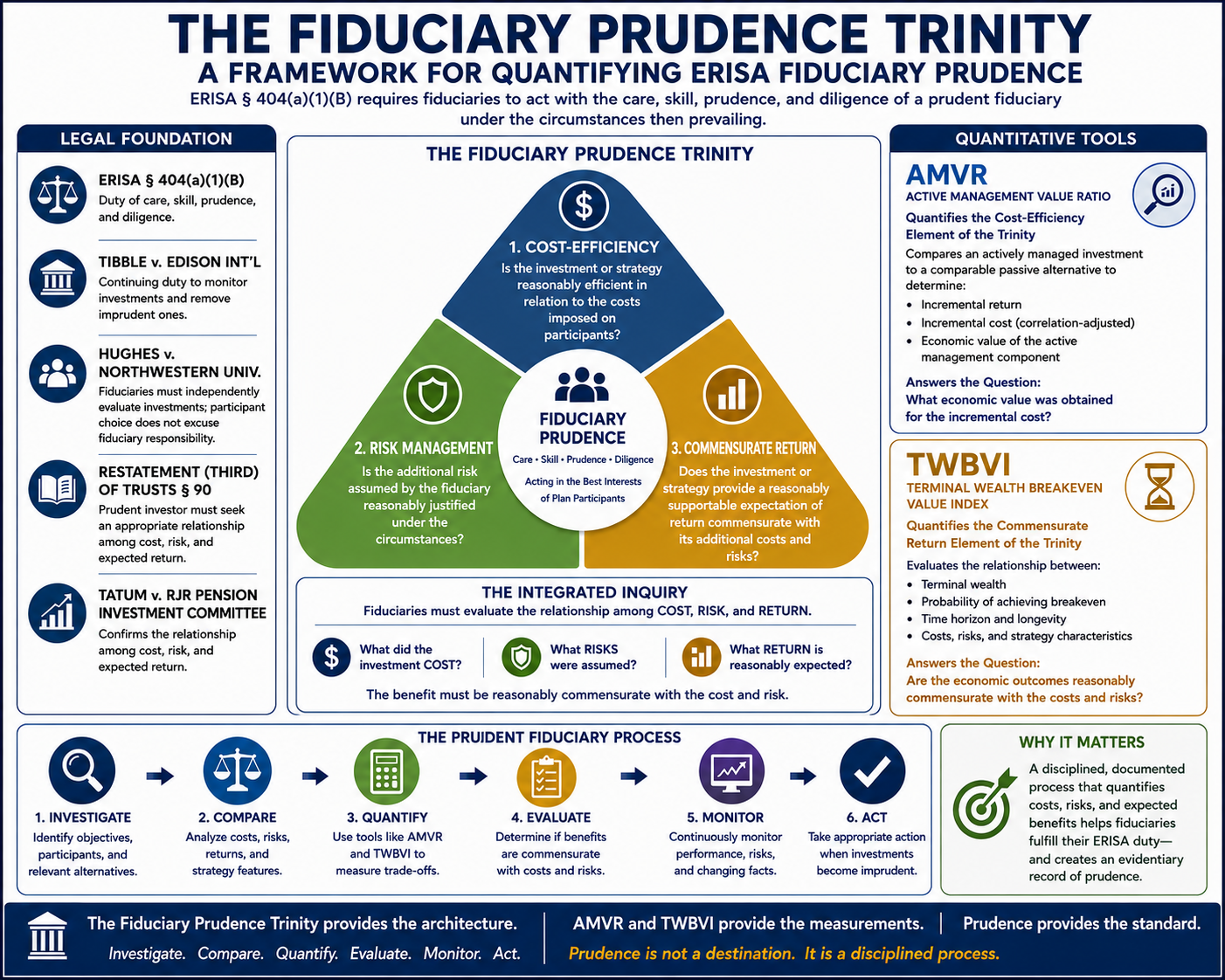
The Active Management Value Ratio (“AMVR”) and the Terminal Wealth Breakeven Value Index (“TWBVI”) metrics likewise do not purport to establish liability mechanically. Rather, they provide quantitative tools by which courts, fiduciaries, experts, and participants can translate otherwise abstract fiduciary concepts into objectively testable economic propositions.
AMVR principally addresses the cost-efficiency component of the Trinity. TWBVI principally addresses the commensurate-return/wealth-preservation component, particularly where an investment strategy involves materially different risk, return, longevity, liquidity, or terminal-wealth characteristics.
The legal significance of these metrics therefore does not arise from the formulas themselves. It arises from their relationship to principles already embedded in ERISA fiduciary law.
The Supreme Court’s decisions in Tibble v. Edison International2, and Hughes v. Northwestern University3 595 U.S. 170 (2022), reinforce the proposition that fiduciaries must independently evaluate investments and continually determine whether they remain prudent. Hughes expressly rejected the proposition that participant choice, standing alone, excuses fiduciaries from independently evaluating the prudence of investments offered through a defined-contribution plan.
The Trinity, AMVR, and TWBVI are therefore best understood as complementary components of a disciplined fiduciary-investment methodology:
investigate → compare → quantify → evaluate → monitor → act.
That methodology is consistent with, rather than contrary to, ERISA.
ARGUMENT
I. THE FIDUCIARY PRUDENCE TRINITY IS A LEGITIMATE SYNTHESIS OF EXISTING ERISA AND TRUST-LAW PRINCIPLES
A. ERISA deliberately incorporates the common law of trusts into the fiduciary standard.
Congress did not create fiduciary prudence in a legal vacuum. Section 404(a) establishes the statutory obligation, but the Supreme Court has repeatedly recognized that the contours of ERISA fiduciary duties are informed by the common law of trusts.
In Tibble, the Court explained that ERISA’s fiduciary duty is “derived from the common law of trusts” and held that trust-law principles provide an appropriate source for determining the continuing obligations of ERISA fiduciaries. Tibble v. Edison Int’l.,4
The Court subsequently reaffirmed that principle in Hughes, explaining that the duty of prudence requires a context-specific evaluation of fiduciary conduct and that fiduciaries must independently evaluate investments offered to plan participants. Hughes5
The proposition is important because it establishes the legal foundation for looking beyond generalized assertions that an investment was “reasonable” and asking the more fundamental question:
Reasonable in comparison with what reasonably available alternative?
That is the inquiry the Trinity facilitates.
II. THE FIRST ELEMENT OF THE TRINITY—COST-EFFICIENCY—FOLLOWS DIRECTLY FROM ERISA AND THE PRUDENT INVESTOR RULE
ERISA does not establish a universal maximum permissible investment fee. But neither does it permit a fiduciary to disregard cost. The Department of Labor’s investment regulation expressly requires fiduciaries, when considering an investment or investment course of action, to act consistently with § 404(a)’s prudence standard. 29 C.F.R. § 2550.404a-1.6
The Supreme Court’s decisions reinforce the importance of cost.
In Hughes, the Court held that allegations concerning excessive recordkeeping fees and unnecessarily expensive investment options could state a plausible prudence claim notwithstanding the existence of other lower-cost options in the plan. Hughes.7 That holding establishes an important proposition:
The mere existence of a lower-cost option does not itself establish imprudence—but neither does the existence of participant choice immunize a fiduciary’s more expensive option from scrutiny.
The fiduciary must independently evaluate the investment.
The Restatement’s formulation provides the economic architecture for that evaluation. Section 9, cmt. f recognizes the relationship among expected return, risk, and cost, including the objective of obtaining the highest return for a given level of risk and cost or, conversely, the lowest risk and cost for a given level of expected return. Therefore, the Trinity, therefore, does not invent “cost-efficiency.” It gives operational form to an established fiduciary principle.
III. AMVR PROVIDES AN OBJECTIVE METHOD FOR TESTING THE COST-EFFICIENCY ELEMENT
The principal difficulty with cost analysis in fiduciary litigation is not determining whether two investments have different expense ratios. It is determining whether the incremental cost of the more expensive investment purchased a corresponding incremental economic benefit.
That is precisely the problem AMVR is designed to address. An actively managed fund should not be evaluated merely by comparing its gross expense ratio with the expense ratio of an index fund.
The relevant fiduciary question is:
What did the additional cost of active management actually purchase?
AMVR approaches the question by comparing the actively managed investment with a reasonably comparable passive alternative and examining the relationship between:
- incremental return;
- incremental cost;
- correlation-adjusted incremental cost; and
- the resulting economic value of the active-management component.
The use of a comparable index fund rather than a costless market index is particularly important because the fiduciary is evaluating an actual investment option, not an abstract market benchmark.
The AMVR framework consequently moves the inquiry from:
“Is the expense ratio reasonable?”
to:
“Is the incremental economic benefit reasonably commensurate with the incremental cost?”
That is a materially more sophisticated fiduciary inquiry.
IV. AMVR SHOULD BE ADMITTED AND USED AS EVIDENCE OF PRUDENCE—NOT AS A SUBSTITUTE FOR THE LEGAL STANDARD
The AMVR provides probative evidence bearing upon fiduciary prudence.
That distinction defeats the most obvious objection to the metric. A fiduciary is not legally required to achieve a particular AMVR score. Nor does a negative AMVR automatically establish legal liability..
Instead, AMVR can help answer a question that ERISA necessarily requires fiduciaries to confront:
Was the additional cost of the selected investment reasonably justified by the additional economic value reasonably expected to be obtained?
That question is particularly compelling where the fiduciary:
- selected an actively managed investment;
- knew that a materially similar lower-cost alternative existed;
- incurred additional management expenses;
- failed to identify a correspondingly greater expected return;
- failed to quantify the additional risks assumed;
- failed to document why the additional costs and risks were justified; or
- continued to retain the investment after evidence demonstrated persistent cost inefficiency.
AMVR thus becomes a forensic tool for evaluating the quality of the fiduciary’s decision-making process. That is entirely consistent with Liss v. Smith,8, and the broader line of authority emphasizing that fiduciary prudence concerns the quality of the decision-making process rather than simply hindsight examination of investment results. The metric is therefore best characterized as quantitative evidence of cost-efficiency, not a judicially imposed investment rule.
V. THE SECOND AND THIRD ELEMENTS OF THE TRINITY REQUIRE THE FIDUCIARY TO CONSIDER RISK AND COMMENSURATE RETURN TOGETHER
Cost cannot be evaluated in isolation. Nor can return.
A fiduciary could not rationally conclude that an investment is prudent merely because it has produced a high historical return without considering the risk undertaken to achieve that return. Conversely, a fiduciary cannot reject an investment merely because it costs more than another investment if the additional cost purchases a reasonably supportable additional benefit.
The central fiduciary inquiry is therefore comparative.
The Restatement captures this relationship through its emphasis on obtaining an appropriate relationship among risk, cost, and expected return.
The Fourth Circuit expressly recognized this principle in Tatum v. RJR Pension Investment Committee9, explaining that § 90 cmt. f recognizes the fiduciary’s objective of seeking “the lowest level of risk and cost for a particular level of expected return—or, inversely, the highest return for a given level of risk and cost.”9
That principle is the conceptual bridge between AMVR and TWBVI. AMVR asks:
What economic value was obtained for the incremental cost?
TWBVI asks:
What wealth-preservation or terminal-value consequences reasonably accompany the selected strategy, given its costs, return characteristics, longevity assumptions, and alternatives?
Together they move fiduciary analysis toward the economic substance of the decision.
VI. TWBVI PROVIDES A METHOD FOR QUANTIFYING THE “COMMENSURATE RETURN” INQUIRY
The commensurate-return requirement presents a particularly difficult problem when investment alternatives have materially different economic characteristics. Historical annual return alone may be inadequate.
Consider, for example, a fiduciary comparing:
- an immediate income-producing product;
- a Treasury ladder;
- CDs;
- an annuity;
- an actively managed portfolio;
- a passive portfolio; or
- another wealth-preservation strategy.
Those alternatives may differ materially with respect to:
- liquidity;
- mortality risk;
- longevity risk;
- interest-rate risk;
- reinvestment risk;
- credit risk;
- inflation risk;
- terminal wealth;
- income guarantees;
- principal preservation;
- fees; and
- the economic value transferred between present consumption and future wealth.
A simple rate-of-return comparison may therefore obscure rather than illuminate fiduciary prudence. TWBVI addresses this problem by focusing upon the relationship between terminal wealth, the probability of achieving or exceeding a relevant economic breakeven point, and the period over which that outcome becomes relevant.
The result is a quantitative framework for evaluating whether an investment’s distinctive characteristics are reasonably commensurate with the economic costs and risks imposed upon the participant.
VII. TWBVI IS PARTICULARLY RELEVANT WHERE THE FIDUCIARY CHOOSES AN INVESTMENT THAT SACRIFICES TERMINAL WEALTH FOR ANOTHER BENEFIT
This is where TWBVI has its greatest potential legal significance. Suppose a fiduciary selects Investment A rather than Investment B.
Investment A provides some additional feature—such as guaranteed income, insurance protection, or another benefit—but produces materially different expected terminal wealth. The fiduciary cannot adequately evaluate the decision merely by stating that Investment A provides “security.”
The relevant fiduciary question is:
What did the participant give up to obtain that security, and was the economic tradeoff reasonably justified under the circumstances prevailing when the decision was made?
TWBVI supplies a means of quantifying that tradeoff. It does not say that maximum terminal wealth is always the fiduciary objective. It does say that terminal wealth is an economically relevant consequence that a prudent fiduciary should consider when selecting among materially different investment strategies.
That distinction is critical.
ERISA does not authorize fiduciaries to maximize one variable while ignoring the others.The fiduciary must evaluate the totality of relevant circumstances.
VIII. THE TRINITY IS CONSISTENT WITH TATUM BECAUSE IT DISTINGUISHES PROCESS FROM OUTCOME
The principal litigation concern with quantitative metrics in fiduciary litigation will likely be hindsight. That concern is legitimate.
It does not, however, invalidate quantitative analysis.
The Supreme Court has repeatedly emphasized that fiduciary prudence is evaluated under the circumstances prevailing when the fiduciary acted. Hughes, 595 U.S. at 174–76. Accordingly, the proper use of AMVR and TWBVI is ex ante, or at least based upon information reasonably available to the fiduciary at the relevant decision point.
The inquiry should therefore be:
What could a prudent fiduciary reasonably have known, calculated, compared, and considered at the time? Not: Did the investment ultimately outperform?
This distinction is essential.
AMVR can be calculated using information available when the decision was made and can subsequently be updated as part of the fiduciary’s continuing monitoring obligation. TWBVI can likewise be constructed using stated assumptions concerning return, costs, longevity, mortality, interest rates, and alternative strategies.
The metrics therefore facilitate—not replace—the conduct-based inquiry.
IX. TIBBLE AND HUGHES SUPPORT THE USE OF QUANTITATIVE TOOLS BECAUSE THEY REQUIRE INDEPENDENT EVALUATION AND CONTINUING MONITORING
Tibble held that ERISA fiduciaries have a continuing duty to monitor investments and remove imprudent investments.11
Hughes subsequently emphasized that fiduciaries must independently evaluate investment options and that the availability of participant choice does not eliminate the fiduciary’s responsibility to determine whether an investment is prudent.12
Those holdings have an important practical implication.
A fiduciary cannot credibly claim that it satisfied its duty simply by documenting that:
- an investment was popular;
- an investment had strong historical performance;
- another fiduciary selected it;
- a consultant recommended it;
- participants could choose something else; or
- the investment was permissible.
The fiduciary must undertake an informed evaluation. Quantification makes that evaluation more rigorous.
The question “Did you investigate?” can be followed by:
What did you compare?
What did the comparison show?
What additional cost did the selected strategy impose?
What additional risk did it impose?
What additional benefit did the fiduciary reasonably expect?
Was that benefit commensurate with the additional cost and risk?
AMVR and TWBVI provide mechanisms for answering those questions, for providing vital evidence.
X. THE TRINITY ALSO PROVIDES A POWERFUL RESPONSE TO THE FALSE DICHOTOMY BETWEEN PROCEDURAL AND SUBSTANTIVE PRUDENCE
An appellate court should reject any suggestion that fiduciary prudence is satisfied merely because fiduciaries followed an appropriate procedural checklist. A fiduciary process is necessary.
But process is not an end in itself. A fiduciary who documents that it “considered fees” without determining whether the additional fees were economically justified has documented a process without necessarily demonstrating prudence.
Likewise, a fiduciary who “considered risk” without determining whether the additional risk produced a commensurate expected benefit has not necessarily completed the substantive inquiry contemplated by § 404(a).
The Trinity bridges the two.
Procedural prudence asks whether the fiduciary investigated. The Trinity helps determine what the fiduciary should have investigated.
AMVR and TWBVI help determine whether the resulting investigation produced economically meaningful information.
This is not an impermissible judicial rewriting of ERISA. It is the practical application of the statutory requirement that fiduciaries exercise “care, skill, prudence, and diligence.”
XI. THE TRINITY SHOULD NOT BE TREATED AS A MECHANICAL THREE-PART TEST
There is an important limitation. The Trinity is not a statutory test. Nor should an appellate court convert it into one.
A negative AMVR does not automatically establish a fiduciary breach.
A low TWBVI does not automatically establish a fiduciary breach. Likewise, a positive AMVR or TWBVI does not immunize a fiduciary from liability.The appropriate legal framework remains § 404(a)’s context-specific prudence standard.
The Trinity instead identifies three economically central dimensions of that inquiry. This distinction makes the framework legally defensible. The court remains free to consider:
- investment objectives;
- participant demographics;
- plan characteristics;
- liquidity requirements;
- diversification;
- risk tolerance;
- investment horizon;
- available alternatives;
- costs;
- expected return;
- tax considerations where relevant;
- guarantees;
- insurance characteristics;
- market conditions;
- prevailing interest rates;
- the fiduciary’s expertise;
- expert advice;
- the information reasonably available at the time; and
- the fiduciary’s documented decision-making process.
AMVR and TWBVI simply make two otherwise difficult dimensions—cost-efficiency and commensurate economic benefit—more susceptible to objective analysis.
XII. THE PROPER ROLE OF AMVR AND TWBVI IN ERISA LITIGATION IS COMPARATIVE, NOT ABSOLUTIST
The most persuasive use of the metrics in litigation is not:
“The metric says the investment is imprudent.”
It is:
“The metric demonstrates an economically material deficiency that the fiduciary was required to investigate and evaluate.”
That distinction shifts the focus back to fiduciary conduct. For example, if AMVR demonstrates that an actively managed fund incurred substantially greater effective costs than a comparable passive alternative while generating no corresponding incremental risk-adjusted return, the plaintiff can argue that the fiduciary should have investigated and evaluated that disparity.
Similarly, if the TWBVI demonstrates that a selected retirement-income strategy materially reduces expected terminal wealth relative to a reasonably available alternative, the plaintiff can argue that the fiduciary was required to investigate whether the benefits obtained from the selected strategy were reasonably commensurate with that sacrifice.
The metric therefore becomes evidence of a red flag. The fiduciary’s response to the red flag becomes the central issue.
XIII. THIS FRAMEWORK IS PARTICULARLY COMPATIBLE WITH THE SUPREME COURT’S CONTEXT-SPECIFIC APPROACH
The Supreme Court has cautioned that the prudence inquiry is context specific because fiduciaries may confront difficult tradeoffs and reasonable fiduciaries may reach different conclusions. Hughes12
The Trinity respects that limitation. Indeed, it strengthens it.
Two fiduciaries can examine the same AMVR or TWBVI results and reasonably reach different conclusions because the underlying plan circumstances may differ. That is precisely why the metrics should inform, rather than dictate, the legal conclusion.
A fiduciary might reasonably conclude that an investment with a negative AMVR remains appropriate because it provides a specific benefit unavailable through the lower-cost alternative. But that conclusion should be based upon an identifiable fiduciary rationale.
Likewise, a fiduciary might reasonably select an investment with a lower TWBVI because the strategy provides a form of longevity protection that is particularly valuable to the plan’s participants.
Again, the issue is not whether the metric mechanically condemns the investment. The issue is whether the fiduciary recognized, quantified, evaluated, and reasonably justified the tradeoff.
XIV. AMVR AND TWBVI THEREFORE CREATE A COMMON LANGUAGE BETWEEN FIDUCIARY LAW AND INVESTMENT ECONOMICS
ERISA fiduciary litigation frequently involves two different languages. Lawyers speak in terms of:
- prudence;
- fiduciary duty;
- investigation;
- alternatives;
- reasonableness;
- causation; and
- damages.
Investment professionals speak in terms of:
- alpha;
- beta;
- correlation;
- expense ratios;
- risk-adjusted return;
- volatility;
- expected return;
- terminal value; and
- probability distributions.
The Fiduciary Prudence Trinity provides a conceptual bridge.
Cost-efficiency translates fiduciary cost-consciousness into an economic comparison.
Risk management translates the prudent-investor requirement into an evaluation of the risks assumed.
Commensurate return translates the fiduciary’s obligation to evaluate expected benefit against cost and risk into an economically testable proposition.
AMVR and TWBVI then provide quantitative instruments for implementing two portions of that framework.That makes the Trinity potentially useful not only in litigation but also in fiduciary governance.
XV. THE FRAMEWORK ALSO ADVANCES ERISA’S PURPOSE BY MAKING FIDUCIARY DECISION-MAKING AUDITABLE
A fiduciary process that cannot explain why an investment was selected is difficult to distinguish from a conclusory process. A prudent process should generate an evidentiary record.
That record should permit a later reviewer to determine:
- what alternatives were identified;
- what costs were compared;
- what risks were evaluated;
- what benefits were expected;
- how those benefits justified the costs and risks;
- what quantitative information was considered;
- what qualitative considerations were considered;
- why the selected alternative was preferable; and
- how the decision would be monitored thereafter.
The Trinity gives that process an organizing architecture.The AMVR and the TWBVI give fiduciaries tools for documenting portions of the analysis.
The resulting record is precisely what a court needs when evaluating fiduciary conduct under § 404(a).
XVI. THE APPLICABLE RULE FOR ERISA LITIGATION SHOULD THEREFORE BE ONE OF REASONED QUANTIFICATION, NOT MANDATED FORMULAS
The recommended litigation rule can be stated narrowly:
ERISA does not require fiduciaries to employ AMVR, TWBVI, or any particular quantitative metric. But where a fiduciary evaluates an investment involving materially different costs, risks, expected returns, or terminal-wealth consequences, quantitative evidence bearing upon those relationships is relevant to determining whether the fiduciary’s investigation and decision-making process satisfied § 404(a)(1)(B).13
A court should therefore permit expert evidence concerning the AMVR, the TWBVI, and comparable quantitative methodologies where the evidence is relevant, methodologically sound, and tied to information reasonably available to the fiduciary at the relevant time. The opposing party remains free to challenge:
- assumptions;
- benchmarks;
- time periods;
- correlation measures;
- risk measures;
- mortality assumptions;
- interest-rate assumptions;
- probability estimates;
- alternative investment selections;
- model sensitivity; and
- the ultimate interpretation of the results.
Those are ordinary questions of evidence and expert methodology. They are not reasons to prohibit quantitative fiduciary analysis altogether.
XVII. THE TRINITY PROVIDES A MORE COMPLETE MODEL OF FIDUCIARY PRUDENCE THAN A CHECKLIST-ONLY APPROACH
The fundamental proposition is simple.
A fiduciary cannot prudently select an investment without understanding what the investment costs, what risks it creates, and what benefits it is reasonably expected to produce.
The Trinity converts that proposition into three related inquiries:
COST
Is the investment economically cost-efficient?
RISK
Are the risks assumed reasonable in relation to the plan’s objectives and circumstances?
RETURN
Is the expected economic benefit reasonably commensurate with the costs and risks assumed?
AMVR principally quantifies the first inquiry and informs the third.
TWBVI principally quantifies the third and incorporates the economic consequences of risk, longevity, and terminal wealth.
Together, they help prevent the fiduciary process from becoming a ritualistic exercise in checking boxes.
CONCLUSION
The Fiduciary Prudence Trinity should be recognized not as a new legal standard but as a coherent analytical framework derived from existing ERISA and trust-law principles.
ERISA requires fiduciaries to exercise care, skill, prudence, and diligence under the circumstances prevailing at the time of the decision.13
Tibble establishes that fiduciaries have an ongoing obligation to monitor investments and remove imprudent ones.14 Hughes confirms that fiduciaries must independently evaluate investments and that participant choice does not relieve fiduciaries of that obligation.15 595.Tatum demonstrates that the Restatement’s relationship among cost, risk, and expected return is relevant to the fiduciary-prudence inquiry.16
Those principles collectively support a disciplined inquiry into cost-efficiency, risk, and commensurate return. The AMVR and TWBVI metrics provide a means of quantifying two of those dimensions.
- AMVR asks whether incremental investment costs purchased sufficient incremental economic value.
- TWBVI asks whether the economic consequences of a selected strategy—including terminal wealth and the probability and timing of breakeven—are reasonably commensurate with the benefits obtained.
Neither metric determines fiduciary liability. Neither displaces the statutory standard. Neither eliminates the need for professional judgment.
Instead, both metrics perform a function that fiduciary law has long required:
they make the fiduciary’s judgment subject to disciplined investigation, comparison, measurement, and explanation.
That is not hindsight. It is prudence.And where a fiduciary could have investigated a material economic tradeoff but failed to do so, the absence of quantification may itself become evidence of the inadequacy of the fiduciary process.
The ultimate proposition is therefore not that every prudent fiduciary must use the Fiduciary Prudence Trinity, AMVR, or TWBVI. It is more fundamental:
A fiduciary cannot satisfy ERISA’s duty of prudence merely by asserting that an investment was reasonable. The fiduciary must be able to demonstrate that it investigated the material alternatives, evaluated the relevant costs and risks, considered the expected benefits, and reached a reasoned conclusion that the economic benefits of the selected investment were commensurate with the costs and risks imposed upon plan participants.
The Fiduciary Prudence Trinity provides the architecture for that inquiry. The AMVR provides a quantitative instrument for the cost-efficiency component.The TWBVI provides a quantitative instrument for the commensurate-return component.
And together they offer what ERISA fiduciary law has historically demanded but fiduciary litigation has too often lacked :a disciplined, reproducible, and economically intelligible method for testing whether fiduciary prudence was actually exercised.
Notes
1. 29 U.S.C. § 1104(a)(1)(B).
2. Tibble v. Edison International2 575 U.S. 523 (2015).(Tibble)
3. Hughes v. Northwestern University3 595 U.S. 170 (2022). (Hughes)
4. Tibble, 528-529.
5. Hughes, 173-176.
6. 29 C.F.R. 2550.404a-1.
7. Hughes, 175.176.
8. Liss v. Smith, 991 F. Supp. 278, 296–97 (S.D.N.Y. 1998),
9. Tatum v. RJR Nabisco Investment Committee,761 F.3d 346, 365–66 (4th Cir. 2014), aff’d on reh’g en banc, 855 F.3d 202 (4th Cir. 2017). (Tatum)
10. Hughes, 175-176.
11. Tibble, 529-530
12. Hughes, 175-176.
13. 29 U.S.C. Section 1104(a)(1)(B).
14.Tibble, 174-175.
15. Hughes, 174-175.
16.Tatum, 365-366.
© Copyright 2026 InvestSense, LLC. All rights reserved.
This article is for informational purposes only and is neither designed nor intended to provide legal, investment, or other professional advice since such advice always requires consideration of individual circumstances. If legal, investment, or other professional assistance is needed, the services of an attorney or other qulified professional advisor should be sought.


You must be logged in to post a comment.