
James W. Watkins, III, J.D., CFP EmeritusTM, AWMA®
InvestSense, LLC
In DOL/EBSA Field Assitance Bulletin 2026-01 (FAB 2026-01), the Department of Labor states its belief that its proposed legislation is entitled to legal deference. Nothing could be further from the truth. FAB 2026-01 is based on an administrative construct that is neither grounded in ERISA’s text nor supported by the governing body of fiduciary jurisprudence. After the Supreme Court’s decision in Loper Bright Enterprises v. Raimondo1, courts no longer yield interpretive authority merely because an agency advances a preferred policy outcome. The judiciary—not the agency—is charged with saying what the law is. And when the agency’s interpretation is inconsistent with statutory text, trust-law principles, and controlling precedent, no deference is warranted.
FAB 2026-01 fails that test at every level.
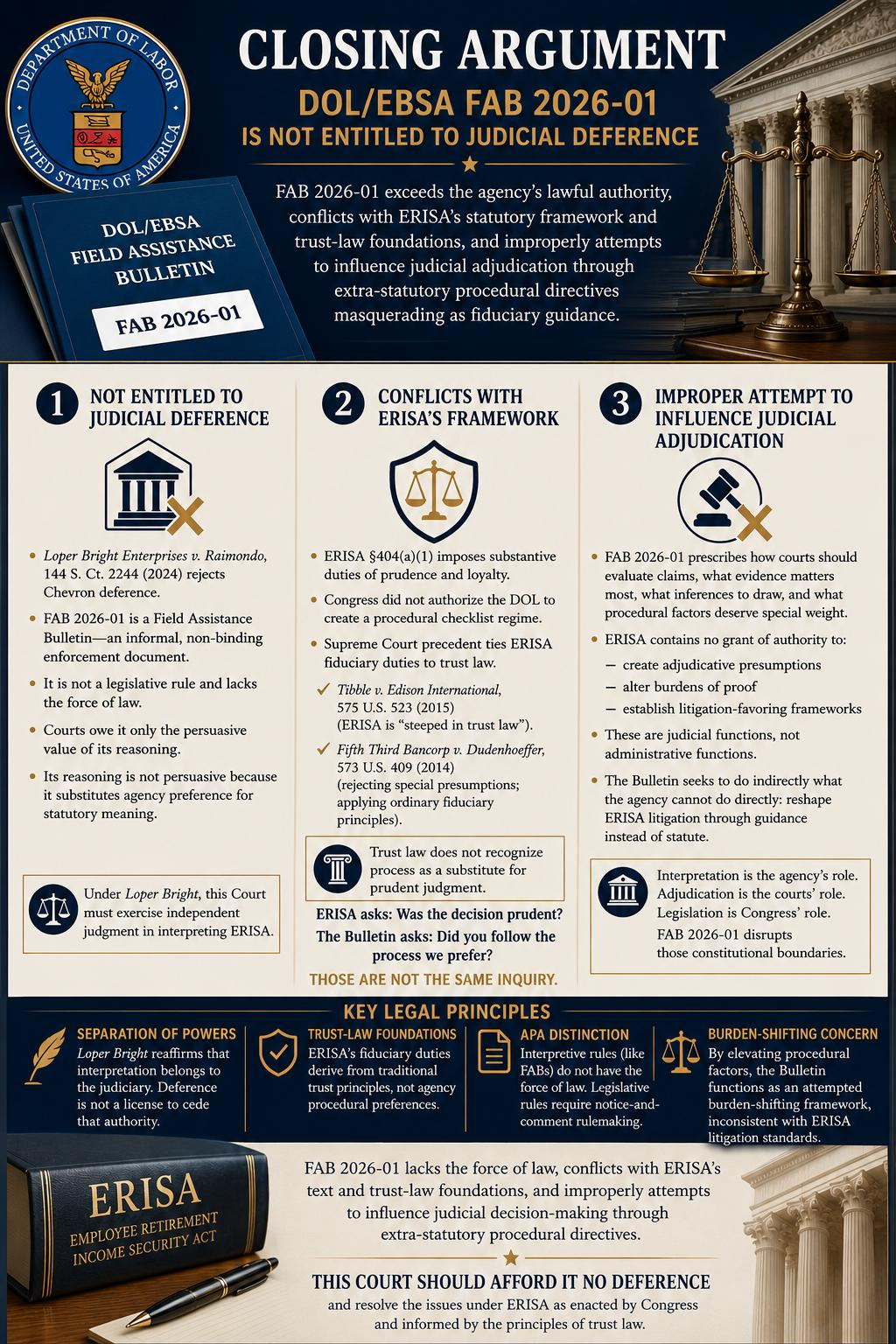
At its core, FAB 2026-01 is constructed upon a fundamentally misleading and legally unsupported premise: that fiduciary prudence under ERISA may be established—or defeated—solely through evidence of “procedural prudence,” divorced from substantive outcomes and objective economic reality. But that proposition is not the law. It has never been the law.
ERISA fiduciary jurisprudence has consistently recognized that prudence contains both procedural and substantive dimensions. Fiduciaries must employ a prudent process, but courts also examine whether that process produced decisions consistent with the interests of participants and beneficiaries. The statute itself imposes a duty to act “with the care, skill, prudence, and diligence” that a prudent fiduciary would exercise under like circumstances, which necessarily encompasses both method and result.2
The Supreme Court’s decisions in Fifth Third Bancorp v. Dudenhoeffer3 and Hughes v. Northwestern University4 do not reduce prudence to a procedural checklist. Nor did the Second Circuit in Donovan v. Bierwirth5 hold that fiduciaries may satisfy ERISA merely by documenting a process untethered from substantive participant welfare. To the contrary, Bierwirth emphasized that courts must determine whether fiduciaries acted with “complete and undivided loyalty” and with the care of prudent persons managing another’s property—not whether fiduciaries merely generated paperwork sufficient to survive scrutiny.
The EBSA’s contrary theory is therefore not an interpretation of existing law; it is an attempt to rewrite it.
And the agency’s effort is especially problematic because the Bulletin repeatedly invokes “clearly established case law” while simultaneously advancing propositions that no federal appellate court has actually endorsed. The internal contradiction is glaring. The agency cannot claim fidelity to settled precedent while constructing an enforcement framework around a theory that lacks meaningful judicial support.
Indeed, FAB 2026-01s analytical architecture appears substantially derived from advocacy-oriented commentary advanced in blog posts and litigation-position papers associated with Mr. Aronowitz and his former fiduciary insurance firm, rather than from neutral judicial precedent. Yet the Bulletin presents these contested advocacy positions as though they represent settled federal law. That omission is material. Agencies are not free to launder private litigation theories into quasi-regulatory authority while obscuring the advocacy origins of those theories.
Even more troubling is FAB 2026-01’s overt attempt to invade the exclusive province of the judiciary and to circumvent the Federal Rules of Civil Procedure.
FAB 2601-01 repeatedly frames ERISA litigation through the lens of “frivolous litigation” and advocates for heightened barriers to discovery and pleading standards designed to terminate cases before factual development may occur. But those matters are governed by the Federal Rules of Civil Procedure and by Article III courts—not by administrative preference.
Neither the DOL nor the the EBSA possesses authority to create a shadow procedural regime for ERISA cases.
Whether a complaint survives dismissal is governed by Rules 8, 12, and the controlling precedents interpreting those rules. Whether discovery is appropriate is governed by Rules 26 through 37 and by judicial supervision. The Executive branch cannot, through interpretive bulletins, predetermine merits outcomes by restricting litigants’ access to discovery or by imposing extra-statutory evidentiary burdens before plaintiffs have any opportunity to obtain fiduciary records uniquely within defendants’ possession.
That concern is particularly acute in ERISA litigation, where the relevant information regarding fiduciary deliberations, fee negotiations, benchmarking practices, revenue sharing, and investment monitoring is almost always controlled exclusively by defendants.
FAB 2026-01 thus attempts to accomplish indirectly what the agency could never accomplish directly: judicial merits adjudication without judicial process.
And respected jurists across the ideological spectrum have already warned against precisely this kind of procedural distortion.
Justice Ketanji Brown Jackson has repeatedly cautioned against converting pleading standards into premature merits determinations that deny plaintiffs meaningful access to adjudication. Sixth Circui Judge Jeffrey Sutton has similarly emphasized that federal courts must not impose heightened procedural barriers untethered from the Federal Rules themselves. And Judge Sidney H. Stein has recognized the importance of factual development in complex ERISA fiduciary litigation, particularly where fiduciary decision-making cannot be fairly evaluated absent discovery.
FAB 2026-01 disregards those warnings entirely, furher evidencing the EBSA’s pattern of willful blindness in order to promote and protect the interests of plan sponsors and the indsurance industry, rather then follow ERISA’s mandate and to protect and protect the best interests of plan participants and their beneficiaries
Under Loper Bright Enterprises v. Raimondo5, courts must exercise independent judgment when determining the meaning of statutes. Agencies are entitled at most to persuasive respect proportional to the quality of their reasoning. But reasoning built upon selective precedent, litigation-driven advocacy theories, and procedural overreach is not persuasive. It is arbitrary.
The courts therefore owe FAB 2026-01 no deference.
Not Chevron6 deference, because Chevron is gone.
Not Skidmore7 respect, because FAB 2026-01 lacks the “power to persuade.”
And certainly not controlling weight where the agency’s interpretation conflicts with statutory text, trust-law principles, governing precedent, and the constitutional separation of powers.
ERISA was enacted to protect plan participants and beneficiaries—not to insulate fiduciaries from judicial scrutiny through administrative shortcuts. The Federal Rules of Civil Procedure exist to ensure that cases are decided on evidence, not ideology. And Article III reserves adjudication to courts, not agencies seeking to influence litigation outcomes through informal pronouncements masquerading as settled law.
For those reasons, the legal system should reject FAB 2026-01’s suggestion that the proposal is subject to any legal deference and should reaffirm that fiduciary prudence under ERISA remains a judicial question governed by statute, precedent, and the ordinary processes of adjudication—not by agency efforts to predetermine outcomes through extra-statutory administrative advocacy.
The ongoing campaign of betrayal of plan participants and their beneficiaries by both the DOL and the EBSA in order to promote the best interests of both plan sponsors and the insurance induastty must stop in order to preserve ERISA’s integrity and the as well as the statute’s original principles and goals.
Notes
1. Loper Bright Enterprises v. Raimondo, 603 U.S. 661 (2024). (Loper Bright)
2. 29 U.S.C. § 1104(a)(1)(B).
3. Fifth Third Bancorp v. Dudenhoeffer, 573 U.S. 409 (2014).
4. Hughes v. Northwestern University, 595 U.S.170 (2022).
5. Donovan v Bierwirth, 680 F.2d 263.
5. Loper Bright, supra.
6. Chevron U.S.A. v. Natural Resources Defense Council, Inc.,467 U.S. 837 (1984).
7. kidmpore v. Swift& Co., 323 U.S. 134 (1944).
© Copyright 2026 InvestSense, LLC. All rights reserved.
This article is for informational purposes only and is neither designed nor intended to provide legal, investment, or other professional advice since such advice always requires consideration of individual circumstances. If legal, investment, or other professional assistance is needed, the services of an attorney or other qulified professional advisor should be sought.


You must be logged in to post a comment.