3 Key Questions for Plan Sponsors on Annuities, “Guaranteed Income,” and Fiduciary Liability Under ERISA – 2025

By James W. Watkins, III, J.D., CFP Board Emeritus™, AWMA®

Seems that social media and trade publications are focused on the issue of “guaranteed lifetime income” options within ERISA plans, with various studies indicating that plan participants would be interested in a source of guaranteed income during retirement. That response should not come as a surprise to anyone.

Would the results be different if the question was framed differently by adding material information. Framing refers to presenting situations in such a way as to influence an individual’s response by appealing to the individual’s cognitive biases. A primary example is to present a scenario where one response will result in gain, while the other response will result in a loss.

So, presenting a poll or the results of a study which indicates that retirees would be interested in a source of guaranteed lifetime income during retirement, or at any time for that matter, is hardly earth shattering. However, what would be the likely results if we frame the same question slightly differently to disclose additional requirements and/or disadvantages, such as the following:

Would you be interested in a product that can guarantee you income for life? The only requirement would be that to receive the lifetime stream of income, you will have to surrender both control of the product and the accumulated value within the product to the company offering the product, with no guarantee of receiving a commensurate return in exchange for such concessions, as well as agreeing that the company offering the product or other third parties, not your heirs, will receive any residual value in your account when you die.

I have never had one person respond positively to my version of the “guaranteed lifetime income”/annuity sales pit.ch During my compliance days, my brokers became very familiar with my mantra – “all God’s children do not need an annuity.” A well-known saying within the annuity industry is that “annuities are sold, not bought.” Plan sponsors should remember that saying and the reasoning behind it.

Annuity advocates will often point out that annuities often offer so-called “riders” that do guarantee a return of the annuity owner’s principal to the annuity owner’s heirs…for an additional price. With annual fees within an annuity often running two percent or more, the additional fee for “riders” serves to further reduce an annuity owner’s end-return.

As both the Department of Labor and the federal General Accountability Office have pointed out, each additional one percent in fees and expenses in a product reduces an investor’s end-return by approximately 17 percent over a twenty-year period.1 Riders often cost an additional one percent or more of the annuity’s accumulated value. When combined with an annuity’s other annual costs, it is easy to see how over half of an annuity owner’s end-return can be lost in an annuity’s annual fees (3 times 17).

Annuities, Plan Sponsors, and the Fiduciary Liability Gauntlet
A CEO invited me to lunch recently to discuss the potential liability issues of offering annuities within his company’s 401(k) plan. Before lunch was over, two other executives sitting nearby came by our table and asked me to call them to discuss the issue.

Full disclosure – I do not like annuities. Never have, never will. My strong dislike of annuities is due primarily to my experience with the annuity industry during my time as a plaintiff’s attorney . I was involved in litigating some medical malpractice and wrongful death cases. When a personal injury case potentially involves significant monetary damages, the defendant’s insurer typically suggests a structured settlement involving an annuity.

As a plaintiff’s attorney, if the defense offers to settle for a million dollars, the plaintiff’s attorney has to ensure that the plaintiff is actually going to receive a settlement with a present value of a million dollars. Failure to do so will typically result in a malpractice claim against the attorney.

The courts have consistently held that the present value of a settlement involving an annuity is the actual purchase price of the annuity, the out-of-pocket costs the insurance company will incur in purchasing the annuity being considered. However, many insurance companies refuse to disclose the actual purchase price of the annuity since it is typically well below the agreed upon settlement price, ensuring a windfall for the annuity issuer. Fortunately, the plaintiff can avoid such dishonesty by asking the court to approve of the creation of a “qualified settlement fund, ” (QSF) into which the settlement proceeds are paid so that the plaintiff can purchase an annuity at a fair price and avoid full and immediate taxation of the settlement proceeds.

I see a similar situation potentially developing in the annuity industry’s current campaign to offer more annuity products within pension plans. As a fiduciary risk management counsel, my job is to explain the potential fiduciary liability pitfalls to plan sponsors in order to avoid unnecessary liability exposure. In my presentations, I currently focus on four areas: (1) a plan sponsor’s duty to personally investigate and evaluate each investment option within a plan, (2) ERISA Section 404(c)’s “adequate information to make an informed decision” requirement, (3) a plan sponsor’s fiduciary duty, which includes a duty to disclose all material information to plan participants, and (4) a plan sponsor’s fiduciary prudence duties under ERISA Section 404(a).

ERISA Section 404(a)’s “Knew or Should Have Known” Standard
Section 404(a) sets out a plan sponsor’s fiduciary duty of prudence:

a fiduciary shall discharge his duties with respect to a plan …with the care, skill, prudence, and diligence under the circumstances then prevailing that a prudent man acting in a like capacity and familiar with such matters would use in the conduct of an enterprise of a like character and with like aims;…2

In determining whether a trustee has breached his duties, the court examines both the merits of the challenged transaction(s) and the thoroughness of the fiduciary’s investigation into the merits of the transaction(s).3

A fiduciary’s independent investigation of the merits of a particular investment is at the heart of the prudent person standard. (citing Donovan v. Cunningham, 716 F.2d 1455, 1467 (5th Cir. 1983); Donovan v. Bierwirth, 538 F.Supp. 463, 470 (E.D.N.Y.1981). The determination of whether an investment was objectively imprudent is made on the basis of what the trustee knew or should have known; and the latter necessarily involves consideration of what facts would have come to his/her attention had he/she fully complied with their duty to investigate and evaluate all plan investment options. It is the imprudent investment rather than the failure to investigate and evaluate that is the basis of suit; breach of the latter duty is merely evidence bearing upon breach of the former, tending to show that the trustee should have known more than he knew.# (emphasis added)4

While courts recognize, even encourage, the use of third parties in the fiduciary’s investigation and evaluation process, the courts have consistently warned that plan sponsors and other plan fiduciaries may not blindly rely on such experts, especially “experts” that are commission salespersons.

Blind reliance on a broker whole livelihood was derived from the commissions he was able to garner is the antithesis [of a fiduciary’s duty to conduct an] independent investigation”5

“The failure to make an independent investigation and evaluation of a potential plan investment is a breach of fiduciary duty.”6

Sponsors must conduct a thorough and objective investigation and evaluation in selecting investment products for a plan. Fiduciary prudence focuses on the process used by a plan sponsor in investigating and evaluating the investment products chosen for a plan, not the eventual performance of the product. In assessing the process used by a plan sponsor, the court evaluate prudence in terms of both procedural and substantive prudence.

Procedural prudence focuses on whether the fiduciary utilized appropriate methods to investigate and evaluate the merits of a particular investment. Substantive prudence focuses on whether the fiduciary took the information from the investigation and made the same decision that a prudent fiduciary would have made.

The Tatum v. RJR Pension Inv. Committee decision7 provides an excellent analysis of various types of fiduciary prudence – objective prudence, procedural prudence, and subjective prudence. It also involves the analysis of an annuity, although in a defined benefit plan context.

The court first addressed the concept of “objective prudence, stating that

A decision is objectively prudent is a hypothetical prudent fiduciary would have the same decision.8 (emphasis added)

I have deliberately added emphasis to the word “would,” as it was a pivotal issue in the court’s decision. The plan sponsor had argued, and the lower court had accepted their argument, that it was sufficient to show that a hypothetical prudent fiduciary “could” have made the same decision.

The Fourth Circuit Court of Appeals rejected that argument, stating that the chosen word with regard to the applicable fiduciary prudence standard was more than just a matter of semantics.

ERISA requires fiduciaries to employ “appropriate methods to investigate the merits of the investment and to structure the investment” as well as to “engage in a reasoned decision-making process, consistent with that of a `prudent man acting in [a] like capacity.'”9

In other words, although the duty of procedural prudence requires more than “a pure heart and an empty head,” courts have readily determined that fiduciaries who act reasonably — i.e., who appropriately investigate the merits of an investment decision prior to acting — easily clear this bar.10

[I]n matters of causation, when a beneficiary has succeeded in proving that the trustee has committed a breach of trust and that a related loss has occurred, the burden shifts to the trustee to prove that the loss would have occurred in the absence of the breach.” (citing Restatement (Third) of Trusts § 100, cmt. f (2012))11

As the Supreme Court has explained, the distinction between “would” and “could” is both real and legally significant….[C]ould” describes what is merely possible, while “would” describes what is probable.12

The “would have” standard is, of course, more difficult for a defendant-fiduciary to satisfy. And that is the intended result. “Courts do not take kindly to arguments by fiduciaries who have breached their obligations that, if they had not done this, everything would have been the same.” …We would diminish ERISA’s enforcement provision to an empty shell if we permitted a breaching fiduciary to escape liability by showing nothing more than the mere possibility that a prudent fiduciary “could have” made the same decision.13 (cites omitted

The court then went on to address the issue of objective and substantive prudence:

a decision is “objectively prudent” if “a hypothetical prudent fiduciary would have made the same decision anyway.”14 (emphasis added)

As mentioned earlier, substantive prudence focuses on the plan sponsor’s consideration of the facts uncovered in its investigations and whether the plan sponsor properly factored in such information and made a legally proper decision.

Other courts have identified key factors that plan sponsors must address in considering annuities.

A fiduciary must consider any potential conflict of interest, such as a potential reversion of plan assets, and structure its investigation accordingly.15

Just as with experts’ advice, blind reliance on credit or other ratings is inconsistent with fiduciary standards.16 

With regard to the potential reversion of plan assets involving annuities or the receipt of same by third parties, such as other annuity owners of the insurance comapny, I would (and have) argued that the fact that reversion to the annuity issuer is especially egregious and constitutes a breach of a plan sponsor’s fiduciary duties of both loyalty and prudence based upon the fact that such a reversion would constitute a windfall for the annuity issuer or a related party, the annuity issuer’s other annuity owners, at the annuity owner’s expense. Equity law is a component of fiduciary law, and “equity abhors a windfall.”

The court concluded by emphasizing that the controlling criteria was whether an annuity under consideration was in the best interest of the plan participants and their beneficiaries. The question will be whether plan sponsors can obtain the necessary information to independently evaluate and verify the accuracy of such information, as well as the ability to interpret the implications of the annuity information they can uncover.

For example, will plan sponsors be able to determine whether plan participants will even be able to breakeven on a particular annuity, especially if the annuity issuer retains the right to reset the terms? Will plan sponsors be able to understand the difference between an ordinary annuity and an annuity due and provide plan participants with the information on the financial implications of each, e.g., breakeven analysis?

ERISA’s “Adequate Information to Make an Informed Decision” Requirement
Plan sponsors typically try to qualify as a 404(c) plan in order to receive immunity from liability for the ultimate performance of the plan participants’ investment choices. Qualification for such protection requires compliance with approximately twenty requirements. As a result, many plan sponsors mistakenly believe they are in compliance with 404(c) when they actually are not.

An “ERISA section 404(c) Plan” is an individual account plan described in section 3(34) of the Act that:

(i) Provides an opportunity for a participant or beneficiary to exercise control over assets in his individual account (see paragraph (b)(2) of this section); and

(ii) Provides a participant or beneficiary an opportunity to choose, from a broad range of investment alternatives, the manner in which some or all of the assets in his account are invested (see paragraph (b)(3) of this section).

(2) Opportunity to exercise control.

(i) a plan provides a participant or beneficiary an opportunity to exercise control over assets in his account only if:

(B) The participant or beneficiary is provided or has the opportunity to obtain sufficient information to make informed investment decisions with regard to investment alternatives available under the plan, and incidents of ownership appurtenant to such investments. For purposes of this paragraph, a participant or beneficiary will be considered to have sufficient information if the participant or beneficiary is provided by an identified plan fiduciary (or a person or persons designated by the plan fiduciary to act on his behalf)…17

As pointed out earlier, the financial services industry, in particular the insurance/annuity industry, are not known for their support of transparency and/or full disclosure. Transparency and full disclosure are the financial services kryptonite. Anytime there is any mention of a true fiduciary standard for the industry, the industry’s lobbyists grab their checkbooks and head toward Capitol Hill, as the financial services industry knows that few, if any, of its products would comply with a true fiduciary standard. They just hope that plan sponsors and consumers never realize that fact.

Annuities present a number of challenges for plan sponsors hoping to qualify for 404(c) protections. Annuities are extremely complex, and deliberately so. There is a saying within the annuity industry, “annuities are sold, not bought.” Anyone who truly understands guaranteed lifetime income annuities would never consider buying one, especially when viable, cost-efficient alternatives are readily available that do not require the investment owner to agree to the unnecessarily harsh terms required by annuity companies.

Annuities have been described as a bond wrapped in an expensive insurance wrapper. The primary issue with commercial annuities is the associated costs, both in terms of monetary costs and opportunity costs in terms of other financial goals, such as estate planning. Annuity advocates will often turn to their “guaranteed income for life” and “no loss” mantras. Annuity opponents will counter with their “at what cost” mantra and the viable cost-efficient alternatives available. Financial service publications have run articles explaining how financial advisers can even help their customers create viable, cost-efficient annuity substitutes.

With annual fees/spreads often in the range of two percent or more, plan sponsors should remember the findings of both the Department of Labor and the General Accountability Office that each additional one percent in fees reduces an investor’s end-return by approximately seventeen percent over a twenty-year period.18 Add a rider charging an additional annual fee of one percent and the investor now faces a reduction of over half of their end-return (3 times 17). Hard to see how a plan sponsor can explain the prudence of including annuities reducing end-returns by one-third to one-half, or more, over more cost-efficient, investor friendly alternatives.

There is no requirement that a 401(k) plan qualify as a 404(c) plan. However, the inability to qualify as a 404(c) plan potentially raises a number of fiduciary prudence and loyalty questions. Given the annuity industry’s unwillingness to provide material information about their products, how can a plan sponsor perform the legally required independent and objective investigation and evaluation required by ERISA? Likewise, how will a plan sponsor provide the ongoing monitoring of each annuity and annuity related product offered within a plan?

If a plan offers annuities which allow the annuity provider to reset or otherwise change the terms of the annuity to protect and benefit the annuity issuer, what are the options and potential consequences for both plan participants and plan sponsors? An even more basic question for plan sponsons is how do they determine whether sufficient information has been, and will continue to be, provided. Remember, plan sponsors that chose to blindly rely on third party information face an unforgiving legal system. These are just some samples of legal liability issues that plan sponsors should consider before choosing to include annuity options within a 403(k) or 403(b) plan. Unfortunately, annuity advisers generally try to avoid addressing such potential legal liability issues. “Not our job” and “we are not acting as fiduciaries” is their common response.

Annuities and ERISA Requirements
ERISA does not expressly require plan sponsors to offer annuities, in any form, within a 401(k) or 403(b) plan. It’s just that simple.

In fact, ERISA does not expressly require a plan to offer any specific type of investment product. ERISA 404(a) only requires that each investment option within a plan be prudent. SCOTUS resolved that issue in the Hughes v. Northwestern University19 case.

So, the obvious question is why, given the various hurdles and the potential fiduciary liability traps inherent with annuities, would a plan sponsor voluntarily expose themselves to unnecessary fiduciary liability exposure? After all, a plan participant wanting to purchase an annuity could easily do so outside of the plan, without creating any potential liability issues for the plan sponsor.

Plan sponsors often try to justify the inclusion of an otherwise legally imprudent investment option based upon a desire to provide plan participants with “choices.” A legally imprudent investment option never has been, and never will be, a legally valid investment “choice.” The fact that a plan sponsor would even include a legally imprudent investment, e.g., a cost-inefficient actively managed mutual fund, simply serves as a red flag for regulators with regard to the overall prudence of the plan’s selection process.

The good news is that it is relatively simple to design and maintain an cost-effective and ERISA compliant 401(k) or 403(b) plan. The bad news is that far too few plan sponsors do so.

Going Forward

[A] fiduciary satisfies ERISA’s obligations if, based upon what it learns in its investigation, it selects an annuity provider it “reasonably concludes best to promote the interests of [the plan’s] participants and beneficiaries.”20

Based on the information presented herein and a plan sponsor’s fiduciary duties of prudence and loyalty, key questions in future 401(k)/403(b) litigation involving the inclusion of annuities and/or annuity related products in plans could/should include

(1) Would a prudent plan sponsor decide to include an annuity as an investment option within a plan when that annuity requires the annuity owner to surrender both the investment contract and the accumulated value within the annuity without any guarantee of a commensurate return?

(2) Would a prudent plan sponsor decide to include an annuity as an investment option within a plan when the terms of the annuity contract legitimately raises questions as to the odds of the annuity owner ever breaking even and, if so, how long it would take?

(3) Would a prudent plan sponsor decide to include an annuity as an investment option within a plan if the annuity issuer reserves the right to reset the terms and guarantees within the annuity and impact the results of questions (1) and (2).

(4) Would a prudent plan sponsor decide to include an annuity as an investment option within a plan if the fees were so excessive as to potentially reduce an annuity owner’s end-return by one-third or more?

(5) Under the SECURE Act, plans sponsors are protected from liability in the event that annuities offered within their plan are unable to honor their financial commitments under their contracts. Yet, plan participants who purchase such annuities within a plan are not protected against loss in such circumstances. Given the obvious inequity in the event of such a situation, where plan sponsors are protected but plan participants are not, would the courts consider your decision to offer such annuities in your plan to be a breach of your fiduciary duties of prudence and/or loyalty?

If, as many ERISA attorneys expect, SCOTUS rules that the burden of proof as to causation shifts to the plan sponsor once the plan participants prove a fiduciary breach and resulting loss, these are questions that plan sponsors are going to be forced to face in future 401(k)/403(b) litigation. The answers, and resulting liability, would appear to be readily apparent.

While most people would agree that the concept of “guaranteed lifetime income” is highly desirable, from a legal and fiduciary liability perspective, the concept always needs to be balanced and conditioned on the question of “at what cost?” As mentioned earlier, in this case, “costs” that would need to be considered are not only financial costs, but also opportunity costs, such as the impact on estate planning and other types of financial planning.

Many would argue that the various costs and concessions associated with annuities, in any form, are simply not worth the “costs,” especially when other equally effective and more cost-efficient alternatives and strategies are available, such as dividends and bonds, e.g., Treasury and corporate, and laddering such bonds. Corporate trust departments often rely on the dividends on utility stocks for guaranteed income. Trusts departments and some fiduciaries have been known to create their own annuities using a combination of bonds, life insurance, and index mutual funds.

I am on record as predicting that the defined contribution arena is going to undergo a significant change in the next 12-18 months, especially in the area of litigation, as a result of the pending decisions in the Cunningham v. Cornell University and the Retirement Security Rule cases. A key question in both cases is which party carries the burden of proof on the issue of causation in defined contribution litigation.

I believe that both cases will result in the burden of proof on the issue of causation in 401(k) /403(b) litigation being shifted to the plans since they alone have access to all of the relevant information. As a result, I believe that there will be a significant increase in the number of cases litigated, both between plans/plan participants and plans/plan advisers, due largely to the fact that most plans cannot and will not be able to successfully meet the burden of proving that their investment selections did not play a role in causing losses sustained by plan participants.

As I explain to my fiduciary risk management clients, there are some well-recognized fiduciary standards that should be followed in evaluating and selecting investments offering guaranteed income. Exposing a plan to unnecessary fiduciary liability exposure is one of those standards, with my corollary for fiduciaries is simply “annuities – Not legally required, so why go there? Don’t go there.”

Previous posts on the unnecessary liability exposure that annuities create for defined contribution plans can be found here, here, and here

Notes
1. Pension and Welfare Benefits Administration, “Study of 401(k) Plan Fees and Expenses,” (“DOL Study) http://www.DepartmentofLabor.gov/ebsa/pdf; “Private Pensions: Changes needed to Provide 401(k) Plan Participants and the Department of Labor Better Information on Fees,” (GAO Study”).
2. 29 C.F.R. § 2550.404(a)-1; 29 U.S.C. § 1104(a).
3. The failure to make any independent investigation and evaluation of a potential plan investment is a breach of fiduciary obligations. Fink v. National Savs. & Trust Co., 772 F.2d 951, 957 (D.C. Cir. 1985) (Fink), In re Enron Corp. Securities, Derivative “ERISA“, 284 F.Supp.2d 511, 549-550, Donovan v. Cunningham, 716 F.2d at 1467.52
4. Fink, 962. (Scalia dissent)
5. Liss v. Smith, 991 F. Supp. 278, 299.
6. United States v. Mason Tenders Dist. Council of Greater NY,, 909 F. Supp 882, 887 (S.D.N.Y. 1995)
7. Tatum v. RJR Pension Inv. Committee, 761 F.3d 346 (4th Cir. 2014). (Tatum).
8. Tatum, 363.
9. Tatum, 358.
10. Tatum, 363.
11. Bussian v. RJR Nabisco, Inc., 223 F.2d 286, 300 (5th Cir. 2000). (Bussian)
12. Tatum, 365.
13. Tatum, 365.
14. Tatum, 363; Bussian, 300 (5th Cir. 2000).
15. Bussian, 300.
16. Bussian, 301.
17. 29 C.F.R. § 2550.404(c); 29 U.S.C. § 1104(c).
18. Pension and Welfare Benefits Administration, “Study of 401(k) Plan Fees and Expenses,” (DOL Study) http://www.DepartmentofLabor.gov/ebsa/pdf; “Private Pensions: Changes needed to Provide 401(k) Plan Participants and the Department of Labor Better Information on Fees,” (GAO Study).
19. Hughes v. Northwestern University, 142 S. Ct. 737, 211 L. Ed. 2d 558 (2022
20. DOL Interpretitive Bulletin 95-1.

Resources
Collins, P.J., Lam, H., & Stampfi, J. (2009) “Equity indexed annuities: Downside protection, but at what cost?” Journal of Financial Planning, 22, 48-57.

FINRA Investor Insights (2022) “The Complicated Risks and Rewards of Indexed Annuties”  The Complicated Risks and Rewards of Indexed Annuities | FINRA.org

FINRA Investor Alert (2003) “Variable Annuities: Beyond the Hard Sell”

Frank, L., Mitchell, J. & Pfau, W. “Lifetime Expected Income Breakeven Comparison Between SPIAs and Managed Portfolios,” Journal of Financial Planning, April 2014, 38-47. 

Katt, P. (November 2006) “The Good, Bad, and Ugly of Annuities,” AAII Journal, 34-39.

Lewis, W. Chris. 2005. “A Return-Risk Evaluation of an Indexed Annuity Investment.” Journal of Wealth Management 7, 4.

McCann, C. & Luo, D. (2006). “An Overview of Equity-Indexed Annuities.” Working Paper, Securities Litigation and Consulting Group.

Milevsky, M. & Posner, S. “The Titanic Option: Valuation of the Guaranteed Minimum Death Benefit in Variable Annuities and Mutual Funds,” Journal of Risk and Insurance, Vol. 68, No. 1 (2009), 91-126.

Olson, J. “Index Annuities: Looking Under the Hood.” Journal of Financial Services Professionals. 65-73 (November 2017),

Reichenstein, W. “Financial analysis of equity-indexed annuities.” Financial Services Review, 18 (2009) 291-311.

Reichenstein, W. (2011), “Can annuities offer competitive returns?” Journal of Financial Planning, 24, 36.

Securities and Exchange Commission. (2008) “Investor Alerts and Bulletins: Indexed Annuties,”SEC.gov | Updated Investor Bulletin: Indexed Annuities

Sharpe, W.F. (1991) “The arithmetic of active management,” Financial Analysts Journal, 47, 7-9.

Terry, A. & Elder, E. (2015) “A further examination of equity-indexed annuities,” 24, 411-428.

Copyright InvestSense, LLC 2023, 2025. All rights reserved.

This article is for informational purposes only, and is neither designed nor intended to provide personal legal, investment, or other professional advice since such advice always requires consideration of individual circumstances.  If legal, investment, or other professional assistance is needed, the services of an attorney or other professional advisor should be sought.

Posted in 401k, 401k compliance, 401k investments, 401k plan design, 401k plans, 401k risk management, 403b, 404c, 404c compliance, AMVR, Annuities, best interest, compliance, consumer protection, cost consciousness, cost efficient, cost-efficiency, ERISA, ERISA litigation, fiduciary, fiduciary compliance, fiduciary duty, fiduciary law, fiduciary liability, fiduciary liability, Fiduciary prudence, fiduciary prudence, fiduciary responsibility, fiduciary risk management, fiduciary standard, investments, pension plans, plan sponsors, prudence, retirement plans, risk management, wealth management, wealth preservation | Tagged , , , , , , , , , , , , , , , , , , , | Leave a comment

2Q 2023 “Cheat Sheets”: Plan Sponsors’ IDK/FOFO Strategy and the Future of Fiduciary Liability and Litigation

By James W. Watkins, III, J.D., CFP Board Emeritus™, AWMA®

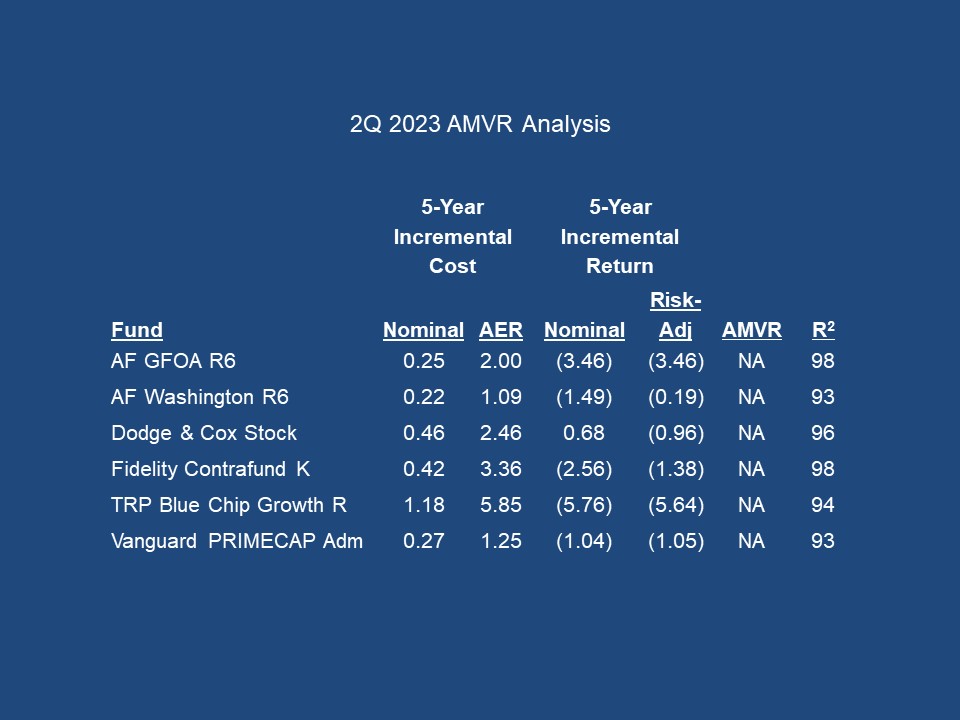
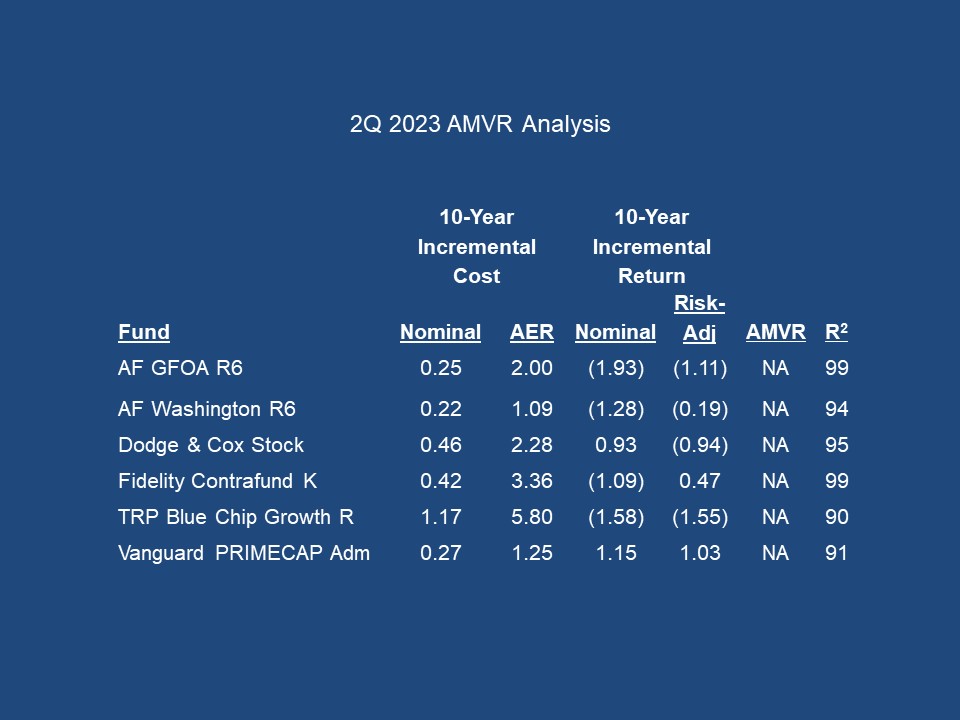
An analysis of the 2Q “cheat sheets” can be summed up quite simply – “the song remains the same.” None of the six funds qualified for an AMVR score based on either the 5 or 10-year analysis, meaning that the funds proved to be cost-inefficient, and thus legally imprudent, under the standards established by the Restatement (Third) of Trusts (Restatement). Readers are reminded that InvestSense bases its AMVR analysis of actively managed funds on incremental risk-adjusted returns and incremental correlation-adjusted costs, as explained later herein

For new followers, the “cheat sheets” provide a 5 and 10-year cost-efficiency analysis of the non-index funds in the ten most commonly used funds in U.S. defined contribution plans, based on “Pensions & Investments” annual poll. But this trend has even more relevance given the amicus brief that the Department of Labor (DOL) filed in the Home Depot 401(k) case currently pending in the 11th Circuit Court of Appeals. As the DOL pointed out in the amicus brief, the message within the brief was intended for the 10th Circuit as well, as they consider the same question in the Matney case.

First, a few of the pertinent quotes from the amicus brief.

ERISA is silent on who bears the burden of proving loss causation in fiduciary breach cases.1

As the Supreme Court and this Court have recognized, where ERISA is silent, principles of trust law—from which ERISA is derived—should guide the development of federal common law under ERISA. Trust law provides that once a beneficiary establishes a fiduciary breach and a related loss, the burden on causation shifts to the fiduciary to show that the loss was not caused by the breach.2

This burden-shifting framework reflects the trust law principle that “as between innocent beneficiaries and a defaulting fiduciary, the latter should bear the risk of uncertainty as to the consequences of its breach of duty.”

Trust law requires breaching fiduciaries to bear the risk of proving loss causation because fiduciaries 14 often possess superior knowledge to plan participants and beneficiaries as to how their plans are run. (citing Restatement (Third) of Trusts § 100 cmt. f)4

In short, [a plan sponsor] has to prove “that a prudent fiduciary would have made the same decision.”5 (emphasis added)

At this point, the DOL made an interesting observation, citing the Second Circuit’s Sacerdote v. New York University decision, in particular the Court’s observation that

If a plaintiff succeeds in showing that “no prudent fiduciary” would have taken the challenged action, they have conclusively established loss causation, and there is no burden left to “shift” to the fiduciary defendant.6

Proving Fiduciary Breach and Loss
The DOL’s amicus brief relied heavily on the common law of trusts. This is appropriate given the fact that the courts have consistently noted that ERISA is essentially the codification of the common law of trusts. The Restatement is just that, a restatement of the common law of trusts, which is why SCOTUS recognized the Restatement as a valid resource in resolving fiduciary disputes.

Two dominant themes throughout ERISA are cost-consciousness/cost-efficiency and diversification. In my role as a fiduciary risk management counsel, I focus on three key Restatement provisions addressing cost-consciousness:

So, with these three principles in mind, how do plaintiffs establish both the plan sponsor’s breach of their fiduciary duties and the resulting loss?

Actively managed mutual funds still dominate most 401(k) and 403(b) plans. A couple of years ago, I created a simple metric, the Active Management Value RatioTM (AMVR). The AMVR allows plans sponsors and other fiduciaries, as well as investors and attorneys, to quickly and easily assess the prudence of an actively managed funds against a comparable index fund.

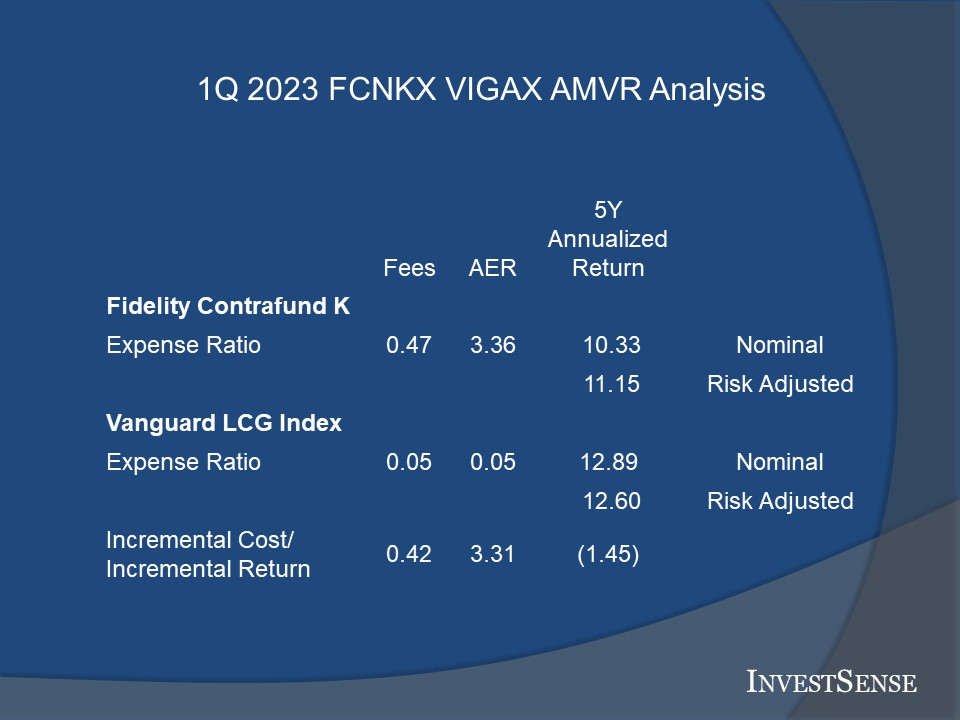
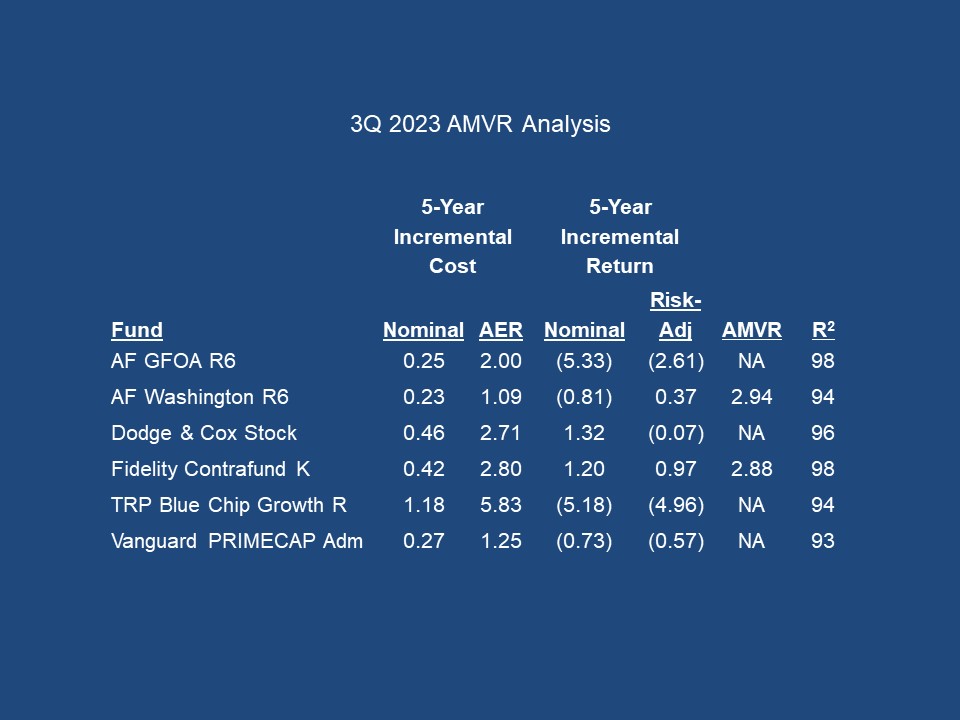
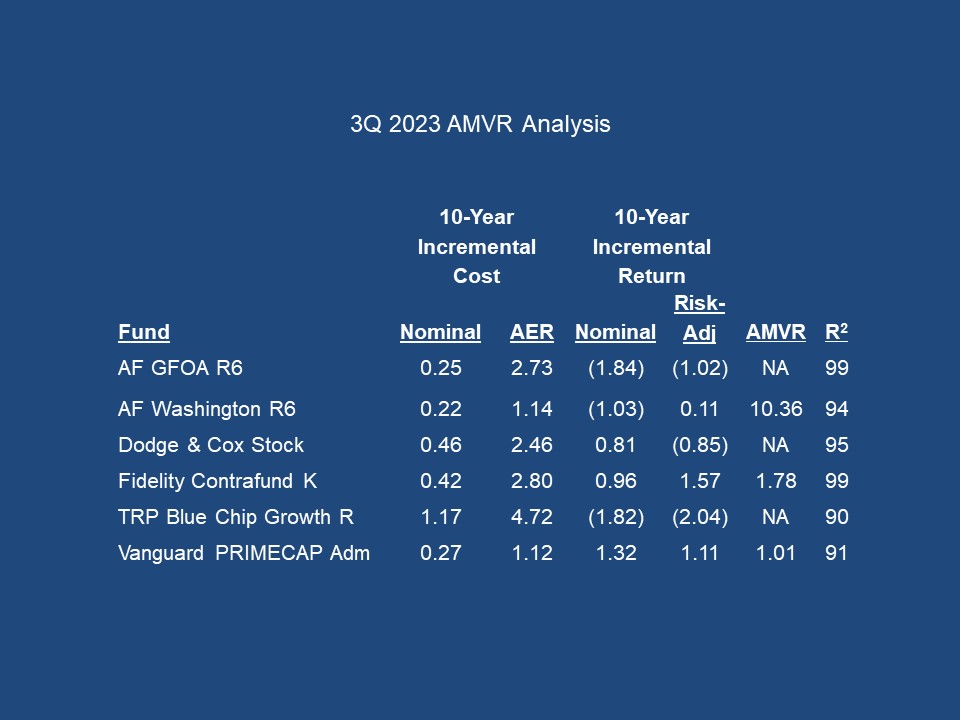
One of the most common actively managed funds in 401(k) and 403(b) plans is Fidelity’s Contrafund Fund, K shares (FCNKX). A five-year and a ten-year AMVR analysis of FCNKX is shown below.

An actively managed fund’s AMVR score is calculated by dividing the fund’s incremental correlation-adjusted costs by its incremental risk-adjusted return. The costs and return calculations are based on comparisons to a comparable index fund.

The AMVR slides shown above also show how the prudence/imprudence of an actively managed fund can quickly be determined by just answering two questions:

(1) Does the actively managed mutual fund provide a positive incremental return relative to the benchmark being used?
(2) If so, does the actively managed fund’s positive incremental return exceed the fund’s incremental costs relative to the benchmark?

If the answer to either of these questions is “no,” the actively managed fund is both cost-inefficient and imprudent according to the Restatement’s prudence standards and should be avoided. The goal for an actively managed fund is an AMVR number greater than “0” (indicating that the fund did provide a positive incremental return), but equal or less than “1” (indicating that the fund’s incremental costs did not exceed the fund’s incremental return).

Assuming that the burden of proof on causation is shifted to the plan sponsor, what is the likelihood that the plan sponsor could successfully carry such burden, could prove “that a prudent fiduciary would have made the same decision?”7

In the five-year analysis, FCNKX failed to even produce a positive incremental risk-adjusted return. Strike One.

If you treat the underperformance (-1.45) as an opportunity cost and combine it with the incremental nominal cost (0.42), the projected loss in end-return over a twenty-year period would be approximately 32 percent. The projected loss would be even greater, approximately 81 percent, if a more realistic cost analysis was conducted using the Active Expense Ratio. Strike Two.

One often overlooked benefit of the AMVR is that it indicates the premium that a cost-inefficient investment extracts from an investor. In this case, the AMVR indicates that an investor would be paying a premium of 331 basis points…while receiving nothing in return. Strike Three.

In the ten-year analysis, FCNKX did provide a slight positive incremental return (0.31). However, the fund was still cost-inefficient, as it did not manage to cover the fund’s incremental costs (0.42), resulting in a net loss for an investor. As the comment to Section Seven of the Uniform Prudent Investors Act states, “wasting beneficiaries, money is imprudent.”8

The 10-year AMVR analysis of FCNKX provides further evidence of why fiduciaries should always calculate a fund’s incremental costs using Miller’s Active Expense Ratio, as it factors in the correlation of returns between two investments to provide a more realistic evaluation of an investment’s value-added benefit, or lack thereof. In this case, the AER calculates that FCNKX is providing approximately 12.50 percent of active management. Factoring in the implicit AER expense ratio (3.36) would result in an investor suffering a projected loss of approximately 56 percent in their end-return over a twenty-year period.

In this case, since the fund did produce a positive risk-adjusted return, we can calculate an AMVR score using the Vanguard Large Cap Growth Index fund as a benchmark. FCNKX’s high r-squared/correlation of return (98) results in an AMVR score of (10.67) (3.31/0.31), indicating that an investor would be paying a premium of over 900 percent ((10.67-1) x 100).

It is hard to see how a plan sponsor, if confronted with such evidence, could carry the burden of proving that their choice of FCNKX as a plan investment was not imprudent. In fact, as pointed out earlier, the Second Circuit Court of Appeals has suggested as much.

The Active Expense Ratio
People frequently ask me why I use the Active Expense Ratio in the AMVR. Their question basically asks why plan sponsors, trustees, RIAs and other fiduciaries never mention the AER if it is so meaingful and important.

The answer is simply that the combination of the AMVR and the AER provide a level of analysis that frequently exposes the imprudence of a recommended investment in comparison to other available alternatives. Transparency is the financial and insurance industries’ kryptonite. Prove it to yourself by asking them to provide you with an AMVR exactly as shown herein.

I had one follower do just that. He reported that the plan adviser came back with a modified version of the AMVR which he claimed were “improvements.” The follower spotted the attempt to conceal the imprudence of the adviser’s recommendations. A framed copy of the follower’s polite note sits proudly on my desk.

Ross Miller, the creator of the Active Expense Ratio metric, summed up the value of the AER as follows:

Mutual funds appear to provide investment services for relatively low fees because they bundle passive and active funds management together in a way that understates the true cost of active management. In particular, funds engaging in ‘closet’ or ‘shadow’ indexing charge their investors for active management while providing them with little more than an indexed investment. Even the average mutual fund, which ostensibly provides only active management, will have over 90% of the variance in its returns explained by its benchmark index.9

By separating the relative costs of passive management and investment management, then calculating the amount of active management contributed by the actively managed fund, a fiduciary can derive the implicit cost of the active management provided by the actively managed fund. The higher an actively managed fund’s r-squared/correlation of returns to a comparable index fund and/or the higher the active fund’s incremental cost relative to the comparable index fund, the higher the actively managed fund’s AMVR score, cost-inefficiency, and legal imprudence. This is just the type of transparency the investment and insurance industries try to avoid, as they consistently oppose any type of true fiduciary standard requiring full and honest disclosure in making investment recommendations.

Going Forward
Being a pack rat has its benefits. In researching my files for this post, I ran across this valuable reminder from a TIAA-CREF publication entitled “Assessing Reasonableness of 403(b) Retirement Plan Fees”:

Plan sponsors are required to look beyond fees and determine whether the plan is receiving value for the fees paid.

Based on my experience, the AMVR suggests that the overwhelming majority of 401(k) and 403(b) plans and plan participants are not receiving value when compared to available investment alternatives, true alternatives under an open architecture platform. Plan sponsors can, and should, perform an objective fiduciary prudence audit using both the AMVR and the AER.

This is especially true since there are currently two cases pending in the federal appellate court that essentially address the

Whether, in an action for fiduciary breach under [ERISA], once the
plaintiff establishes a breach and a related plan loss, the burden
shifts to the fiduciary to prove that the loss is not attributable
to the fiduciary’s breach.10

As the DOL’s amicus brief mentions, the common law of trusts supports the position that the burden of proof on causation properly belongs to the plan sponsor/fiduciary. The majority of the federal Circuit Courts of Appeals agree, as does the Solicitor General of the United States. SCOTUS has already recognized that the Restatement is a respected resource that the courts often look to in resolving fiduciary issues.

Therefore, one can legitimately argue that very soon the courts will be required to shift the burden of proof on causation to plan sponsor once the plan participants establish the breach and resulting loss. The evidence presented herein suggests that that will be a burden many plan sponsors are unable to fulfill.

Enjoy the 4th!

Notes
1. Department of Labor amicus brief in Pizarro v. Home Depot, Inc., No. 22-13643 (11th Cir. 2022) (Amicus Brief), 10. https://www.dol.gov/sites/dolgov/files/SOL/briefs/2023/HomeDepot_2023-02-10.pdf
2. Amicus Brief, 10.
3. Amicus Brief, 13.
4. Amicus Brief, 14.
5. Amicus Brief, 24.
6. Amicus Brief, 26.
7. Amicus Brief, 24.
8. Uniform Prudent Investor Act (UPIA), Section 7 (Introduction).
9. Ross Miller, “Evaluating the True Cost of Active Management by Mutual Funds,” Journal of Investment Management, Vol. 5, No. 1, 29-49 (2007) https://papers.ssrn.com/sol3/papers.cfm?abstract_id=746926.
10. Amicus Brief, 2.

Copyright InvestSense, LLC 2023. All rights reserved.

This article is for informational purposes only, and is neither designed nor intended to provide legal, investment, or other professional advice since such advice always requires consideration of individual circumstances.  If legal, investment, or other professional assistance is needed, the services of an attorney or other professional advisor should be sought.

Posted in 401k, 401k compliance, 401k investments, 401k plan design, 401k risk management, 403b, Active Management Value Ratio, AMVR, compliance, consumer protection, cost consciousness, cost efficient, cost-efficiency, ERISA, ERISA litigation, fiduciary, fiduciary compliance, fiduciary duty, fiduciary law, fiduciary liability, fiduciary liability, Fiduciary prudence, fiduciary prudence, fiduciary responsibility, fiduciary risk management, investment advisers, investments, Mutual funds, pension plans, plan advisers, plan sponsors, prudence, retirement plans, risk management, wealth management, wealth preservation | Tagged , , , , , , , , , , , , , , , , | Leave a comment

Is the Exxon Model the Future of ERISA Fiduciary Prudence?

By James W. Watkins, III, J.D., CFP Board Emeritus™, AWMA®

“Living is easy with eyes closed
Misunderstanding all you see…”

“Strawberry Fields Forever” – The Beatles

In my role as a fiduciary risk management counsel, I constantly see plan sponsors and other investment fiduciaries exposing themselves to unnecessary liability exposure simply because they do not truly understand what their fiduciary duties. A perfect example is the current situation with the annuity industry promoting, in some cases reportedly misleading plan sponsors, on the inclusion of annuities in 401(k) and 403(b) plans.

ERISA does not require a plan to offer annuities within a 401(k) or 493(b) plan. In fact, Section 404 of ERISA does not expressly require a plan to offer any specific type of investment option. Section 404 simply requires each investment option offered within a plan to be prudent.

(a) Prudent man standard of care

(1) [A] fiduciary shall discharge his duties with respect to a plan solely in the interest of the participants and beneficiaries and—
(A) for the exclusive purpose of:
(i) providing benefits to participants and their beneficiaries; and
(ii) defraying reasonable expenses of administering the plan;
(B) with the care, skill, prudence, and diligence under the circumstances then prevailing that a prudent man acting in a like capacity and familiar with such matters would use in the conduct of an enterprise of a like character and with like aims;

Some of my clients report that some annuity advocates have stated that plan sponsors have a moral duty to offer annuities within a plan. Simply not true.

I am on record as saying that I believe that the next 12-18 months is going to dramatic changes in the area of 401(k) and 403(b) litigation, with increased litigation between plan sponsors plan participants, well as between plan sponsors and plan advisers. The first signs appeared in connection with the First Circuit Court of Appeals’ Brotherston case1, in the form of both the decision itself and the Solicitor General’s amicus brief2 that was filed with SCOTUS when Putnam Investments asked the Court to review the case.

I have written several lengthy posts analyzing both the decision and the Solicitor General’s amicus brief. In short, both the First Circuit and the Solicitor General agreed that (1) the burden of proof as to the causation of losses in 401(k) litigation belongs to the plan sponsor, not the plan participants, and (2) that index funds and market indices can be used as comparators in 401(k) litigation in computing losses/damages sustained by plan participants.

The Department of Labor (DOL) recently filed an amicus brief in a pending 401(k) case.3 Citing the common law of trusts, the DOL agreed with both the First Circuit and the Solicitor General as to which party bears the burden of proof on the issue of causation in 401(k) litigation. The DOL further argued that that position is currently the prevailing opinion in the majority of the federal circuits.. The DOL’s position could play a significant role in deciding both the Home Depot and the Matney cases, both of which are currently pending in federal courts.

ERISA Plaintiff’s Exhibit A
As I tell all my fiduciary risk management clients and ERISA plaintiff attorneys, the key to fiduciary prudence is to focus on cost-efficiency, not on the active/passive debate. A friend and colleague of mine, Preston McSwain of Fiduciary Wealth Partner, recently sent me a link to a YouTube video that he thought I would find interesting, The video, “Greenwich Roundtable-Pure Passive: Risks and Rewards,” features the former CIO of Exxon’s $30 billion defined benefit plan. He explains how and why the plan switched to an all-index funds approach and how it benefitted both the company and the plan participants.

A couple of years ago, I created a simple metric, the Active Management Value RatioTM (AMVR). The AMVR allows fiduciaries, investors, and attorneys to quickly and easily evaluate the cost-efficiency of an actively managed fund. The AMVR is based on the research of well-respected investment experts such as Nobel laureate Dr. William F. Sharpe, Charles D. Ellis, Burton G. Malkiel, and Ross Miller.

The video provides further evidence of the importance of cost-efficiency in satisfying a plan sponsor’s fiduciary duty of prudence and how easy it is to achieve using only index funds. The AMVR makes it even easier for plan sponsors to comply with their fiduciary duty of prudence, as explained here and here.

Going Forward
With the DOL’s recent amicus brief, I firmly believe that the question as to the burden of proof on the issue of causation of losses shifting to plan sponsors is not a question of “if,” but rather “when.” I believe that SCOTUS will eventually be called on to decide on one consistent standard on the issue so that the rights and protections guaranteed under ERISA will be uniformly applied in the legal system. At that point, it will be extremely difficult for plan sponsors to justify the use of cost-inefficient actively managed funds.

As Judge Kayatta noted in the Brotherston decision, plan sponsors should choose index funds if they wish to avoid unnecessary liability exposure, he was simply telling the truth. Judge Kayatta’s position has been consistently supported by studies on the cost-efficiency of actively managed funds, studies with findings such as

99% of actively managed funds do not beat their index fund alternatives over the long term net of fees.4  

Increasing numbers of clients will realize that in toe-to-toe competition versus near–equal competitors, most active managers will not and cannot recover the costs and fees they charge.5

[T]here is strong evidence that the vast majority of active managers are unable to produce excess returns that cover their costs.6

[T]he investment costs of expense ratios, transaction costs and load fees all have a direct, negative impact on performance….[The study’s findings] suggest that mutual funds, on average, do not recoup their investment costs through higher returns.7

Judge Kayatta’s position is further supported by John Langbein, who served as the Reporter on the committee that wrote the Restatement (Second) of Trusts over fifty years ago. Shortly after the release of the revised Restatement, Langbein wrote a law review article on the new Restatement. At the end of the article, he made a bold prediction:

When market index funds have become available in sufficient variety and their experience bears out their prospects, courts may one day conclude that it is imprudent for trustees to fail to use such accounts. Their advantages seem decisive: at any given risk/return level, diversification is maximized and investment costs minimized. A trustee who declines to procure such advantage for the beneficiaries of his trust may in the future find his conduct difficult to justify.  

I would suggest that that time is here and that the Greenwich Roundtable video shows how and why index funds will be the applicable standard for prudent plan sponsors and other investment fiduciaries. The question right now for plan sponsors and other investment fiduciaries is whether they will be able to carry the burden of proof as to causation of damages, whether they will be able to prove that their choices did not cause any losses suffered by a plan’s participants. The prudent plan sponsor will promptly audit their plans using the AMVR to determine the extent of any potential liability – and whether Exxon’s all-index fund strategy should be considered.

Notes
1. Brotherston v. Putnam Investments, LLC, 907 F.3d 17 (2018) (Brotherston)
2. https://www.justice.gov/osg/brief/putnam-invs-llc-v-brotherston
3. https://www.dol.gov/sites/dolgov/files/SOL/briefs/2023/HomeDepot_2023-02-10.pdf
4. Laurent Barras, Olivier Scaillet and Russ Wermers, False Discoveries in Mutual Fund Performance: Measuring Luck in Estimated Alphas, 65 J. FINANCE 179, 181 (2010).
5. Charles D. Ellis, The Death of Active Investing, Financial Times, January 20, 2017, available online at https://www.ft.com/content/6b2d5490-d9bb-11e6-944b-eb37a6aa8e. 
6. Philip Meyer-Braun, Mutual Fund Performance Through a Five-Factor Lens, Dimensional Fund Advisors, L.P., August 2016.
7. Mark Carhart, On Persistence in Mutual Fund Performance,  52 J. FINANCE, 52, 57-8 (1997).
8. John H. Langbein and Richard A. Posner, Measuring the True Cost of Active Management by Mutual Funds, Journal of Investment Management, Vol 5, No. 1, First Quarter 2007 http://digitalcommons.law.yale.edu/fss_papers/498

Copyright InvestSense, LLC 2023. All rights reserved.

This article is for informational purposes only, and is neither designed nor intended to provide legal, investment, or other professional advice since such advice always requires consideration of individual circumstances.  If legal, investment, or other professional assistance is needed, the services of an attorney or other professional advisor should be sought.
Posted in 401k, 401k compliance, 401k investments, 401k plan design, 401k risk management, 403b, Active Management Value Ratio, AMVR, compliance, consumer protection, cost consciousness, cost efficient, cost-efficiency, ERISA, ERISA litigation, evidence based investing, fiduciary, fiduciary compliance, fiduciary duty, fiduciary law, fiduciary liability, fiduciary liability, Fiduciary prudence, fiduciary prudence, fiduciary responsibility, fiduciary risk management, fiduciary standard, investment advisers, investments, Mutual funds, pension plans, plan advisers, plan sponsors, prudence, retirement plans, risk management, SCOTUS, Supreme Court | Tagged , , , , , , , , , , , , , , , , , , | Leave a comment

Interpreting the DOL’s Amicus Brief and its Potential Impact on the Future of 401(k) Litigation

By James W. Watkins, III, J.D., CFP Board Emeritus™, AWMA®

Whenever I meet with a prospective new client, I first explain InvestSense’s “401(k) Fiduciary Prudence Circle,” (FP Circle), one of the cornerstones of our “Fiduciary InvestSense™” process. ERISA and the courts analyze a fiduciary’s decisions in terms of the process used by a plan sponsor in selecting investment options for a plan, not in terms of the ultimate performance of the investment options chosen. The combination of the FP Circle and the Active Management Value Ratio™ (AMVR) provide evidence of both the use of a meaningful process and the compliance of same with applicable legal standards.

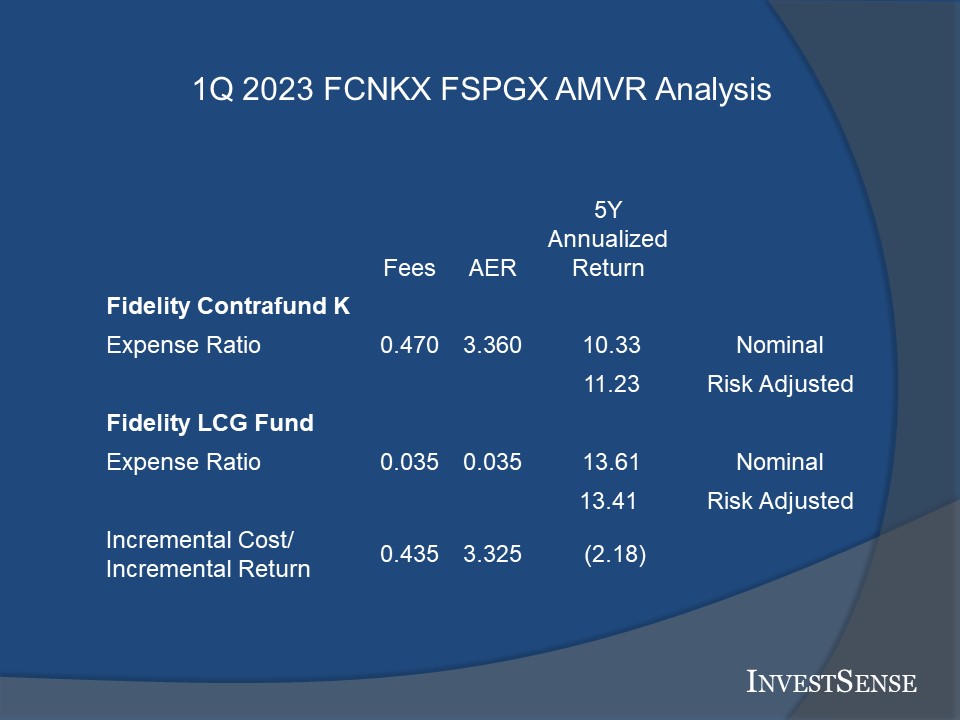
We also educate the prospective client on some 401(k)/403(b) fiduciary risk management issues that other consultants usually do not cover. The two AMVR slides below illustrate one of our presentations involving Fidelity Contrafund, a fund found in many defined contribution plans.

The first slide is an AMVR analysis comparing Fidelity Contafund K shares (FCNKX) and the Fidelity Large Cap Growth Fund (FSPGX). Designed to compete with comparable Vanguard funds, FSPGX has done so, both in terms of returns and overall cost efficiency. The issue for plan sponsors is that FSPGX has outperformed FCNKX as well.  FSPGX is clearly a more cost-efficient investment option for fiduciaries than FCNKX.

The problem is that Fidelity does not make FSPGX available to defined contribution plans. As a result, plans seemingly settle for FCNKX, despite the obvious fiduciary liability issues due to FCNKX’s comparative cost-inefficiency when compared to other available investment options.

The slide below is an AMVR analysis comparing Fidelity Contafund K shares (FCNKX) and Vanguard’s Large Cap Growth Index Fund Admiral shares (VIGAX). Plans often use Vanguard’s Admiral shares and institutional shares interchangeably given their similarities in terms of cost and performance.

One again, just as with FSPGX, FCNKX proves to be cost-efficient relative to VIGAX. The cost-inefficiency of FCNKX become even worse when Miller’s Active Expense Ratio is used instead of FCNKX’s nominal cost numbers, as shown in the “AER” column.

The need for plans to address these fiduciary prudence and cost-inefficiency issues has become even more important in light of a recent amicus brief filed by the DOL (DOL brief) addressing the issue of which party has the burden of proof with regard to the issue of causation of damages in 401(k)/403(b) litigation. While there is a split within the federal courts on this issue, the DOL’s brief provides a persuasive argument that the burden of proof belongs to plan sponsors, not plan participants.

One of the most persuasive arguments made in support of this position, both in terms of courts decisions and the DOL’s brief, has been that since the legal focus is necessarily on the process used by a plan in making decisions on the plan’s investment options, such information is exclusively within the possession of the plan. This is why the law has consistently stated that plaintiffs are not required to plead a party’s mental processes or state of mind and why the law allows circumstantial evidence to establish same.

Plan sponsors should take note of and review their plans in light of two statements in the DOL’s brief concerning causation of damages:

In short, [a plan sponsor] would have to prove ‘that a prudent fiduciary would have made the same decision.’

If a plaintiff succeeds in showing that ‘no prudent fiduciary’ would have taken the challenged action, they have conclusively established loss causation, and there is no burden left to ‘shift’ to the fiduciary defendant.

As the AMVR slides herein demonstrate, the AMVR can be easily used to establish the relative cost-inefficiency, and, thus, the relative imprudence of an actively managed mutual fund. As a result, if, as expected, SCOTUS eventually rules that the burden of proof on the issue of causation does “shift” to the plan sponsor, that burden might prove to be a very difficult burden to satisfy in many cases.

For further information on the AMVR, click here.

Posted in 401k, 401k compliance, 401k investments, 401k plan design, 401k risk management, 403b, Active Management Value Ratio, AMVR, compliance, consumer protection, cost consciousness, cost efficient, cost-efficiency, Cost_Efficiency, ERISA, ERISA litigation, evidence based investing, fiduciary, fiduciary compliance, fiduciary duty, fiduciary law, fiduciary liability, fiduciary liability, Fiduciary prudence, fiduciary prudence, fiduciary responsibility, fiduciary risk management, fiduciary standard, investments, Mutual funds, pension plans, plan sponsors, prudence, retirement plans, risk management, SCOTUS, wealth management, wealth preservation | Tagged , , , , , , , , , , , , , , , , , , | Leave a comment

Fiduciary InvestSense™: Annuities, Plan Sponsors, and Fiduciary Law

By James W. Watkins, III, J.D., CFP Board Emeritus™, AWMA®

As an attorney and a fiduciary risk management consultant, my job is to protect plan sponsors, trustees, and other investment fiduciaries against unnecessary fiduciary liability…and themselves. Far too often, I find that 401(k) and 403(b) plan sponsors are their own worst enemy. As that great philosopher, Pogo, once said, “we have met the enemy, and he is us.”

I have spent the last 27+ years involved in some way or the other with fiduciary law. The one constant has been the evidence that plan sponsors and other investment fiduciaries do not truly understand what their fiduciary responsibilities do, and do not, require them to do.

As a result, I am often contacted by fiduciaries with questions about fiduciary law, including requests for information on how to extricate themselves from a fiduciary-related legal predicament. As I tell my fiduciary risk management clients, the best strategy for avoiding risk is to avoid it altogether whenever possible. And that is the situation that many plan sponsors are facing with regard to deciding whether to include annuities in their 401(k) and 403(b) plans.

The two fiduciary duties most often cited in 401(k) and 403(b) litigation are the duties of prudence and loyalty

We have explained that the fiduciary duties enumerated in § 404(a)(1) have three components. The first element is a “duty of loyalty” pursuant to which “all decisions regarding an ERISA plan `must be made with an eye single to the interests of the participants and beneficiaries.’” Second, ERISA imposes a “prudent man” obligation, which is “an unwavering duty” to act both “as a prudent person would act in a similar situation” and “with single-minded devotion” to those same plan participants and beneficiaries.1

Finally, an ERISA fiduciary must “`act for the exclusive purpose‘” of providing benefits to plan beneficiaries.2 (emphasis added)

I believe in the KISS philosophy – Keep It Simple & Smart. To that end, I have a simple process that I recommend that plan sponsors use to resolve such matters. I suggest that they ask themselves these two questions:

1. Does ERISA or any other law expressly require that the investment be included in the plan?

2. Would/Could inclusion of the investment in the plan potentially expose the plan and plan sponsor to unnecessary fiduciary liability exposure?

Smart, enlightened plan sponsors will continue to refuse to offer annuities, in any form, within their plans. Why?

  • With regard to annuities and the first question, neither ERISA nor any other law expressly requires plan sponsors to offer annuities or any other any specific type of investment product within a plan.
  • With regard to the second question, neither ERISA nor any other law requires plan sponsors to voluntarily expose themselves to unnecessary fiduciary risk liability. Annuities present genuine fiduciary liability issues, despite the annuity industry’s ongoing refusal to acknowledge and address such issues.

Whenever there is any talk about the enactment of a true fiduciary standard to cover the financial services industry, the industry immediately threatens legal action to block such legislation, with the usual claim of seeking preservation of choice for plan participants. Advocates for a meaningful fiduciary standard typically counter by pointing out that (1) legally imprudent investment products do not constitute a meaningful “choice” for plan participants, and (2) the “choice” argument is, in reality, an attempt to cover up the fact that there are genuine questions as to whether annuities could ever qualify as a prudent investment under a true fiduciary standard. As discussed herein, the evidence suggests that due to the way that they are presently structured, few, if any, annuities could meet a true fiduciary standard

SECURE 2.0 created a “safe-harbor” from liability for plan sponsors who chose to include annuities within their plan, only to have the annuity issuer default on the payments required under the annuity. SECURE 2.0 failed to provide similar protections for plan participants who suffer losses in such circumstances.

The pro-annuity provisions of SECURE 2.0 remind me of the court’s words in Hirshberg & Norris v. SEC, where the court rejected the defendant’s suggestion that the securities laws were intended to protect the investment industry, the court stating that

[t]o accept it would be to adopt the fallacious theory that Congress enacted existing securities legislation for the protection of the broker-dealer rather than for the protection of the public. On the contrary, it has long been recognized by the federal courts that the investing and usually naive public need special protection in this specialized field.3

Replace the reference to “securities” with “ERISA” and “broker-dealers” with “annuity industry” and I believe the court’s words are equally applicable to the current situation facing plan sponsors, as annuity salesmen try to convince them to include annuities in their plans.

The annuity industry continually bemoans the fact that they cannot get more plan sponsors, and investment fiduciaries in general, to offer annuities. I talk to plan sponsors on a regular basis and the story on their reluctance to offer annuities is generally some variation of the following:

  • Distrust of the annuity industry due to (1) the perceived lack of full and meaningful disclosure, and (2) the refusal of the annuity industry to acknowledge and address the genuine fiduciary liability issues that plan sponsors face due to design and overall complexity issues with annuities.
  • The impact of the costs and fees typically associated with annuities, resulting in a potential breach of a plan sponsor’s duty of prudence. While annuity advocates often play a game of semantics, stating that annuities doe do charge “fees,” the reality is that annuities often have significant “costs” which are “hidden” in an annuity’s “spread.” Furthermore, such spreads, often 1-2 percent, or more, are taken prior to the annuity issuer calculating the amount of interest to be credited to the annuity owner, raising genuine potential fiduciary breach issues for plan sponsors including them in a plan.
  • The difficulty and/or inability of plan sponsors to perform the legally independent investigation and evaluation of a product required by ERISA. The courts have warned plan sponsors that reliance on commissioned salespeople for advice is not legally reasonable or justifiable due to the inherent conflicts of interest in such situations.
  • The frequent inclusion of certain complicated and confusing provisions within annuity contracts that protect the annuity issuer’s interests at the expense of an annuity owner’s expense, resulting in a breach of a plan sponsor’s duties of loyalty and prudence.
  • The frequent inclusion of certain provisions within annuity contracts that require the annuity owner to surrender ownership and control over both the annuity contract and the accumulated value of the contract, with no guarantee of a commensurate return for the plan participant, in order for the annuity owner to receive the “guaranteed income for life” benefit. This scenario could potentially result in a windfall for the annuity issuer at the plan participant’s expense, a clear breach of a plan sponsor’s duties of loyalty and prudence.

Chris Tobe, one of my fellow co-founders on “The CommonSense 401(k) Project” has written extensively on a number of factors that generally result in annuities being a liability trap for fiduciaries. Two of the primary factors Chris cites are the single entity credit risk and illiquidity issues associated with annuities. Chris has extensive experience in the design and analysis of annuities. Plan sponsors should read Chris’ excellent analyses.

A full and complete analysis of the analysis is beyond the scope of this post. At the end of thois post I have included a list of various studies and other resources that I recommend to all of my fiduciary risk management clients. I highly recommend that plan sponsors invest the time to read these resources in order to understand the potential liability “traps” inherent in annuities.

Indexed Annuities
There are several passages in particular that I feel summarize the key legal fiduciary liability issues thatt annuities present, passages that support the distrust issues that plan sponsors and other investment fiduciaries often mention to me. Equity-indexed annuities are currently a popular form of annuities. Dr. William Reichenstein is a well-respected expert in financial services. Dr. Reichenstein has authored several articles on the financial inefficiency of equity-indexed annuities. Among his findings and conclusions:

Indexed annuities (IA) including equity indexed annuities (EIAs) are complex investment contracts. (citing features such as surrender penalties; an annuity’s “spread;” arbitrary restrictions on returns that owners can actually achieve, e.g., caps and participation rates, and ability to reset same on a regular basis and on such terms at the annuity issuer desires; market value adjusted options penalizing an annuity owner who withdraws money from an annuity before term, various interest crediting methods and potential interest forfeiture rules e.g., annual reset, point-to-point, or high water point; potential interest forfeiture rules; the issue of averaging and they type of averaging used.4

More important, because of their design, index annuities must underperform returns on similar risk portfolios of Treasury’s and index funds. EIAs impose several risks that are not present in market-based investments including surrender fees and loss of return on funds withdrawn before the end of the term. This research suggests that salesmen have not satisfied and cannot satisfy SEC requirements that they perform due diligence to ensure that the indexed annuity provides competitive returns before selling them to any client.5

The interest credited on an EIA is based on the price index. So, the investor may get part of the price appreciation, but she does not receive any dividends associated with the underlying stock index. The return may be further reduced based on participation rate, spread, and cap rate. Moreover, the insurance firm almost always has the ability to adjust at its discretion the participation rate, spread, or cap rate at the beginning of each term.6

When annuity advocates questioned his findings, Reichenstein provided a follow-up paper responding to the advocates’ criticisms as follows:

I concluded that because of their structure “all indexed annuities must produce below-market, risk-adjusted returns.”7

As discussed by Reilly and Brown (2009, p. 549), to try to add value compared with a passive investment strategy, active managers use one of three generic themes: (1) market timing; (2) overweighing stocks by sectors/ industries, overweighing value or growth stocks, or overweighing stocks by size; and (3) through security selection. All attempts to beat a market index on a risk-adjusted basis use one or more of these three themes. By design, indexed annuities cannot add value with any of these themes.8

By design, (1) they do not attempt market timing, (2) they do not make sector/industry/ style/size bets, and (3) they do not try to add value through security selection. Furthermore, because hedging strategies usually require long and short positions in options contracts, the industry cannot argue that indexed annuity strategies beat the market because option values are consistently undervalued or overvalued. So, I concluded that the risk-adjusted returns on indexed annuities must trail the risk-adjusted returns available in marketable securities by the sum of their spread plus their transaction costs.9

In short, because of their design, indexed annuities cannot add value to offset their substantial embedded costs.10

In support of his argument, Reichenstein referenced a study by two-well respected members of the financial services community, Nobel laureates Eugene Fama and Kenneth French  Fama and French cited the research of Dr. William F. Sharpe and the arithmetic of equilibrium accounting, declaring that

To put this argument in the context of indexed annuities, we do not need empirical tests to ensure that IAs underperform their risk-adjusted benchmark portfolio’s returns. Because their structure prevents them from adding value compared to this benchmark return, they must underperform this benchmark return by the sum of their spread plus their transaction costs.11

McCann and Luo studied equity-indexed annuities and best summarized my opinion toward equity-indexed annuities in the context of fiduciary risk management:

[The] net result of equity-indexed annuities’ complex formulas and hidden costs is that they survive as the most confiscatory investments sold to retail investors.12

Terry and Elder analyzed Reichenstein’s research and offered the findings of their own research on equity-indexed annuities.

[Reichenstein’s] essential point is that indexed annuities are simply repackaging returns that are already available to investors in the market place without adding any potential security selection or market timing value. The cost of this repackaging is the ‘spread.’ In summary, the simple economics of [equity-indexed annuities] is that investors are paying 2-3% annually in investor spreads to receive returns similar to those already available in the market, trivial insurance benefits, and to receive a no loss guarantee.13

Insurance companies [typically reserve] the option of changing many of the {index annuity’s] contract features after the first year. In particular they change the participation rates, spreads, and cap rates to maintain their investment spreads.” In other words, annuity issuers reserve the right to reduce the annuity’s owner’s return in order to maintain their investment spread.14

The opportunity costs of investing in [indexed annuities] over long horizons compared with reasonable and implementable alternative strategies are quite high….{A]t a minimum, these opportunity costs should be disclosed to potential  investors at time of purchase.15

I believe the same sentiments are equally applicable to fiduciary responsibilities with regard to 401(k) and 403(b) plan and provide valuable risk management advice for plan sponsors with regard to equity-indexed annuities.

John Olson, a respected expert on annuities, provided an excellent summary on the key issues involving index annuities:

Owners of index annuities will almost never receive the full amount of gain that was realized by the index chosen. That is because there is rarely enough money left over after buying the bonds required to back the contractual guarantees to buy enough options on the index to get the full amount of any gain in that index. This is one reason why it is not true that an index annuity owner gets the upside of the market with no downside risk. At best, he or she will receive only a portion of index gain, both because the insurer could not buy enough option to get that full gain and because many index annuities limit the amount of index-linked interest that it will credit. (It does so because the specialized call options it purchases are themselves limited by a cap, allowing the insurer to purchase more upside potential than it could without such a cap.)16

Olson’s paper addresses several myth and misconception about index annuities, including Olson refuting the annuity industry’s popular “cannot lose money-no risk” claim.

It is possible–if one withdraws money from or cash (sic) in the contract during the surrender charge period. While some contracts have a genuine guarantee of principal (surrender charges my wipe out interest earned but not the money contributed in premiums) that preserves premium even in the early contract years, most do not. That said, negative performance in the chosen index or indices will not erode the contract’s cash value Thus, previously credited interest cannot be lost due to bad index performance.17

Remember the point regarding the plan sponsor’s fiduciary responsibilities on the ability to determine and analyze the interest crediting method utilized by a annuity issuer? As previously notes, the courts have warned plan sponsors that reliance on commissioned salespeople does meet the “reasonable reliance” requirement for hiring experts.

Variable Annuities
A second type of annuity sometimes appearing in 401(k) and 403(b) plans is variable annuities (VAs). I have previously written on both this blog and my “CommonSense InvestSense” blog about the potential liability issues involved with variable annuities. The “CommonSense InvestSense” blog is more directed toward on individual investors.

Over the ten-plus years that I have written the “CommonSense InvestSense” blog, one post in particular has generated the most responses, “Variable Annuities: Reading Between the Marketing Lines.” I continue to get people thanking me for an objective and plain-English explanation of an otherwise complex product. More rewarding was the fact that most people told me that the article persuaded them to avoid variable annuities altogether.

As with equity-indexed annuities, I believe that variable annuities are fiduciary liability “traps.” Interestingly enough, some insurance executives share the same concerns.

Again, a full and complete discussion and analysis is beyond the scope of this post. The purpose of this post is to hopefully raise awareness of genuine fiduciary liability issues inherent with annuities and the need for plan sponsors to consider such issues.

The three most concerning issues from a fiduciary liability standpoint are (1) the use of “inverse pricing” often used in calculating a VA’s annual M&E/death benefit fee, (2) the cost-inefficiency of many of the investment sub-accounts offered with the VA, and (3) the fact that equity-indexed annuities are typically structured in such a way as to promote a windfall for the annuity issuer at the annuity owner’s expense. This inequitable situation results when annuities condition the receipt of the alleged benefit, “guaranteed income for life,” on the annuity owner surrendering both the annuity contract and the accumulated value within the VA to the annuity issuer, with no guarantee that the annuity owner will receive a commensurate return.

I refer you to my “CommonSense InvestSense” blog post for a more complete analysis of the legal liability issues involved with VAs.

For this post, I just want to touch on three common sales pitches used in VA sales so that plan sponsors can recognize and avoid them.

1. Annuity owners do not pay a sales charge, so more of their money goes to work for them.

The statement that variable annuity owners pay no sales charges, while technically correct, is misleading. Variable annuity salespeople do receive a commission for each variable annuity they sell, such commission usually being a percentage of the total amount invested in the variable annuity.

While a purchaser of a variable annuity is not directly assessed a front-end sales charge or a brokerage commission, the variable annuity owner does reimburse the insurance company for the commission that was paid. The primary source of such reimbursement is through a variable annuity’s various fees and charges, particularly the M&E charge.

To ensure that the cost of commissions paid is recovered, the insurance company typically imposes surrender charges on a variable annuity owner who tries to cash out of the variable annuity before the expiration of a certain period of time. The terms of these surrender charges vary, but a typical surrender charge schedule might provide for an initial surrender charge for withdrawals during the first year, decreasing 1 percent each subsequent year thereafter until the surrender charges end. There are some surrender charge schedules that charge a flat rate over the entire surrender charge period.

2. The inherent value of the VA’s death benefit is highly questionable and often grossly excessive.

[T]he fee [for the death benefit] is included in the so-called Mortality and Expense (M&E) risk charge. The M&E risk charge is a perpetual fee that is deducted from the underlying assets in the VA, above and beyond any fund expenses that would normally be paid for the services of managed money.18

[T]he authors conclude that a simple return of premium death benefit is worth between one to ten basis points, depending on purchase age. In contrast to this number, the insurance industry is charging a median Mortality and Expense risk charge of 115 basis points, although the numbers do vary widely for different companies and policies.19

The authors conclude that a typical 50-year-old male (female) who purchases a variable annuity—with a simple return of premium guaranty—should be charged no more than 3.5 (2.0) basis points per year in exchange for this stochastic-maturity put option. In the event of a 5 percent rising-floor guaranty, the fair premium rises to 20 (11) basis points. However, Morningstar indicates that the insurance industry is charging a median M&E risk fee of 115 basis points per year, which is approximately five to ten times the most optimistic estimate of the economic value of the guaranty.20

Excessive and unnecessary costs violate the fiduciary duty of prudence. The value of a VA’s death benefit is even more questionable given the historic performance of the stock market. As a result, it is unlikely that a VA owner would ever need the death benefit. These two points have resulted in some critics of VAs to claim that a VA owner needs the death benefit like a duck needs a paddle.”

3. The “inverse pricing” method used by many VAs is inequitable.

VA advocates tout various benefits. Anyone considering a VA should also consider the question-“at what cost?” VAs often calculate a VA’s annual M&E charge/death benefit based on the accumulated value within the VA, even though contractually they typically limit their legal liability under the death benefit to the VA owner’s actual investment in the VA.

As a result, over time, it is reasonable to expect that the accumulated value within the VA will significantly exceed the VA owner’s actual investment in the VA. This method of calculating the annual M&E, known as “inverse pricing,” results in a VA issuer receiving a windfall equal to the difference in the fee collected and the VA issuer’s actual costs of covering their legal liability under the death benefit guarantee.

As mentioned earlier, fiduciary law is a combination of trust, agency, and equity law. A basic principle of equity law is that “equity abhors a windfall.” The fact that VA issuers knowingly use the inequitable inverse pricing method to benefit themselves at the VA owner’s expense results in a fiduciary breach for fiduciaries who recommend, sell or use VAs in their practices or in their pension plans.

The industry is well aware of this inequitable and counter-intuitive situation. John D. Johns, a CEO of an insurance company, addressed these issues in an article entitled “The Case for Change.”

Another issue is that the cost of these protection features is generally not based on the protection provided by the feature at any given time, but rather linked to the VA’s account value. This means the cost of the feature will increase along with the account value. So over time, as equities appreciate, these asset-based benefit charges may offer declining protection at an increasing cost. This inverse pricing phenomenon seems illogical, and arguably, benefit features structured in this fashion aren’t the most efficient way to provide desired protection to long-term VA holders. When measured in basis points, such fees may not seem to matter much. But over the long term, these charges may have a meaningful impact on an annuity’s performance.21

In other words, inverse pricing is always a breach of a fiduciary’s duties of both loyalty and prudence, as it results in a windfall for the annuity issuer at the annuity owner’s expense, a cost without any commensurate return, which also violates Section 205 of the Restatement of Contracts.

In other words, the use of inverse pricing is always a breach of a fiduciary’s duties of loyalty and prudence, as it results in a windfall for the annuity issuer at the annuity owner’s expense, a cost without a commensurate return, which also violates Section 205 of the Restatement of Contracts.

Going Forward
As shown herein, annuities have the ability to raise genuine fiduciary liability issues for plan sponsors. Those issues may become even more problematic for plan sponsors in the near future in connection with 401(k)/403(b) litigation. While some federal courts are already placing the burden of proof regarding causation of damages on plan sponsors, there is still a split in the federal courts.

There is currently a case, Matney v. Briggs Gold of North America22, which will seemingly force the legal system, most likely the Supreme Court, to establish one consistent standard for courta in 401(k)/403(b) actions. Given the fact that the First Circuit Court of Appeals and other federal circuits, the United States Solicitor General, and more recently the Department of Labor have expressed support for shifting said burden of proof to plan sponsors, the likelihood is that the Supreme Court would follow suit and rule in favor of such a policy, especially since it is consistent with the common law of trusts.

In talking with my clients about the issue of annuities in 401(k) and 403(b) plans, I ask them whether they will be able to carry the burden of proof as to causation, be able to calculate and verify the guaranteed benefits such as the interest crediting payments received within such annuities to ensure both the prudence of the products and that a plan participant’s ERISA rights are not being violated.

Similarly, will a plan sponsor be able to determine which index interest crediting model is in a plan participant’s best interests, e.g., one year annual reset, multiple year point to point, one-year monthly cap index, one-year averaged monthly? Will plan sponsors be able to determine whether the index used in such indexed annuities is legitimate and in the plan participants’ best interests? Suddenly, the simplicity of index funds is looking better and better.

Plan sponsors, and investment fiduciaries in general, need to understand the significant, and irreconcilable differences, between the insurance/ annuity industry model and the ERISA/fiduciary law model. The insurance/ annuity industry is all about managing the odds, managing risk in such a way to ensure that the odds are in their favor, that their best interests take precedence over those of their customers, that losses are offset by gains to ensure their overall profitability.

ERISA and fiduciary law is just the opposite, the focus being on equity, fundamental fairness, and certainty, always acting in such a way that the plan participant’s best interests are best served. With fiduciary law, the fiduciary gets one chance to “get it right,” there are no “mulligans” or do-overs. Furthermore, the recent SCOTU’ and Seventh Circuit Hughes23 decisions clearly establish that the concept of offsets is not recognized under ERISA/fiduciary law.

One can legitimately argue that the basic concept and structure of an annuity is the anti-thesis of fiduciary law and equitable principles. Conditioning an annuity owner’s receipt of the advertised benefits of “guaranteed income for life,” with “no investment losses,” upon the annuity owner’s surrendering both the control and ownership of both the annuity contract and the accumulated value within the annuity, without any guarantee of receiving a commensurate return, is not only fundamentally unfair and inequitable, but clearly inconsistent with both the fiduciary duty of prudence and loyalty, as it increases the odds of a windfall in favor of the annuity issuer at the annuity owner’s expense. “Equity abhors a windfall is a basic tenet of equity law, which is basic component of fiduciary law.

The typical response of annuity advocates to such criticism-that annuity owners can purchase a rider to ensure the return of their principal-does not satisfy such fiduciary law and liability concerns and only serves to further reduce the annuity’s owner’s effective end-return. Both the Department of Labor and the General Accountability Office have noted that each additional 1 percent in fees/costs reduces an investor’s end-return by approximately 17 percent over a 20-year period.24

There is a familiar expression in the investment and annuity industries-“sell the sizzle, not the steak.” That describes the marketing strategy typically used by the annuity industry, with the “guaranteed income for life” and “no risk” spiels being the “sizzle.” The inequities aspects of annuties discussed herein, inequities designed to serve the best interests of the annuity issuer, not the annuity owner, are obviously the “steak.”

Fiduciary investment risk management 101-Keep It Simple & Smart. Once again, the best strategy for avoiding unnecessary fiduciary investment risk is to avoid it altogether whenever possible. Neither ERISA nor any other law expressly requires plan sponsors to offer annuities within a 401(k) or 403(b) plan. Plan participants desiring to purchase an annuity are free to do so outside the plan, without exposing the plan sponsor to any unnecessary fiduciary liability risk.

Notes
1. Gregg v. Transportation Workers of Am. Intern, 343 F.3d 833, 841-842 (6th Cir. 2003). (Gregg)
2. Gregg, 841-842.
3. 117 F.2d 228, 233 (1949).
4. Reichenstein, W. (2009) Financial analysis of equity indexed annuities. Financial Services Review, 18, 291-311, 291 (Reichenstein I)
5. Reichenstein I, 291.
6. Reichenstein I, 298.
7. Reichenstein, W. (2011) Can annuities offer competitive returns? Journal of Financial Planning, 24, 36. (Reichenstein II)
8. Reichenstein II, 36.
9. Reichenstein II, 36.
10. Reichenstein II, 36-37.
11. Fama, E. F. & French, K. R. (2009) Why Active Investing Is a Negative Sum Game, (available at http://www.dimensional.com/famafrench/2009/06/why-active-investing-is-a-negative-sum-game.html)
12. McCann, C. & Luo, D. (2006) An Overview of Equity-Indexed Annuities. Working Paper, Securities Litigation and Consulting Group (McCain & Luo
13. Terry, A. & Elder, E. (2015) A further examination of equity-indexed annuities. 24, 411-428, 416. (Terry & Elder)
14. Terry & Elder, 419.
15. Terry & Elder, 427.
16. Olson, J. (November 2017) Index Annuities: Looking Under the Hood. Journal of Financial Services Professionals. 65-73, 71,
17. Olson, 72.
18. Milevsky, M. &  Posner, S. The Titanic Option: Valuation of the Guaranteed Minimum Death Benefit in Variable Annuities and Mutual Funds, Journal of Risk and Insurance, Vol. 68, No. 1 (2009), 91-126, 92. (Milevsky & Posner)
19. Milevsky & Posner, 92.
20. Milevsky & Posner, 92.
21. Johns, J. D. (September 2004) The Case for Change, Financial Planning 158-168, 158. (Johns)
22. Matney v. Briggs Gold of North America, No. 4045 (10th Cir. 2022)
23. Hughes v. Northwestern University, No. 18-2569, March 23, 2023 (7th Cir. 2023); Hughes v. Northwestern University, 142 S.Ct. 737 (2022)
24. Pension and Welfare Benefits Administration, “Study of 401(k) Plan Fees and Expenses,” (“DOL Study) http://www.DepartmentofLabor.gov/ebsa/pdf; “Private Pensions: Changes needed to Provide 401(k) Plan Participants and the Department of Labor Better Information on Fees,” (GAO Study”).

Recommended Reading
Collins, P.J., Lam, H., & Stampfi, J. (2009) Equity indexed annuities: Downside protection, but at what cost? Journal of Financial Planning, 22, 48-57.

FINRA Investor Insights (2022) The Complicated Risks and Rewards of Indexed Annuties  The Complicated Risks and Rewards of Indexed Annuities | FINRA.org

Fama, E. F. & French, K. R. (2009) Why Active Investing Is a Negative Sum Game, (available at http://www.dimensional.com/famafrench)

FINRA Investor Alert (2003) Variable Annuities: Beyond the Hard Sell

Frank, L., Mitchell, J. & Pfau, W. Lifetime Expected Income Breakeven Comparison Between SPIAs and Managed Portfolios, Journal of Financial Planning, April 2014, 38-47. 

Katt, P. (November 2006) The Good, Bad, and Ugly of Annuities AAII Journal, 34-39.

Lewis, W. Chris. 2005. A Return-Risk Evaluation of an Indexed Annuity Investment.” Journal of Wealth Management 7, 4.

McCann, C. & Luo, D. (2006). An Overview of Equity-Indexed Annuities. Working Paper, Securities Litigation and Consulting Group.

Milevsky, M. & Posner, S. The Titanic Option: Valuation of the Guaranteed Minimum Death Benefit in Variable Annuities and Mutual Funds, Journal of Risk and Insurance, Vol. 68, No. 1 (2009), 91-126.

Olson, J. Index Annuities: Looking Under the Hood. Journal of Financial Services Professionals. 65-73 (November 2017),

Reichenstein, W. Financial analysis of equity-indexed annuities. Financial Services Review, 18 (2009) 291-311.

Reichenstein, W. (2011), Can annuities offer competitive returns? Journal of Financial Planning, 24, 36.

Securities and Exchange Commission. (2008) Investor Alerts and Bulletins: Indexed Annuties SEC.gov | Updated Investor Bulletin: Indexed Annuities

Sharpe, W.F. (1991) The arithmetic of active management. Financial Analysts Journal, 47, 7-9.

Terry, A. & Elder, E. (2015) A further examination of equity-indexed annuities. 24, 411-428.

Posted in 401k, 401k compliance, 401k investments, 401k plan design, 401k risk management, 403b, Annuities, best interest, compliance, cost consciousness, cost efficient, cost-efficiency, ERISA, ERISA litigation, fiduciary, fiduciary compliance, fiduciary duty, fiduciary law, fiduciary liability, fiduciary liability, Fiduciary prudence, fiduciary prudence, fiduciary responsibility, fiduciary risk management, fiduciary standard, investments, Mutual funds, pension plans, plan sponsors, prudence, retirement planning, retirement plans, risk management, SCOTUS, Supreme Court, wealth management, wealth preservation | Tagged , , , , , , , , , , , , , , , , , , | 2 Comments

The Active Expense Ratio: Fiduciary Risk Management’s “Little Secret”

By James W. Watkins, J.D., CFP Board Emeritus™, AWMA®

When I created the Active Management Value Ratio (AMVR) metric, the goal was to create a simple tool that would allow investors, investment fiduciaries, and attorneys to quickly and easily evaluate the cost-efficiency and, thus, the fiduciary prudence of an actively managed mutual fund. The metric itself is based on a combination of research and concepts of investment icons such as Nobel laureate Dr. William F. Sharpe, Charles D. Ellis, and Burton L. Malkiel.

T]he best way to measure a manager’s performance is to compare his or her return with that of a comparable passive alternative.7

So, the incremental fees for an actively managed mutual fund relative to its incremental returns should always be compared to the fees for a comparable index fund relative to its returns. When you do this, you’ll quickly see that that the incremental fees for active management are really, really high—on average, over 100% of incremental returns!2

Past performance is not helpful in predicting future returns. The two variables that do the best job in predicting future performance [of mutual funds] are expense ratios and turnover.3  

These three opinions formed the basis for the initial iteration of the AMVR. Further research led to the current version of the AMVR – AMVR 3.0 – which incorporates the research of Ross Miller and his Active Expense Ratio (AER) metric. Miller explains the importance of the AER as follows:

Mutual funds appear to provide investment services for relatively low fees because they bundle passive and active funds management together in a way that understates the true cost of active management. In particular, funds engaging in ‘closet’ or ‘shadow’ indexing charge their investors for active management while providing them with little more than an indexed investment. Even the average mutual fund, which ostensibly provides only active management, will have over 90% of the variance in its returns explained by its benchmark index.4

An example of an AMVR analysis of the retirement share of a well-known actively managed mutual fund is shown below.

An AMVR analysis can be calculated for any time period. In this case, a five-year analysis comparing an actively managed fund and a comparable index fund shows that the actively managed fund is cost-inefficient, as it fails to provide a positive incremental return (1.33), so naturally the incremental costs exceed the incremental returns. A cost-inefficient fund is an imprudent investment under the Restatement (Third) of Trusts.

The example show above is far from an anomaly. Research has consistently shown that the overwhelming majority of actively managed funds are cost-inefficient.


99% of actively managed funds do not beat their index fund alternatives over the long term net of fees.5  

Increasing numbers of clients will realize that in toe-to-toe competition versus near–equal competitors, most active managers will not and cannot recover the costs and fees they charge.6

[T]here is strong evidence that the vast majority of active managers are unable to produce excess returns that cover their costs.7

[T]he investment costs of expense ratios, transaction costs and load fees all have a direct, negative impact on performance….[The study’s findings] suggest that mutual funds, on average, do not recoup their investment costs through higher returns.8

The cost-inefficiency in the example is even more serious if measured using the AER, In this case, the high incremental costs of the funds combined with the fund’s high correlation of return to the benchmark (98) results in an AER of 5.67.

In Tibble,9 SCOTUS recognized the Restatement (Third) of Trusts (Restatement) as a legitimate resource in resolving fiduciary disputes, including questions regarding fiduciary duties under ERISA. The Restatement clearly recognizes the importance of cost-efficiency, stating that fiduciaries should carefully compare the costs associated with a fund, especially when considering funds with similar objectives and performance. The Restatement advises plan fiduciaries that in deciding between funds that are similar except for their costs, the fiduciary should only choose an active fund with higher costs and/or risks if

the course of action in question can reasonably be expected to compensate for its additional costs and risk,…10

Studies by both the DOL and the GAO have found that each additional one percent in fees/costs reduces an investor’s end-return by 17 percent over a 20-yeat period.11 In our example, that would result in a projected loss of 45 percent using the nominal incremental cost/underperformance numbers (2.63), and 94 percent using the AER incremental cost/underperformance numbers (5.52).

The Active Expense Ratio – Fiduciary Risk Management’s “Little Secret”
Whenever I show a prospective fiduciary risk management client a sample AMVR analysis, one of the first questions is about the AER column and why is it important. Miller’s quote obviously addresses the significance of the AER.

In my last post, I referenced a similar quote in a 2007 speech from then SEC General Counsel, Brian G. Cartwright. Cartwright asked his audience to think of an investment in an actively managed mutual fund as a combination of two investments: a position in an “virtual” index fund designed to track the S&P 500 at a very low cost, and a position in a “virtual” hedge fund, taking long and short positions in various stocks. Added, together, the two virtual funds would yield the mutual fund’s real holdings.

The presence of the virtual hedge fund is, of course, why you chose active management. If there were zero holdings in the virtual hedge fund — no overweightings or underweightings — then you would have only an index fund. Indications from the academic literature suggest in many cases the virtual hedge fund is far smaller than the virtual index fund. Which means…investors in some of these … are paying the costs of active management but getting instead something that looks a lot like an overpriced index fund. So don’t we need to be asking how to provide investors who choose active management with the information they need, in a form they can use, to determine whether or not they’re getting the desired bang for their buck?12

The AER provides investors, investment fiduciaries, and ERISA attorneys with just the tool to provide such information. The AER for an actively managed fund can be calculated with just the actively managed fund’s r-squared information and the fund’s incremental cost data.

In the AMVR analysis above, the actively managed fund had an r-squared, or correlation of returns, number of 98. Miller then provides an equation for calculating the percentage of active management provided by the actively managed fund relative to a comparable index fund. In this case, the r-squared number of 98 equates to an implied active weight of 12.50 percent.

Over the last decade or so, it has not been uncommon for U.S. domestic equity funds to have r-squared numbers of 95 and above, resulting in relatively low active weight numbers, typically less that 25 percent. The list below shows the active weights associated with r-squared number of 95 and above.

99 > .0913
98 > .1250
97 > .1537
96 > .1695
95 > .1866

The AER is then calculated by dividing the actively managed fund’s incremental costs by the actively managed fund’s active weight number. Here, the actively managed fund’s incremental costs (0.42) divided by the fund’s active weight (.125) results in an AER score of 3.36, or seven times the actively managed fund’s publicly reported expense ratio.

Another way of combining the AMVR and the AER is to use the data to determine how you would have rationalized the imprudence of a choice of the actively managed fund in a 401(k)/403(b) action. ERISA plaintiff attorneys are increasingly using the AER in bracketing estimated damages. The argument would be given the actively managed fund significantly underperformance the comparable index fund, the index fund would have not only have provided plan participants with a significantly better return, but the incremental return would not have been incurred, thereby increasing the plan participants’ returns even more. As John Bogle was fond of saying, “Investors keep what they don’t pay for.”

Going Forward
As some courts continue to try to justify the use of cost-inefficient active funds in 401(k) plans, an often-unaddressed issue involves the fundamental issues of just how much active management do “actively” managed funds actually provide and at what cost to investors

The high correlation of returns that is being seen between U.S. domestic equity funds and comparable index funds naturally raises the question of “closet indexing.” Closet index funds tout the alleged benefits of active management and try to justify higher expenses ratios and costs on such alleged benefits.

The financial implications of closet indexing for investors are well-known.  

[A] large number of funds that purport to offer active management and charge fees accordingly, in fact persistently hold portfolios that substantially overlap with market indices….Investors in a closet index fund are harmed by paying fees for active management that they do not receive or receive only partially….13 

The AER makes plan sponsors and other investment fiduciaries address the uncomfortable question of closet indexing and the resultant cost-inefficiency and legal imprudence of such funds. The AER recognizes that a high correlation of returns between a “actively managed” fund and a comparable index fund suggests that active management is contributing little, if anything, in terms of performance and return for an investor. The AER recognizes that the combination of a high r-squared number and high incremental costs increases a fund’s implicit costs and overall cost-inefficiency.

The AER should make courts and plan sponsors realize that the implicit costs of funds that provide a low level of active management, funds with a low active weight/active contribution, are naturally going to be higher than a fund that truly provides active management. The AER raises the fundamental question of how much “active management” must a fund provide to qualify as an actively managed fund and avoid potential allegations of fraud and misrepresentation under federal securities laws.

The Department of Labor (DOL) recently filed an amicus brief in a pending 401(k) action. The significance of the amicus brief is that the DOL sided with both several other federal circuit courts of appeal and the common law in taking the position that plan sponsors, not plan participants, have the burden of proof with regard to the issue of causation in 401(k)/403(b) litigation. This issue is currently involved in two pending federal 401(k) litigations.

Now that the DOL has taken a position that is consistent with both a previous amicus brief filed with SCOTUS by the Solicitor General in the Brotherston14 case and a significant portion of the federal courts of appeal, I believe that SCOTUS will ultimately agree the burden of proof on the issues of causation shifts to the plan sponsor once the plan participants properly plead their case.

With ERISA plaintiff attorneys already incorporating the AER in calculating damages, plan sponsors need to ask themselves whether they could carry that burden of proof. I believe that the studies referenced herein, as well as the AMVR, raise genuine doubts about the ability of plan sponsor to meet that challenge. That is many of my fiduciary risk management clients are already proactively using both the AMVR and the AER to estimate and reduce the extent of any potential fiduciary liability exposure.

Notes
1. William F. Sharpe, “The Arithmetic of Active Investing,” available online at https://web.stanford.edu/~wfsharpe/art/active/active.htm.
2. Charles D. Ellis, “Letter to the Grandkids: 12 Essential Investing Guidelines,” available online athttps://www.forbes.com/sites/investor/2014/03/13/letter-to-the-grandkids-12-essential-investing-guidelines/#cd420613736c
3. Burton G. Malkiel, “A Random Walk Down Wall Street,” 11th Ed., (W.W. Norton & Co., 2016), 460.
4. Ross Miller, “Evaluating the True Cost of Active Management by Mutual Funds,” Journal of Investment Management, Vol. 5, No. 1, 29-49 (2007) https://papers.ssrn.com/sol3/papers.cfm?abstract_id=746926.
5. Laurent Barras, Olivier Scaillet and Russ Wermers, False Discoveries in Mutual Fund Performance: Measuring Luck in Estimated Alphas, 65 J. FINANCE 179, 181 (2010).
6. Charles D. Ellis, The Death of Active Investing, Financial Times, January 20, 2017, available online at https://www.ft.com/content/6b2d5490-d9bb-11e6-944b-eb37a6aa8e. 
7. Philip Meyer-Braun, Mutual Fund Performance Through a Five-Factor Lens, Dimensional Fund Advisors, L.P., August 2016.
8. Mark Carhart, On Persistence in Mutual Fund Performance,  52 J. FINANCE, 52, 57-8 (1997).
9. Tibble v. Edison International, 135 S. Ct 1823 (2015).
10. Restatement (Third) Trusts (American Law Institute), cmt. h(2). All rights reserved. (Restatement)
11. Pension and Welfare Benefits Administration, “Study of 401(k) Plan Fees and Expenses,” (“DOL Study”); “Private Pensions: Changes Needed to Provide 401(k) Plan Participants and the Department of Labor Better Information on Fees,” (“GAO Study”).
12. SEC Speech: The Future of Securities Regulation: Philadelphia, Pennsylvania: October 24, 2007 (Brian G. Cartwright). http://www.sec.gov/news/speech/2007/spch102407bgc.htm
13. Martijn Cremers and Quinn Curtis, Do Mutual Fund Investors Get What They Pay For?:The Legal Consequences of Closet Index Fundshttps://papers.ssrn.com/sol/papers.cfm?abstract_id=2695133 (Cremers), 5, 42.
14. Brotherston v. Putnam Investments, LLC, 907 F.3d 17 (2018). (Brotherston)

Copyright InvestSense, LLC 2023. All rights reserved.

This article is for informational purposes only, and is neither designed nor intended to provide legal, investment, or other professional advice since such advice always requires consideration of individual circumstances.  If legal, investment, or other professional assistance is needed, the services of an attorney or other professional advisor should be sought.


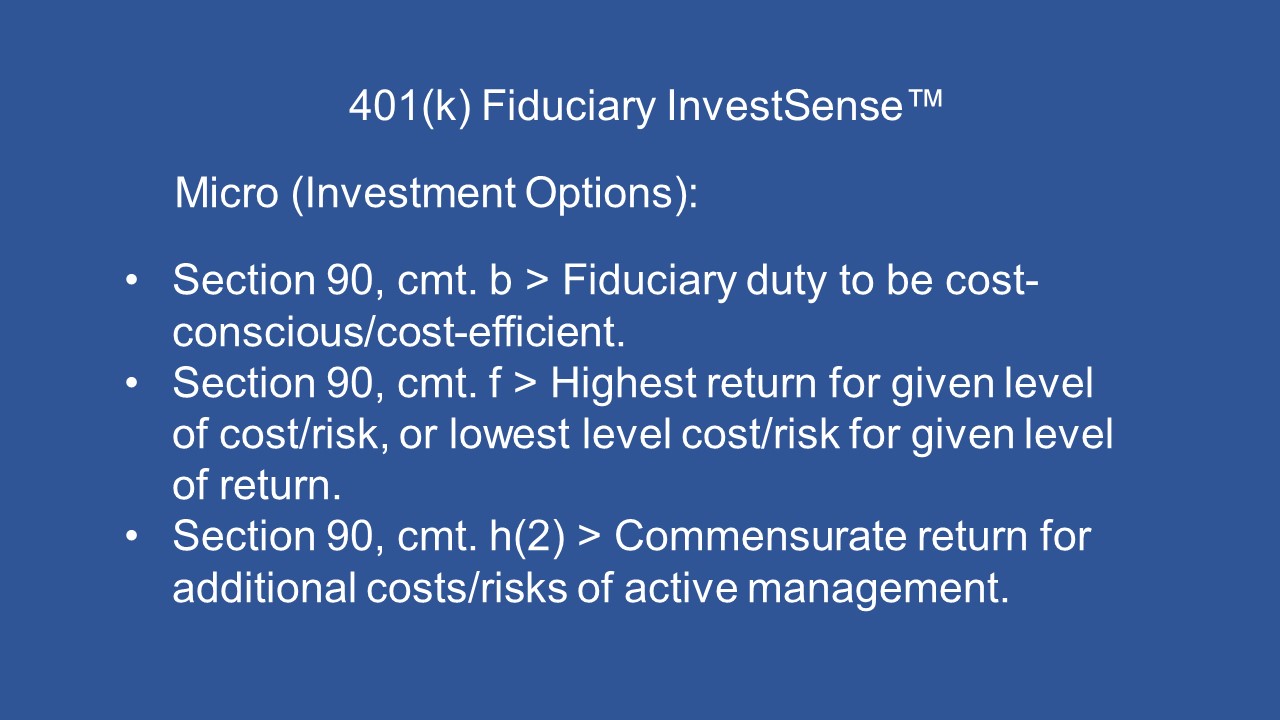
Posted in 401k, 401k compliance, 401k investments, 401k plan design, 401k risk management, 403b, Active Management Value Ratio, AMVR, asset allocation, closet index funds, compliance, cost consciousness, cost efficient, cost-efficiency, Cost_Efficiency, ERISA, ERISA litigation, fiduciary, fiduciary compliance, fiduciary duty, fiduciary law, fiduciary liability, fiduciary liability, Fiduciary prudence, fiduciary prudence, fiduciary responsibility, fiduciary risk management, fiduciary standard, investment advisers, investments, Mutual funds, pension plans, plan advisers, plan sponsors, prudence, retirement planning, retirement plans, risk management, SCOTUS, wealth management, wealth preservation | Tagged , , , , , , , , , , , , , , , | Leave a comment

Common Sense and Fundamental Fairness: The Matney Case and the Future of 401(k)/403(b) Litigation

By James W. Watkins, J.D., CFP Board Emeritus™, AWMA®

I have referenced the Matney v. Briggs Gold of North America (Matney) case1 in a number of recent posts. In my opinion, the significance of Matney lies in the fact that the case presents an opportunity to consider the same issues that were presented in the Brotherston v. Putnam Investments, LLC case2 (Brotherston) back in 2018.

SCOTUS ultimately denied Putnam’s petition for certiorari, presumably based on the Solicitor General’s recommendation to deny cert since the petition involved an interlocutory appeal. While the Solicitor General recommended denying the petition, his amicus brief completely supported the First Circuit’s decision.3

Two key issues involved in both Brotherston and Matney – the legitimacy of index funds as comparators in 401(k)/403(b) litigation, and which party had the burden of proof on the issue of causation in such cases. As to the first issue, both the First Circuit and the Solicitor General pointed to SCOTUS’ previous recognition of the Restatement (Third) of Trusts (Restatement) as a valuable resource in resolving fiduciary issues.4 Both parties pointed to Section 100, comment b, of the Restatement, which states that comparable indices and index funds are legitimate comparators in addressing questions of fiduciary prudence.

As to the second question, both the First Circuit and the Solicitor General stated that under the common law of trusts, once a plaintiff establishes a breach of fiduciary duty and a resulting loss, the burden of proof as to causation shifts to the fiduciary. This position is based on common sense and necessity since only the fiduciary knows the processes, if any, that were used and relied on in making their decisions. The Sixth Circuit recognized this issue in its TriHealth decision:

But at the pleading stage, it is too early to make these judgment calls. ‘In the absence of further development of the facts, we have no basis for crediting one set of reasonable inferences over the other. Because either assessment is plausible, the Rules of Civil Procedure entitle [the three employees] to pursue [their imprudence] claim (at least with respect to this theory) to the next stage….’5

This wait-and-see approach also makes sense given that discovery holds the promise of sharpening this process-based inquiry. Maybe TriHealth ‘investigated its alternatives and made a considered decision to offer retail shares rather than institutional shares’ because ‘the excess cost of the retail shares paid for the recordkeeping fees under [TriHealth’s] revenue-sharing model….’ Or maybe these considerations never entered the decision-making process. In the absence of discovery or some other explanation that would make an inference of imprudence implausible, we cannot dismiss the case on this ground. Nor is this an area in which the runaway costs of discovery necessarily cloud the picture. An attentive district court judge ought to be able to keep discovery within reasonable bounds given that the inquiry is narrow and ought to be readily answerable.6

The Opportunity Provided by Matney
While Matney is still pending in the Tenth Circuit, I believe that it is reasonable to assume that the Tenth Circuit’s decision will be ultimately be appealed to SCOTUS given the importance of the issues involved. Just as in Hughes, there is a split in the federal courts, in this case on the both the “apples and oranges” and the burden of proof on causation issues, effectively denying workers a consistent and equitable enforcement of the rights and protections guaranteed under ERISA.

The district court’s decision started out strong, recognizing that the processes used by a plan sponsor are determinative in assessing the fiduciary prudence of their selection of a plan’s investment decisions.

But Plaintiffs do not challenge decisions specific to the options in which they invested. They focus on an allegedly flawed process that resulted in investment offerings Plaintiffs say were imprudent and unnecessarily cost them money…Plaintiffs allege infirmities in the overall decision-making process, and that confers standing to challenge decisions that happened to affect not only their accounts but other accounts in the Plan the fiduciaries managed.7 

The court recognizes that plaintiffs have limited access to information demonstrating the process fiduciaries use to make their decisions. But a plaintiff can survive a motion to dismiss if the court can infer from the circumstantial allegations that the fiduciary’s decision-making process was flawed. (citing Pension Benefit Guar. Corp. ex. rel. St. Vincent Catholic Med. Ctr.’s Ret. Plan v. Morgan Stanley Inv. Mgmt. Inc., 712 F.3d 705, 719–20 (2d Cir. 2013); Braden v. WalMart Stores, Inc., 588 F.3d 585, 596 (8th Cir. 2009).8

Nevertheless, circumstantial factual allegations “must give rise to a ‘reasonable inference’ that the defendant committed the alleged misconduct, thus ‘permit[ting] the court to infer more than the mere possibility of misconduct.” (citing St. Vincent, 712 F.3d at 718–19 (emphasis in original) (quoting Iqbal, 5556 U.S. at 678–79)).9 

Then the district court proceeded to make some interesting statements regarding the use of revenue sharing in reducing the expense ratios of funds and other investments, as well as the consideration of other fiduciary prudence factors. The court rejected the plaintiff’s use of collective investment trusts (CITs) as comparators, citing differing strategies and the familiar “apples and oranges” argument.

Importantly, Plaintiffs misstate expense ratios of Plan funds. But they also make “apples to oranges” comparisons that do not plausibly infer a flawed monitoring and decision-making process. “To show that ‘a prudent fiduciary in like circumstances’ would have selected a different fund based on the cost or performance of the selected fund, a plaintiff must provide a sound basis for comparison—a meaningful benchmark.” (citing Meiners, 898 F.3d at 822) The fact that “cheaper alternative investments with some similarities exist in the marketplace” does not provide a “meaningful benchmark” upon which to determine whether the Committee breached its duty. (citing Meiners, at 823) (emphasis in original).10

The district court seemingly overlooked the fact that the Restatement effectively discredits the “apples and oranges” and recognizes comparable indices and index funds as “meaningful benchmark”. The court seemingly ignored the fact that SCOTUS endorsed the use of the Restatement in cases where ERISA does not provide express instructions/requirements.11

The district court’s attempt to use revenue sharing to reduce a fund’s expense ratio is totally inconsistent with the Seventh Circuit’s acknowledgment that such attempts to offset expense ratios with revenue sharing payments on a one-to-one basis are improper.12 In another example of the “fundamental fairness” trend, the Seventh Circuit rejected the district court’s one-to-one offset argument.

The problem is that the Form 5500 on which Albert relies does not require plans to disclose precisely where money from revenue sharing goes. Some revenue sharing proceeds go to the recordkeeper in the form of profits, and some go back to the investor, but there is not necessarily a one-to-one correlation such that revenue sharing always redounds to investors’ benefit. Albert’s ‘net investment expense to retirement plans theory’ assumes that there is such a correlation; if that assumption is wrong, then simply subtracting revenue sharing from the investment-management expense ratio does not equal the net fee that plan participants actually pay for investment management.13

The Hughes/TriHealth Prescription
The Seventh Circuit’s Hughes decision frequently cited the Sixth Circuit’s TriHealth decision in describing the current 401(k)/403(b) litigation standards.

1. ERISA requires a fiduciary to assess whether a given fund is prudent in light of other investment options in a plan, comparable funds, and the expenses charged, among other factors.14
2. At the pleading stage, a plaintiff must provide enough facts to show that a prudent alternative action was plausibly allege fiduciary decisions outside a range of reasonableness.15
3. The duty of prudence requires a plan fiduciary to “incur only costs that are reasonable in amount and appropriate to the investment responsibilities of the trusteeship.”16
4. At the pleading stage, a plaintiff must provide enough facts to show that a prudent alternative action was plausibly available.17
5. Every possible alternative explanation for an ERISA fiduciary’s conduct need not be ruled out at the pleadings stage.18
6. Where alternative inferences are in equipoise – that is where they are all reasonable based on the facts – the plaintiff is to prevail on a motion to dismiss. This is because, at the pleading stage, we must accept all well-pleaded facts as true and draw reasonable inferences in the plaintiff’s favor.19

Matney provides a perfect opportunity for SCOTUS to further create a uniform, consistent set of standards for 401(k)/403(b) litigation. The recognition of the “apples and oranges” argument is a consistent and inexplicable refusal of some federal courts to ignore SCOTUS and ignore the Restatement’s common sense fiduciary standards.

In Matney, the district court recognized that process, not product, is the key issue in 401(k)/403(b) litigation. Two statements in particular drew my attention:

(1) “circumstantial factual allegations ‘must give rise to a ‘reasonable inference’ that the defendant committed the alleged misconduct, thus ‘permit[ting] the court to infer more than the mere possibility of misconduct,”20 and

(2) “[t]o show that ‘a prudent fiduciary in like circumstances’ would have selected a different fund based on the cost or performance of the selected fund, a plaintiff must provide a sound basis for comparison—a meaningful benchmark.”21 (emphasis added)

Change “cost or performance” to “cost and performance” and I believe the letter and spirit of ERISA can be easily, and uniformly, accomplished. People who follow my posts are well aware of my position that the relative cost-efficiency of a fund, not its classification as active or passive, should be the key factor in determining whether a plan sponsor or any other investment fiduciary has breached their fiduciary duties.

In Hughes, the Seventh Circuit noted that “cost-consciousness management is fundamental to prudence in the investment function. The Active Management Value Ratio (AMVR) metric provides a simple method of assessing the cost-efficiency of a fiduciary’s decisions. A sample of an AMVR analysis slide is shown below.

The slide clearly establishes a “reasonable inference” of a fiduciary breach, clearly showing the cost-inefficiency of the actively managed mutual fund relative to a comparable index fund based on the actively managed fund’s incremental cost and return. The combination of the active fund’s relative underperformance (opportunity cost) and the fund’s incremental expense ratio cost could then be used to estimate both the loss and damages caused by the plan sponsor’s fiduciary breach.

The AMVR itself is simply the basic cost/benefit equation, using incremental cost/return as the input data. The AMVR calculation itself is obtained by dividing an active fund’s incremental cost by its incremental return. An AMVR greater than “1.0” indicates that the actively managed fund is cost-efficient.

Plan sponsors, attorneys and courts can then see the extent of the cost-inefficiency, the “imprudence premium,” being reflected in the amount by which a fund’s AMVR score exceeds “1.0,” e.g., 1.50 indicates an imprudent premium of 50 basis points/50 percent. Estimated liability exposure and/or legal damages can then be calculated using the DOJ’s and GAO’s findings that each additional 1 percent in costs/fees reduces an investor’s end-return by approximately 17 percent over a 20-year period.22

In the example, the fund’s negative incremental return automatically makes the fund an imprudent choice relative to the comparable index fund. While some may want to argue difference in strategies and goals, ERISA focuses on the benefit provided to the plan participants. Whatever the active fund’s strategies and goals may have been, they ultimately were inferior in terms prudence, as the combined investment costs would have resulted in a loss of between $2.07 to $7.00 per share, compounded annually. The AMVR slide also shows that an investment in the active fund would have resulted in a plan participant suffering a projected 34 percent loss in end-return over a 20- period relative to the index fund option.

Going Forward
I believe the next 12-18 months are going to be a pivotal period in defining the future of 401(k)/403(b) litigation, both in terms of pleading standards and results. I believe the Matney could be the final piece of the puzzle.

The good news is that equitable and consistent results are easily attainable in 401(k)/403(b) litigation just by following the Restatement’s standards and SCOTUS’ decisions, as well as by simply applying some common sense, “humble arithmetic,” and fundamental fairness.

Notes
1. Matney v. Briggs Gold of North America, Case No. 2:20-cv-275-TC (C.D. Utah 2022) (Matney)
2. Brotherston v. Putnam Investments, LLC, 907 F.3d 17 (2018) (Brotherston)
3. Brief for the United States as Amicus Curiae, Hughes v. Northwestern University, United States Supreme Court, No. 19-1401.     
4. Restatement (Third) Trusts (American Law Institute) All rights reserved. (Restatement)
5. Forman v. TriHealth, Inc., 40 F.4th 443, 450 (6th Cir. 2022)
6. TriHealth, Ibid.
7. Matney, 14
8. Matney, 8
9. Matney, 8
10. Matney, 19
11. Tibble v. Edison International, 135 S. Ct 1823 (2015)
12. Albert v. Oshkosh Corp., 47 F.4th 570 (2022) (Oshkosh)
13. Oshkosh, 581
14. Hughes v. Northwestern University, No. 18-2569, March 23, 2023 (7th Cir. 2023) (Hughes), 11.
15. Hughes, 20
16. Hughes, 14
17. Hughes, 21
18. Hughes, 18-19
19. Hughes, 19
20. Matney, 8
21. Matney, 19
22. Pension and Welfare Benefits Administration, “Study of 401(k) Plan Feess and Expenses,” (“DOL Study”); “Private Pensions: Changes Needed to Provide 401(k) Plan Participants and the Department of Labor Better Information on Fees,” (“GAO Study”).

Copyright InvestSense, LLC 2023. All rights reserved.

This article is for informational purposes only, and is neither designed nor intended to provide legal, investment, or other professional advice since such advice always requires consideration of individual circumstances.  If legal, investment, or other professional assistance is needed, the services of an attorney or other professional advisor should be sought.
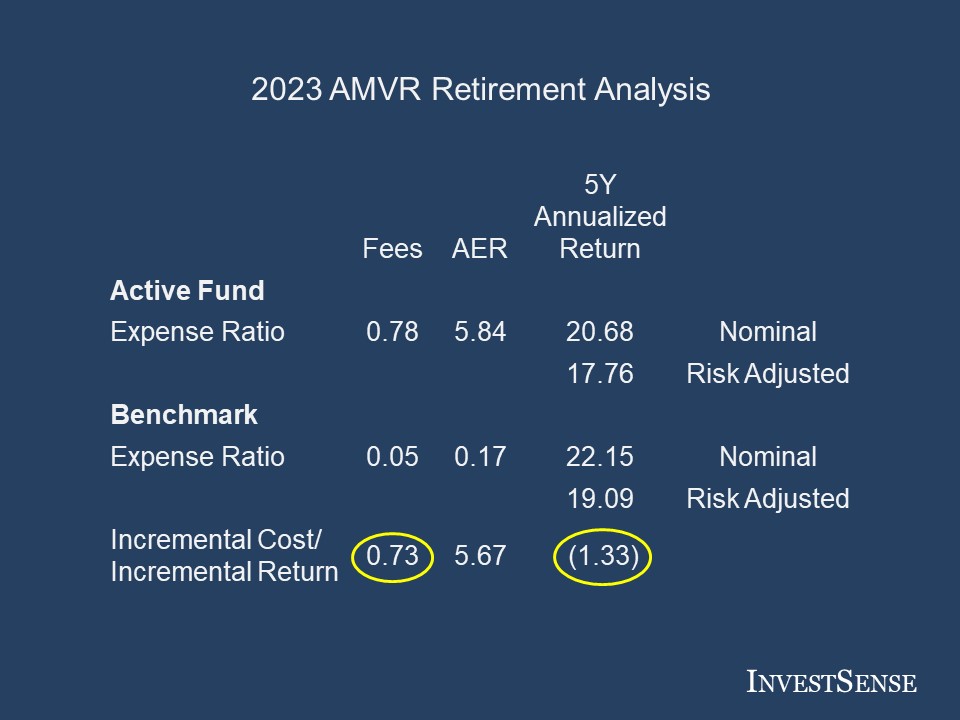
Posted in 401k, 401k compliance, 401k investments, 401k plan design, 401k risk management, 403b, Active Management Value Ratio, AMVR, consumer protection, cost consciousness, cost efficient, cost-efficiency, Cost_Efficiency, ERISA, ERISA litigation, fiduciary, fiduciary compliance, fiduciary duty, fiduciary law, fiduciary liability, fiduciary liability, Fiduciary prudence, fiduciary prudence, fiduciary responsibility, fiduciary risk management, fiduciary standard, investments, Mutual funds, pension plans, plan advisers, plan sponsors, prudence, retirement planning, retirement plans, risk management, SCOTUS, SEC, wealth management, wealth preservation | Tagged , , , , , , , , , , , , , , , , , , , | Leave a comment

1Q 2023 AMVR “Cheat Sheets”: How Much Active Management Do Actively Managed Funds Really Provide?

By James W. Watkins, J.D., CFP Board Emeritus™, AWMA®

The words that I remember
From my childhood still are true
That there’s none so blind
As those who will not see
– Justin Hayward/Moody Blues – “I Know You’re Out There Somewhere”

I know my reference to the Moody Blues will draw a chuckle from my friend, Robin Powell, leader of the evidence-based investing movement and owner of “The Evidence-Based Investor” blog (evidenceinvestors.com). We often joke about the fact that we may among the few that are still Moody Blues fans. But those lines still resonate with me because of the truth they tell, especially within the world of financial services and pensions plans.

The ongoing refusal of some to courts acknowledge SCOTUS’ recognition of the Restatement of Trusts as a legitimate resource in resolving disputes involving fiduciary issues is puzzling. More troubling is the fact that such refusal has resulted in the inequitable situation of the rights and guarantees promised by ERISA being decided on where one resides.

Fortunately, it appears that there may be hope on the horizon. Hopefully SCOTUS will have an opportunity to require that the legal system adhere to one consistent and equitable set of standards in deciding 401(k) and 403(b) litigation. That hope is the Matney v. Briggs Gold case1 currently pending in the Tenth Circuit of Appeals, a case that involves the two key issues that were involved in the Brotherston case2, namely the legitimacy of index funds as comparators in fiduciary prudence evaluations and the question of which party has the burden of proof regarding causation in 401(k)/403(b) actions.

The DOL recently weighed in on the burden of proof issue, stating that once the plan participants properly plead a breach of fiduciary duties, the plan sponsor should then have the burden of proof on the issue of causation, the burden of disproving the participants/ allegations, since they alone know what process they employed in making their decisions. The DOL cited the common law of trusts as a key factor in its position, just as the First Circuit Court of Appeals and the Solicitor General had done in Brotherston.

Once again, this past quarter’s Active Management Value Ratio (AMVR) “cheat sheets” clearly demonstrate why plan sponsors should closely monitor the progress of the Matney case. If ERISA plaintiff attorneys and the courts focus on the more meaningful factor of cost-efficiency rather than the antiquated and meaningless active/passive argument, I believe that plan sponsors will have an extremely difficult time carrying the burden of proof in proving that their decisions did not cause the resulting losses to the plan participants.

Once again, an actively managed fund’s AMVR score is calculated by dividing the fund’s incremental correlation-adjusted costs by its incremental risk-adjusted return. The costs and return calculations are based on comparisons to a comparable index fund.

The AMVR slides shown above also show how the prudence/imprudence of an actively managed fund can quickly be determined by just answering two questions:

(1) Does the actively managed mutual fund provide a positive incremental return relative to the benchmark being used?
(2) If so, does the actively managed fund’s positive incremental return exceed the fund’s incremental costs relative to the benchmark?

If the answer to either of these questions is “no,” the actively managed fund is both cost-inefficient and unsuitable/imprudent according to the Restatement’s prudence standards, and the actively manged fund should be avoided. The goal for an actively managed fund is an AMVR number greater than “0” (indicating that the fund did provide a positive incremental return), but equal to or less than “1” (indicating that the fund’s incremental costs did not exceed the fund’s incremental return).

Is Active Management Much Ado About Nothing?
Some courts have consistently tried to justify the choice of various actively managed funds which fail the AMVR’s fiduciary prudence test. Said courts have tried to justify underperformance based on factors such as investment strategies, goals and preserving choices for plan participants. My response is that if the purpose and goals of ERISA are to be honored and furthered, then the comparative performance of a fund and the comparative benefits provided to the plan participants are the true tests of a fund’s prudence. As for the “choices” argument, common sense says that a cost-inefficient mutual fund is not, and never has been a legally viable “choice.”

In short, the actively managed fund had its chance to test its approach against a comparable index fund’s approach. More often than not, the actively managed fund loses. While a number of people took exception to Judge Kayatta’s suggestion in Brotherston that plan sponsors should choose index funds if they wish to avoid unnecessary liability exposure, he was simply telling the truth. Judge Kayatta’s position has been consistently supported by studies on the cost-efficiency of actively managed funds, studies with findings such as

99% of actively managed funds do not beat their index fund alternatives over the long term net of fees.3  

Increasing numbers of clients will realize that in toe-to-toe competition versus near–equal competitors, most active managers will not and cannot recover the costs and fees they charge.4

[T]here is strong evidence that the vast majority of active managers are unable to produce excess returns that cover their costs.5

[T]he investment costs of expense ratios, transaction costs and load fees all have a direct, negative impact on performance….[The study’s findings] suggest that mutual funds, on average, do not recoup their investment costs through higher returns.6

Judge Kayatta’s position is further supported by John Langbein, who served as the Reporter on the committee that re-wrote the Restatement (Second) of Trusts over fifty years ago. Shortly after the release of the revised Restatement, Langbein wrote a law review article on the new Restatement. At the end of the article, he made a bold prediction:

When market index funds have become available in sufficient variety and their experience bears out their prospects, courts may one day conclude that it is imprudent for trustees to fail to use such accounts. Their advantages seem decisive: at any given risk/return level, diversification is maximized and investment costs minimized. A trustee who declines to procure such advantage for the beneficiaries of his trust may in the future find his conduct difficult to justify.  

While all of these comments are true, they fail to address an even more fundamental question: How much active management do actively managed funds actually provide?

In a 2007 speech at the University of Pennsylvania Law School, Brian G. Cartwright, then general counsel of the SEC, asked the same question. Cartwright asked his audience to think of an investment in a mutual fund as a combination of two investments: a position in an “virtual” index fund designed to track the S&P 500 at a very low cost, and a position in a “virtual” hedge fund, taking long and short positions in various stocks. Added, together, the two virtual funds would yield the mutual fund’s real holdings. Cartwright told the students,

The presence of the virtual hedge fund is, of course, why you chose active management. If there were zero holdings in the virtual hedge fund — no overweightings or underweightings — then you would have only an index fund. Indications from the academic literature suggest in many cases the virtual hedge fund is far smaller than the virtual index fund. Which means…investors in some of these … are paying the costs of active management but getting instead something that looks a lot like an overpriced index fund. So don’t we need to be asking how to provide investors who choose active management with the information they need, in a form they can use, to determine whether or not they’re getting the desired bang for their buck?8


I would suggest that the AMVR provides such information. I would also suggest that combining the AMVR with Ross Miller’s Active Expense Ratio (AER) provides an even more meaningful evaluation of the prudence/imprudence of an actively managed fund.

The AER determines the Active Weight (AW) within an actively managed fund, then uses the fund’s AW to recalculate the implicit expense ratio that an investor in the fund is paying. Miller explained the importance of the AER, stating that

Mutual funds appear to provide investment services for relatively low fees because they bundle passive and active funds management together in a way that understates the true cost of active management. In particular, funds engaging in ‘closet’ or ‘shadow’ indexing charge their investors for active management while providing them with little more than an indexed investment. Even the average mutual fund, which ostensibly provides only active management, will have over 90% of the variance in its returns explained by its benchmark index.9

Using just a fund’s R-squared number and its incremental costs, Miller found that in terms of Active Weight, actively managed funds often provide very little active management, As a result, investors often pay an implicit expense ratio that is 300-400 percent, or even more, higher than the fund’s publicly stated expense ratio.

The slides above clearly show how the combination of a higher incremental cost and a high R-squared number result in a significantly higher AER. Under Miller’s AER, an R-squared of 98 equates to active weight of just 12.50 percent. I would suggest that referring to such a fund as “actively managed” might be questioned. One could also suggest that a refusal or failure to recognize and acknowledge such an inequitable situation constitutes “willful blindness” by a plan sponsor and an obvious breach of their fiduciary duties.

People often ask me why InvestSense uses the AER and correlation-adjusted costs in calculating a fund’s AMVR score. Simply because I believe that the AER provides a more accurate perspective of the costs an investor incurs. And as both the DOL and the GAO have stated, each additional 1 percent in fees/costs reduces an investor’s end-return by approximately 17 percent over a 20-year period10

Going Forward
In earlier posts, I had stated that I would announce a new metric, the “Fiduciary Prudence Score.” I shelved that metric, as some of my mentors suggested that it might confuse people and distract from the strength of the AMVR. Since I believe that the next 12-18 months are going to see a significant shift in the 401(k)/403(b) litigation arena, I do not want to do anything that would possibly detract from the simplicity and value of the AMVR.

If I am correct in my prediction for the next 12-18 months, plan sponsors should consider a fiduciary audit of their plan, an audit that uses both the AMVR and the AER as key fiduciary factors. When I meet with a prospective client, I suggest to them that they ask their current plan adviser to prepare an AMVR slide using exactly the same layout and criteria shown on the slides shown in this post. In most cases, the adviser has either totally refused to do so, or has made “improvements” to the AMVR calculation process. Once SCOTUS’ hears Matney, or a similar case, and shifts the burden of proof on causation to plans, plan sponsors will belatedly realize the true value of cost-benefit anaysis, such as the AMVR, as a fiduciary risk management tool.

Notes
1. Matney v. Barrick Gold of North America, No. 4045 (10th Cir.)
2. Brotherston v. Putnam Investments, LLC, 907 F.3d 17 (2018) (Brotherston)
3. Laurent Barras, Olivier Scaillet and Russ Wermers, False Discoveries in Mutual Fund Performance: Measuring Luck in Estimated Alphas, 65 J. FINANCE 179, 181 (2010).
4. Charles D. Ellis, The Death of Active Investing, Financial Times, January 20, 2017, available online at https://www.ft.com/content/6b2d5490-d9bb-11e6-944b-eb37a6aa8e. 
5. Philip Meyer-Braun, Mutual Fund Performance Through a Five-Factor Lens, Dimensional Fund Advisors, L.P., August 2016.
6. Mark Carhart, On Persistence in Mutual Fund Performance,  52 J. FINANCE, 52, 57-8 (1997).
7. John H. Langbein and Richard A. Posner, Measuring the True Cost of Active Management by Mutual Funds, Journal of Investment Management, Vol 5, No. 1, First Quarter 2007 http://digitalcommons.law.yale.edu/fss_papers/498
8.  SEC Speech: The Future of Securities Regulation: Philadelphia, Pennsylvania: October 24, 2007 (Brian G. Cartwright). http://www.sec.gov/news/speech/2007/spch102407bgc.htm
9. Ross Miller, “Evaluating the True Cost of Active Management by Mutual Funds,” Journal of Investment Management, Vol. 5, No. 1, 29-49 (2007) https://papers.ssrn.com/sol3/papers.cfm?abstract_id=746926
10. Pension and Welfare Benefits Administration, “Study of 401(k) Plan Feess abd Expenses,” (“DOL Study”). http://www.DepartmentofLabor.gov/ebsa/pdf; “Private Pensions: Changes Needed to Provide 401(k) Plan Participants and the Department of Labor Better Information on Fees,” (GAO Study”).

Copyright InvestSense, LLC 2023. All rights reserved.

This article is for informational purposes only, and is neither designed nor intended to provide legal, investment, or other professional advice since such advice always requires consideration of individual circumstances.  If legal, investment, or other professional assistance is needed, the services of an attorney or other professional advisor should be sought.

Posted in 401k plan design, 401k risk management, 403b, Active Management Value Ratio, AMVR, closet index funds, compliance, cost consciousness, cost efficient, cost-efficiency, ERISA, ERISA litigation, fiduciary, fiduciary compliance, fiduciary duty, fiduciary law, fiduciary liability, fiduciary liability, Fiduciary prudence, fiduciary prudence, fiduciary responsibility, fiduciary risk management, fiduciary standard, investment advisers, investments, Mutual funds, pension plans, plan advisers, plan sponsors, prudence, retirement plans, risk management, SCOTUS, SEC, Supreme Court, wealth management, wealth preservation | Tagged , , , , , , , , , , , , , , | Leave a comment

“At the Pleading Stage”: An Analysis of the Seventh Circuit’s Reconsideration of Hughes v. Northwestern University

by James W. Watkins, III, J.D., CFP Board EmeritusTM AWMA® 

The Seventh Circuit’s recent decision1 in Hughes v. Northwestern University simply reinforces my opinion that there is definitely a trend going on in 401(k) and 403(b) litigation, a trend reinforcing both the spirit and the letter of the law with regard both ERISA and the Restatement of Trusts. As I have stated before, I believe the next 12-18 months is going to see a significant change in the 401(k) and 403(b) landscape, once that restores fundamental fairness in litigation involving such areas.

As a result, the prudent plan sponsor will perform an independent and objective analysis of their plan to determine the extent of any potential fiduciary liability exposure. I believe that most plan sponsors truly want to provide their employees with a meaningful retirement plan. Unfortunately, the evidence suggests that most plan sponsors fail to do so due to a lack of understanding as to what their fiduciary duties actually require and how to properly perform such duties. Fortunately, compliance with ERISA is relatively simple to accomplish and maintain.

When I review an ERISA decision, the first thing I ask is whether the decision is sustainable on appeal, whether it is consistent with both ERISA and the Restatement of Trusts. If not, then the decision arguably does nothing more than create a false sense of security for a plan sponsor. I think we have seen too many of such decisions.

However, I think the Seventh Circuit’s recent reconsideration of its earlier Hughes decision is a continuation of a trend which seems to be trying to establish a sense of fundamental fairness in 401(k)/403(b) litigation, most notably with regard to allowing plaintiffs to have some degree of discovery. Given ERISA’s focus on the fiduciary process used by a plan sponsor and the obvious fact that only the plan sponsor can know what that process was, any attempt by a court to require the plan participants to prove the flaws in such process without at least “controlled” discovery is inequitable.

The Sixth Circuit recognized that fact in its TriHealth decision, as Chief Judge Sutton suggested that too many 401(k) cases were being prematurely dismissed due to plaintiffs not being a chance at reasonable discovery.

But at the pleading stage, it is too early to make these judgment calls. ‘In the absence of further development of the facts, we have no basis for crediting one set of reasonable inferences over the other. Because either assessment is plausible, the Rules of Civil Procedure entitle [the three employees] to pursue [their imprudence] claim (at least with respect to this theory) to the next stage….’ 2

This wait-and-see approach also makes sense given that discovery holds the promise of sharpening this process-based inquiry. Maybe TriHealth ‘investigated its alternatives and made a considered decision to offer retail shares rather than institutional shares’ because ‘the excess cost of the retail shares paid for the recordkeeping fees under [TriHealth’s] revenue-sharing model….’ Or maybe these considerations never entered the decision-making process. In the absence of discovery or some other explanation that would make an inference of imprudence implausible, we cannot dismiss the case on this ground. Nor is this an area in which the runaway costs of discovery necessarily cloud the picture. An attentive district court judge ought to be able to keep discovery within reasonable bounds given that the inquiry is narrow and ought to be readily answerable.3

Common sense supports this argument. If in fact the plan sponsors conducted the legally required objective and thorough independent investigation and evaluation of the funds selected for a plan, discovery could easily be limited to producing any and all materials used and relied on by the plan sponsor. The time and costs involved in such controlled discovery should be minimal. Then again, as the Sixth Circuit points out, such controlled discovery would also expose plan sponsors who did not comply with ERISA’s fiduciary requirements.  

The Seventh Circuit liberally cited from the Sixth Circuit’s TriHealth decision, pointing out that the plaintiff’s obligation to sufficiently plead its case is a separate and distinct obligation from proving causation. The Seventh Circuit’s consistent theme throughout the Hughes decision was on the concept of fundamental fairness to the parties and a balanced consideration of the facts.

“[P]laintiffs must have alleged enough facts to show that a prudent fiduciary would have taken steps to reduce fees and remove some imprudent investments.4

ERISA requires a fiduciary to assess whether a given fund is prudent in light of other investment options in a plan, comparable funds, and the expenses charged among other factors.5

Where alternative inferences are in equipoise-that is where they are all reasonable based on the facts, the plaintiff is to prevail in a motion to dismiss. (Citing TriHealth at 450), ‘Equally reasonable inferences…could exonerate[the plan sponsor]…[but] at the pleading stage, it is too early to make these judgment calls. This is because, at the pleading stage, we must accept all well-pleaded facts as true and draw reasonable inferences in the plaintiff’s favor.’6

A court’s role in evaluating pleadings is to decide whether the plaintiff’s allegations are plausible-not which side’s version is more probable. This, on a motion o dismiss, courts must give due regard to alternative explanations for an ERISA fiduciary’s conduct, but htye need not be overcome conclusively by the plaintiff.7

Another example of this “fundamental fairness” trend was evident in the Seventh Circuit’s Oshkosh decision, where the Court discredited the plan’s arguments that the expense ratios for the funds in the plan should be adjusted on a one-to-one basis to account for revenue sharing.

The problem is that the Form 5500 on which Albert relies does not require plans to disclose precisely where money from revenue sharing goes. Some revenue sharing proceeds go to the recordkeeper in the form of profits, and some go back to the investor, but there is not necessarily a one-to-one correlation such that revenue sharing always redounds to investors’ benefit. Albert’s ‘net investment expense to retirement plans theory’ assumes that there is such a correlation; if that assumption is wrong, then simply subtracting revenue sharing from the investment-management expense ratio does not equal the net fee that plan participants actually pay for investment management.8

The Hughes Decision and Cost-Inefficiency
As mentioned earlier, the Seventh Circuit specifically included cost as one factor that plan sponsors must consider in selecting investment options for their plan. The Court addressed this even further. stating that

[c]ost-conscious management is fundamental to prudence in the investment function, [and should be applied] not only in making investments but also in monitoring and reviewing investments.9 (citing RESTATEMENT (THIRD) OF TRUSTS Section 90, cmt. B, and Section 88, cmt. A)

Wasting beneficiaries’ money is imprudent.10 (citing UNIF. PRUDENT INVESTOR ACT SECTION 7, cmt. (UNIF. L. COMM”N 1995)

The Active Management Value Ratio (AMVR) could significantly help the parties and the courts properly evaluate the various claims and theories put forth in 401(k) and 403(b) litigation.

Reports and publications consistently rank the American Funds Growth Fund of America Fund (RGAGX) as one of the most common investment options within 401(k) and 403(b) plans. The following AMVR slide could help evaluate the fiduciary prudence of the fund.


Two things that immediately stand out on the AMVR slide:

1. RGAGX fails to provide a positive incremental return relative to the benchmark, the Vanguard Large Cap Growth Index Fund (VIGAX).
2. RGAGX has nominal incremental costs relative to VIGAX, without any commensurate return for such costs.

The DOL and the GAO have both stated that each additional 1 percent in fees/costs reduces an investor’s end-return by 17 percent over a twenty-year period.11 If we treat RGAGX’s relative underperformance (201 basis points) as an opportunity cost and combine such cost with RGAGX’s relative incremental cost (25 basis points), the projected reduction in end-return would be over 38 percent. I am not sure how a plan sponsor could successfully argue that causing an investor to suffer such a loss was a prudent investment choice when VIGAX was an available investment option.

Going Forward
I have previously stated that I believe that the next 12-18 months are going to be a pivotal period for the 401(k)/403(b) industry, for both plan sponsors and plan advisers. The combination of the currently emerging “fundamental fairness” trend within the courts and the simple and straightforward “Humble Arithemetic” evidence of the AMVR could prove difficult for plan sponsors to overcome if they wish to avoid unnecessary fiduciary liability exposure.

Those that follow me know that I believe that the final piece of the 401(k)/403(b) fiduciary prudence puzzle will be the Matney v. Barrick Gold of North America12 case (Matney). Matney is currently pending in the 10th Circuit Court of Appeals. Matney provides the legal system with an opportunity to resolve two ongoing ERISA issues, (1) the validity of the “apples and oranges” argument regarding comparison of actively managed mutual funds and index mutual funds, and (2) the question of who carries the burden of proof on the issue of causation.

Both of these issues were presented to SCOTUS in the Brotherston appeal in 2018. SCOTUS denied Purnam Investments’ petition for certiorari at that time. Matney gives SCOTUS another opportunity to resolve the two issues and end a split on the issues in the federal courts, guaranteeing employees an equitable and uniform standard of legal review in the courts.

Notes
1. Hughes v. Northwestern University, No. 18-2569, March 23, 2023 (7th Cir. 2023) Hughes)
2. Forman v. TriHealth, Inc., 40 F.4th 443, 450 (6th Cir. 2022)
3. TriHealth, Ibid.
4. Hughes, 17
5. Hughes, 11
6. Hughes, 19
7. Hughes, 20
8. Albert v. Oshkosh Corp., 47 F.4th 570, 581 (2022)
9. Hughes, 14
10. Hughes, 15
11. Pension and Welfare Benefits Administration, “Study of 401(k) Plan Feess abd Expenses,” (“DOL Study”). http://www.DepartmentofLabor.gov/ebsa/pdf; “Private Pensions: Changes needed to Provide 401(k) Plan Participants and the Department of Labor Better Information on Fees,” (GAO Study”).
12. Matney v. Barrick Gold of North America, No. 4045 (10th Cir.)

Copyright InvestSense, LLC 2023. All rights reserved.

This article is for informational purposes only, and is neither designed nor intended to provide legal, investment, or other professional advice since such advice always requires consideration of individual circumstances.  If legal, investment, or other professional assistance is needed, the services of an attorney or other professional advisor should be sought.

Posted in 401k, 401k compliance, 401k investments, 401k plan design, 401k risk management, 403b, Active Management Value Ratio, AMVR, cost consciousness, cost efficient, cost-efficiency, Cost_Efficiency, ERISA, ERISA litigation, fiduciary, fiduciary compliance, fiduciary duty, fiduciary law, fiduciary liability, fiduciary liability, Fiduciary prudence, fiduciary prudence, fiduciary responsibility, fiduciary risk management, fiduciary standard, Mutual funds, pension plans, plan advisers, plan sponsors, prudence, SCOTUS, Supreme Court | Tagged , , , , , , , , , , , , , | Leave a comment

“Humble Arithmetic” and the Future of 401(k) Litigation

By James W. Watkins, III, J.D., CFP Board EmeritusTM, AWMATM

Fortunately, there is currently a case pending in the 10th Circuit, the Matney case, which may go a long way in resolving two of the primary issues that continue to result in such inconsistent rulings. At the same time, I think a lot of the problems with ERISA cases could be avoided if the ERISA plaintiff attorneys and the courts would simply use what John Bogle referred to as “Humble Arithmetic.”

Several years ago I created a metric, the Active Management Value RatioTM 3.0 (AMVR). The AMVR is based on the research of investment icons such as Nobel laureate Dr. William F. Sharpe, Charles D. Ellis, and Burton L. Malkiel.

The AMVR allows plan sponsors and other investment fiduciaries, to quickly evaluate the cost-efficiency of an actively managed mutual fund. The legal system’s continued focus on the active/passive debate, rather than on the cost-inefficiency of most 401(k) investment options, is part of the current problem with ERISA litigation.

In Tibble, SCOTUS recognized the Restatement (Third) of Trusts (Restatement) as a legitimate resource in resolving fiduciary disputes, including questions regarding fiduciary duties under ERISA. The Restatement clearly recognizes the importance of cost-efficiency, stating that fiduciaries should carefully compare the costs associated with a fund, especially when considering funds with similar objectives and performance.1 The Restatement advises plan fiduciaries that in deciding between funds that are similar except for their costs, the fiduciary should only choose an active fund with higher costs and/or risks if

the course of action in question can reasonably be expected to compensate for its additional costs and risk,…2

Studies have shown that the public is more visually oriented than verbally oriented. The AMVR allows us to visually demonstrate the value of the Restatement’s position.

Burton L. Malkiel said that the best two predictors of future performance are a fund’s expense ratio and turnover, or trading costs.3 Mutual funds are not legally required to disclose their actual trading costs. However, recognizing the importance of such costs in analyzing the prudence of funds, John Bogle created a proxy that allows investors to factor in such costs in selecting mutual funds. Bogle’s proxy is simply to double a fund’s reported turnover ratio, and then multiply that number by 0.60. Under Bogle’s proxy, a fund with a turnover ratio of 25 percent would have estimated trading costs of 30 basis points, or 0.30 ( a basis point is equal to 1/100th of 1 percent).

For purposes of this post I want to compare the costs and performance of two actively managed mutual that are commonly found in 401(k) plans: Fidelity Contrafund Fund K shares (FCNKX) and T. Rowe Price Blue Chip Growth Fund R shares (RRBGX). The funds will be compared to the Vanguard Growth Index Fund Admiral shares (VIGAX).

First, a comparison of the funds based on the expense ratios and trading costs.

We’ll come back to this later. For now, just remember Bogle’s quote: “You get what you don’t pay for.”

The 5 and 10-year AMVR charts for FCNKX provide some interesting insights.

The 5-year AMVR slide shows that FCNKX is an imprudent investment choice relative to VIGAX based on the fact that
(1) FCNKX fails to provide a positive incremental return relative to VIGAX, and
(2) FCNKX’s incremental costs (0.42) obviously exceeds FCNKX’s negative incremental return.

The 10-year AMVR slide shows that FCNKX is arguably prudent investment choice relative to VIGAX based on the fact that
(1) FCNKX provides a positive incremental return relative to VIGAX, and
(2) FCNKX’s positive incremental return (0.81) exceeds FCNKX’x incremental costs (0.42).

But is it possible that looks could be deceiving, that other factors need to be considered to gain a more accurate evaluation of FCNRX relative prudence?

Ross Miller created a metric, the Active Expense Ratio (AER), that factor in rhe correlation of returns between two funds. If an actively managed fund’s returns are highly correlated to the less-expensive index fund, one should question how much active management the actively managed fund actually provided. Are investors getting a fair return on their investment in terms of cost-efficiency.

Miller explained the value of the AER as follows:

Mutual funds appear to provide investment services for relatively low fees because they bundle passive and active funds management together in a way that understates the true cost of active management. In particular, funds engaging in ‘closet’ or ‘shadow’ indexing charge their investors for active management while providing them with little more than an indexed investment. Even the average mutual fund, which ostensibly provides only active management, will have over 90% of the variance in its returns explained by its benchmark index.3

In the two AMVR slides. the “AER” column provides an interesting insight into the prudence of FCNKX. The correlation of returns between FCNKX and VIGAX was extremely high over the time period in question, 98 percent. As a result, the actual active value contribution for FCNKX was estimated to be approximately 12.5 percent, resulting in much higher, 6-7 times higher, implicit expense ratio over each time period. Based on these findings, one can argue that FCNKX was actually an imprudent investment option relative to VIGAX for 401(k) plans and other investment fiduciaries, as well as for investors in general.

The AMVR slide for RRBGX provides an even more compelling reason for factoring in an actively managed fund’s AER.

From what I have been able to tell, to date no court or attorney has utilized such a cost-efficiency process to evaluate the fiduciary prudence of investment options. The actual calculation process is extremely simple and straightforward. I have actually had occasion to do the calculations on a napkin using my cell phone. So, if ERISA’s original purpose and goals are to be realized, I have to wonder why the process described herein have not been at least explored and argued.

The argument becomes even more compelling if we incorporate the findings from Malkiel’s performance predictors. Malkiel’s theory definitely held true in our examples, especially when the AEWR was considered.

I often use a RRBGX AMVR slide to show just how damaging the combination of high expense ratios and a high correlation of returns between an actively managed funds and a comparable index fund can have on fiduciary prudence realized returns. The correlation between RRBGX and VIGAX was 98. While the 10-year AMVR slide showed improvement, RRBGX still failed to produce a positive incremental return

Going Forward
I believe that recent developments suggest that significant changes are coming in 401(k) and 403(b) litigation. One of the key unresolved issues involves which party has the burden of proof on the issue of causation in ERISA 401(k) litigation. The DOL recently filed an amicus brief in the Home Depot 401(k) litigation in the 11th Circuit. The DOL’s amicus brief supports the position of the common law of trusts, the First Circuit Court of Appeals’ and the Solicitor General position that the plan sponsor has that burden. As the AMVR slides herein suggest, that burden may prove a difficult one to carry in most cases if SCOTUS adopts that position as well.

Notes
1. Restatement (Third) Trusts (American Law Institute) All rights reserved. (Restatement)
2. Restatement, Section 90, comment h(2)
3. Ross Miller, “Evaluating the True Cost of Active Management by Mutual Funds,” Journal of Investment Management, Vol. 5, No. 1, 29-49 (2007) https://papers.ssrn.com/sol3/papers.cfm?abstract_id=746926

Copyright InvestSense, LLC 2023. All rights reserved.

This article is for informational purposes only, and is neither designed nor intended to provide legal, investment, or other professional advice since such advice always requires consideration of individual circumstances.  If legal, investment, or other professional assistance is needed, the services of an attorney or other professional advisor should be sought.


Posted in 401k, 401k compliance, 401k investments, 401k plan design, 401k risk management, 403b, Active Management Value Ratio, AMVR, cost consciousness, cost efficient, cost-efficiency, Cost_Efficiency, ERISA, ERISA litigation, fiduciary, fiduciary compliance, fiduciary duty, fiduciary law, fiduciary liability, fiduciary liability, Fiduciary prudence, fiduciary prudence, fiduciary responsibility, fiduciary risk management, fiduciary standard, investments, Mutual funds, pension plans, plan advisers, plan sponsors, prudence, retirement plans, risk management | Tagged , , , , , , , , , , , , | Leave a comment