Bradley Campbell of Faegre Drinker recently commented on the unusual strength of the language in the Fifth Circuit’s “Memorandum Opinion and Order” staying the DOL’s Retirement Security Rule.1 Given distristrict court Chief Judge Lynn’s earlier well-reasoned analysis and opinion in connection with the DOL’s initial Fiduciary Rule,2 as well as the fact that the Fifth Circuit’s Chief Judge cited the district court’s decision in his dissenting opinion in the 5th Circuit’s decision on the Rule,3 the Fifth’s Circuit’s statement that “[p]laintiffs are virtually certain to succeed on the merits,”4 arguably raises some legitimate questions, especially if, as expected, this case moves forward to SCOTUS..
As the court stated, in order to grant a stay or a preliminary injunction or stay, the movant must show (1) a substantial likelihood of success on the merits; (2) a substantial threat of irreparable harm; (3) that the balance of hardships weights in the movant’s favor; and (4) that issuance of a preliminary injunction will not disserve the public interest.5
As to the likelihood of success, I would point to the Judge Lynn’s well-reasoned district court decision, one which was persuasive enough to convince the Chief Judge of the Fifth Circuit’s to dissent from the majority’s decision. The Fifth Circuit stated that the DOL’s Rule was “arbitrary and capricious.”10 The Court also stated that it had weighed the equities between the parties. And yet, I would respectfully submit that common sense and “humble arithmetic” suggest otherwise.
Annuity advocates often argue that the DOL’s proposed Rule is unnecessary, that the NAIC oversees the insurance industry to ensure that the public’s “best interests” are protected, that conflicts of interest are properly addressed. However, as the Retirement Security Rule points out
[The NAIC’s] definition of ‘material conflict of interest] expressly carves out ‘cash compensation or non-cash compensation’ from treatment as sources of conflicts of interests. The NAIC model Regulation also provids that it does not apply to transactions involving contracts used to fund an employee pension or welfare plan covered by ERISA.6
The NAIC expressly disclaimed that its standard creates fiduciary obligations, and the obligations differ in significant respects from those applicable to broker-dealers in the SEC’s Regulation Best Interest..[The NAIC’s model] does not expessly incorporate the obligation not to put the producer’s or insurer’s interests before the customer’s interests, even though compliance with their terms is treated as meeting the ‘best interest’ standard.7
Additionally, the obligation to comply with the ‘best interest’ standard is limited to the indivual producer, as opposed to the insurer repsonsible for supervising the producer.8
Judge Lynn then provides support for the need for the DOL’s Retirement Security Rule by pointing out that
Further, the SEC’s Regulation Best Interest and the NAIC Model Regulations are each limited in important ways in terms of application to advice provided to ERISA plan fiduciaries although this is not the case with the Advisers Act fiducirry obligations….The NAIC Model Regulation does not apply to transactions involving conracts used to fund an employee pension or welfare plan covered by ERISA. The Department [of Labor] believes that retirement investors and the regulated community are best served by an ERIAS fiducairy standard that applies uniformly to all invstments that retirement investors may make with respect to their retirement accounts.9
And yet, the Fifth Circuit ignored the DOL’s accurate and logical arguments and analysis, choosing to protect the annuity industry over protecting plans and plan participants by issuing a stay of the DOL Rule based upon the Court’s opinion that the industry is virtually certain to succeed on the merits. It could legitimately be argued that Judge Lynn’s opinion more accurately reflects the current situations and concerns that caused the DOL to create the Retirement Security Rule in the first place..
One of the key targets of the Rule was fixed indexed annuities (FIAs). FIAs were origianlly marketed as equity indexed annuities (EIAs). I was a compliance director at the time EIAs were introduced. My immediate response when the annuity wholesaler introduced then during a weekly sales meeting was “no way,” as the product was misleading in suggesting market returns. However, the various artificial restrictions on returns made it clear that the product was structured more to ensure that the annuity issuer benefitted at the annuity owner’s expense.
My opinion on FIAs/EIAs remains the same. And apparently others in the industry agreed with my assessment, since many of the larger insurance companies avoided the product due to potential liability concerns when the EIAs were first introduced.
A vice president at Northwestenn Mutual stated that
These products are so complicated that I think it’s a stretch to believe that the agents, much less the clients, understand what they’ve got. The commissions are extreme. The surrender eriods are too long. The complexity is way too high.11
MassMutual Financial Group was so concerned that they prepared a study compaing how an FIA based on the S&P 500 would have performed over the 30-year period ending Dececmber 2003. The study concluded that the EIA would have delivered just 5.8% a year, compared to the 8.5% return on the S&P 500 (without dividends) and 12.2% return (with dividends reinvested). The study also found that investors in the EIA would have even done better invested in simple Treasury bills, which delivered 6.4% a year.12
In ” Can Annuities Offer Competitive Returns?,13“Dr. William Reichenstein, formerly a chaired professor of finance at Baylor University, came to the same conclusion about the imprudence of EIAs
By design, indexed annuities cannot add value. By design, (1) they do not attempt market timing, (2) they do not make sector/industry/style/size bets, and (3) they do not try to add value through security selection….So, I concluded that the risk-adjusted returns on indexed annities must trail the risk-adjusted returns available in marketable securities by the sum of their spread plus their transaction costs,14
Annuity issuers adamantly oppose disclosing the spreads that they assess against annuity owners. Spreads reduce the amount of interest credited to the annuity owner. Even when annuity disclose alleged spreads, they may not accurately reflect the actual impact in terms of reduced returns/loss incurred by an annuity owner. The graphic shown below shows how an alleged annual 2 percent spread (200 basis point) in connection with an FIA with a 10 percent cap effectively reduces an annuity owner’s annual return by 20 percent, not by the alleged 2 percent. And this does not even factor in the annual compounding effect of this excessive cost.
It is hard to believe that any court could/would try to ignore or justify such an inequitable practice, one which reduces an investor’s annual return by an outrageous 20 percent or more a year. Despite the Fifth Circuit’s “arbitrary and capricious “ allegation, these are facts based on ‘humble arithmetic,” not self-serving, speculative projections and “declarations”.
Yet, in staying the effectiveness of the DOL’s Rule, that is exactly what the Fifth Circuit has effectively done by virtue of issuing a stay of the Rule and allowing the annuity industry to continue to market these anti-consumer best interest products for who knows how long, with serious consequences for workers trying the prepare for “retirement readiness,” workers who may not have the time to make up for unnecessary losses resulting from the stay.
The Fifth Circuit also tried to justify the stay based on the annuity industry’s allegations of irreparable harm. The first words that came to mind when I read this was the “squandering plaintiff” ruse that the annuity industry used to try to convince the courts to require that structured settlements be required in actions involving significant damages. The annuity advocates claimed that the annuity industry had data and studies showing that 90 percent of injured plaintiffs receiving lump sum settlements instead of structured settlements and annuities dissipated such settlements within five years. And yet, when called on to produce such data studies, the annuity industry failed to do so.15
Jeremy Babener, a settlement expert, wrote several informative articles on this issue. Eventually, he cited an annuity advocate and industry in-house legal counsel who suggested that no such studies or findings ever existed, that they were simply made up/imaginary.16
So, against that backdrop of the annuity industry’s willingness and propensity to exaggerate and misrepresent the truth when it serves their purpose, I have to wonder to what extent the Fifth Circuit properly weighed the industry’s alleged irreparable claims, especially given the Court’s note that the alleged injury must also be complete, that “speculative injury is not sufficient.”17
Among the industry’s claims, based on personal self-serving “declarations”
(1) the Rule will cause more than half a billion dollars in compliance costs, and another $2.5 billion in costs over the next decade. Compliance costs are always in flux as new products are introduced. And yet, by their very nature, such forward looking projections are self-serving and speculative, and, thus, should not be a factor in any decision since they would be inadmissable under the federal rules of evidence;18
(2) 87% of independent insurance agents “estimate” that the Rule will increase their staffing and operational costs,19
(3) 93% of these independent agents anticipate rising professional liability insurance premiums,20
(4) Some agents fear they will be forced out of business, forced to restructure their business, or to retire. (speculative and hyperbole).21
Compliance costs are always a cost in both the securities and insurance industries. However, I remain sceptical of such claims given my compliance background. If one accepts these claims at face value, I would argue that it is tantamount to an admission against interest, an admission that an insurance/annuity company is selling these products without proper compliance programs and safeguards. These “woe is me” claims are reminiscent of the Aesop’s famous saying _ “A tyrant always has a pretext for his tyranny.”
These self-serving “declarations” should have absolutely no weight in whether to protect workers against imprudent investment products. Instead, the evidence suggests that once again the legal system is once again drinking the annuity industry’s self-serving misrepresentation Kool-aid without verification of same, just as with the industry’s “squandering plaintiff” ruse in connection with structured settlements and significant injuries, all to once again benefit the annuity industry at the public’s expense.
The insurance/annuity industry created and market these complex and misleading products to ensure that they profit at the public’s expense. They should now be tasked with cleaning up their own mess to ensure that their products are actually in the best interest of consumers, especially those saving for retirement.
I think that most people agree that this case will, and should, be heard by SCOTUS to ensure an equitable and consistent interpretation and enforcement of the rights and guarantees promised under ERISA. As for now, the courts need to “call” the annuity industry’s bluff in order to properly weight the equities and to preserve, protect and promote ERISA’s stated purpose and goals. The DOL should also petition for a reconsideration of the stay by the Fifth Circuit, en banc, and then petition SCOTUS, if necessary.
For more information on the inherent fiduciary liability issues with FIAs, variable annuities, and annuities in general, see my earlier post, “A Fiduciary’s Guide to Annuities: Why Go There?
Notes 1. American Council of Life Insurers v. United States Department of Labor, “Memorandum Opinion and Order,” Civil Action No. $:24-cv-00482-O 7-26-2024. (Memorandum) 2. Chamber of Commerce of the United States of America v. United States Department of Labor, 231 F. Supp.3d 152 (N.D. Tex 2017). (District Court) 3. Memorandum, 7. 4. Memorandum, 7.. 5. Memorandum, 7. 6. 29 CFR Part 2510.B.5 (Retirement Security Rule), State Legislative and Regulatory Developments 7. Retirement Security Rule, 100. 8. Retirement Security Rule, 101. 9. Retirement Security Rule, 101. 10. Memorandum, 7. 11. “Why Big Insurers Are Staying Away From This Year’s Hot Investment Product,” Wall Street Journal, D-12, December 14, 2005. (Staying Away) 12. Staying Away, D-1. 13. William Reichenstein, “Can Annuties Offer Competitive Returns?” Journal of Financial Planning, (August 2011), 36; William Reichenstein, “Financial Analysis of Equity-Indexed Annities,” Financial Services Review 18, 291-311. 14. Reichenstein, 36 15. Jeremy Babener, “Justifying the Structured Settlement Tax Subsidy: The Use of Lump Sum Settlement Monies,” NYU Journal of Law and Business Vol 6 (Fall 2009), 129. (Babener) 16. Babener. 129. 17. Memorandum, 10. 18. Memorandum, 11. 19. Memorandum, 11-12 20.. Memorandum, 11-12. 21. Memorandum, 12.
I recently posted my initial impressions on the 11th Circuit’s Decision in the Pizarro v. Home Depot 401(k) case:
It should be noted that the court granted HD summary judgment even though the court found that there were significant issues of material facts, which typically precludes summary judgment under Rule 56 of the federal rules of civil procedure. Hopefully, SCOTUS will have an opportunity to weigh in in order to resolve the split within the courts to ensure all employees’ rights guaranteed under ERISA are protected by the uniform and equitable interpretation and enforcement of ERISA in the courts, The 11th Circuit’s decision is also contra to the amicus brief filed by the Solicitor General with SCOTUS in the Brotherston case, hashtag#401k #hashtag #fiduciaryprudence
Having gone back and reviewed the district court’s original decision, the 11th Circuit’s decision and the the amicus brief that the DOL filed, I would like to share these additional observations and opinions, as this case will shape the future of both ERISA and ERISA litigation, and thus the rights and protections gauranteed to American workers.
Right now, ERISA can fairly be defined by the well-known acronym SNAFU due to the inconsistent interpretation and enforcment of ERISA within the federal courts. The courts are split on the issue as to which party has the burden of proof with regard to causation of damages in ERISA actions.
While there is currently a split within the federal courts, the majorituy of the courts adhere to the principle that plan sponsors have the burden of proof on causation, based on the basic principles set out in the common law of trusts. In Tibble v. Edison International,1 the Supreme Court (SCOTUS) endorsed the Restatement (Third) of Trusts (Restatement) as a legitimate resource in resolving trust and fiduciary disputes.
The Restatement’s position is generally that once plan participants show a fiduciary breach and resultinng loss, the burden of proof on the issue of causation shifts to the plan sponsor. This is different than the general rule in civil litigation, where the plaintiff is responsibleible for proving all aspects of his/her case. As the Solicitor General explained in an amicus brief filed with SCOTUS in the Putnam Investments, LLC v. Brotherston case, the change in ERISA litigation is due largely to the fact that plan sponsors often have access to relevant information, such as the rationale behind the internal plan decisions about why certain investment options were selected, that is known only to them.
When plan participants file an ERISA action against a plan sponsor, the plan sponsor typically responds quickly by filing a motion to dismiss and or a motion for summary judgment to quickly resolve the case and prevent discovery by the plan participants. This strategy creates a fundamental fairness/equity issue, as it may prevent the plan participants to obtain the critical information needed to prove their case, the information uniquely known only to the plan sposnsor.
The Solicitor General has addressed the current situation regarding shifting the burden of proof, stating that
In trust law, burden shifting rests on the view that ‘as between innocent beneficiaries and a defaulting fiduciary, the latter should bear the risk of uncertainty as to the consequences of its breach of duty. ERISA likewise seeks to ‘protect *** the interests of participants in employee benefit plans’ by imposing high standards of conduct on plan fiduciaries. Indeed, in some circumstances, ERISA reflects congressional intent to provide more protections than trust law. Applying trust law’s burden-shifting framework, which can serve to deter ERISA fiduciaries from engaging in wrongful conduct, thus advances ERISA’s protective purposes.3
More importantly, we have many decades of experience with the allocation of the burden of proof called for routinely by trust law, with no evidence of any particular difficulties, unfairness, or costs in applying that rule in the few cases in which it actually makes a difference.4 Solicitor General’s Brotherston amicus brief , 10 (Amicus brief) and 907 F.3d 39
The Sixth Circuit Court of Appeals recently acknowledged the equity issues in the current situation, stating
But at the pleading stage, it is too early to make these judgment calls. ‘In the absence of further development of the facts, we have no basis for crediting one set of reasonable inferences over the other. Because either assessment is plausible, the Rules of Civil Procedure entitle [the three employees] to pursue [their imprudence] claim (at least with respect to this theory) to the next stage….5
This wait-and-see approach also makes sense given that discovery holds the promise of sharpening this process-based inquiry. Maybe TriHealth ‘investigated its alternatives and made a considered decision to offer retail shares rather than institutional shares’ because ‘the excess cost of the retail shares paid for the recordkeeping fees under [TriHealth’s] revenue-sharing model….’ Or maybe these considerations never entered the decision-making process. In the absence of discovery or some other explanation that would make an inference of imprudence implausible, we cannot dismiss the case on this ground. Nor is this an area in which the runaway costs of discovery necessarily cloud the picture. An attentive district court judge ought to be able to keep discovery within reasonable bounds given that the inquiry is narrow and ought to be readily answerable.6
In support of awarding Home Depot a summary judgment, both the district court and the 11th Circuit cited previous 11th Circuit decisions as controlling. However, as the DOL’s amicus brief pointed out, the cited cases do not support the argument against shifting the burden of proof on the issue of causation, but rather the decisions cited actually support the argument for shifting the burden of proof on causation.
As the DOL pointed out,
The district court’s error infected its disposition of nearly every strand of Plaintiff’s claim.7
Willett did not even consider burden shifting, let alone reject it. If anything, the Eleventh Circuit precedent – including Willett itself – supports applying trust law’s burden shifting rule to ERISA fiduciary cases.8
However, the 11th Circuit’s decision not t o shift the burden on the issue of causation is questionable for more than just its reliance on its Willett decision. The 11th Circuit rejected prior rulings citing the informational edge held by plan sponsors. As the Supreme Court ruled in the Schaffer decision
the ordinary rule does not place the burden upon a litigant of establishing facts peculiarly within the knowledge of his adversary.9
This approach is aligned with the Supreme Court’s instruction to “look to the law of trusts ” for guidance in ERISA cases.10 Tibble The 11th Circuit’s decision is contrary to ERISA’s trust law roots , the weight of circuit authorty, and the 11th Circuit’s case law. amicus
In rejecting Plaintiff’s burden shifting argument, the 11th Circuit denied the existince of an “informational advantage” in favor of plan sponsors, stating that
ERISA imposes on fiduciaries a comprehensive scheme of mandatory disclosure and reporting, both to plan particiapnts and to the public at large. The statute itself thus enforces a suite of requirements mitigating the informational advantage imputed to the trustee at common law. These disclosures, combined with the ‘proper use of discovery tools,” men that ERISA fiduciaries lack the informational advanatge that would justify shifting the burden.11
I would argue that the Court’s argument is misleading. Furthemore, the facts in this case itself, and Home Depot itself , nullify the Court’s argument.
First, the disclosures required by ERISA, are primarily quantitative in nature, e.g., returns, and do not address the qualitative/fiduciary prudence aspects of a plan’s deliberative process.
In the immediate case, the very lack of meaningful minutes of the plans deliberative meetings deny the plan participants the information needed to properly prove their case, resulting in the very “informational advantage that the plan said would be needed to justify shifting the burden of proof.
The district noted the qualitative problems with the plan’s minutes, including (1) the lack of an explanation on why the court failed to remove a fund whose trailing three-year performance had underpermed its benchmark for fourteen consecutive quarters, and its five-year performance had underperformed its benchmark for ten consecutive quarters, yet removed another fund when it lagged its benchmark for only one quarter;
(2) The fact that the investment committee did not benchmark to the benchmarks specified in the plans investment policy statement (IPS), and in some cases relied on customized benchmarks, which are always suspect due to the potenial for self-serving manipulation. Failure to follow a plan’s IPS is evidence of a fiduciary breach that a plan did not engage in a prudent monitoring process;
(3) The minutes consistently failing to disclose the amount of time spent deliberating and the content of such discussions.
(4) the evidence indcates that Home Depot “neither invetigated nor discussed whether advisory fees of certain advisors were “reasonable relative to the service they provided, even thought the evidence clearly indicated that such fees were higher than rates offered by competitors for active account management. The evidence showed that the plan’s fees were also higher than those charged by competitors to comparably-sized plans.12
(5) Home Depot measured some funds against changing benchmarks, the rationale for which was never discussed in the Investment Committee meeting minutes.13
(6) The Investment Committee did not discuss the fact that the TS&W Fund, As of March 2017, had underperformed 99% of its peers on a three-year basis and 83% of its peers on a five-year basis.14 * 27
(7) The Inveastment Committee measured the Blackrock TDFs using a BlackRock custom benchmark, in violation of the terms of the IPS. The BlackRock TDFs underperformed from 2013-2015.15
The Home Depot’s response is both evidence of the plan’s attitude toward its fiduciary responsibilities and the fallacy in the the 7th Circuit’s “no informational advantage” theory:
Minutes are not verbatim transcripts of everything discussed at IC (investment committee) meetings so this evidence does not raise a material fact question about the prudence of their monitoring process.16 District Court @218
The district court obviously disagreed, ruling that the lack of information and explanation within Home Depot’s minutes did create a material fact questions. Under Rule 56, that alone should have precluded summary judgment in favor of Home Depot. Yet, the district court did grant Home Depot’s motion for summary judgments and the 11th Circuit has now upheld such action,
Home Depot’s nondisclosure position creates the “guessing” situation that the 1st Circuit warned against in their Brotherston decision:
It makes liittle sense to have the plaintiff hazard a guess as to what the fiduciary would have done had it not breached its duty in selecting investment vehicles, only to be told “guess again.”17 Brother @ 39
Using the 11th Circuit’s own announced standard, the 11th Circuit’s failure to shift the burden of proof on causation should be reviewed by SCOTUS. The ongoing refusal of some federal courts to adopt the majority position of shifting the burden of proof on causation is unjustifiable and continues to deprive a signficant portion of workers the protections and rights guaranteed to them under ERISA, simply due to the jurisdictions they live in.
The Solicitor General of the United States has already weighed in on this issues by virtue of the amicus brief it filed in connection with the Brotherston. While the Solicitor General ultimately recommended that the Court not grant certiorari in the case, his opinion was basednot on the merits, but on the fact that it was an interlocutory appeal from an ongoing case. Based on the merits of the case, he supported the shifting the burden of proof argument based on the principles established by the Restatement of Trusts and the Supreme Court’s support of the Restatement in resolving fiduciary issues.
ERISA is a comprehensive statute designed to promote the interests of employees and their beneficiaries. The statute promotes this interest by, among other things, imposing stringent trust law-derived duties on those who manage the plan and its assets.18 DOL amicus @1,
However, the current split between the federal courts on the issue of the burden of proof on causation has resulted in inconsistent and inequitable decisions, causing investors to suffer unnecessary financial loss over the six years since the Court denied certiorari in Brotherston. Hopefully, the plaintiffs in this case will appeal for certiorari so that SCOTUS has an opportuntity to establish a uniform standard on this issue in order to resolve the inconsistent interpresentation and enforcement of ERISA.
Notes 1. Tibble v. Edison Int’l, 575 U.S. 523 (2015) 2. Amicus Brief of the Solicitor Genral of the United States, Putnam Investments, LLC v. Brotherston, at 19. (Solicitor’s Brief) 3. Solicitor’s Brief, at 17. 4. Solicitor’s Brief, at 17 and Brotherston v. Putnam Invesments, LLC., 907 F.3d 17, 39 (1st Cir. . 5. Foreman v. TriHealth, Inc, 40 F.4th 443, 450 (6th Cir. 2022) (TriHealth) 6. TriHealth, 453. 7. DOL Amicus Brief in Pizarro v. Home Depot, at 24. (DOL brief) 8, Ibid., at 19, Useden v. Acker, 947 F.2d 1563 (11th Cir. 1991), Willett v. Blue Cross and Blue Shield of Alabama, 953 F.2d 1335 (11th Cir. 1992). 9. Schaffer v. Weast, 546 U.S. 49, 60. 10. Tibble v. Edison Int’l, 575 U.S. 523, 529 (2015). 11.Pizarro v. Home Depot, Inc., Case No. 22-13643 (11th Circuit 2024) 12. DOL Brief, at 4, 5, 8 13. Pizarro v. Home Depot, Inc.,2022 WL 4687096, at *7, *8,*16 and *21-22. (N.D. Ga. 14. DOL brief, 27 15. Pizarro v. Home Depot, 2022 WL 46709687096, at *8, *21-22. 16. Pizarro v. Home Depot, 2022 WL 46709687096, at *7, *8,*16 and *21-22. 17. Brotherston, 39 18. DOL brief, 1
This article is for informational purposes only and is neither designed nor intended to provide legal, investment, or other professional advice since such advice always requires consideration of individual circumstances. If legal, investment, or other professional assistance is needed, the services of an attorney or other professional advisor should be sought.
The 11th Circuit recently released its much anticipated decision in Pizarro v. Home Depot. The case is significant since it involves the question of which party has the burden of proof on the issue of causation in ERISA litigation. There is currently a split within the federal circuit courts on this issue, resulting in an inconsistent and inequitable interpretation and enforcement of ERISA, which has resulted in plan participants effectively being denied the rights and protections guaranteed to them under ERISA.
The Court’s decision presented a number of interesting and novel arguments, not the least of which was the court’s rejection of a common argument in these cases, the argument that the burden of proof on causation by necessity must belong to a plan sponsor given the fact that they alone know what policies and procedures were used in evaluating and selecting the plan’s investment options.
The 11th Circuit disputed that assumption:
ERISA imposes on fiduciaries a comprehensive scheme of mandatory disclosure and reporting, both to plan participants and to the public at large. The statute itself thus enforce a suite of requirements mitigating the informational advantage imputed to the trustee at common law. These disclosures, combined with the “proper use of discovery tools,” mean that ERISA fiduciaries lack the informational advantage that would justify shifting the burden of proof.
The 11th Circuit is surely aware that plan sponsors usually file motions to dismiss and/or Summary judgment motions quickly to prevent the type of meaningful discovery contemplated by the Court. In response to the 11th Circuit’s argument, I think the Sixth Circuit properly recognized and addressed the relevant issues in its decision in Foreman v. TriHealth, Inc. decision:
But at the pleading stage, it is too early to make these judgment calls. ‘In the absence of further development of the facts, we have no basis for crediting one set of reasonable inferences over the other. Because either assessment is plausible, the Rules of Civil Procedure entitle [the three employees] to pursue [their imprudence] claim (at least with respect to this theory) to the next stage….’2
This wait-and-see approach also makes sense given that discovery holds the promise of sharpening this process-based inquiry. Maybe TriHealth ‘investigated its alternatives and made a considered decision to offer retail shares rather than institutional shares’ because ‘the excess cost of the retail shares paid for the recordkeeping fees under [TriHealth’s] revenue-sharing model….’ Or maybe these considerations never entered the decision-making process. In the absence of discovery or some other explanation that would make an inference of imprudence implausible, we cannot dismiss the case on this ground. Nor is this an area in which the runaway costs of discovery necessarily cloud the picture. An attentive district court judge ought to be able to keep discovery within reasonable bounds given that the inquiry is narrow and ought to be readily answerable.3
One could argue that the Sixth Circuit’s Chief Judge Jeffery Sutton does not agree that ERISA’s disclosure requirements provide sufficient information to overcome the inherent informational advantage that plan sponsors enjoy in carrying the burden of proof on the issue of causation. Judge Sutton also suggests that too many cases are summarily dismissed prematurely based on this issue of causation, without necessarily all the relevant and legally required facts.
Plan sponsors often seek quick dismissals of ERISA cases, allegedly to avoid the high costs of discovery. However, as Judge Sutton suggested, there are various methods of allowing discovery while controlling costs. “Controlled” discovery, limited to documents and minutes from a plan’s investment meetings, would probably suffice, assuming such documents and minutes actually exist.
The Solicitor General of the United States addressed the burden of proof on causation issue back in 2018 in connection with the Brotherston v. Putnam Investments, LLC4 case. While the Solicitor General supported shifting the burden of proof to plan sponsors, he advised SCOTUS against taking the case since it was before the Court as an interlocutory appeal. The Court followed the Solicitor General’s advice.
This case needs to be heard and the issues involved resolved once and for all without letting another 6 years pass and more plan participants suffer needless financial losses.
Given the significance of this decision and the impact of the burden of proof re causation in ensuring that 0lan participants are being treated equitably and that ERISA remains meaningful, hopefully the plan participants will seek certiorari from SCOTUS, who would presumably hear the case given the divide between the courts and the importance of ERISA and plan participants.
Stay tuned!
Notes 1. Pizarro v. Home Depot, Case No. 22-13643 (11th Cir. 2024) decided 8/2/2024 2. Forman v. TriHealth, Inc., 40 F.4th 443, 450 (6th Cir. 2022). (TriHealth) 3. TriHealth, 453. 4. Brotherston v. Putnam Investments, LLC, 907 F.3d 17 (1st Cir. 2018).
Testimony of James W. Watkins, III, J.D., CFP Board Emeritus™, AWMA® re QDIAs and Annuities as QDIAs
In my practice, I often refer to as the “fiduciary responsibility trinity” (Trinity). The Trinity consists of the Tibble v. Edison International1 (Tibble I), Brotherston v. Putnam Investments, 2 (Brotherston), and Hughes/Northwestern3 decisions.
Tibble recognized the Restatement of Trusts (Restatement) as a legitimate resource in resolving fiduciary issues and ruled that a plan sponsor has an ongoing fiduciary duty to monitor plan investment options for prudence.
Brotherston ruled that comparable index funds can be used for benchmarking purposes, citing Section 100 b(1) of the Restatement.
Hughes/Northwestern ruled that a plan sponsor has a fiduciary duty to ensure that each investment option within a plan is prudent and to remove any that are not.
The question that I am constantly asked by plan sponsors and other investment fiduciaries, as well as attorneys, is “so how do I use all this to evaluate the fiduciary prudence of an investment option?” Since SCOTUS recognized the legitimacy of the common law of trusts in resolving fiduciary questions in its Tibble decision4, and since the Restatement of Trusts (Restatement) is essentially the codification of the common law of trust, I always suggest consulting the Restatement for guidance.
Three comments within Section 90 of the Restatement, commonly known as the “Prudent Investor Rule,” provide a simple blueprint for selecting prudent investment options for ERISA plans.
Comment b states that “cost-conscious management is fundamental to prudence in the investment function.”5
Comment f states that ”A fiduciary has a duty to select mutual funds that offer the highest return for a given level of cost and risk; or, conversely, funds that offer the lowest level of costs and risk for a given level of return.”6
Comment h(2) essentially says that actively managed mutual funds that are not cost-efficient, that cannot objectively be projected to provide a commensurate return for the additional costs and risks associated with active management, are imprudent.7
Taken together, these three comments stress the importance of a properly conducted cost-benefit analysis in selecting prudent investment options. Cost-benefit analysis is routinely used in business to evaluate the viability of projects. Yet, the investment industry typically avoids a cost-benefit analysis, as it knows what the results would show. Academic studies have consistently concluded that actively managed funds are typically cost-inefficient, most even failing to cover their costs:
99% of actively managed funds do not beat their index fund alternatives over the long-term net of fees.8
Increasing numbers of clients will realize that in toe-to-toe competition versus near–equal competitors, most active managers will not and cannot recover the costs and fees they charge.9
[T]here is strong evidence that the vast majority of active managers are unable to produce excess returns that cover their costs.10
It should be noted that when the SEC announced Regulation Best Interest, Chairman Jay Clayton also stressed the importance of cost-efficiency relative to acting in the best interest of customers:
rational investor seeks out investment strategies that are efficient in the sense that they provide the investor with the highest possible expected net benefit, in light of the investor’s investment objective that maximizes utility.11
[A]n efficient investment strategy may depend on the investor’s utility from consumption, including…(4) the cost to the investor of implementing the strategy.12
In 2015, the DOL issued Interpretive Bulletin 15-01 (IB 15-01).13 IB 15-01 reinstated earlier language from Interpretative Bulletin 94-114, language that supports the previously mentioned Restatement comments and the potential importance of cost-benefit analysis in evaluating the fiduciary prudence of plan investments:
Consistent with fiduciaries’ obligations to choose economically superior investments….[Plan fiduciaries should consider factors that potentially influence risk and return. 15
[B]ecause every investment necessarily causes a plan to forgo other investment opportunities, an investment will not be prudent if it would provide a plan with a lower expected rate of return than available alternative investments with commensurable degrees of risk or is riskier that alternative available investments with commensurate rates of return.16
The Active Management Value Ratio As a fiduciary risk management consultant, I created a simple metric, the “Active Management Value Ratio,” (AMVR) that allows investors, investment fiduciaries, and attorneys to quickly perform cost-benefit analyses of actively managed investments. My favorite comment about the AMVR has been “it’s simply third grade math…but very persuasive third grade math.” The attached sample AMVR slide shows how easy the AMVR calculations are using “Humble Arithmetic” – subtraction and division. The actual AMVR formula is the actively managed fund’s incremental correlation-adjusted costs divided by the actively managed fund’s incremental risk-adjusted returns.
Interpreting the AMVR is equally easy, consisting of answering two questions:
Did the actively managed fund provide a positive incremental return?
If so, did the actively managed fund’s positive incremental return exceed the fund’s incremental costs?
If the answer to either question is “no,” then the actively managed fund is neither cost-efficient nor prudent under the Restatement’s guidelines.
The AMVR is based on the research findings and concepts of investment icons Nobel laureate Dr. William F. Sharpe, Charles D. Ellis, and Burton L. Malkiel:
The best way to measure a manager’s performance is to compare his or her return with that of a comparable passive alternative.17– Dr. William F. Sharpe
So, the incremental fees for an actively managed mutual fund relative to its incremental returns should always be compared to the fees for a comparable index fund relative to its returns. When you do this, you’ll quickly see that the incremental fees for active management are really, really high – on average, over 100% of incremental returns.18– Charles D. Ellis
Past performance is not helpful in predicting future returns. The two variables that do the best job in predicting future performance [of mutual funds] are expense ratios and turnover. 19– Burton G. Malkiel
Selecting prudent investments is just that simple. Cost-benefit analysis is consistent with applicable legal standards. Using an objective analysis metric, can an investment be projected to provide a commensurate return to an investor for the additional costs and risks associated with the investment in question?
“Black Box” Target Date Funds and Qualified Designated Investment Alternatives (QDIAs) Studies have consistently suggested that the majority of the public is financially illiterate when it comes to personal finances and investing. Target Date Funds (TDFs) were designed to simplify the investment process for investors, including plan participants, by creating professionally designed asset allocation plans designed to prudently reduce investment risk as an investor got older, while still providing a prudent return in anticipation of retirement.
Nice in theory, but actual results are still questionable given the disparity in risk among TDFs once the TDF owner reaches their “target” retirement date. In many cases, the asset allocation errors have been attributed the use of “black box” portfolio optimizers/asset allocation computer applications, many of which utilize Markowitz’s “Mean Variance Optimization” (MVO) theory. The issues involved with the use of MVO by such “black box” computer applications are well-known and were summed up perfectly by Michaud:
Although Markowitz efficiency is a convenient and useful theoretical framework for defining portfolio optimality, in practice it is an error-prone procedure that often results in “error-maximized” and “investment irrelevant” portfolios.20
In practice, the most important limitations of MV optimization are instability and ambiguity. Small changes in input assumptions often imply large changes in the optimized portfolio….21
In other words, molehills of erroneous assumptions result in mountains of erroneous projections out. Plan participants deserve better and ERISA demands better.
Notes 1.Tibble v. Edison International, Inc., 135 S. Ct. 1823, 1828 (2015) (Tibble). 2. Brotherston v. Putnam Investments, 907 F.3d 17 (1st Cir. 2018). 3. Hughes v. Northwestern University, 595 U.S. ___ (2022). 4. Tibble 5. Restatement (Third) of Trusts, Section 90, cmt. b. American Law Institute, All rights reserved. 6. Restatement (Third) of Trusts, Section 90, cmt. f. American Law Institute, All rights reserved. 7. Restatement (Third) of Trusts, Section 90, cmt. h(2). American Law Institute, All rights reserved. 8. Laurent Barras, Olivier Scaillet and Russ Wermers, False Discoveries in Mutual Fund Performance: Measuring Luck in Estimated Alphas, 65 J. FINANCE 179, 181 (2010). 9. Charles D. Ellis, The Death of Active Investing, Financial Times,January 20, 2017, available online at https://www.ft.com/content/6b2d5490-d9bb-11e6-944b-eb37a6aa8e. 10. Philip Meyer-Braun, Mutual Fund Performance Through a Five-Factor Lens, Dimensional Fund Advisors, L.P., August 2016. 11. SEC Release 34-86031, “Regulation Best Interest: The Broker-Dealer Standard of Conduct (Reg BI), 279. 12. Reg BI, 279. 13. DOL Interpretative Bulletin 15-01, 29 CFR.2015-01. 14. DOL Interpretative Bulletin 94-01, 29 CFR.1994-015. 15. DOL Interpretative Bulletin 15-01, 29 CFR.2015-01. 16. DOL Interpretative Bulletin 15-01, 29 CFR.2015-01. 17. William F. Sharpe, “The Arithmetic of Active Investing,” available online at https://web.stanford.edu/~wfsharpe/art/active/active.htm. 16. Charles D. Ellis, “Letter to the Grandkids: 12 Essential Investing Guidelines,” https://www.forbes.com/sites/investor/2014/03/13/letter-to-the-grandkids-12-essential-investing-guidelines/#cd420613736c 17. Burton G. Malkiel, “A Random Walk Down Wall Street,” 11th Ed., (W.W. Norton & Co., 2016), 460. 18. Michaud at XIV 19. Michaud, 2.
“Don’t make the process harder than it is.” – Jack Welch, former GE CEO
When I meet with a prospective client, this is what I always tell them. Then I show them how their current plan is exposing them to unnecessary fiduciary liability exposure.
I continue to see posts and comments about how plan participants want annuities and guaranteed income products. When a plan member brings that issue up, my response is “who cares what plan participants want. You shouldn’t.” A plan sponsor’s fiduciary reality is defined by ERISA and the Restatement of Trusts, not by what plan participants allegedly want or what plan advisers and/or consultants may recommend. nor by the transitory and possibly uneducated wishes of plan participants.
Nowhere in ERISA does it mention any duty to provide investment alternatives that plan participants want. Annuity advocates respond with “that’s horrible” and make unfounded claims about moral and ethical duties to offer their imprudent investment products. Note, this is the same industry that deliberately mislead courts for years with claims that they had reports indicating that 95 percent of injured plaintiffs dissipated their injury awards within five years, also known as the annuity industry’s “squandering plaintiff” ruse. All this was done to try to get courts to require that injured victims accept structured settlements involving annuities, even as the annuity industry was misrepresenting the actual value of such settlements.1
The goal of the annuity industry’s fraud was to convince courts to require that any monetary award given to an injured victim be in the form of a structured settlement involving an annuity. Fortunately, most courts saw through this ruse, especially when the annuity industry was unable to produce the alleged studies supporting their “squandering plaintiff” claims.2
My fear is that we are seeing a repeat performance of these misrepresentations with relation to the annuity industry’s push for inclusion of annuities and “guaranteed income” products in 401(k) and other ERISA pension plans. One of the services that I provide as part of my fiduciary risk management consultant practice is fiduciary oversight services. Whenever income annuities are involved, I prepare a breakeven analysis like I did during my days as a plaintiff’s personal injury attorney facing the defense’s “squandering plaintiff” argument.
Shown below is a breakeven analysis based on a 65 year-old male purchasing an income annuity. A proper annuity breakeven analysis should factor in both present value, to account for the time value of money, and mortality risk, to factor in the odds that the annuity annuity may not survive long enough to recover the principal originally paid to purchase the annuity. My experience has been that most investors agree with Mark Twain’s famous quote – “I am more concerned with the return OF my money than I am the return ON my money.
As the analysis below shows, even if the 65 year-old purchaser in this example beat the odds and lived to be 100, the owner still would not break even. If mortality risk is factored in, the annuity owner would fall woefully short of breaking even, over $30,000 short!
Fortunately, the reports are that most plan sponsors are not falling for the annuity industry’s annuity and “guaranteed income” marketing push. I am always reminded of what the late Peter Katt, a fee-only insurance adviser, used to say about evaluating insurance products – “At what cost?” For additional information about the inherent fiduciary liability issues with annuities and “guaranteed income” products, read my recent post.
Cost-Benefit Analysis Cost-benefit analysis is commonly used in the business world to assess the viability of a project. Despite the simplicity of cost-benefit analysis, far too many investment fiduciaries, including plan sponsors, do not employ the strategy, especially given the consistent finding of studies finding that the overwhelming majority of actively managed mutual funds are cost-inefficient, with many not even able to cover their costs2
99% of actively managed funds do not beat their index fund alternatives over the long term net of fees.3
Increasing numbers of clients will realize that in toe-to-toe competition versus near–equal competitors, most active managers will not and cannot recover the costs and fees they charge.4
[T]here is strong evidence that the vast majority of active managers are unable to produce excess returns that cover their costs.5
Do costs exceed benefits? How much simpler could fiduciary prudence be for investment fiduciaries. Since studies show that humans are visually oriented, I created a visual metric, the Active Management Value Ratio (AMVR). I teach my clients, as well as investment fiduciaries, attorneys, and investors, how to use the AMVR to quickly calculate the cost-efficiency and fiducairy prudence of an actively managed mutual fund relative to a comparable index fund. The AMVR is based on the research of investment icons, including Nobel laureate Dr. William F. Sharpe, Charles D. Ellis, and Burton L. Malkiel.
The best way to measure a manager’s performance is to compare his or her return with that of a comparable passive alternative.6
So, the incremental fees for an actively managed mutual fund realtive to its incremental returns should always be compared to the fees for a comparable index fund relative to its returns. When you do this, you’ll quickly see that the incremental fees for active management are really, really high – on average, over 100% of incremental returns.7
Past performance is not helpful in predicting future returns. The two variables that do the best job in predicting future performance [of mutual funds] are expense ratios and turnover.8
There are actually two forms of the AMVR, one that uses just a fund’s nominal, or publicly reported performance data, and a second version, which incorporates Miller’s Active Expense Ratio, which allows an attorney or investment fiduciary to detect both a fiduciary breach and the projected resulting monetary damages, using Miller’s Active Expense Ratio. Miller explained the importance of the AER as follows:
Mutual funds appear to provide investment services for relatively low fees because they bundle passive and active funds management together in a way that understates the true cost of active management. In particular, funds engaging in ‘closet’ or ‘shadow’ indexing charge their investors for active management while providing them with little more than an indexed investment. Even the average mutual fund, which ostensibly provides only active management, will have over 90% of the variance in its returns explained by its benchmark indexs.9
The two-column version is based on the funds’ nominal performance data. In this example, a plan sponsor can easily see that the actively managed fund is cost-inefficient, thus imprudent relative to the comparable index fund, since the active fund provides no benefit for the additional/incremental costs. Since studies have shown that most actively managed funds are cost-inefficient relative to comparable index funds, the two-column AMVR is a quick way to evaluate actively managed funds with minimal data requirements.
When questions of potential legal liability are involved, the three-column AMVR is the preferred option since it allows a fiduciary to determine both potential liability exposure and the projected cost of damages from such breach of fiduciary dutiesby incorporating Miller’s AER. In this example, treating the underperformance of the actively managed fund as an opportunity cost, the projected cost would be 4.83 per share (1.95 + 2.88).
Based on the research of both the GAO and the DOL, showing that each additional one percent of costs/fees reduces an investor’s return by approximately 17 percent over 20 year period, the investor would suffer a projected loss of 82 percent of their end-return from the cost-inefficient actively managed fund.10
Fortunately, the AMVR provides a quick and easy way for a plan sponsor to proactively detect such potential fiduciary breaches using “humble arithmetic,” and to protect their plan participants by ensuring that the investment options offered within the plan are cost-efficient, thus prudent. Fiduciary risk management literally can, and should be that simple.
Going Foward While there are some other proprietary techniques and strategies that we use to reduce potential fiduciary liability exposure, the strategies discussed here are key parts in our process simplification model which we refer to as our KISS model – Keep It Simple and Smart!
Smart people do not assume unnecessary risk. Going back to the issue of annuities within plans, plan participants desiring annuities or “guaranteed income” products still have the opportunity to purchase those products outside of the plan, allowing the plan sponsor to avoid any liability issues.
Fiduciary liability is all about employing prudent processes in managing ERISA plans. So don’t make the fiduciary process harder than it is.
That said, we always suggest to our clients to insist that their plan adviser provide then with written AMVR analyses on funds and breakeven analyses on annuities using the exact methods shown here. It will make a plan sponsor’s life easier and, if an adviser refuses (and most do), this will let a plan sponsor know to keep looking for a better adviser candidate.
Notes 1. Jeremy Babener, “Justifying the Structured Settlement Tax Subsidy: The Use of Lump Sum Settlement Monies,” NYU Journal of Law & Business (Fall 2009), 36 (Babener); Laura Koenig, “Lies, Damned Lies, and Statistics: Structured Settlements, Factoring, and the Federal Government,” Indiana Law Journal, Vol. 82, Issue 3, Article 6, available at https:www.repository.law.indiana.edu/ilj/vol82/iss3/ 6. (Koenig). 2. Babener, Koenig. 3. Laurent Barras, Olivier Scaillet and Russ Wermers, False Discoveries in Mutual Fund Performance: Measuring Luck in Estimated Alphas, 65 J. FINANCE 179, 181 (2010). 4. Charles D. Ellis, The Death of Active Investing, Financial Times,January 20, 2017, available online at https://www.ft.com/content/6b2d5490-d9bb-11e6-944b-eb37a6aa8e. 5. Philip Meyer-Braun, Mutual Fund Performance Through a Five-Factor Lens, Dimensional Fund Advisors, L.P., August 2016. 6. William F. Sharpe, “The Arithmetic of Active Investing,” available online t https://web.stanford.edu/~wfsharpe/art/active/active.htm. 7. Charles D. Ellis, “Letter to the Grandkids: 12 Essential Investing Guidelines,” https://www.forbes.com/sites/investor/2014/03/13/letter-to-the-grandkids-12-essential-investing-guidelines/#cd420613736c 8. Burton G. Malkiel, “A Random Walk Down Wall Street,” 11th Ed., (W.W. Norton & Co., 2016), 460. 9. Ross Miller, “Evaluating the True Cost of Active Management by Mutual Funds,” Journal of Investment Management, Vol. 5, No. 1, 29-49 (2007) https://papers.ssrn.com/sol3/papers.cfm?abstract_id=746926. 10. Pension and Welfare Benefits Administration, “Study of 401(k) Plan Fees and Expenses,” (DOL Study) http://www.DepartmentofLabor.gov/ebsa/pdf; “Private Pensions: Changes needed to Provide 401(k) Plan Participants and the Department of Labor Better Information on Fees,” (GAO Study).
This article is for informational purposes only and is neither designed nor intended to provide legal, investment, or other professional advice since such advice always requires consideration of individual circumstances. If legal, investment, or other professional assistance is needed, the services of an attorney or other professional advisor should be sought.
James W. Watkins, III, J.D., CFP EmeritusTM, AWMA®
A [fiduciary] is held to something stricter than the morals of the market place. Not honesty alone, but the punctilio of an honor the most sensitive, is the standard of behavior….1
Consistent with fiduciaries’ obligations to choose economically superior investments,.. [P]lan fiduciaries should consider factors that potentially influence risk and return.2
Fiduciary law is a combination of three types of law–trust, agency and equity. The basic concept of fiduciary law is fundamental fairness.
SCOTUS has consistently recognized the fiduciary principles set out in the Restatement (Third) of Trusts (Restatement) as guidelines for fiduciary responsibility, especially for plan sponsors.
ERISA is essentially a codification of the Restatement (Third) of Trusts (Restatement). SCOTUS has recognized that the Restatement is a legitimate resource for the courts in resolving fiduciary questions, especially those involving ERISA.2
Under the Restatement, loyalty and prudence are two of the primary duties of a fiduciary. A fiduciary’s duty of loyalty requires that a plan sponsor act solely in the best interests of the plan participants and their beneficiaries. A fiduciary’s duty of prudence requires that a plan sponsor exercise reasonable care, skill, and caution in managing a plan, specifically with regard to controlling unnecessary costs and risks.
The key question in evaluating annuities, or any other investment, should always be “at what cost?” With annuities, you generally have annual costs as well as additional optional costs for various “bells and whistles.” While costs vary, a basic average annual cost for immediate annuities seems to be 0.7 percent. The average costs for various additional options with all annuities seems to be an additional 1.0 percent. However, it is a plan sponsor’s duty to always ascertain the exact costs.
Plan sponsors need to always remember this mantra – “Costs matter.” Costs do matter, a lot. The General Accounting Office has stated that each additional 1 percent in costs/fees reduces an investor’s end-return by approximately 17 percent over a twenty year period. 3
Against that backdrop, plan sponsors are now confronted with the potential issues of including annuities and within a 401(k) plan, even thought these is no legal, moral, or other type of requirement to do so. I believe that annuities are inappropriate for 401(k) and 403(b) plan sponsors, as well as other investment fiduciaries such as registered investment advisers and trustees and are potential fiduciary liability traps, as they are structured to best serve the annuity issuer’s “best interests,” not those of an annuity owner. The following example of a typical income annuity shows a breakeven analysis for a 65-year old purchasing a garden-variety income annuity
Annuities An exhaustive analysis of annuities is beyond the scope of this post. I simply want to address three of the most common types of annuities and some of the fiduciary issues associated with each. One of the fiduciary issues involved with annuities is their complexity. The analyses herein will be based on the simple, garden variety of each of the three annuities.
1. Immediate Annuities (aka Income Annuities} These annuities are often recommended to provide supplemental income in retirement. In most cases, immediate annuities can be used to provide income for life or for a certain period of time, e.g., 5, 10, 15 or 20 years.
Peter Katt was an honest and objective insurance adviser. During my compliance career, he was my trusted go-to resource. While he passed away in 2015, the lessons I learned from him will always be invaluable. I strongly recommend to investors and investment fiduciaries that they Google his name and read his articles, especially those he wrote for the AAII Journal.
Katt’s thought on immediate annuities include:
The immediate annuity is for people who want the absolute security that they can’t outlive their nest egg. The problem is that there is nothing left over for your heirs.4
While annuities often offer options to address this issue, such options often result in reduced monthly payments and/or additional costs.
Katt always said to get the annuity salesmen to provide a written analysis providing the breakeven analysis for an annuity, the estimated time that would be required for an annuity owner to recover their original investment in the annuity. He told me that breakeven periods of twenty years or more are common, making it unlikely that the annuity owner will ever recover their original investment. And remember, with a life-only immediate annuity, once the annuity owner dies, the balance in the annuity goes to the annuity issuer, not the annuity owner’s heirs.
The sample breakeven analysis shown below shows the odds a 65 year old purchasing a simple income annuity paying 5 percent annually would face of not even breaking even, even if they lived to be 100. The example shows why it is importance to factor in both present value and mortality risk in evaluating the prudence of a garden-variety annuity.
If at some point, the annuity owner realizes that they made a mistake and wants to get out of the annuity by selling it, the purchaser, at best, is going to base the offering price on the annuity’s present value, not the original face value. In some cases, the purchaser will discount the offering price even further, using the mortality risk-based value.
This is why I often refer to the annuity industry’s attempt to make courts order that cases involving significant amounts of money include “structured settlements” that include annuities, what I refer to as “victimizing the victim.” For years, the annuity industry mislead the courts in an effort to persuade courts to require settlements to include annuities by claiming to have research showing that over 90 percent of plaintiffs receiving large sums outright squandered the money within 5 years. When finally pressed to produce such research, the annuity industry admitted that there was no such research.5
Katt also said to always ask the annuity salesman for the APR that was used in calculating the breakeven point. The APR is the interest rate that annuity issuers typically use in determining an annuity’s payments. In the example above, the applicable APR is 5 percent.
One of the drawbacks with immediate annuities is that once an interest rate is set, that will be the applicable interest rate for the period of the annuity. Again, some annuities may offer options to avoid this inflexibility…at an additional cost.
The inflexibility of an annuity’s interest rate results in purchasing power risk for an annuity owner. This risk increases as the period of the annuity increases. Purchasing power risk refers to the risk that the annuity’s payments will lose their buying power over the years due to inflation. Some annuities provide for “step-ups” in rates…at an additional cost.
Katt’s advice-anyone considering an immediate annuity should first build a balanced portfolio consisting of stocks and bonds to ensure flexibility, and then invest augment that portfolio with a reasonable am0unt in the immediate annuity. While some annuity salesmen will argue for an “all or nothing” approach in order to maximize their commission. Prudent investors will follow Katt’s advice.
Perhaps the strongest argument against including immediate annuities in 401(k) and other pension plans comes from a study by three well-respected experts on the subject. In analyzing when a Single Premium Immediate Annuity (SPIA), probably the most popular type of immediate annuity, would make sense, the three experts stated that
Results suggest that only when the possibility of outliving 70 percent or more of a cohort exists, and then only at elderly ages. For ages younger than 80, assets are best kept within the family, because both inflation and possible future market returns have time to do better than SPIA lifetime sums.6
Based upon my experience, very few 401(k) plans have plan participants aged 80 or older. I predict that plan sponsors who decide to offer immediate annuities, in any form, in their plans can expect to see that quote again, especially cases involving litigation.
2. Fixed Indexed Annuities (aka Equity Indexed Annuities) Target date funds (TDFs) are controversial investments that attempt to create investment portfolios that are appropriate based on the investor’s estimated retirement, or target, date. Target date funds have typically designed portfolios consisting of equity and fixed income investments.
There have been reports suggesting that the annuity industry may be trying to include some form of equity indexed annuities (EIAs) as an element in TDFs in 401(k) and 403(b) plans. So, what would be wrong with that? Dr. William Reichenstein, finance professor emeritus at Baylor University sums up the primary issue perfectly.
The designs of equity index annuities (EIAs) and bond indexed annuities ensure that they must offer below-market risk-adjusted returns compared with those available on portfolios of Treasurys and index funds. Therefore, this research implies that indexed annuity salesmen have not satisfied and cannot satisfy SEC requirements that they perform due diligence to ensure that the indexed annuity provides competitive returns before selling them to any client.6
While EIAs/FIAs are technically insurance products, not securities, Dr. Reichenstein’s analysis is still applicable with regard to a fiduciary’s duties of loyalty and prudence. If the design of these products ensures that they cannot offer competitive returns to those of alternative investments, then how does a plan sponsor, or any fiduciary for that matter, plan to meet their fiduciary duty of loyalty and prudence? Would the inclusion of EIAs in either TDFs, or in 401(k) plans in general. potentially create unnecessary fiduciary liability exposure for plan sponsors or other investment fiduciaries,
As regulators emphasize, before an insurance agent can sell an annuity, he or she must perform due diligence to ensure that the investment offered ex ante competitive returns. Therefore, it is appropriate to compare the net returns available in an equity-indexed annuity to those available on similar-risk investments held outside an annuity.7
[By] design, [equity]indexed annuities cannot add value through security selection ….[T]he hedging strategies [used by equity-indexed annuities] ensure that the individuals buying equity-indexed annuities will bear essentially all the risks. Consequently, all indexed annuities must (ital) produce risk-adjusted returns that trail those offered by readily available marketable securities by their spread, that is, by their expenses including transaction costs.8
Furthermore, by design, indexed annuities typically impose restrictions on the amount of return that an investor can actually receive. Therefore, the combination of the design of these products and the restrictions on returns typically imposed by EIAs/FIAs ensure a fiduciary breach.
So, even though the annuity industry markets these equity indexed annuities by emphasizing stock market returns, the majority of fixed indexed annuity owners are guaranteed to never receive the actual returns of the stock market. While some annuity firms are marketing so-called “uncapped” equity indexed annuities, they may still impose restrictions, and such “uncapped” returns…come with additional costs.
The restrictions and conditions that equity indexed annuities naturally vary. For example, during my time as a compliance director, the equity indexed annuities I saw typically imposed a 8-10 percent cap and a participation rate of 80 percent. What that meant was that regardless of the returns of the applicable market index, with a cap of 10 percent, the most the annuity owner could receive was 10 percent of the index’s return.
As if that was not unfair enough, that 10 percent return was then further reduced by the annuity’s participation rate. So, with a participation rate of 80 percent, the maximum return an investor could receive in our example was 8 percent.
More recently, the point has been made that while a fixed indexed annuity may claim to only impose a certain amount of spread, for instance a 2 percent “spread” that would only reduce the annuity owner’s realized return by 2 percent on a capped return of 10 percent, “humble arithmetic” indicates that the impact of the 2 percent “spread” a capped 10 percent return would be a 20 percent reduction in return (A basis point equals 1/100th of 1 percent, so 100 basis points equals 1 percent. 200 basis points divided by 1000 basis points equals 20 percent).
Reichenstein points out even more inequities, noting that
Because interest rates and options’ implied volatilities change, the insurance firm almost always retains the right to set at its discretion at least one of the following: participation rate, spread, and cap rate.9
And finally, a simple explanation of how equity indexed annuity companies aka indexed fixed annuities further manipulate returns to ensure that they protect their interests first.
From AmerUS Group financial statements, ‘Product spread is a key driver of our business as it measures the difference between the income earned on our invested assets and the rate which we credit to policy owners, with the difference reflected as segment operating income. We actively manage product spreads in response to changes in our investment portfolio yields by adjusting liability crediting rates while considering our competitive strategies….’ This spread ensures that the annuity will offers noncompetitive risk-adjusted returns.10
I could go on to discuss additional issues such as single entity credit risk and illiquidity risk, but I think investment fiduciaries get the picture. The evidence against equity index annuities establishes that they are a fiduciary breach simply waiting to happen. I strongly recommend that plan sponsors and other investment fiduciaries read Reichenstein’s analysis before deciding to offer fixed indexed annuities, in any shape or form, in their plans or to clients. With no legal obligation to offer annuities of any type, the obvious risk management question is – “why go there?”
3. Variable Annuities Any fiduciary that sells, uses, or recommends a variable annuity (VA) has probably breached their fiduciary duty…period. Annuity expert Moshe Milevsky summed it up perfectly with the following observations and opinions in his classic article, :The Titanic Option”:
Exhibit A Benefit – VAs provide a death benefit to limit a VA owner’s downside risk.
[T]he fee [for the death benefit] is included in the so-called Mortality and Expense (M&E) risk charge. The M&E risk charge is a perpetual fee that is deducted from the underlying assets in the VA, above and beyond any fund expenses that would normally be paid for the services of managed money.11
[T]he authors conclude that a simple return of premium death benefit is worth between one to ten basis points, depending on purchase age. In contrast to this number, the insurance industry is charging a median Mortality and Expense risk charge of 115 basis points, although the numbers do vary widely for different companies and policies.12
The authors conclude that a typical 50-year-old male (female) who purchases a variable annuity—with a simple return of premium guaranty—should be charged no more than 3.5 (2.0) basis points per year in exchange for this stochastic-maturity put option. In the event of a 5 percent rising-floor guaranty, the fair premium rises to 20 (11) basis points. However, Morningstar indicates that the insurance industry is charging a median M&E risk fee of 115 basis points per year, which is approximately five to ten times the most optimistic estimate of the economic value of the guaranty.13 (emphasis added)
Excessive and unnecessary costs violate the fiduciary duty of prudence, especially when they produce a windfall for an annuity issuer at the expense of the annuity owner. The value of a VA’s death benefit is even more questionable given the historic performance of the stock market. As a result, it is unlikely that a VA owner would ever need the death benefit. These two points have resulted in some critics of VAs to claim that a “VA owner needs the death benefit like a duck needs a paddle.”
Exhibit B Benefit – VAs provide a death benefit to limit a VA owner’s downside risk.
At what cost? VAs often calculate a VAs annual M&E charge/death benefit based on the accumulated value within the VA, even though contractually most VAs limit their legal liability under the death benefit to the VA owner’s actual investment in the VA.
This method of calculating the annual M&E, known as inverse pricing, results in a VA issuer receiving a windfall equal to the difference in the fee collected and the VA issuer’s actual costs of covering their legal liability under the death benefit guarantee.
As mentioned earlier, fiduciary law is a combination of trust, agency and equity law. A basic principle of fiduciary law is that “equity abhors a windfall.” The fact that VA issuers knowingly use the inequitable inverse pricing method to benefit themselves at the VA owner’s expense would presumably result in a fiduciary breach for fiduciaries who recommend, sell or use VAs in their practices or in their pension plans.
The industry is well aware of this inequitable situation. John D. Johns, a CEO of an insurance company, addressed these issues in an article entitled “The Case for Change.”
Another issue is that the cost of these protection features is generally not based on the protection provided by the feature at any given time, but rather linked to the VA’s account value. This means the cost of the feature will increase along with the account value. So over time, as equities appreciate, these asset-based benefit charges may offer declining protection at an increasing cost. This inverse pricing phenomenon seems illogical, and arguably, benefit features structured in this fashion aren’t the most efficient way to provide desired protection to long-term VA holders. When measured in basis points, such fees may not seem to matter much. But over the long term, these charges may have a meaningful impact on an annuity’s performance.14
In other words, inverse pricing is always a breach of a fiduciary’s duties of both loyalty and prudence, as it results in a windfall for the annuity issuer at the annuity owner’s expense, a cost without any commensurate return, which would presumably violate Section 205 of the Restatement of Contracts.
Exhibit C Benefit – VAs allow their owners the opportunity to invest in the stock market and increase their returns.
VAs offer their owners an opportunity to invest in equity-based subaccounts. Subaccounts are essentially mutual funds, usually similar to the same mutual funds that investors can purchase from mutual fund companies in the retail market.
While there has been a trend for VAs to offer cost-efficient index funds as investment options, many VA subaccounts are essentially same overpriced, consistently underperforming, i.e., cost-inefficient, actively managed mutual funds offered in the retail market. As a result, VA owners’ investment returns are typically significantly lower than they would have been when compared to returns of comparable index funds.
Exhibit D Benefit – VAs provide tax-deferral for owners.
So do IRAs. So do any brokerage account as long as the account is not actively traded. However, dividends and/or capital gain distributions are taxed when they occur.
The key point here is that IRAs and brokerage accounts usually do not impose the high costs and fees associated with annuities. This is especially true of VAs, where annual fees of 3 percent or more are common, even higher when riders and/or other options are added.
Remember the earlier 1/17 note? Multiply 3 by 17 to see the obvious fiduciary issues regarding the fiduciary duties of loyalty and prudence.
Although not an issue for plan sponsors, another “at what cost” fiduciary issue for other investment fiduciaries has to do with the adverse tax implications of investing in non-qualified variable annuities (NQVA). Non-qualified variable annuities are essentially those that are not purchased within a tax-deferred account, e.g., a 401(k)/403(b) account, an IRA account.
When investors invest in equity investments, they typically are not taxed on the capital appreciation until such gains are actually realized, such as when they sell the investment or, in the case of mutual funds, when the fund makes a capital gains distribution.
In many cases, investors can reduce any tax liability by taking advantage of the special reduced tax rate for capital gains. However, withdrawals from a NQVA do not qualify for the lower capital gains tax. All withdrawals from a NQVA are considered ordinary income, and thus taxed at a higher rate than capital gains. An investment that increases its owner’s tax liability by converting capital gains into ordinary income is hardly prudent or in an investor’s “best interest.”
Bottom line – there are other less costly investment alternatives available that provide the benefit of tax deferral. While they may not offer the same guaranteed income, they provide other significant benefits, while avoiding some of the fiduciary liability risks associated with VAs, e.g., reduced flexibility, purchasing power risk, higher taxes.
Exhibit E Benefit: Annuity owners do not pay a sales charge, so more of their money goes to work for them.
The statement that variable annuity owners pay no sales charges, while technically correct, is misleading. Variable annuity salesmen do receive a commission for each variable annuity they sell. Commissions paid on VA sales are typically among the highest paid in the financial services industry.
While a purchaser of a variable annuity is not directly assessed a front-end sales charge or a brokerage commission, the variable annuity owner does reimburse the insurance company for the commission that was paid. The primary source of such reimbursement is through a variable annuity’s various fees and charges.
To ensure that the cost of commissions paid is recovered, the annuity issuer typically imposes surrender charges on a variable annuity owner who tries to cash out of the variable annuity before the expiration of a certain period of time. The terms of these surrender charges vary, but a typical surrender charge schedule might provide for a specific initial surrender charge during the first year, then decreasing 1 percent each year thereafter until the eighth year, when the surrender charges would end. There are some surrender charge schedules that charge a flat rate over the entire surrender charge period.
Going Forward I have been asked by clients and the media for my opinion on what I see for fiduciary law and 401(k) litigation going forward. My answer-a significant increase in litigation.
What too many plan sponsors fail to recognize and appreciate is the fact that those recommending the inclusion of annuities in plans generally are not doing so in a fiduciary capacity and therefore arguably have no potential fiduciary liability. Plan sponsors, trustees and other investment fiduciaries that follow such advice will typically have unlimited personal liability exposure based on the issues discussed herein.
Plan sponsors and other investment fiduciaries have a duty to independently investigate, evaluate, select and monitor the investment options they select or recommend.
Over and above its duty to make prudent investments, the fiduciary has a duty to conduct an independent investigation of the merits of a particular investment….A fiduciary’s independent investigation of the merits of a particular investment is at the heart of the prudent person standard.15
The failure to make any independent investigation and evaluation of a potential plan investment” has repeatedly been held to constitute a breach of fiduciary obligations.16
A determination whether a fiduciary’s reliance on an expert advisor is justified is informed by many factors, including the expert’s reputation and experience, the extensiveness and thoroughness of the expert’s investigation, whether the expert’s opinion is supported by relevant material, and whether the expert’s methods and assumptions are appropriate to the decision at hand. One extremely important factor is whether the expert advisor truly offers independent and impartial advice.17
Defendants relied on FPA, however, and FPA served as a broker, not an impartial analyst. As a broker, FPA and its employees have an incentive to close deals, not to investigate which of several policies might serve the union best. A business in FPA’s position must consider both what plan it can convince the union to accept and the size of the potential commission associated with each alternative. FPA is not an objective analyst any more than the same real estate broker can simultaneously protect the interests of “can simultaneously protect the interests of both buyer and seller or the same attorney can represent both husband and wife in a divorce.18
These fiduciaries duties are inviolate. There are no “mulligans” or “do overs” in fiduciary law. As the courts have repeatedly pointed out, “A pure heart and an empty head’ are no defense to allegations of the breach of one’s fiduciary duties.19
If anything positive comes out of the current debate over the inclusion of annuities in 401(k) plans, hopefully it will be a greater recognition and appreciation of the importance of one’s fiduciary duties by plan sponsors and other investment fiduciaries.
Plan sponsors and other investment fiduciaries considering offering/recommending annuities, in any form, need to always remember some basic rules of fiduciary law:
1. There are no “mulligans” or “do-overs” in fiduciary law. 2. There is no balancing of good versus bad features/acts in fiduciary accounts. Fiduciary errors are strictly “one and done.” 3. Courts in fiduciary cases often admonish defendant fiduciaries that “a pure heart and an empty head” are no defense to claims of a fiduciary breach. Smart fiduciaries do not voluntarily assume unnecessary fiduciary liability exposure.
In my practice as a fiduciary risk management consultant, I focus on two basic principles emphasized in Section 90 of the Restatement: cost-consciousness/cost-efficiency and commensurate return. Three comments within Section 90 of the Restatement, commonly known as the “Prudent Investor Rule,” provide a simple blueprint for selecting prudent investment options for ERISA plans.
Comment b states that “cost-conscious management is fundamental to prudence in the investment function.”
Comment f states that ”A fiduciary has a duty to select mutual funds that offer the highest return for a given level of cost and risk; or, conversely, funds that offer the lowest level of costs and risk for a given level of return.”
Comment h(2) essentially says that actively managed mutual funds that are not cost-efficient, that cannot objectively be projected to provide a commensurate return for the additional costs and risks associated with active management, are imprudent.
As the exhibits provided herein show, annuities typically fail on all three points due to excessive fees and failure to provide a commensurate return. Add in the fact that plan sponsors have no obligation, legal or otherwise, to provide annuities or any type of “guaranteed income” product. Common sense, as well as the lack of any legal requirement to offer such products, dictate that a prudent plan sponsor will avoid these products altogether given the inherent liability issues in such products. A prudent plan sponsor will allow a plan participant interested in such products to purchase them outside of the plan, thereby avoiding any potential liability exposure for the plan sponsor.
Resources The article by Frank, Mitchell, and Pfau provides detailed instructions on how to perform annuity breakeven analyses using Microsoft Excel.
Notes 1. Meinhard v. Salmon, 249 N.Y. 458, 464 (1928). 2. 29 CFR 2509.2015-01. 3. Pension and Welfare Benefits Administration, “Study of 401(k) Plan Feess abd Expenses,” (“DOL Study”). http://www.DepartmentofLabor.gov/ebsa/pdf; “Private Pensions: Changes needed to Provide 401(k) Plan Participants and the Department of Labor Better Information on Fees,” (GAO Study”), http://www.gao.gov/new.item/d0721.pdf 4. Peter C. Katt, “The Good, Bad, and Ugly of Annuities,” AAII Journal, November 2006, 34-39 5. Jeremy Babener, “Justifying the Structured Settlement Tax Subsidy: The Use of Lump Sum Settlement Monies,” NYU Journal of Law & Business (Fall 2009), 36. 6. Larry R. Frank, Sr., John B. Mitchell, and Wade Pfau, “Lifetime Expected Income Breakeven Comparison Between SPIAs and Managed Portfolios,” Journal of Financial Planning, April 2014, 38-7. 7. Reichenstein, 302. 8. Reichenstein, 303. 9. Reichenstein, 309. 10. Reichenstein, 309.. 11. Moshe Miklevsky and Steven E. Posner, “The Titanic Option: Valuation of the Guaranteed Minimum Death Benefit in Variable Annuities and Mutual Funds,” Journal of Risk and Insurance, Vol. 68, No. 1 (2009), 91-126, 92. (Milevsky and Posner) 12. Milevsky and Posner, 94. 13. Milevsky and Posner, 122. 14. John D. Johns, “The Case for Change,” Financial Planning, September 2004, 158-168. 15. Fink v. National Saving & Loan, 772 F.2d 951 (D.C. Cir. 1985); Donovan v. Cunningham, 716 F.2d. 1455, 1467; Donovan v. Bierwirth, 538 F.Supp. 463, 470 (E.D.N.Y.1981). 16. Liss v. Smith, 991F.Supp. 278 (S.D.N.Y. 1998). 17. Gregg v. Transportation Workers of Am. Intern, 343 F.3d 833, 841-842 (6th Cir. 2003). (Gregg) 18. Gregg, 842. 19. Cunningham, 1461.
This article is for informational purposes only and is neither designed nor intended to provide legal, investment, or other professional advice since such advice always requires consideration of individual circumstances. If legal, investment, or other professional assistance is needed, the services of an attorney or other professional advisor should be sought.
James W. Watkins, III, J.D., CFP EmeritusTM, AWMA®
SCOTUS may soon have yet another ERISA-related case to review. AT&T Services, Inc. recently petitioned SCOTUS for a writ of certiorari to review the Ninth Circuit’s decision in Bugielski v. AT&T Services, Inc. (AT&T). AT&T presented the question for the Court as follows:
Whether a fiduciary to an employee benefit plan causes the plan to engage in a prohibited transaction under Section 406(a)(1)(C) of the Employee Retirement Security Act of 1974 by entering into a routine, arm’s-length agreement for plan services.
The Ninth Circuit had answered the question in the affirmative. I thought the Ninth Circuit’s decision was well-reasoned and technically correct.
People often ask me to explain the concept of “prohibited transactions” in the context of ERISA. I have entered the cite for the Ninth Circuit’s decision into my phone so that I can now answer said question by simply providing with the cite for the Ninth Circuit’s decision. In my opinion,the strength of the Ninth Circuit’s decision was the fact that the court relied heavily on DOL and EBSA documents and opinions, as well as ERISA itself.
Whether SCOTUS grants cert remains to be seen. However, given my experience that few plan sponsors and other plan fiduciaries have a true understanding of (1) what ERISA requires them to do and not to do, and (2) the rules regarding prohibited transactions, I thought a review of the Ninth Circuit’s decision might be helpful
The Ninth Circuit’s opinion is nineteen pages long. So, my guess is that very few plan sponsors are going to take the time to read and/or do whatever is necessary to understand the Ninth Circuit’s decision or the general rules applicable to prohibited transactions. That is a shame, as it means they probably are in violation of such rules and simply do not realize their potential liability exposure.
In this post, I want to discuss some of the key fundamental points that the Ninth Circuit discussed in hopes of raising the consciousness of plan sponsors and other plan fiduciaries to the point that they realize a need to seek out experienced and knowledgeable ERISA counsel to address any concerns.
Normally, I omit internal cites in quotes in my posts. Several colleagues suggested that I leave them in to help readers who may want research the issues addressed without having to go back and forth to the “Notes” section.
The Employee Retirement Income Security Act of 1974 (“ERISA”) establishes standards for employee benefit plans to protect the interests of plan participants. See 29 U.S.C. § 1001. To that end, ERISA imposes a duty of prudence upon those who manage employee retirement plans, prohibits plans from engaging in transactions that could harm participants’ interests, and mandates disclosures to the United States Department of Labor.1
Specifically, Plaintiffs argue that this transaction was not exempt under §408(b)(2), which exempts from § 406’s bar service contracts or arrangements between a plan and a “party in interest” if (1) the contract or arrangement is reasonable, (2) the services are necessary for the establishment or operation of the plan, and (3) no more than reasonable compensation is paid for the services. 29 U.S.C. § 1108(b)(2); 29 C.F.R. § 2550.408b-2(a). For the contract or arrangement to be “reasonable,” the party in interest must disclose to the plan’s fiduciary all compensation the party expects to receive “in connection with” the services provided pursuant to the contract or arrangement. 29 U.S.C. § 1108(b)(2)(B), 29 C.F.R. § 2550.408b-2(c)(1)(iv); see also Reasonable Contract or Arrangement Under Section 408(b)(2)—Fee Disclosure, 77 Fed. Reg. 5632-01 (Feb. 3, 2012).2
Under § 406(a)(1)(C), a fiduciary “shall not cause the plan to engage in a transaction, if he knows or should know that such transaction constitutes a direct or indirect … furnishing of goods, services, or facilities between the plan and a party in interest.” 29 U.S.C. § 1106(a)(1)(C). A “party in interest” includes “a person providing services to such plan.” Id. § 1002(14)(B).3
The Ninth Circuit pointed out that since the prohibited transaction rule is a per se rule, whether or not the violation caused any harm is immaterial. As the court pointed out repeatedly throughout the decision, ERISA and the associated regulations provide exemptions to allow plans to enter into “’service transaction” that keep plans running smoothly,” e.g., bookkeeping and administrative services.
[W]e know that Congress recognized that § 406(a)(1)(C) would prohibit necessary services; that is why it created an exemption. See 29 U.S.C. § 1108(b)(2)(A) (exempting contracts for “services necessary for the establishment or operation of the plan”)….[I]t would be “nonsensical” to read § 406(a)(1) “to prohibit transactions for services that are essential for defined contribution plans, such as recordkeeping and administrative services.” Id. at 584-85.4
The Department of Labor’s Employee Benefits Security Administration’s (“EBSA”) explanation for amending the regulation implementing § 408(b)(2) confirms our reading of § 406. In pertinent part, that explanation provides:
The furnishing of goods, services, or facilities between a plan and a party in interest to the plan generally is prohibited under section 406(a)(1)(C) of ERISA. As a result, a service relationship between a plan and a service provider would constitute a prohibited transaction, because any person providing services to the plan is defined by ERISA to be a “party in interest” to the plan. However, section 408(b)(2) of ERISA exempts certain arrangements between plans and service providers that otherwise would be prohibited transactions under section 406 of ERISA.5
The agency noted that “[p]ayments from third parties and among service providers can create conflicts of interest between service providers and their clients.” Id. at 5650. 6
The court then addressed a common situation in plans where a company that provides recordkeeping and/or administrative service also offers investment and/or investment advice, including proprietary products:
Finally, we are persuaded by the Department of Labor’s advisory opinion that a company that “provide[d] recordkeeping and related administrative services to retirement plans” and made available to those plans “a variety of investment options, including its own insurance company separate accounts and affiliated and unaffiliated mutual funds,” would be “a party in interest with respect to the plan” because it was “a provider of services.”[3] U.S. Dep’t of Labor, Opinion No. 2013-03A. (emphasis added)7
The Ninth Circuit then addressed the potential impact of fees and the need for greater transparency between plans and a party in interest:
Expenses, such as management or administrative fees, can sometimes significantly reduce the value of an account in a defined-contribution plan.” Tibble v. Edison Int’l, 575 U.S. 523, 526, 135 S.Ct. 1823, 191 L.Ed.2d 795 (2015). Therefore, if AT&T entered into bad deals—as Plaintiffs hypothesize—those fees could “significantly reduce” participants’ assets.8
The Court pointed out that ERISA does not necessarily prohibit such situations, but simply requires that greater disclosure and transparency is required in order to fulfill ERISA’s mission of protecting plan participants.
Instead, it simply ensures that, when transacting with a party in interest, a fiduciary understands the compensation the party in interest will receive from the transaction and determines that compensation is reasonable. See 29 C.F.R. § 2550.408b-2(a), (c), (d). This reading is consistent with ERISA’s broader aim to protect plan participants, as well as §§ 406 and 408’s aim to increase transparency around service providers’ compensation and potential conflicts of interest. See 29 U.S.C. § 1001; Reasonable Contract or Arrangement Under Section 408(b)(2)—Fee Disclosure, 77 Fed. Reg. at 5632. 9
Section 406(a)(1)(C) is not a complete ban; instead, it requires fiduciaries, before entering into an agreement with a party in interest, to understand the compensation the party in interest will receive, evaluate whether the arrangement could give rise to any conflicts of interest, and determine whether the compensation is reasonable. 29 C.F.R. § 2550.408b-2; see generally Reasonable Contract or Arrangement Under Section 408(b)(2)—Fee Disclosure, 77 Fed. Reg. 5632-01. Rather than frustrating “ERISA’s statutory purpose,” Oshkosh, 47 F.4th at 585, this scheme furthers it by ensuring fiduciaries understand the impact the transaction will have on participants’ interests. See 29 U.S.C. § 1001. 10
EBSA stated explicitly that the information the party in interest must disclose to the fiduciary about the compensation it expects to receive “in connection with” the services provided “will assist plan fiduciaries in understanding the services and in assessing the reasonableness of the compensation, direct and indirect, that the [party in interest] will receive.” Reasonable Contract or Arrangement Under Section 408(b)(2)—Fee Disclosure, 77 Fed. Reg. at 5635-36 (emphasis added). Put differently, the regulation contemplates that the fiduciary will assess the reasonableness of the compensation that the party receives “directly from the covered plan,” 29 C.F.R. § 2550.408b-2(c)(1)(viii)(B)(1) (defining “direct compensation”), and “from any source other than the covered plan,” id. § 2550.408b-2(c)(1)(viii)(B)(2) (defining “indirect compensation”). Reasonable Contract or Arrangement Under Section 408(b)(2)—Fee Disclosure, 77 Fed. Reg. at 5650. 11
This conclusion—that the fiduciary must consider all compensation the party in interest receives in connection with the services it provides the plan—is required by the text of the regulation, conforms to the structure and purpose of § 408(b)(2)’s requirements, and is reinforced by EBSA’s explanation for revising § 2550.408b-2. The first exemption requirement—that the contract or arrangement be “reasonable”—calls for the party in interest to disclose information to the fiduciary about the compensation the party in interest expects to receive in connection with the services provided under the contract with the plan. 29 C.F.R. § 2550.408b-2(c)(1)(iv). 12
The third requirement—that “no more than reasonable compensation is paid”—expects a fiduciary to consider this information….As EBSA explained, the point of disclosure is to provide information from which the fiduciary can make responsible decisions for the plan….the disclosed information “will assist plan fiduciaries in understanding the services and in assessing the reasonableness of the compensation” the party will receive). 13
EBSA was particularly concerned with the special risks presented by these fees. It recognized that “[p]ayments from third parties and among service providers can create conflicts of interest between service providers and their clients,” and these payments have “been largely hidden from view,” thereby preventing fiduciaries “from assessing the reasonableness of the costs for plan services.” Reasonable Contract or Arrangement Under Section 408(b)(2)—Fee Disclosure, 77 Fed. Reg. at 5650. (emphasis added)14
EBSA therefore implemented the regulation to “improve … transparency” and make it easier for fiduciaries to satisfy their “duty to consider compensation that will be received by a [party in interest] from all sources in connection with the services it provides to a covered plan” under the contract. (emphasis added)15
§ 408(b)(2) requires service providers to disclose all compensation they receive in connection with a plan because “plan fiduciaries need this information, when selecting and monitoring service providers,” to be able to “assess[] the reasonableness of the compensation paid for services and the conflicts of interest that may affect a service provider’s performance of services” and satisfy their duty of prudence).See Reasonable Contract or Arrangement Under Section 408(b)(2)—Fee Disclosure, 77 Fed. Reg. at 5632. 16
Going Forward In my opinion, AT&T’s reaction to the Ninth Circuit’s decision and the resulting decision to seek cert can be summed up in one word – transparency. Transparency is the financial service industry’s kryptonite. Transparency may well result in greater liability for plan advisers/plan providers or, at a minimum, allow for a more meaningful comparison of available investment alternatives for plans, furthering ERISA’s goals of protecting plan participants and providing meaningful investment options within pension plans.
If I were SCOTUS, I would deny AT&T’s petition for cert, as the Ninth Circuit already addressed and properly dismissed AT&T’s arms-length argument by recognizing that under ERISA, a prohibited transaction, as defined under ERISA, is a per se violation…period.
Moreover, § 406(a)(1)(C) contains no language limiting its application to non-arm’s-length transactions, and accepting AT&T’s “statutory intent” argument would undermine the scheme Congress enacted. Specifically, § 408(b)(2) broadly exempts from § 406’s bar transactions for “services necessary for the establishment or operation of the plan.” 29 U.S.C. § 1108(b)(2)(A). And the definition of “necessary” is similarly broad: a service is necessary if it “is appropriate and helpful to the plan obtaining the service in carrying out the purposes for which the plan is established or maintained.” 29 C.F.R. § 2550.408b-2(b). In other words, ERISA already contains an exemption for those “service transactions” that keep plans running smoothly, which are the very transactions AT&T argues should be exempt. We see no reason to fashion a judge-made exemption when Congress has already provided a statutory exemption. 17
As I suggested in an earlier post, perhaps SCOTUS should consider having an ERISA week during its next term given the ERISA cases currently pending before the Court and the AT&T case, with the Home Depot case potentially heading toward SCOTUS once the Eleventh Circuit hands down its decision.
Copyright InvestSense, LLC 2024. All rights reserved.
This article is for informational purposes only, and is neither designed nor intended to provide legal, investment, or other professional advice since such advice always requires consideration of individual circumstances. If legal, investment, or other professional assistance is needed, the services of an attorney or other professional advisor should be sought.
I recently received a call from the CEO of a corporation asking if I could meet with him. He said he had recently attended a conference where the major topics of discussion were potential liability issues involving the DOL’s new Retirement Security Rule and the so-called “retirement income” crisis. He said he wanted to talk to me because he felt he and other plan fiduciaries were being “okey doked.” He paused, apologized, and started to explain his use of the okey doke term. I stopped him and told him I was very familiar with the term, especially in connection with the financial services and annuities industries.
For those unfamiliar with the term “okey doke,” the Urban Dictionary defines it as “[t]o be misled, tricked, or otherwise hoodwinked.” An AI inquiry on askai.com asking what the term “okey doked’ means” produced the following response:
In this context, being ‘okey doked’ could mean being tricked or deceived by someone who is trying to maintain control over you.
A lot has been written about the so-called “retirement income” crisis, including whether such a crisis exists at all. To address the alleged crisis, the insurance industry has created various types of “guaranteed income” products, including annuities and target date funds containing annuity components
Whether the so-called retirement income crisis does or does not exist is totally irrelevant from a plan sponsor’s fiduciary responsibilities under ERISA and fiduciary law. Annuities and other retirement income products and strategies are essentially a liability trap for plan sponsors.
Anytime a proponent of annuities and/or other types of insurance-based guaranteed income product attempts to engage with me in a discussion, I quickly cut them off. I simply point out that as an attorney that specializes in fiduciary risk management strategies, nothing in ERISA or fiduciary law expressly requires a plan sponsor to offer any specific investment within a plan, certainly not annuities or guaranteed income products. Plan participants interested in such products are free to pursue them outside of the plan, thereby avoiding any potential fiduciary liability exposure for the plan.
My clients are familiar with my simple fiduciary risk management approach:
First question – Is the product or strategy expressly required by ERISA? In other words – “Why go there?
Answer: The answer will always be “no.” As SCOTUS pointed out in Harris v. Northwestern University decision1, ERISA Section 404(a) only requires that each individual investment option offered within a plan be legally prudent.
My clients will typically provide an answer expressing some sort of altruistic reason for including unrequired investment options, such as wanting to help their employees. While that is admirable, a plan sponsor can provide the opportunity for an employee to work toward “retirement readiness” and retirement income by simply providing prudent, cost-efficient investment options within the plan, options that do not present potential unnecessary liability exposure for the plan.
Second, would/could the inclusion of the product or strategy possibly result in unnecessary liability exposure for the plan?
Answer: In most cases, the answer is yes. I have written several posts addressing the inherent liability issues with most of the investment options often offered within plans, including the cost-inefficiency associated with most actively managed mutual funds and the fact that most annuity products are designed to ensure that the annuity owner will never break even, resulting in an inequitable windfall for the annuity issuer and/or third-parties associated with the annuity issuer, all at the annuity owner’s expense. Equity law is a component of fiduciary law, and equity abhors a windfall.
As a result, my advice to my clients with regard to annuities and other insurance-backed guaranteed income products is simple and direct ‘ “Don’t go there.”
Protection Against Being “Okeydoked” So, how does a plan sponsor or any other investment fiduciary protect against being “okeydoked/”
With regard to cost-inefficient actively managed mutual funds, the most effective means of protection is to require the plan adviser to provide a cost-efficiency analysis for each recommended mutual fund using the Active Management Value Ratio (AMVR) metric. The AMVR is essentially a version of the cost-benefit analysis used by corporations to evaluate the viability of a project. The AMVR analyzes the cost-efficiency between an actively managed mutual fund and a comparable index fund.
The AMVR allows the user to focus strictly on cost and benefit/return, ignoring all the disingenuous collateral arguments regarding “apples and oranges” and the need to factor in various strategy differences. Whether the AMVR user uses the simplified AMVR, relying on the funds’ nominal, or stated, incremental costs and incremental risk-adjusted returns, or uses the advanced AMVR, which uses the funds’ incremental correlation-adjusted costs and the funds’ incremental risk-adjusted returns, the AMVR will typically establish the cost-inefficiency of the actively managed fund.
The plan adviser’s AMVR analyses should maintain the format as set out in my posts. Based on my experience, the plan adviser will either refuse to provide such AMVR analyses or will “improve” the process by replacing the original AMVR format with some sort of self-serving measure, aka the okey doke factor.
As for annuities, I addressed several liability concerns with regard to fixed annuities in a recent post. To summarize:
Fixed Annuities – Breakeven analyses factoring in both present value and mortality risk.
Variable Annuities (VA) – The use of inverse pricing in calculating the annual fee for the VA’s death benefit and evaluating the cost-efficiency of the investment subaccounts offered within the VA.
Fixed Indexed Annuities (FIAs) fka Equity Indexed Annuities – The excessiveness of the FIAs costs/fees, most notably the implicit cost/impact of so-called interest caps, participation rates, and spreads. For example, an FIA that caps annual interest achievable at 10 percent and imposes an alleged 2 percent spread, is effectively reducing an FIA owner’s end return by 20 percent, not 2 percent.
The plan sponsor should require the plan adviser and/or other plan consultant to submit a written report providing the specific numbers derived from the analysis above for each recommended annuity investment. The plan sponsor should also require that the adviser’s/consultant’s report should set out the potential impact of such costs/fees using the DOL’s and GAO’s findings that each 1 percent in costs/fees reduces an investor’s end return by approximately 17 percent over twenty years. As John Bogle pointed out, both returns and the impact of costs/fees compound.
Be advised, most plan advisers and/or plan consultants are not going to agree to such disclosure, especially in writing, as they know the results would indicate the cost-inefficiency of their products and recommendations. Better that plan sponsors know this beforehand in order to proactively protect against unwanted fiduciary liability. There are advisers who will gladly provide such analyses of prospective and/or existing plan investment options.
Going Forward Beware the financial services and annuity “okey doke!” Large institutional plan advisers often combine their “okey doke” with a contractual fiduciary disclaimer clause that requires the plan sponsor to agree that the the adviser will not be held to a fiduciary standard in connection with providing advice to the plan. In my opinion, a fiduciary disclaimer clause is the equivalent of a plan adviser admitting that they know the poor quality of the advice and recommendations they intend to provide to the plan and, indirectly, the plan participants.
Transparency is the financial services and annuity industries’ kryptonite. Therefore, a refusal to provide the written analyses described herein may well be treated as an indication that the adviser is setting the plan sponsor up to be “okeydoked,” with the likelihood of resulting fiduciary liability. Just remember the words of Albert Einstein:
Notes 1. Hughes v. Northwestern University, 142 S. Ct. 737, 211 L. Ed. 2d 558 (2022)
Copyright InvestSense, LLC 2024. All rights reserved.
This article is for informational purposes only, and is neither designed nor intended to provide legal, investment, or other professional advice since such advice always requires consideration of individual circumstances. If legal, investment, or other professional assistance is needed, the services of an attorney or other professional advisor should be sought.
James W. Watkins, III, J.D., CFP EmeritusTM, AWMA®
In Tibble v. Edison International,1 SCOTUS noted the reliance of courts on the common law of trusts in resolving fiduciary matters, stating that
We have often noted that an ERISA fiduciary’s duty is ‘derived from the common law of trusts.’ In determining the contours of an ERISA fiduciary’s duty, courts often must look to the law of trusts.2 (citations omitted)
With SCOTUS’ endorsement in place, the next step is to determine what the the Restatement (Third) of Trusts (Restatement) says regarding fiduciary prudence. The Restatement sets out the common law of trusts. Section 90 of the Restatement is commonly known as the “Prudent Investor Rule.” Three key components of the Prudent Investor Rule are set out in comments b, f and h(2) of the Rule.
In 2015, the DOL issued Interpretive Bulletin 15-013 (IB 15-01). IB 15-01 reinstated earlier language from Interpretive Bulletin 94-14, specifically the following:
Consistent with fiduciaries’ obligations to choose economically superior investments….[P]lan fiduciaries should consider factors that potentially influence risk and return.5 (emphasis added)
[B]ecause every investment necessarily causes a plan to forgo other investment opportunities, an investment will not be prudent if it would provide a plan with a lower expected rate of return than available alternative investments with commensurate degrees of risk or is riskier than alternative available investments with commensurate rates of return.6
Sure sounds a lot like comment f from Section 90 of the Restatement. Sure sounds like further support for the use of cost-benefit analysis in evaluating the fiduciary prudence of the decisions of plan sponsors and other investment fiduciaries. Sure sounds like further support for the Active Management Value Ratio metric, which measures the cost-efficiency of an actively managed mutual fund relative to a comparable index fund.
Copyright InvestSense, LLC 2024. All rights reserved.
This article is for informational purposes only, and is neither designed nor intended to provide legal, investment, or other professional advice since such advice always requires consideration of individual circumstances. If legal, investment, or other professional assistance is needed, the services of an attorney or other professional advisor should be sought.
James W. Watkins, III, J.D., CFP EmeritusTM, AWMA®
Last week I posted the following post online in X (formerly Twitter) and LinkedIn:
There is no requirement, legal, moral, or otherwise, that requires plan sponsors to offer annuities or any other type of guaranteed income products within a plan. ERISA Section 404(a) only requires that each individual investment option offered within a plan be legally prudent. Plan participants desiring annuities or other guaranteed income products are free to purchase same outside the plan, without exposing plan sponsors to unnecessary liability exposure. Plan sponsors should be asking why, with no legal duty to offer such products within a plan, the annuity industry keeps pushing for such products in-plan.
As for me, I will stand pat with the law and Einstein.
The post represented the frustration that I have with certain people in the annuity industry intentionally trying to mislead plan sponsors and other investment fiduciaries by suggesting that plan sponsors have a legal, moral, or other source of obligation to their plan participants to include annuities or other guaranteed incomce products within a 401(k)/403(b). That is not only false and deceitful, but it could result in plan sponsors harming their plan participants and unnecessarily exposing the plan sponsor to fiduciary liability.
As I tell my fiduciary risk management clients, when you see a post about the alleged results of a poll suggesting that plan participants want annuities and/or some other type of guaranteed income product in their 401(k)/403(b) plan, the prudent plan sponsor’s response should “so what.” Same for when an article suggests that plan sponsors should offer such products in their plan.
For years, the annuity industry deliberately misled the courts in an attempt to persuade the courts to require that annuities be used in civil cases involving significant injuries and financial damages. The annuity industry repeatedly cited research supposedly showing that 90-95 percent of plaintiffs receiving large financial awards dissipated such awards within five years. When a court finally challenged the alleged research, the annuity admitted that no such research ever existed, that the annuity industry had simply made it up.1
As for what plan participants may or may not want as investment options in a plan, plan participants do not decide what products are offered within a plan. That is exclusively the decision of the plan sponsor.
The plan sponsor’s decisions on investment options within a plan should be based solely on the legal requirements as set out in ERISA and the associated regulations. The relevant portion of Section 404(a) states as follows:
[A] fiduciary shall discharge that person’s duties with respect to the plan….with the care, skill, prudence, and diligence under the circumstances then prevailing that a prudent person acting in a like capacity and familiar with such matters would use in the conduct of an enterprise of a like character and with like aims.2
Note that there is no requirement to offer any specific type of investment product within a plan. As SCOTUS stated in the Hughes v. Northwestern University decision3, ERISA only requires that each individual investment option offered within a plan be legally prudent.
ERISA’s associated regulations provide an additional warning for plan sponsors with regard to selecting investment options for a plan.
(b) Investment duties
(1) With regard to the consideration of an investment or investment course of action taken by a fiduciary of an employee benefit plan pursuant to the fiduciary’s investment duties, the requirements of [404(a)]…are satisfied if the fiduciary:
(i) Has given appropriate consideration to those facts and circumstances that, given the scope of such fiduciary’s investment duties, the fiduciary knows or should know are relevant to the particular investment or investment course of action involved,…
(2) For purposes of paragraph (b)(i)…”appropriate consideration” shall include, but is not necessarily limited to:
the risk of loss and the opportunity for gain (or other return) associated with the investment course of action compared to the opportunity for gain course of action compared to the opportunity for gain (or other return) associated with reasonably available alternatives with similar risks;…4 (emphasis added)
As the courts often say, “a pure heart and an empty head” are not a defense to fiduciary imprudence.5
Fixed Annuities With regard to annuities, I recommend a forensic analysis appropriate for the type of annuity involved. For fixed annuities, the simplest type of prudence analysis is a breakeven analysis. A breakeven analysis evaluates the odds of an annuity owner breaking even on their investment and how long it will take.
A simple breakeven analysis can be performed using Excel’s Present Value (PV) formula. To get a more reliable breakeven analysis, both PV and mortality risk must be factored into the breakeven calculations. When both present value and mortality risk are factored in, the results typically indicate that the annuity owner would have to live well beyond the age of 100 to just break even. As a result, in terms of fiduciary prudence, it is unlikely that a fixed annuity would qualify as being prudent.
Earlier in my legal career I had to routinely perform breakeven analyses factoring in both present value and mortality risk. An example of such an analysis is shown below, based on a 65 year-old male purchasing a $100,000 single life fixed annuity with a guaranteed rate of 5 percent. As the chart indicates, at age 100, the annuity owner would be well below breaking even on his original $250,000 investment. Obviously, the results would change based on the input data used.
Variable Annuities The issue of commensurate returns and fundamental fairness becomes an even bigger issue in terms of variable annuities and fixed indexed annuities. Here is a sampling of comments on variable annuities from investment professionals:
The authors’ main conclusion is that a simple return-of-premium death benefit is worth between one and ten basis points, depending on gender, purchase age, and asset volatility. In contrast, the median Mortality and Expense risk charge for return-of-premium variable annuities is 115 basis points. Presumably, the remaining markup can be attributed to profits, model imperfections, or, more cynically, to an implicit payment for the tax-deferral privilege.6
In a good world, variable annities wouldn’t be allowed. People don’t understand them.7
Three key fiduciary prudence issues with variable annuities are (1) the questionable value of the guaranteed death benefit, (2) the manner in which the fee for the death benefit is calculated, and (3) the cost-efficiency of the investment subaccounts offered within a variable annuity.
As for the death benefit itself, annuity expert Moshe Milevsky questioned the basic value of the benefit itself given the long-term performance of the stock market and the unlikely chance that a variable annuity owner would ever need to use the death benefit.8 As some critics have suggested, “a variable annuity owner needs the death benefit as much as a duck needs a paddle.”
The other issue with the variable annuity’s death benefit has to do with the equitability of the manner in which the fee is calculated. Variable annuities often calculate the annual fee for the death benefit on the accumulated value of the annuity, even though the typical variable annuity death benefit is limited to the annuity owner’s actual capital investment in the variable annuity. With regard to in-plan variable annuities, this strategy raises questions regarding possible violations of a fiduciary’s duty of prudence and the duty of loyalty, the obligation to act solely in the best interests of the plan participants.
With variable annuities, owners are allowed to seek market returns by investing in various subaccounts. Subaccounts are essentially the same as their mutual fund counterpart. Each subaccount charges the annuity owner a separate management fee.
The problem is that many of the variable annuity subacounts are actively managed and, just like their actively managed mutual fund counterparts, have proven to be cost-inefficient when compared to comparable index funds using the AMVR. While the annuity industry often argues about the need to preserve choices for plan participants, a cost-inefficient investment never has been, and never will be, considered a legally prudent investment choice.
Fixed Indexed Annuities Dr. William Reichenstein is a chaired professor at Baylor University and a well-respected expert in the field of financial services. Dr. Reichenstein has authored several articles on the financial inefficiency of equity-indexed annuities, now known as fixed indexed annuities in order to avoid being classified as a security and subject to SEC regulation. Among his findings and conclusions:
Indexed annuities (IA) including equity indexed annuities (EIAs) are complex investment contracts. (citing features such as surrender penalties; an annuity’s “spread;” arbitrary restrictions on returns that owners can actually achieve, e.g., caps and participation rates, and ability to reset same on a regular basis and on such terms at the annuity issuer desires; market value adjusted options penalizing an annuity owner who withdraws money from an annuity before term, various interest crediting methods and potential interest forfeiture rules e.g., annual reset, point-to-point, or high water point; potential interest forfeiture rules; the issue of averaging and they type of averaging used.4
More important, because of their design, index annuities must underperform returns on similar risk portfolios of [Treasury bonds] and index funds. EIAs impose several risks that are not present in market-based investments including surrender fees and loss of return on funds withdrawn before the end of the term. This research suggests that salesmen have not satisfied and cannot satisfy SEC requirements that they perform due diligence to ensure that the indexed annuity provides competitive returns before selling them to any client.5
The interest credited on an EIA is based on the price index. So, the investor may get part of the price appreciation, but she does not receive any dividends associated with the underlying stock index. The return may be further reduced based on participation rate, spread, and cap rate. Moreover, the insurance firm almost always has the ability to adjust at its discretion the participation rate, spread, or cap rate at the beginning of each term.6
I was a securities compliance director when EIAs were first introduced. I remember sitting in a Monday sales meeting listening to the annuity wholesaler pitch EIAs and thinking, “no way. This is a lawsuit waiting to happen.” The regional manager, who was also a registered principal, leaned over and quietly said “we aren’t gonna approve these, are we?” My response – “I’m not.” I ran a tight ship.
As a result of the insurance lobby’s efforts, FIAs are technically categorized as insurance. This has allowed the annuity industry to mislead people into thinking that they can achieve the returns of the stock market or a stock market index via a FIA. So, investors immediately see the returns of a stock index, such as the S&P 500 index, and believe they can achieve similar results with FIAs. They quickly learn otherwise.
As the Wall Street Journal noted, this potential for “mind-boggling confusion” and potentially abusive marketing practices, such as selling EIAs/FIAs with long surrender periods to the elderly, resulted in many of the leading insurance firms refusing to offer EIAs/FIAs.9
As one insurance executive stated,
These products are so complicated that I think it’s a stretch to beleive that the agents much less the clients understand what they’ve got….The commissions are extreme. The surrender periods are too long. The complexity is way too high.10
The Mass Mutual Financial Group was so concerned about EIAs that they conducted an independent study comparing the performance of EIAs against the S&P 500 over a thirty period ending on December 2003. The results of the study?
Over the 30 years the equity-indexed annuity would have delivered just 5.8 percent a year, far below the 8.5 percent for the S&P 500 without dividends and the 12.2 percent for the S&P 500 with dividends reinvested. Indeed annuity investors would have been better off in super-safe Treasury bills which delivered 6.4 percent a year.11
And things have not changed. FIAs are structured in such a way as to continually ensure similar underperformance. First, as Reichenstein pointed out, FIAs investors do not receive any dividends paid out by the market index used in an FIA. True, that is because of the fact that the options that FIAs typically use in connection with FIAs do not provide dividends. The options are a pure market index price play based on the movement of the underlying market index. That said, dividends on the S&P 500 have historically provided approximately 40 percent of the S&P 500’s annual returns.
Second is the issue of the artificial and subjective restrictions on the amount of annual returns that FIA investors can realize. FIAs often impose restrictions such as “caps” on returns and/or “participation rates” in order to reduce their investment costs.
The impact of such caps and/or participation rates are exacerbated by an annuity issuer’s deduction of a yield spread, or “spread,” which is taken off the top of the FIA investor’s capped return, further reducing an FIA owner’s realized return. For example, assume an FIA imposes a 10 percent annual cap and a alleged spread of 2 percent, resulting in a realized end-return of only 8 percent. Other costs and fees may then be applied, further reducing the FIA owner’s realized return.
Insurance companies adamantly refuse to disclose the amount of spreads that they apply on annuities. For the sake of argument, let’s assume the insurance company claims that they apply a 2 percent spread. The financial services industry often refers to costs and fees in terms of “basis points” (bps). A basis point equals 1/100th of one percent (0.01). 100 bps equals one percent.
In our example, 2 percent would equal 200 bps. If the FIA had an annual cap of 10 percent 1000 bps), then the FIA would suffer a 20 percent loss of return (200 bps divided by 1000 bps), not a 2 percent loss. I would not want to be the attorney trying to argue the fiduciary prudence of an investment whose fees/costs results in an investor suffering a loss or 20 percent of their realized return!
Sadly, weak state insurance departments allow this abuse to continue unchallenged. Plan sponsors that choose to include FIAs as an investment option within their plan can be assured that the DOL and the ERISA plaintiff’s bar will not allow such abusive practices to go unchallenged, as demonstrated by the DOL’s recently revised Retirement Security Rule.
Going Forward Annuity advocates often get frustrated with me because I refuse to argue the technical aspects of annuities. I simply reference the fact that neither ERISA nor fiduciary law requires that annuities, nor any other specific type of investment, be offered within a pension plan. Annuity advocates similarly refuse to acknowledge or address the legitimate fiduciary liability risks inherent in the current versions of most annuities.
I developed a simple fiduciary risk management process for my fiduciary clients, Keep It Simple & Smart (KISS). The system consists of three simple questions. My clients often remark that the KISS sytem is not not only simple and effective, but is further proof that simplicity is the new sophistication. Since it is based on ERISA and the Restatement (Third) of Trusts, I expect our 100 percent compliance record to remain unblemished if followed.
Whenever I am contacted by a client asking about the inclusion of an annuity in their plan, my response is simple and direct – “There is no legal requirement to offer annuities within a plan. So, why go there and expose yourself to the risk of unnecessary fiduciary liability. If employees want to buy an annuity, let them do so outside of the plan. Don’t go there.”
I would advise all plan sponsors and other investment fiduciaries to consider that same advice. Smart people do not expose themselves to unnecessary risk and liability.
Notes 1. Jeremy Babener, “Structured Settlements and Single-Claimant Qualified Settlement Funds: Regfulating in Accordance With Structured Settlement History,” New York University Journal of Legislation and Public Policy, Vol . 13, 1. (March 2010) 2. 29 U.S.C. § 1104(a). 3. Hughes v. Northwestern University, 142 S. Ct. 737, 211 L. Ed. 2d 558 (2022) 4. 29 C.F.R. § 2550.404(a). 5. Donovan v.Cunningham, 716 F.2d 1455, 1467 (5th Cir. 1983). 6. Reichenstein, W., “Financial analysis of equity indexed annuities.” Financial Services Review, 18, 291-311, 291 (2009); Reichenstein, W., “Can annuities offer competitive returns?” Journal of Financial Planning, 24, 36 (August 2011) (Reichenstein) 7. Katt, P., “The Good, Bad, and Ugly of Annuities,” AAII Journal, 34-39. (November 2006) 8. Milevsky, M. & Posner, S., “The Titanic Option: Valuation of the Guaranteed Minimum Death Benefit in Variable Annuities and Mutual Funds,” Journal of Risk and Insurance, Vol. 68, No. 1 (2009), 91-126, 92. 9. Jonathan Clements, “Why Big Issuers Are Staying Away From This Year’s Hottest Investment Products,” Wall Street Journal, December 14, 2005, D1. (Clements) 10. Clements. 11. Clements.
Copyright InvestSense, LLC 2024. All rights reserved.
This article is for informational purposes only, and is neither designed nor intended to provide legal, investment, or other professional advice since such advice always requires consideration of individual circumstances. If legal, investment, or other professional assistance is needed, the services of an attorney or other professional advisor should be sought.





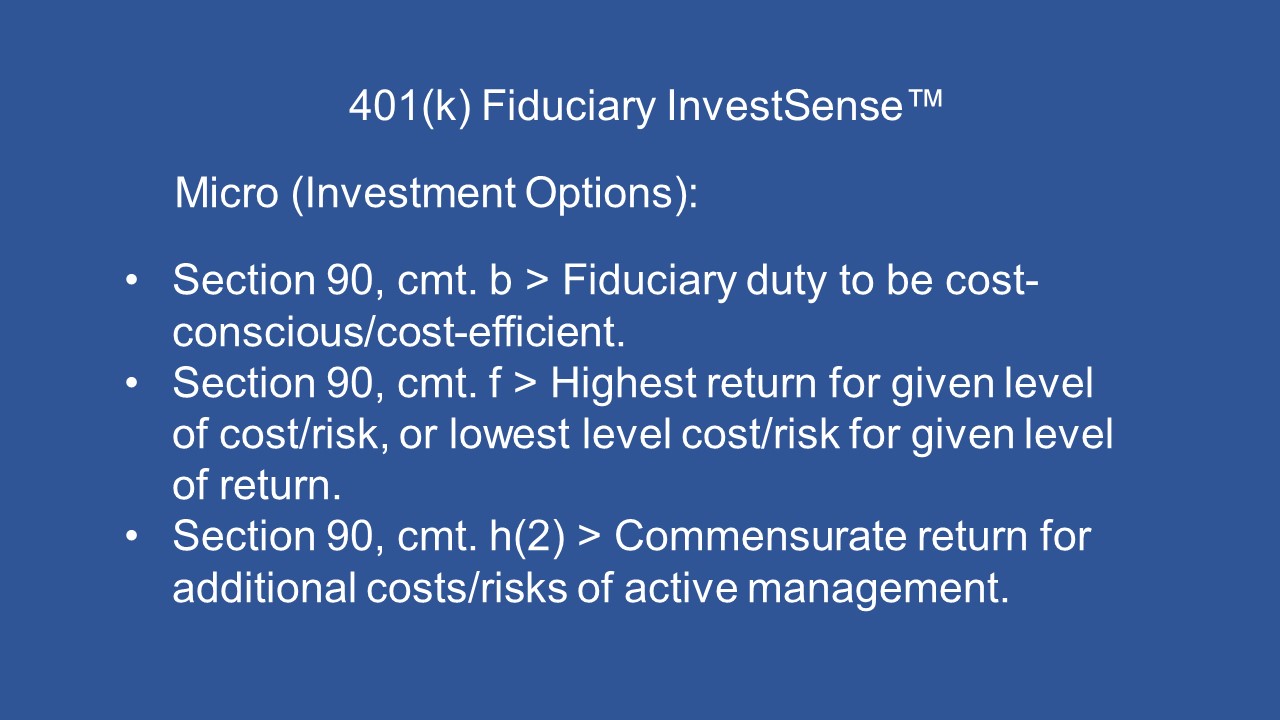


 The Prudent Investment Fiduciary Rules
You must be logged in to post a comment.