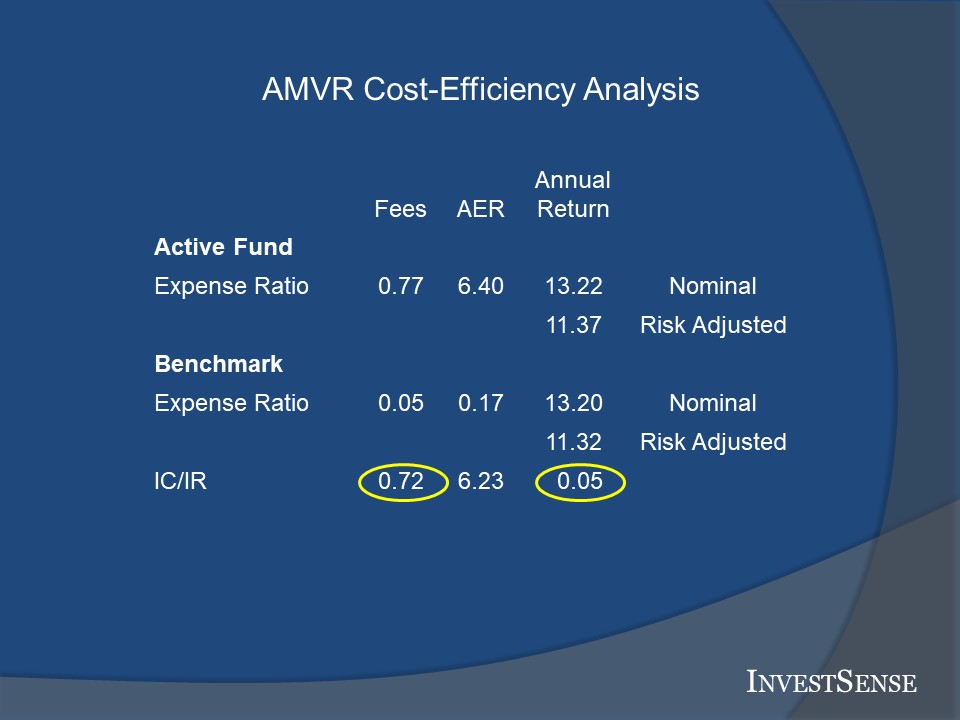
At that point, many people, both investment professionals and ordinary investors, stop their AMVR analysis of the actively managed fund in question, unnecessarily exposing themselves to potential financial losses and/or legal liability. When InvestSense provides pension plans and attorneys with consulting services and forensic audits, we re-calculate a fund’s incremental returns using risk-adjusted returns and the fund’s incremental costs using the Active Expense Ratio (AER) metric.
Many people are unfamiliar with the AER. Created by Ross Miller, the AER factors in the implicit impact of a fund’s correlation of returns to the benchmark used in the AMVR analysis. The importance of this step in an AMVR analysis is that the higher the active fund’s correlation of returns to the applicable benchmark, the less contribution that the actively managed fund’s management is actually providing to the active fund’s overall performance. As Professor Miller explained,
Mutual funds appear to provide investment services for relatively low fees because they bundle passive and active fund management together in a way that understates the true cost of active management. In particular, funs engaging in closet or shadow indexing charge their investors for active management while providing them with little more than an indexed investment. Even the average mutual fund, which ostensibly provides only active management, will have over 90% of the variance in its returns explained by its benchmark index.1
The AER also helps identify and avoid so-called “closet index” funds. Closet index funds are, by definition, cost-inefficient, charging excessive fees for underperformance. As one noted expert explained,
a large number of funds that purport to offer active management and charge fees accordingly, in fact persistently hold portfolios that substantially overlap with market indices….Investors in a closet index fund are harmed by for fees for active management that they do not receive or receive only partially. .
Closet indexing raises important legal issues. Such funds are not just poor investments; they promise investors a service that they fail to provide. As such, some closet index funds may also run afoul of federal securities laws.3
Over the last decade or so, there has been a definite trend of extremely high correlation of returns between U.S. domestic equity funds and comparable index funds. Professor Miller’s study found that the AER number for most U.S. domestic equity funds was often 400-500 percent higher than the fund’s publicly stated expense ratio, sometimes even higher.
Today, it is not uncommon to find that most U.S. domestic equity funds have high R-squared, or correlation, numbers of 90 percent of more. The higher a fund’s R-squared number and its incremental costs, the higher the fund’s AER number will be.
Charles D. Ellis, one of America’s most respected investment experts, stressed the importance of an actively managed fund’s correlations of returns numbers by pointing that on a fund that has an R-squared number of 95, that leaves the remaining 5 percent of the fund’s return having to try to justify the fund’s incremental costs. The odds of that happening are extremely unlikely, especially on a consistent basis, given the high correlation between the funds.
Active Management Value RatioTM 4.0
Active Management Value RatioTM (AMVR) 4.0 differs from AMVR 3.0 in the methodology used to calculate AMVR. In AMVR 3.0, we divided incremental cost by incremental return. Several legal colleagues and retired judges suggested that I “flip” the calculation to make it more similar to the Sharpe Ratio and, hopefully, make it easier to gain greater admissibility in the courts.
The main purpose of the AMVR is to establish whether a certain actively managed mutual fund is cost-efficient or not relative to a comparable, less expensive index fund. By establishing the cost-inefficiency of an actively managed mutual fund, the plaintiffs’ ERISA attorney creates a “material issue of fact,” which should prevent the court from dismissing the plan participants’ case.
Courts decide issues of law; juries decide questions of fact. While most 401(k)/403(b) actions are bench trials, I believe that may change in the near future, in part because of AMVR slides like the one shown here. I believe the AMVR would help juries answer the fundamental question- are an actively managed fund’s incremental costs greater than incremental returns?
When people ask me about the AMVR, I tell them that the AMVR addresses the basic question every investor should ask about an actively managed mutual fund:
Does the actively managed fund provide a commensurate return for the additional costs and risks an investor is asked to assume?
This come directly from the the “Prudent Investor Rule,” Section 90 of the Restatement (Third) of Trusts, comment h(2).
So what story does this AMVR “cheat sheet” slide tell us? This slide presents information on the six non-index funds from the top ten mutual funds used in U.S. defined contribution plan, based on invested assets, from “Pensions & Investments” annual survey. FIrst of all, the high R-squared correlation numbers should alert us to the possibility of “closet index” funds.
Next, 5 out of the 6 funds fail to provide a positive incremental return relative to a comparable Vanguard index fund based on nominal returns. Nominal returns are the simple return numbers you see on online services such as Morningstar. A fund obviously does not provide a commensurate return when it underperforms the benchmark fund.
To be cost-efficient, a fund’s AMVR has to be positive and greater than 1.00, showing that a fund’s nominal incremental returns are greater than the fund’s incremental costs. Here, Dodge and Cox Funds’s nominal AMVR score would be 8.93 (4.20./0.47).
However, ERISA plaintiff attorneys and others would argue that the use of nominal return numbers does not present an accurate picture of the situation. Many argue that investment performance figures are misleading unless they are adjusted for both risk and correlation of returns.
Here we see that adjusting for risk, using standard deviations, two funds produce positive annualized return, Dodge & Cox Stock Fund (2.69) and T. Rowe Price Blue Chip Growth (0.14). Those numbers are expressed in terms of basis points (bps). A basis point is one one-hundredth (0.01) of one percent. One hundred basis points equals one percent.
In our example Dodge and Cox had a higher standard deviation (19.14%) than the benchmark fund, Vanguard’s Large Cap Index Fund (VIGAX) (16.24). That explains Dodge & Cox Stock Fund’s lower risk-adjusted incremental return number.
The incremental costs numbers are calculated using the Active Expense Ratio (AER) mentioned earlier. The AER estimates a fund’s active weight/contribution, then determines the active’s fund’s inferred effective expense ratio. In essence, it indicates whether a fund’s incremental returns justify the fund’s incremental costs and, if not, the inferred additional costs.
High incremental costs combined with a high correlation of returns number significantly increase a fund’s AER number. Here, the combination of a high correlation number (97) combined with a moderately high incremental costs number (47 bps) resulted in an AER of 3.00, as compared to its nominal, or stated, expense ratio of 52 bps
As a result, Dodge & Cox Fund’s AMVR of 0.89 would technically classify it as cost-inefficient since its AMVR is less than 1.00. An investor should look for other options that provide a higher AMVR score.
As for the T. Rowe Price Blue Chip Growth Fund, the small positive risk-adjusted incremental return was completely overwhelmed by the fund’s high AER, the result of the combination of its high incremental costs (1.16 percent, or 116 bps) and high correlation of returns (98), resulting in an AER of 9..23. The fund’s AMVR would be its risk-adjusted incremental return (0.14) divided by its correlation-adjusted costs (9.23), 0.01, well-below the 1.00 required for cost-efficient status.
Going Forward To borrow from the Oracle of Omaha:
Rule No. 1 – With regard to actively managed mutual funds, only invest in funds that provide a commensurate return for the additional costs and risks an investor in such finds is asked to assume.
Rule No. 2 – Calculate such additional cost and risks based upon a fund’s risk-adjusted returns and correlation-adjusted costs.
Rule No. 3 – Never forget Rules No. 1 and No. 2.
Very few actively managed mutual funds will ever pass this test using the “humble arithmetic” of the AMVR, simply because most actively managed funds are not cost-efficient. As a result, investors and plan participants will be directed back toward the relative safety and financial security of index funds, and investment fiduciaries will avoid unnecessary and unwanted fiduciary liability exposure.
Notes 1. Ross Miller, “Evaluating the True Cost of Active Management by Mutual Funds,” Journal of Investment Management, Vol. 5, No. 1, 29-4. 2. Martijn Cremers and Quinn Curtis, Do Mutual Fund Investors Get What they Pay For?:The Legal Consequences of Closet Index Funds, https://papers.ssrn.com/sol/papers.cfm?abstract_id=2695133.
This article is neither designed nor intended to provide legal, investment, or other professional advice since such advice always requires consideration of individual circumstances. If legal, investment, or other professional assistance is needed, the services of an attorney or other professional advisor should be sought.
The very essence of leadership is that you have to have a vision. You can’t blow an uncertain trumpet. – Father Theodore Hesburgh, University of Notre Dame
Over twenty years ago, I registered the domain name “investsense.com.” Since then, I have advocated what my concept of the term means and the potential benefits that can be derived by practicing investsense.
InvestSense – the art and science of combining sound, proven investment techniques and strategies with simple, common sense,
My vision is equally simple:
Plaintiff ERISA attorneys who incorporate CommonSense InvestSense principles into their practices should never lose a 401(k)/403(b) fiduciary breach case.
401(k) and 403(b) plan sponsors who properly incorporate CommonSense InvestSense principles into the plan’s investment selection process should never lose an action alleging a breach of their fiduciary duties.
Now, I cannot guarantee those outcomes because, as we have seen, the courts have made some “interesting” decisions based on arguments that seem contrary to both ERISA’s stated purpose and the common law of trusts, from which fiduciary law is largely derived. As I write this post, SCOTUS is considering whether to rectify some questionable rulings involving a plan sponsor’s burden of proof in 401(k)/403(b) litigation
The basic rule of pleading is that the plaintiff is only required to provide the defendant with sufficient information to put the defendant “on notice” of what the plaintiff’s general allegations, or “notice pleading.” The reason for this rule is that the specific information involved in the alleged wrongdoing is, in most cases, exclusively within the possession of the defendant in the early stages of litigation and until the plaintiff has had the opportunity to conduct discovery. Therefore, it would be, and is, inherently inequitable to require greater specificity in the plaintiff’s initial pleadings.
Yet, some courts have done just that, dismissing 401(k) and 403(b) fiduciary breach actions based not on the merits of the case, but rather on concepts such as “comparing apples and oranges” and “menu of options.” The arguments against such questionable standards is that not only are they inconsistent with ERISA’s provisions, but they also ignore ERISA’s stated purpose, the protection of pension plan participants. Too often, recent ERISA court decisions have seemed to go out of their way to protect plans at the expense of the plan’s participans.
In two separate cases, Putnam Investments, LLC v. Brotherston and now Hughes v. Northwestern University, the Solicitor General has submitted an amicus brief to SCOTUS arguing that the burden of proof on the issue of causation, i.e., whether the plan sponsor was prudent in the selection of the plan’s investment options, should fall on the plan sponsor once the plan participants have provided sufficient notice pleading. The Solicitor Generals have pointed out that such a duty would be consistent with both the common law of trusts and rulings of other U. S. appellate courts.
SCOTUS has not indicated whether it will hear the Northwestern case. With the term of the current term almost over, it appears that the earliest the Court would consider the case will be the next term, which begins in October.
In the meantime, plan sponsors and plaintiff ERISA attorneys should consider the potential benefits of incorporating CommonSense InvestSense principles, as they would apply regardless of the outcome in the Northwestern case. The basic foundation for the InvestSense concept is the studies of investment icons Nobel laureate Dr. William D. Sharpe, Charles D. Ellis and Burton Malkiel.
Properly measured, the average actively managed dollar must underperform the average passively managed dollar, net of costs….The best way to measure a manager’s performance is to compare his or her return with that of a comparable passive alternative.”1
So, the incremental fees for an actively managed mutual fund relative to its incremental returns should always be compared to the fees for a comparable index fund relative to its returns. When you do this, you’ll quickly see that that the incremental fees for active management are really, really high—on average, over 100% of incremental returns!2
Past performance is not helpful in predicting future returns. The two variables that do the best job in predicting future performance [of mutual funds] are expense ratios and turnover.3
This emphasis on cost consciousness and the cost-efficiency of investments is consistent with the fiduciary principles set out in the Restatement (Third) of Trusts. The importance of costs and cost-efficiency is also a core concept in the SEC’s new Regulation Best Interest (Reg BI). In discussing Reg BI’s provisions regarding costs as a factor in recommending investments, former SEC Chairman Jay Clayton stated that
A rational investor seeks out investment strategies that are efficient in the sense that they provide the investor with the highest possible expected net benefit, in light of the investor’s investment objective that maximizes utility.4
[A]n efficient investment strategy may depend on the investor’s utility from consumption, including…(4) the cost to the investor of implementing the strategy.5
One comment was particularly interesting with regard to its applicability to the concept of InvestSense.
[W]hen a broker-dealer recommends a more expensive security or investment strategy over another reasonably available alternative offered by the broker-dealer, the broker-dealer would need to have a reasonable basis to believe that the higher cost is justified (and thus nevertheless in the retail customer’s best interest) based on other factors….6
So cost matter. John Bogle said it. Ellis, Sharpe and Malkiel said it. And now former SEC Chairman Clayton is on record as saying it. I cannot wait to hear how plan sponsors are going to argue that cost-inefficient investment options are justified/prudent. So how does that translate into 401(k)/403(b) litigation and the potential benefits to ERISA plaintiff attorneys and plan sponsors of incorporating the core principles of InvestSense into their worlds?
A couple of years ago I created a metric, the Active Management Value RatioTM (AMVR), that allows investors, fiduciaries and attorneys to simply and quickly determine the cost-efficiency, and thus prudence, of actively managed mutual funds. Additional information about the AMVR is available on this blog, or click here.
Again, if SCOTUS does rule that plan sponsors have the burden of proof on the issue of causation, then plan sponsors will face the same cost-efficiency issues addressed by Clayton, the need to show a reasonable basis for the selection of higher cost investment options for their plan. That may prove to be a formidable task, given that studied have consistently shown that the overwhelming majority of actively managed funds are cost-inefficient relative to comparable passive, or index funds.
99% of actively managed funds do not beat their index fund alternatives over the long term net of fees.7
Increasing numbers of clients will realize that in toe-to-toe competition versus near–equal competitors, most active managers will not and cannot recover the costs and fees they charge.8
[T]here is strong evidence that the vast majority of active managers are unable to produce excess returns that cover their costs.9
[T]he investment costs of expense ratios, transaction costs and load fees all have a direct, negative impact on performance….[The study’s findings] suggest that mutual funds, on average, do not recoup their investment costs through higher returns.10
These findings have resulted in recommendations that investment fiduciaries such as plan sponsors seriously consider selecting index funds instead of actively managed mutual funds. John Langbein, who served as the Reporter for the committee that wrote the Restatement (Thrid) of Trusts offered the following advice:
When market index funds have become available in sufficient variety and their experience bears out their prospects, courts may one day conclude that it is imprudent for trustees to fail to use such accounts. Their advantages seem decisive: at any given risk/return level, diversification is maximized and investment costs minimized. A trustee who declines to procure such advantage for the beneficiaries of his trust may in the future find his conduct difficult to justify.11
And the First Circuit Court of Appeals took the unusual step of offering the following advice to those who might object to its Brotherston decision:
In so ruling, we stress that nothing in our opinion places on ERISA fiduciaries any burdens or risks not faced routinely by financial fiduciaries. While Putnam warns of putative ERISA plans forgone for fear of litigation risk, it points to no evidence that employers in, for example, the Fourth, Fifth, and Eighth Circuits, are less likely to adopt ERISA plans. Moreover, any fiduciary of a plan such as the Plan in this case can easily insulate itself by selecting well-established, low-fee and diversified market index funds. And any fiduciary that decides it can find funds that beat the market will be immune to liability unless a district court finds it imprudent in its method of selecting such funds, and finds that a loss occurred as a result. In short, these are not matters concerning which ERISA fiduciaries need cry “wolf.”12
For my part, I offer the following AMVR fiduciary analysis comparing a very common investment option in 401(k) and 403(b) plans, the Fidelity Contrafund Fund (FCNKX), to the Fidelity Large Cap Growth Index Fund (FSPGX). As the slide clearly shows, Contrafund is cost-inefficient, and thus imprudent, relative to Fidelity’s own large cap growth index fund.
This is not to slight Contrafund’s legendary manager, Will Danoff. Working against Contrafund is its high expense ratio (77 basis points) and high R-squared correlation number (97) relative to the large cap growth index fund. The disparity is even more alarming if the analysis is done using Ross Miller’s Active Expense Ratio, which factors a fund’s R-squared correlation number even more heavily.
Trust me, there are plenty of other examples documenting the cost-inefficiency of popular 401(k)/403(b) actively managed mutual funds. The fact is that “true” actively managed mutual funds will always have higher expense ratios (Ellis) and higher trading costs (Malkiel).
Advocates of actively managed funds often argue that active management can offset such higher costs with better performance. Theoretically, yes. However, remember the quotes from the earlier studies. History does not support that optimism.
Furthermore, Contrafund’s high R-squared correlation number (97), is reflective of a definite trend of more than a decade of U.S. domestic equity funds having correlation numbers of 90 and above, many higher than 95, relative to comparable index funds. Bottom line-odds of a fiduciary breach being found are extremely high when actively managed funds are compared to comparable index funds.
Going Forward At the beginning of this post, I set out two of my visions about CommonSense InvestSense
ERISA plaintiff attorneys who incorporate CommonSense InvestSense principles into their practice should never lose a 401(k)/403(b) fiduciary breach action.
410(k) and 403(b) plan sponsors who properly incorporate CommonSense InvestSense principles into the plan’s investment selection process should never lose an action alleging a breach of their fiduciary duties
As I have explained the importance of the Northwestern case and the potential ramifications of a SCOTUS decision to plan sponsors, I usually get a question as to why there are no potential adverse implications from the case for plan advisers since, in most cases, the plan sponsors were simply following the plan adviser’s recommendations and advice. There
There are definitely potential adverse implications for plan advisers as a result of a SCOTUS decision in the Northwestern case. However, those implications will most likely be determined by plan sponsors reaction to the Court’s decision rather than as a result of the decision itself.
Notes 1. William F. Sharpe, “The Arithmetic of Active Investing,” available online at https://web.stanford.edu/~wfsharpe/art/active/active.htm. 2. Charles D. Ellis, “Letter to the Grandkids: 12 Essential Investing Guidelines,” available online athttps://www.forbes.com/sites/investor/2014/03/13/letter-to-the-grandkids-12-essential-investing-guidelines/#cd420613736c 3. Burton G. Malkiel, “A Random Walk Down Wall Street,” 11th Ed., (W.W. Norton & Co., 2016), 460. 4. “Regulation Best Interest: The Broker-Dealer Standard of Conduct,” Release No. 34-86031; File No. S7-07-18, https://www.sec.gov/rules/final/2019/34-86031.pdf, 378 5. Ibid., 378 6. Ibid., 279 7. . Laurent Barras, Olivier Scaillet and Russ Wermers, False Discoveries in Mutual Fund Performance: Measuring Luck in Estimated Alphas, 65 J. FINANCE 179, 181 (2010). 8.. Charles D. Ellis, The Death of Active Investing, Financial Times,January 20, 2017, available online at https://www.ft.com/content/6b2d5490-d9bb-11e6-944b-eb37a6aa8e. 9. Philip Meyer-Braun, Mutual Fund Performance Through a Five-Factor Lens, Dimensional Fund Advisors, L.P., August 2016. 10. Mark Carhart, On Persistence in Mutual Fund Performance, Journal of Finance, Vol. 52, No. 1, 57-8 (1997). 11. Brotherston v. Putnam Investments, LLC,, 907 F.3d 17, 39 (1st Cir. 2018) 12. John H. Langbein and Richard A. Posner, Measuring the True Cost of Active Management by Mutual Funds, Journal of Investment Management, Vol 5, No. 1, First Quarter 2007 http://digitalcommons.law.yale.edu/fss_papers/498.
This article is neither designed nor intended to provide legal, investment, or other professional advice since such advice always requires consideration of individual circumstances. If legal, investment, or other professional assistance is needed, the services of an attorney or other professional advisor should be sought.implications
“Properly measured, the average actively managed dollar must underperform the average passively managed dollar, net of costs….The best way to measure a manager’s performance is to compare his or her return with that of a comparable passive alternative.”1
Ask a plan sponsor, trustee or other investment fiduciary about their investment selection process, and they will probably quote you annualized return, nothing more, because they do not bother to properly select and monitor investments. Probably because in too many cases they do not know how to properly select and monitor investments.
This may seem harsh, but the evidence supports my theory. Take Dr. Sharpe’s quote for example. How many fiduciary investors bother to compare potential actively managed fund choices with a comparable index fund? How many fiduciary investors simply blindly follow whatever advice their adviser recommends, again because they do not know to properly evaluate the funds themselves?
SCOTUS has recognized the legitimacy of the Restatement of Trusts as a resource in addressing fiduciary questions. Section 90 of the Restatement, commonly known as the Prudent Investor Rule, stresses two consistent themes, cost-efficiency and risk-management through diversification. With regard to cost-efficiency, the Restatement states that
Active strategies, however, entail investigation and analysis expenses and tend to increase general transaction costs,…If the extra costs and risks of an investment program are substantial, those added costs and risks must be justified by realistically evaluated return expectations. Accordingly, a decision to proceed with such a program involves judgments by the [fiduciary] that: (a) gains from the course of action in question can reasonably be expected to compensate for its additional costs and risks;…2 – Restatement (Third) Trusts [Section 90 cmt h(2)]
Because the differences in the totality of the costs…can be significant, it is important for the [fiduciary] to make careful overall cost comparisons, particularly among similar products of a specific type being considered for a [plan’s] portfolio.3
Investment icon Charles D. Ellis has contributed immeasurably to the wealth management industry over the years, especially in the area of prudent and cost-efficient investing. One of Ellis’ greatest contributions has been the recommendation that
So, the incremental fees for an actively managed mutual fund relative to its incremental returns should always be compared to the fees for a comparable index fund relative to its returns. When you do this, you’ll quickly see that that the incremental fees for active management are really, really high—on average, over 100% of incremental returns!4
With that in mind, it should come as no surprise that studies have consistently found that the overwhelming majority of act5ively managed mutual funds are not cost-efficient.
“99% of actively managed funds do not beat their index fund alternatives over the long-term net of fees.”5
“[I]ncreasing numbers of clients will realize that in toe-to-toe competition versus near-equal competitors, most active managers will not and cannot recover the costs and fees they charge.6
“[T]he investment costs of expense ratios, transaction costs and load fees all have a direct, negative impact on performance….[The study’s findings] suggest that mutual funds, on average, do not recoup their investment costs through higher returns.”7
“[T]here is strong evidence that the vast majority of active managers are unable to produce excess returns that cover their costs.”8
Several years ago I created a metric, the Actively Managed Value RatioTM (AMVR), based upon Ellis’ research and findings. The metric is simple, yet powerful. I use it in both my forensic investment analysis and my 401(k)/403(b) compliance consulting practices.
To further demonstrate the power of the AMVR, I often present the AMVR as an analogy to passing in football. When a football team throws a pass,, three things can happen, two of which are bad – a completion, an incompletion, or an interception.
The same soft of analogy can be used with regard to investing in actively managed mutual funds. Using the AMVR and Ellis’ incremental cost/incremental return technique for illustration purpose, investing in actively managed mutual funds results in one of four results – incremental returns greater than incremental costs (cost-efficient investing), or one of three scenarios in which incremental costs exceed incremental returns (cost-inefficient investing), what I call the AMVR Triple Option
In AMVR Analysis Triple Option #1, the actively managed fund simply underperforms the comparable benchmark index fund. Other than computing damages, there is no reason to even factor in the fund’s incremental costs in determining prudence given the active fund’s underperformance.
In AMVR Analysis Triple Option #2, the actively managed fund manages to produce a positive return. However, the fund’s incremental costs clearly exceed the fund’s incremental return by well over 100 percent. As a result, the active fund would still be an imprudent investment choice.
AMVR Analysis Triple Option #3 is the one that the plaintiff’s bar is increasingly using to argue a breach of fiduciary duties by investment fiduciaries. This option involves a metric, Ross Miller’s Active Expense Ratio, which factors in the R-squared, or correlations of returns number, between an actively managed fund and a comparable benchmark index fund.
Why factor in an active fund’s correlation of returns number? Miller explains that
Mutual funds appear to provide investment services for relatively low fees because they bundle passive and active fund management together in a way that understates the true cost of active management. In particular, funds engaging in closet or shadow indexing charge their investors for active management while providing them with little more than an indexed investment. Even the average mutual fund, which ostensibly provides only active management, will have over 90% of the variance in its returns explained by its benchmark index.9
Over the past ten to fifteen years, there has been a definite trend of increasing correlation of returns between U.S. domestic equity funds. As a result, there has been a an increasing correlation of returns between U.S. domestic equity funds and index funds.
In some cases, the high correlation of returns may have been due to a deliberate attempt by actively managed funds trying to avoid large differences in performance so as not to potentially lose investors to index funds. Funds that engage in such practices have come to be known as “closet index” funds and “index huggers.”
In this example, the correlation of returns between the active fund and the index fund was 97. As the graphic shows, active funds that have high incremental costs and/or a high correlation of returns number will see a dramatic increase in their effective expense ratio, as well a dramatic decrease in their AMVR/cost-efficiency score.
A fund’s R-squared, aka correlation of returns, number also plays a factor in the Restatement’s other consistent theme, risk management through effective diversification. The key to effective diversification is to create an investment portfolio consisting of investments that are not highly correlated, investments that counter balance each other during varying market and/or economic conditions, the hope being the avoidance of large financial losses. So while most investors ,including fiduciary investors, believer that investing is an active, offensive process that focuses on returns, Ellis has long maintained that
“Even though most investors see their work as active, assertive, and on the offensive, the reality is and should be that stock and bond investing alike are primarily a defensive process. The great secret for success in long-term investing is to avoid serious losses.”10
Going Forward Cost-efficiency and the AMVR are simply common sense. And yet, when I show plan sponsors and trustees the AMVR Triple Option slides, they usually immediately respond positively and say that, for the first time, they understand the prudent investment process. Unfortunately, at that point they also realize that they have not been following a prudent process and that their plan/trust, and themselves, face unlimited liability.
The AMVR is a simple, yet powerful tool that can produce a win-win situation for both beneficiaries/trustees and plan participants/plan beneficiaries for investment fiduciaries that are willing to invest a little time and learn to properly use the AMVR.
Notes 1. William F. Sharpe, “The Arithmetic of Active Investing,” available online at https://web.stanford.edu/~wfsharpe/art/active/active.htm. 2. Restatement (Third) Trusts, Section 90, cmt h(2). (American Law Institute) 3. Restatement (Third) Trusts, Section 90, cmt m. (American Law Institute) 4. Charles D. Ellis, “Letter to the Grandkids: 12 Essential Investing Guidelines,” available online at https://www.forbes.com/sites/investor/2014/03/13/letter-to-the-grandkids-12-essential-investing-guidelines/#cd420613736c 5. Laurent Barras, Olivier Scaillet and Russ Wermers, False Discoveries in Mutual Fund Performance: Measuring Luck in Estimated Alphas, 65 J. FINANCE 179, 181 (2010). 6. Charles D. Ellis, The Death of Active Investing, Financial Times, January 20, 2017, available online at https://www.ft.com/content/6b2d5490-d9bb-11e6-944b-eb37a6aa8 Ellisa, Charles D., “Winning the Loser’s Game: Timeless Strategies for Successful Investing,” 6th Ed., (New York, NY, 2018e. 7 Philip Meyer-Braun, Mutual Fund Performance Through a Five-Factor Lens, Dimensional Fund Advisors, L.P., August 2016. 8. Mark Carhart, On Persistence in Mutual Fund Performance, Journal of Finance, Vol. 52, No. 1, 57-8 (1997). 9. Ross Miller, “Evaluating the True Cost of Active Management by Mutual Funds,” Journal of Investment Management, Vol. 5, No. 1, 29-4 10. Charles D. Ellis, “Winning the Loser’s Game: Timeless Strategies for Successful Investing,” 6th Ed., (New York, NY, 2018)
The Solicitor General of the United States recently filed an amicus brief with SCOTUS asking the Court to hear the case of Hughes v. Northwestern University (Northwestern). The case involves questions regarding the management of University’s 403(b) plan, specifically potential breaches of the plan’s fiduciary duties. You can find a link to the brief here.
While the petition for certiorari poses several questions, the one that I believe could, and should, be unequivocally resolved is the so-called “menu of investment options” defense. While this issues has already been rejected by most courts, there are a few courts that continue to accept the defense, effectively deny plan participants the rights and protections guaranteed to them under ERISA. The plaintiffs cite this ongoing division within the federal judicial circuits as one reason for why cert should be granted.
The case comes to SCOTUS from the Seventh Circuit Court of Appeals. I point this out because of the Seventh Circuit’s statement in connection with an earlier case, Hecker v. Deere & Co. Actually, I should say Hecker I (556 F.3d 575 (2009) and Hecker II (569 F.3d 708 (2009)). In Hecker I, the Seventh Circuit handed down a decision which many interpreted to suggest that plans could insulate themselves from liability by simply offering a large number of potential investment options, regardless of whether they were legally prudent or not.
The decision produced such an uproar that the plaintiffs filed a request for a re-hearing by the entire Seventh Circuit. While the Court denied the request for a re=hearing, they did take the opportunity to “clarify” their earlier decision. In addressing the Secretary of Labor’s concerns regarding immunity and the “menu of options” related portion of the Court’s decision, The Court responded as follows:
The Secretary also fears that our opinion could be read as a sweeping statement that any Plan fiduciary can insulate itself from liability by the simple expedient of including a very large number of investment alternatives in its portfolio and then shifting to the participants the responsibility for choosing among them. She is right to criticize such a strategy. It could result in the inclusion of many investment alternatives that a responsible fiduciary should exclude. It also would place an unreasonable burden on unsophisticated plan participants who do not have the resources to pre-screen investment alternatives. The panel’s opinion, however, was not intended to give a green light to such “obvious, even reckless, imprudence in the selection of investments” (as the Secretary puts it in her brief).
And yet, many would argue that that is what the Seventh Circuit has continued to do, including in the Northwestern case currently before the SCOTUS. The Solicitor General, in noting the ongoing division between federal judicial districts, cited the rejection of the “menu of options” argument in other Circuit Courts of Appeal:
“fiduciaries are not excused from their obligations not to offer imprudent investments with unreasonably high fees on the ground that they offered other prudent investments.” (citing Sweda v.University of Pa.,923 F.3d 320, 332 n.7 (3d Cir. 2019))
“It is no defense to simply offer a ‘reasonable array’ of options that includes some good ones, and then ‘shift’ the responsibility to plan participants to find them.” (citing Davis v. Washington Univ. in St. Louis, 960 F.3d 478, 484 (8th Cir. 2020)
The Solicitor General concluded with the recommendation that SCOTUS grant cert and hear the case, stating that
The case presents an opportunity for this Court to clarify that ERISA requires fiduciaries to work actively to limit a plan’s expenses and remove imprudent investments, and that fiduciaries will not be excused from those responsibilities on the ground that they selected some (or even many) other prudent investments for a plan.
I believe that the First Circuit’s Brotherston decision and the Solicitor General’s amicus brief to SCOTUS in that case put to rest the “apples and oranges” argument regarding the use of index funds for benchmarking purposes. Hopefully, SCOTUS will follow the Solicitor General’s recommendation and hear Hughes v. Northwestern in order to ensure that all federal judicial districts are making consistent and equitable decisions in 401(k) and 403(b) actions by using the same guidelines and principles, ensuring plan participants the rights and protections guaranteed to them under ERISA.
We provide two sets of data so that users can choose which data to use. The nominal data is based on the publicly disclosed data. The second set of data is the nominal data adjusted for risk and the funds’ R-squared, or correlation of returns, number. InvestSense believes that the adjusted data provides a more accurate, and thus a more meaningful comparison for users.
At the end of each calendar quarter, InvestSense updates the Active Management Value Ratio ™ “cheat sheet.” The “cheat sheet” provides data that allows fiduciaries, investors and attorneys to calculate the cost-efficiency of the top non-index funds from “Pensions & Investments” annual list of the top ten mutual funds in U.S. 401(k) plans, based on the cumulative invested assets within each fund within the plans.
Since fiduciaries are required to continually monitor their investment selections for continued prudence, we have chosen to switch our time frame from five years to three years. This reflects a more timely and prudent review process.
The Active Management Value Ratio (AMVR) is simply a fund’s incremental cost divided by its incremental return. Interpreting the AMVR is equally easy. Once an actively managed fund’s cost efficiency has been calculated relative to a comparable benchmark, usually a comparable index fund, the plan sponsor or the ERISA attorney only have to answer two simple questions:
1. Did the actively managed fund provide a positive incremental return? 2. If so, did the actively managed fund’s incremental return exceed the fund’s incremental costs
If the answer to either of these of these questions is “no,” the actively managed is not cost-efficient and, therefore, does not meet the plan sponsor’s fiduciary duty of prudence. The AMVR also allows the user to determine with other regulatory compliance standards, including the SEC’s Reg BI’s “best Interest” standard and FINRA’s “suitability,” “fair dealing” and “high commercial standards” standard.
The AMVR is based on the prudence standards set out in the Restatement (Third) of Trusts1 (Restatement) and the research and finding of several well-known and respected investment experts.
Comparison of actively managed and index funds: ‘[T]he best way to measure a manager’s performance is to compare his or her return with that of a comparable passive alternative.“-Nobel laureate, Dr. William F. Sharpe2
Comparison of incremental costs and incremental returns:So, the incremental fees for an actively managed mutual fund relative to its incremental returns should always be compared to the fees for a comparable index fund relative to its returns. When you do this, you’ll quickly see that that the incremental fees for active management are really, really high—on average, over 100% of incremental returns!-Charles D. Ellis3
Adjusting incremental nominal costs for correlation of returns between an actively managed fund and a comparable benchmark index fund, using Ross Miller’s Active Expense Ratio metric:Mutual funds appear to provide investment services for relatively low fees because they bundle passive and active fund management together in a way that understates the true cost of active management. In particular, funs engaging in closet or shadow indexing charge their investors for active management while providing them with little more than an indexed investment. Even the average mutual fund, which ostensibly provides only active management, will have over 90% of the variance in its returns explained by its benchmark index.4
As for adjusting a fund’s nominal returns for risk, that us consistent with the Restatement’s position that prudent investing requires that investors that assume greater cost and/or risk should receive a commensurate return for the assumption of such additional cost and risks.5
Findings the 1Q 2021 AMVR ‘cheat sheet” shows two of the funds passing the AMVR’s prudence standard, a score of 1.0 or less, using the fund’s nominal returns- American Funds’ Washington Mutual R6 shares and Dodge and Cox Stock. However, when the correlation-adjusted costs (CAC) and risk-adjusted return (RAR) number are used, only Washington Mutual passes the AMVR’s prudence standards. Dodge and Cox Stock’s failure to pass on the adjusted number is due to a high R-squared correlation of returns number (97) and a high standard of deviation number (23.40).
Too many fiduciaries, investors ands attorneys overlook or do not understand the significance that a fund’s correlation of returns numbers can have in determining the overall prudence of a fund. As Charles D. Ellis has pointed out by example, an R-squared number of 95 leaves the remaining 5 percent of the fund’s return having to try to justify 100 percent fund’s incremental costs. The odds of that happening are extremely unlikely, especially on a consistent basis, given the current high correlation of returns between most U.S. actively managed and comparable index equity funds.
Going Forward Several weeks ago I publicly published the following AMVR forensic analysis comparing Fidelity Contrafund K shares (FCNKX), one of the most widely offered investment options in 401(k) and 403(b) plans, with Fidelity’s popular Large Cap Growth Index Fund (FSPGX).
The reaction has been immediate, from various groups, including fiduciaries, investors and attorneys. Steve Jobs said the secret to a memorable presentation is to create an “OMG” moment. This one analysis may turn out to be the OMG moment for the Active Management Value RatioTM .
Courts in 401(k)/403(b) fiduciary breach actions have consistently stated that the failure of a plan to choose the least expensive funds as investment options for a plan is required by ERISA. Courts often cite Judge Doty’s statement in Meiners v. Wells Fargo6 for support of this principle, with Judge Doty stating that plan participants must show “more” than just absolute fees to establish a breach of a plan sponsor’s fiduciary duties under ERISA.
The AMVR provides that “more” in a simple, yet powerful way. The AMVR and its focus on cost-efficiency is consistent with both ERISA’s and the Restatement’s focus on cost-consciousness. The AMVR is consistent with the SEC’s Reg BI and its focus on costs as a factor in determining “best Interest.” The AMVR is consistent with FINRA’s requirement that stockbrokers deal fairly with customers and always act consistently with high commercial standards.
SCOTUS has endorsed the Restatement as a resource that the courts often use in resolving fiduciary questions. Professor John Langbein served as the Reporter on the committee that wrote the current Restatement. Professor Langbein and Professor Richard Posner wrote an article article shortly after the new Restatement was released, over forty years ago, that I believe sums up the current fiduciary prudence controversy in the courts.
When market index funds have become available in sufficient variety and their experience bears out their prospects, courts may one day conclude that it is imprudent for trustees to fail to use such accounts. Their advantages seem decisive: at any given risk/return level, diversification is maximized and investment costs minimized. A trustee who declines to procure such advantage for the beneficiaries of his trust may in the future find his conduct difficult to justify.7
However, aside from legal aspects of the metric, numerous people have suggested that the most powerful aspect of the AMVR is that it just plain, common sense. When an investment’s incremental costs exceed its incremental return, the investment is obviously not prudent.
SCOTUS currently has a case before it, Hughes v. Northwestern University, which would allow the Court to resolve the current inequitable and divided interpretation of ERISA in various federal courts. Langbein and Posner’s foresight is over forty years old. The common sense approach of the AMVR shows the importance of factoring in cost-efficiency in determining the prudence of an investment. Hopefully, SCOTUS will hear the Northwestern University case and consider all these factors in order to make ERISA and fiduciary prudence meaningful again.
This article is for informational purposes only and is neither designed nor intended to provide legal, investment or other professional advice since such advice always requires consideration of individual facts and circumstances. If legal or other professional assistance is needed, the services of an attorney other appropriate professional adviser should be sought.
If we desire respect for the law, we must first make the law respectable.” Justice D. Brandeis Brandeis
SCOTUS is currently deciding whether to hear the Hughes v. Northwestern University1 403(b) case. The key issue in the case is an allegation of fiduciary breach by the plan with regard to the level of the plans fees.
SCOTUS had an opportunity to address this issue earlier in the Brotherston2 decision. However, SCOTUS decided not to hear the Brotherston decision, based largely upon the Solicitor General’s amicus brief advising them not to do so.
However, the Solicitor General’s recommendation not to hear the case was based primarily on the fact that the Brotherston case was an interlocutory appeal, as the case was still ongoing and all the evidence had not been presented. The Solicitor General’s amicus brief actually presented a compelling and well-reasoned discussion in support of shifting the burden of proof as to causation in 401(k) fiduciary litigation once the plan participants have met their burden of notice pleading on the fiduciary’s breach of duty and a resulting loss.
The Solicitor General’s argument was based on the common law of trusts. The Solicitor General referenced several sections of the Restatement (Third) of Trusts3 (Restatement) in support of his arguments. This is consistent with the Court’s acceptance of the Restatement as a valued resource in resolving fiduciary questions.
We have often noted that an ERISA fiduciary’s duty is ‘derived from the common law of trusts.’ .In determining the contours of an ERISA fiduciary’s duty, court often must look to the law of trusts.4
Just as in the Brotherston decision, SCOTUS has asked the current Solicitor General to file an amicus brief in the Hughes case. Since both Brotherston and Hughes involve similar issues, there would nothing improper about SCOTUS from going back and reconsidering the Solicitor General’s research and opinions on such issues. In short, the Solicitor concluded that Section 100 of the Restatement supported both the use of index funds as comparators in ERISA cases and the shifting of the burden of proof as to causation.
Citing the First Circuit’s Brotherston decision and Section 100, comment f, of the Restatement, the Solicitor General pointed out that
ERISA incorporates the ‘the common law of trusts’ and that trust law ‘places the burden of proof of disproving causation on the fiduciary once the beneficiary has established that there is a loss associated with the fiduciary’s breach.5
The Solicitor General, like the First Circuit, noted the equitable nature of such a shift given the fact that plans usually are the only party with all of the relevant information during the early stages of such litigation. Citing Section 100, comment c, the Solicitor General stated that
[t]he fiduciary is in the best position to provide information about how it would have made investment decisions in light of the objectives of the particular plan and the characteristics of plan participants. Indeed, this Court recognized in {earlier cases] that it is appropriate in some circumstances to shift the burden to establish ‘facts peculiarly within the knowledge of one party.”6(cites omitted)
The Solicitor General noted other benefits from shifting the burden of proof regarding causation to plans.
Applying trust law’s burden-shifting framework to ERISA fiduciary-breach claims also furthers ERISA’s purposes. In trust law, the burden shifting rests on the view that ‘as between innocent beneficiaries and a defaulting beneficiary, the latter should bear the risk of uncertainty as to the consequences of its breach of duty…Indeed, in some circumstances, ERISA reflects congressional intent to provide more protections than trust law.7 (cites omitted)
The amicus brief went on to note that
Applying trust law’s burden-shifting framework which can serve to deter ERISA fiduciaries from engaging in wrongful conduct, thus advances ERISA’s protective purposes. By contrast, declining to apply trust-law’s burden-shifting framework could create significant barriers to recovery for conceded fiduciary breaches.8 (emphasis added) (cites omitted)
As several of my other posts on this site have noted, ERISA fiduciary breach litigation has already seen too many instances of this type of injustice through legal fictions such as the “apples to oranges” and “menu of options” defenses, both of which are seemingly inconsistent with both ERISA and/or the Restatement.
Humble Arithmetic and ERISA Fiduciary Breach Litigation With the end of the quarter approaching, I will be preparing my “cheat sheet” on the most popular mutual funds in U.S. defined contribution plans, based on invested amounts. A recent Active Management Value Ratio (AMVR) has caused some discussion.
This image is a perfect example of the truth of Justice Brandeis’ statement regarding the “relentless rules of humble arithmetic.” Both of the funds are categorized as large cap growth funds by Morningstar. Both funds are from same fund family. Fidelity Contrafund is consistently ranked as one of the top five mutual funds offered as an investment option within U.S. defined contribution plans.
Based on this AMVR analysis, thi image would seem to provide the evidence plan participants need to prove both a fiduciary breach and a sustained loss. On the other hand, if the burden of proof regarding causation were shifted to the plan, it would seem to be a heavy burden to fulfill.
From years of conducting such AMVR forensic analyses, I can state that the image is a fairly consistent representation of the cost-inefficiency of most U.S. domestic equity funds. Those findings are also consistent with most academic studies of the such funds, resulting in findings such as
“99% of actively managed funds do not beat their index fund alternatives over the long-term net of fees.”9
“[I]ncreasing numbers of clients will realize that in toe-to-toe competition versus near-equal competitors, most active managers will not and cannot recover the costs and fees they charge.10
“[T]he investment costs of expense ratios, transaction costs and load fees all have a direct, negative impact on performance….[The study’s findings] suggest that mutual funds, on average, do not recoup their investment costs through higher returns.”11
“[T]here is strong evidence that the vast majority of active managers are unable to produce excess returns that cover their costs.”12
Going Forward A number of large financial services firms have recently sold their 401(k)/403(b) divisions. Could a possible explanation be concern over a possible review and adverse decision by SCOTUS and the inability to successfully such a burden? Could the humble arithmetic and simplicity of the Active Management Value Ratio metric be be a contributing factor in these decisions to leave the 401(k)/403(b) arena?
While this post has discussed the issues in terms of 401(k)/403(b) plans, it should be noted that the Solicitor General’s amicus brief addressed the issues in terms of the Restatement in general, which applies to all investment fiduciaries, e.g., trustees, RIAs, wealth managers, not just plan sponsors. Therefore, to use 401(k) legend Fred Reish’s familiar admonition, “forewarned is forearmed.”
Notes 1. Brotherston v. Putnam Investments, LLC, 907 F.3d 17 (1st Cir, 2018. 2. Hughes v. Northwestern University 3. Restatement (Third) Trusts (American Law Institute). 4. Tibble v. Edison, Intl., S. Ct. 1823 (2015). 5. Restatement (Third) Trusts, (American Law Institute). 6. “Brief for the United States as Amicus Curiae,” Putnam Investments, LLC v. Brotherston, available at Hughes v. Northwestern University – SCOTUSblog 7. Ibid. 8. Ibid. 9.Laurent Barras, Olivier Scaillet and Russ Wermers, False Discoveries in Mutual Fund Performance: Measuring Luck in Estimated Alphas, 65 J. FINANCE 179, 181 (2010). 10. Charles D. Ellis, The Death of Active Investing, Financial Times, January 20, 2017, available online at https://www.ft.com/content/6b2d5490-d9bb-11e6-944b-eb37a6aa8e. 11. Philip Meyer-Braun, Mutual Fund Performance Through a Five-Factor Lens, Dimensional Fund Advisors, L.P., August 2016. 12. Mark Carhart, On Persistence in Mutual Fund Performance, Journal of Finance, Vol. 52, No. 1, 57-8 (1997).
This article is for informational purposes only and is neither designed nor intended to provide legal, investment or other professional advice since such advice always requires consideration of individual facts and circumstances. If legal or other professional assistance is needed, the services of an attorney other appropriate professional adviser should be sought.
The First Circuit recognized this issue in its Brotherston decision.1 The Court noted that far too often in these cases, the plan has all or virtually all of the relevant information. As a result, demanding more than notice pleading at the initial stages of such actions and dismissing such actions for an inability to do so inequitable and draconian
In dismissing such actions, courts often cite Judge Doty’s decision, in the Meiners decision in which he stated that
In order to plausibly allege a fund is underperforming, Meiners must provide some benchmark against which the Wells Fargo funds can meaningfully be compared.
Meiners must plead something more to make his excessive fees claim plausible….Nothing in the complaint suggests that the Vanguard and Fidelity funds are reliable comparators….Without a meaningful comparison, the mere fact that the Wells Fargo funds are more expensive than the other two funds does not give rise to a plausible breach of fiduciary duty.2
Cost-efficiency provides plan sponsors, plan participants and attorneys with a simple, equitable and objective means of providing “more,” of comparing and monitoring investment options within a plan. Cost-efficiency avoids the dubious “apples to oranges” argument and focus entirely on the plan participants financial welfare. Using cost-efficiency, there are but two categories-cost efficient and cost-inefficient. The use of cost-efficiency in evaluating investments is consistent with the fiduciary standards established by the Restatement (Third) of Trusts, as well as FINRA and SEC standards, including Regulation Best Interest.
I created a simple metric, the Active Management Value RatioTM (AMVR), that allows for a quick and simple calculation of the cost-efficiency of actively managed mutual funds. The AMVR only requires a minimal amount of data, all of which is available for free online, and the ability to do simple math calculations.
Every Pictures Tell A Story As more people have read about the AMVR, I have received an increasing number of calls, emails and other forms of correspondence on how to interpret the metric. As a result, I have prepared a presentation that I use in meeting with prospective clients such as plan sponsors, trustees and plaintiff’s attorneys. The slides below are some of the slides from that presentation.
Many people only evaluate mutual funds in terms of a fund’s nominal, or publicly stated, costs, expense ratios and annualized returns. That approach completely overlooks other important costs and expenses, such as a fund’s trading costs. While funds are not legally required to disclose their actual trading costs, such costs are required to be deducted from the fund’s gross return in reporting their nominal returns.
In the slide below, it is obvious that the fund is not cost-efficient, as the fund fails to provide any positive incremental returns (IR), i.e., underperforms the relative benchmark.
The next step in an AMVR cost-efficiency analysis is evaluating cases in which a fund does produce a positive incremental return. However, this slide shows that a fund that produces a positive incremental return, or “alpha,” is not necessarily cost-efficient because the fund’s incremental costs exceed the fund’s incremental returns.
That’s how simple and straightforward the AMVR metric is. The AMVR is essentially the basic cost-benefit analysis technique used in various forms of business. The only difference is that the AMVR uses a fund’s incremental costs and incremental return for input data. The data are expressed in terms of basis points, a common financial term. A basis point equals 1/100th of a point (0.01), with 100 basis points equaling one point.
For those that find basis points confusing, I suggest “monetizing” the results by thinking of basis points in terms of dollars. In the example below, would anyone pay $72 in order to receive $7 dollars in return?
The following chart chart illustrates the goal-a fund whose incremental returns (5.78 bps) exceed the fund’s incremental costs (0.735 bps) .
Advanced AMVR At that point, many people, both investment professionals and ordinary investors, stop their AMVR analysis of the actively managed fund in question, unnecessarily exposing themselves to potential financial losses. When InvestSense provides pension plans and attorneys with consulting services and forensic audits, we re-calculate a fund’s incremental costs using the Active Expense Ratio (AER) metric.
Created by Ross Miller, the AER factors in the implicit impact of a fund’s correlation of returns to the benchmark used in the AMVR analysis. The importance of this step in an AMVR analysis is that the higher the active fund’s correlation of returns to the applicable benchmark, the less contribution that the actively managed fund’s management is actually providing to the active fund’s overall performance. As Professor Miller explained,
Mutual funds appear to provide investment services for relatively low fees because they bundle passive and active fund management together in a way that understates the true cost of active management. In particular, funs engaging in closet or shadow indexing charge their investors for active management while providing them with little more than an indexed investment. Even the average mutual fund, which ostensibly provides only active management, will have over 90% of the variance in its returns explained by its benchmark index.(19)
The AER also helps identify and avoid so-called “closet index” funds. Closet index funds are, by definition, cost-inefficient, charging excessive fees for underperformance. As one noted expert explained,
a large number of funds that purport to offer active management and charge fees accordingly , in fact persistently hold portfolios that substantially overlap with market indices….Investors in a closet index fund are harmed by for fees for active management that they do not receive or receive only partially. .
Closet indexing raises important legal issues. Such funds are not just poor investments; they promise investors a service that they fail to provide. As such, some closet index funds may also run afoul of federal securities laws.3
Over the last decade or so, there has been a definite trend of extremely high correlation of returns between U.S. domestic equity funds and comparable index funds. Professor Miller’s study found that the AER number for most U.S. domestic equity funds was often 400-500 percent higher than the fund’s publicly stated expense ratio, sometimes even higher.
Today, it is not uncommon to find that most U.S. domestic equity funds have high R-squared, or correlation, numbers, often 90 percent of more. The higher a fund’s R-squared number and its incremental costs are, the higher the fund’s AER number will be.
Charles D. Ellis, one of America’s most respected investment experts, stressed the importance of an actively managed fund’s correlations of returns numbers by pointing that on a fund that has an R-squared number of 95, that leaves the remaining 5 percent of the fund’s return having to try to justify the fund’s incremental costs. The odds of that happening are extremely unlikely, especially on a consistent basis, given the high correlation between the funds.
Going Forward Studies have consistently concluded that the overwhelming majority of actively managed funds are not cost-efficient, with conclusions such as
“99% of actively managed funds do not beat their index fund alternatives over the long-term net of fees.”4
“[I]ncreasing numbers of clients will realize that in toe-to-toe competition versus near-equal competitors, most active managers will not and cannot recover the costs and fees they charge.”5
“[T]he investment costs of expense ratios, transaction costs and load fees all have a direct, negative impact on performance….[The study’s findings] suggest that mutual funds, on average, do not recoup their investment costs through higher returns.”6
“[T]here is strong evidence that the vast majority of active managers are unable to produce excess returns that cover their costs.”7
Primarily for those reasons, I am on record as saying that the ERISA plaintiff’s bar should never lose a properly vetted case, e.g., AMVR evaluated. Granted, a court may have other ideas. However, in speaking with former judges and legal colleagues, they all say that the simplicity of the AMVR metric and the sheer disparity in the numbers in most cases should make it difficult for a court to ignore such evidence.
Likewise, using the AMVR, a plan sponsor can provide their plan participants with a meaningful opportunity to work toward retirement readiness, as well as avoid unnecessary liability exposure for themselves, to conduct the “thorough and objective” analysis and selection of each investment option within their plan, as required under ERISA.
Too ERISA cases are now seemingly being determined in large part on where the plan participants reside, as some courts continue to apply inconsistent and often puzzling interpretations of ERISA and applicable regulations. SCOTUS is currently considering a case involving the Northwestern University 403(b) plan, which could dramatically change the entire 401(k)/403(b) litigation landscape and ensure that a uniform and equitable process is in place and plan participants’ rights and guarantees under ERISA are protected.
In closing, perhaps the best way to summarize the data and arguments presented herein are to reference a quote made by John Langbein shortly after the Restatement (Third) of Trusts was released. Langbein, the reporter on the Restatement, made the following prediction:
When market index funds have become available in sufficient variety and their experience bears out their prospects, courts may one day conclude that it is imprudent for trustees to fail to use such accounts. Their advantages seem decisive: at any given risk/return level, diversification is maximized and investment costs minimized. A trustee who declines to procure such advantage for the beneficiaries of his trust may in the future find his conduct difficult to justify.8
I would argue that the evidence, and the Brotherston Court’s comments, indicates that that day has arrived.
Notes 1. Brotherston v. Putnam Investments, LLC, 907 F.3d 17, 39 (1st Circuit 2018). 2. Meiners v. Wells Fargo & Company, United States District Court (D. Minnesota), Civil No. 16-3981. 3. Martijn Cremers and Quinn Curtis, Do Mutual Fund Investors Get What they Pay For?:The Legal Consequences of Closet Index Funds, https://papers.ssrn.com/sol/papers.cfm?abstract_id=2695133 4. Laurent Barras, Olivier Scaillet and Russ Wermers, False Discoveries in Mutual Fund Performance: Measuring Luck in Estimated Alphas, 65 J. FINANCE 179, 181 (2010). 5. Charles D. Ellis, The Death of Active Investing, Financial Times, January 20, 2017, available online at https://www.ft.com/content/6b2d5490-d9bb-11e6-944b-eb37a6aa8e. 6. Philip Meyer-Braun, Mutual Fund Performance Through a Five-Factor Lens, Dimensional Fund Advisors, L.P., August 2016. 7. Mark Carhart, On Persistence in Mutual Fund Performance, Journal of Finance, Vol. 52, No. 1, 57-8 (1997). 8. John H. Langbein and Richard A. Posner, Measuring the True Cost of Active Management by Mutual Funds, Journal of Investment Management, Vol 5, No. 1, First Quarter 2007 https://digitalcommons.law.yale.edu/fss_papers/498
This article is for informational purposes only and is neither designed nor intended to provide legal, investment or other professional advice since such advice always requires consideration of individual facts and circumstances. If legal or other professional assistance is needed, the services of an attorney other appropriate professional adviser should be sought.
After reading the court’s opinion dismissing the Intel 401(k) action, two things immediately came to mind: (1) the brilliance of the First Circuit’s Brotherston decision, and (2) how increasingly some of the dismissals of 401(k) actions seem to be more focused on improperly preventing the plan participants from having discovery and the opportunity to discover the truth about the plans actions.
The second point may seem harsh at first, but the Brotherston decision essentially made the same suggestion. And if we examine the rationales commonly expressed by some of the courts in dismissing 401(k) breach of fiduciary duties actions, I believe there is strong evidence to support my suggestion.
ERISA’s Purpose Diverted ERISA was enacted to provide employees with protection against employer abusive practices in connection with company pension plans. However, some of the recent arguments by the courts seemingly inequitably protect the employers at the expense of the employees.
For instance, one rationale cited by the court’s is the “apples and oranges” concept, the argument being that comparisons between actively managed mutual funds and passively managed index funds are inherently inequitable and inadmissible. The First Circuit quickly dismissed that argument, pointing out that with regards to ERISA, the primary focus should be on what is in the best financial interests of plan participants as they work toward “retirement readiness.”
In Tibble v. Edison International, Inc,2 SCOTUS recognized the Restatement of Trusts (Restatement) as a resource often used by the courts in resolving fiduciary questions. Section 90 of the Restatement, more commonly known as the Prudent Investor Rule, cites three particularly pertinent.
As SCOTUS pointed out in their Tibble decision, ERISA is essentially the codification of the common law of trusts. The Restatement is simply that, a restatement of the common law of trusts. Section 90 of the Restatement, more commonly known as the Prudent Investor Rule, sets out three core obligations for fiduciaries:
A duty to be cost-conscious;3
A duty to seek the highest return for a given level of cost and risk, or, conversely, the lowest level of cost and risk for a given level of return;4 and
A duty to avoid the use or recommendation of actively managed mutual funds unless it can be objectively estimated that the actively managed fund will provide a level of return that is at least commensurate with the extra costs and risk associated with the actively managed fund.5
Academic studies have consistently shown that very few actively managed funds meet the last requirement. The studies have consistently shown that the overwhelming majority of actively managed funds are not cost-efficient, with conclusions such as
“99% of actively managed funds do not beat their index fund alternatives over the long-term net of fees.”6
“[I]ncreasing numbers of clients will realize that in toe-to-toe competition versus near-equal competitors, most active managers will not and cannot recover the costs and fees they charge.”7
“[T]he investment costs of expense ratios, transaction costs and load fees all have a direct, negative impact on performance….[The study’s findings] suggest that mutual funds, on average, do not recoup their investment costs through higher returns.”8
“[T]here is strong evidence that the vast majority of active managers are unable to produce excess returns that cover their costs.”9
I would also suggest that a simple cost-efficiency analysis using InvestSense’s proprietary metric, the Active Management Value RatioTM (AMVR), would expose a major shortcoming of the “apples/oranges” argument.
Below are the basic forensic AMVR analyses for two well known known mutual funds that are often selected by 401(k) plans-Fidelity Contrafund class K shares and American Fund’s Growth Fund of America class R-6 shares. In both analyses, Fidelity’s Large Cap Growth Index Fund is used for benchmarking purposes.
Interpreting the AMVR is equally easy. Once an actively managed fund’s cost efficiency has been calculated relative to a comparable benchmark, usually a comparable index fund, the plan sponsor or the ERISA attorney only have to answer two simple questions:
1. Did the actively managed fund provide a positive incremental return? 2. If so, did the actively managed fund’s incremental return exceed the fund’s incremental costs
If the answer to either of these of these questions is “no,” the actively managed is not cost-efficient and, therefore, does not meet the plan sponsor’s fiduciary duty of prudence.
While these simple analyses make the point that comparing two cost-inefficient actively managed mutual funds in no way benefits or protects plan participants, a strong argument could be made that doing so, that not including a cost-efficiency analysis using a comparable index funds, would violate a plan sponsor’s duties of loyalty and prudence.
These two articles and others on this site also address another rationale often cited by courts in dismissing 401(k) fiduciary breach actions, the “menu of options” argument. The argument is basically that a plan can insulate itself from fiduciary liability by just offering a large number of investment options within the plan.
The “menu of options” defense has never had any legal merit. ERISA Section 404(a) itself points out that ERISA requires that each investment option offered within a plan must be prudent both individually and in terms of the plan as a whole. Both the Hecker II decision10 and the DeFelice decision11 reiterated ERISA’s position.
Plans often reference the Hecker I decision12 in support of the “menu of options” defense. For some reason they never mention that the 7th Circuit quickly back and “clarified” their earlier decision. While the Court referenced their Hecker II decision as a “clarification,” many attorneys deemed it to be a reversal of their Hecker I decision, and rightfully so.
The Secretary [of Labor] also fears that our opinion could be read as a sweeping statement that any Plan can insulate itself from liability by the simple expedient of including a vey large number of investment alternatives in its portfolio and then shifting to the participants the responsibility for choosing among them. She is right to criticize such a strategy. It could result in the inclusion of many investment alternatives that a responsible fiduciary should exclude. It would also place an unreasonable burden on unsophisticated plan participants who do not have the resources to prescreen investment alternatives. The panel’s opinion, however, was not intended to give a green light to such “obvious, even reckless, imprudence in the selection of investments (as the Secretary puts in her brief.)13
And yet, the courts continue to argue the “menu of options” defense in dismissing 401(k) actions..
The “Meaningful Benchmark” Argument The “meaningful benchmark” argument is increasingly being cited by courts in dismissing 401(k) actions alleging a plan sponsor’s breach of their fiduciary duties. In most cases, courts asserting this rationale cite Judge Doty’s decision in Meiners v. Wells Fargo Co.14 (Meiners).
The Meiners action involved the common issues of the underperformance and the excessive fees of the plan’s investment options. In addressing the underperformance issue, Judge Doty notes that the fund in question had a larger allocation to bonds than the fund used by the plaintiff in benchmarking. Therefore, Judge Doty said that relative underperformance was understandable, adding that
In order to plausibly allege a fund is underperforming, Meiners must provide some benchmark against which the Wells Fargo funds can meaningfully be compared.=15
In addressing the use of funds as comparators in general, Judge Doty stated that
[A] comparison of the returns of two funds is insufficient because ‘funds…designed for different purposes…choose their investments differently, so there is no reason to expect them to make similar returns over any given span of time.16
Judge Doty concluded by citing the 8th Circuit’s Tussey v. ABB, Inc. decision17 for the proposition that
Making [a] comparison [between two funds] would…imply a (mistaken view that whichever fund earned more over the relevant time frame ‘should’ have been offered to the participants, or even that it performed ‘better’ in a meaningful sense.18
Hold onto that thought.
On the subject of fees, Judge Doty stated that just as with the issue of performance, Meiners failed to provide a “meaningful benchmark” against which the Wells Fargo funds’ fees could be compared. Judge Doty made the familiar argument about plan sponsors not being obligated to select the cheapest investment option. Judge Doty concluded by stating that
Meiners must plead something more to make his excessive fees claim plausible….Nothing in the complaint suggests that the Vanguard and Fidelity funds are reliable comparators….Without a meaningful comparison, the mere fact that the Wells Fargo funds are more expensive than the other two funds does not give rise to a plausible breach of fiduciary duty.19
A Common Sense and Cost-Efficiency Solution Of note, in neither Meiners nor any of the other 401(k) actions that have been dismissed upon reliance on the “meaningful benchmark” theory, have I seen an explanation or example of what would constitute an acceptable “meaningful benchmark.” I immediately thought of the First Circuit’s discussion about the inequity of forcing plan participants to try to read a plan sponsor’s mind, only to get a series of “nopes” and mind games.
We already have an unacceptable and inequitable situation where plan participants’ rights and protections under ERISA are being determined on where they live, not on the stated purpose and principles of ERISA. With the goal of fundamental fairness, equity and a purposeful advancement of participants’ goal of “retirement readiness,” I suggest that SCOTUS and the Restatement (Third) of Trusts have already provided a viable blueprint for making ERISA meaningful again.
In analyzing an investment option, Nobel laureate William F. Sharpe has stated that
‘[T]he best way to measure a manager’s performance is to compare his or her return with that of a comparable passive alternative.’120
Building on Sharpe’s theory, investment icon Charles D. Ellis has provided further advice on the process used in evaluating the cost-efficiency of an actively managed mutual fund.
So, the incremental fees for an actively managed mutual fund relative to its incremental returns should always be compared to the fees for a comparable index fund relative to its returns. When you do this, you’ll quickly see that that the incremental fees for active management are really, really high—on average, over 100% of incremental returns.21
Ellis’ argument on behalf of forensic cost-efficiency analyses is consistent with SCOTUS’ endorsement of the Restatement of Trusts as a resource in resolving fiduciary issues. As mentioned earlier, the Section 90 of the Restatement stresses the importance of a fiduciary being cost-conscious.
The Restatement even sets out three core principles regarding the prudent evaluation and selection of actively managed mutual funds. One of the core principles is that an actively managed fund is an imprudent investment choice unless it can be objectively determined that the fund will provide a commensurate return for the additional costs and risks generally associated with actively managed funds. As mentioned earlier, the evidence overwhelmingly indicates that most actively managed funds do not even come close to meeting this hurdle.
Going Forward Remember Judge Doty’s statements that
In order to plausibly allege a fund is underperforming, Meiners must provide some benchmark against which the Wells Fargo funds can meaningfully be compared.
[We need to avoid]a (mistaken view that whichever fund earned more over the relevant time frame ‘should’ have been offered to the participants, or even that it performed ‘better’ in a meaningful sense.
As outlined in this post, I believe analyzing actively managed funds based on a simple, cost-efficiency basis provides the objective and “meaningful” benchmarking Judge Doty was advocating and other courts are adopting . The AMVR metric allows investment fiduciaries such as plan sponsors and trustees, as well as litigators, to easily perform such an analysis, as the AMVR only requires the ability to perform what one judge described as “simple, third grade math.”
Neither cost-efficiency based benchmarking should not draw valid opposition in court. Cost-efficiency as a meaningful benchmark has been explicitly endorsed by the Restatement (Third) of Trusts and implicitly by SCOTUS, which recognized the Restatement as a viable resource in resolving fiduciary responsibility questions.
The use of the AMVR metric to perform cost-efficiency analyses in ERISA actions should also not encounter any serious opposition in litigation. The AMVR is simply a modified version of the widely accepted cost/benefit equation, using a fund’s incremental costs and incremental returns as the input data. Common sense tells us that when an investment’s incremental costs exceed its incremental returns, the investment is not prudent.
The rights and protections guaranteed to American workers are too important to depend on where a worker resides, the questionable misinterpretation of ERISA or various individual court interpretations of what constitutes a “meaningful” benchmark. Brotherston provided a meaningful and well-reasoned analysis of the current situation and a common sense solution to the problem by placing the burden of proof as to causation on plan sponsors since, in most cases, they alone have the relevant evidence on such issues.
SCOTUS is currently considering hearing the Northwestern University 403(b) case. The Northwestern case involves many of the issues discussed herein. SCOTUS desperately need to hear the Northwestern case to ensure that ERISA remains meaningful and American workers are protected against the abusive practices that are being exposed in the current 401(k)/403(b) fiduciary breach actions, decisions and settlements.
In my closing statement to the jury, I always asked the jury to do justice, citing the following quote by the late General Norman Schwarzkopf:
The truth is, we always know the right thing to do. The hard part is doing it.
SCOTUS, American workers desperately need a hero.
Notes 1. Brotherston v. Putnam Investments, LLC, 907 F.3d 17, 39 (1st Circuit 2018). 2. Tibble v. Edison, Intl. 135 S. Ct. 1823 (2015) 3. Restatement (Third) Trusts, Section 90, cmt. b. (American Law Institute) 4. Restatement (Third) Trusts, Section 90, cmt. f .(American Law institute) 5. Restatement (Third) Trusts, Section 90, cmt. h(2). (American Law Institute) 6. Laurent Barras, Olivier Scaillet and Russ Wermers, False Discoveries in Mutual Fund Performance: Measuring Luck in Estimated Alphas, 65 J. FINANCE 179, 181 (2010). 7. Charles D. Ellis, The Death of Active Investing, Financial Times, January 20, 2017, available online at https://www.ft.com/content/6b2d5490-d9bb-11e6-944b-eb37a6aa8e. 8. Philip Meyer-Braun, Mutual Fund Performance Through a Five-Factor Lens, Dimensional Fund Advisors, L.P., August 2016. 9. Mark Carhart, On Persistence in Mutual Fund Performance, Journal of Finance, Vol. 52, No. 1, 57-8 (1997). 10. Hecker v. Deere & Co. (Hecker II), 569 F.3d 708, 711 (7th Cir. 2009). 11. DiFelice v. U.S. Airways, 497 F.3d 410, 423 fn. 8 (4th Cir. 2007). 12. Hecker v. Deere & Co. (Hecker I), 556 F.3d 575 (7th Cir. 2009). 13. Hecker II, supra. 14. Meiners v. Wells Fargo & Company, United States District Court (D. Minnesota), Civil No. 16-3981. 15. Ibid. 16. Ibid. 17. Tussey v. ABB, Inc., 138 S. Ct. 281 (2017). 18. Ibid. 19. Meiners, supra 20. William F. Sharpe, “The Arithmetic of Active Investing,” available online at https://web.stanford.edu/~wfsharpe/art/active/active.htm. 21. Charles D. Ellis, “Letter to the Grandkids: 12 Essential Investing Guidelines,” available online athttps://www.forbes.com/sites/investor/2014/03/13/letter-to-the-grandkids-12-essential-investing-guidelines/#cd420613736c
This article is for informational purposes only and is neither designed nor intended to provide legal, investment or other professional advice since such advice always requires consideration of individual facts and circumstances. If legal or other professional assistance is needed, the services of an attorney other appropriate professional adviser should be sought.
FINRA’s current suitability standard is found in Rule 2111 (Rule). The Rule essentially sets up a three-part suitability analysis that broker-dealers and registered representatives must conduct before recommending investment products and/or strategies to the public. The two key standards contained in the Rule require that any products and/or strategies must be suitable for both the general public and the specific customer involved.
While the Rule is important, equally important from both a compliance and professional liability standpoint is the Rule’s Supplemental Material, SM-.01, which states:
Implicit in all member and associated person relationships with customers and others is the fundamental responsibility for fair dealing. Sales efforts must therefore be undertaken only on a basis that can be judged as being within the ethical standards of FINRA rules, with particular emphasis on the requirement to deal fairly with the public. The suitability rule is fundamental to fair dealing and is intended to promote ethical sales practices and high standards of professional conduct.1
The requirement of fair dealing is important to FINRA’s overall mission and purpose. The importance of the requirement of fair dealing, as well as the applicable standards in determining when the standard has been violated, have been consistently set out in numerous FINRA and SEC enforcement decisions.
NASD Rule [SM-2111-.01] imposes on members a “fundamental responsibility for fair dealing,” which is ‘implicit in all [their] relationships’ with customers. As relevant here NASD Rule [SM-2111-.01] provides that “sales efforts must be judged on the basis of whether they can be reasonably said to represent fair treatment for the persons to whom the sales efforts are directed….
The record shows that Epstein’s mutual fund recommendations served his own interests by generating substantial production credits, but did not serve the interests of his customers. Epstein abdicated his responsibility for fair dealing when he put his own self-interest ahead of the interests of his customers.2
In short, Belden put his own interest before that of his customer. We thus conclude that the securities that Belden recommended to [the customer] were unsuitable in the circumstances of this case. Belden’s conduct also was inconsistent with Conduct Rule 2110, which requires observance of ‘high standards of commercial honor and just and equitable principles of trade.’3
This commitment to “fair dealing” and “just and equitable principles of trade” were reinforced in FINRA Regulatory Notice 12-25, when FINRA stated that
In interpreting FINRA’s suitability rule, numerous cases explicitly state that ‘a broker’s recommendations must be consistent with his customers’ best interests.’ The suitability requirement that a broker make only those recommendations that are consistent with the customer’s best interests prohibits a broker from placing his or her interests ahead of the customer’s interests…These are all important considerations in analyzing the suitability of a particular recommendation, which is why the suitability rule and the concept that a broker’s recommendation must be consistent with the customer’s best interests are inextricably intertwined.4
FINRA’s statement that suitability and a customer’s best interests are “inextricably intertwined” is a perfect lead-in to an analysis of my “fair dealing” theory and compliance with Reg BI. Reg BI tracked FINRA’s suitability Rule so closely that some labeled Reg BI as a watered down version of the Rule.
The pertinent sections of Reg BI state that
240.15l-1 Regulation Best Interest
(a) Best interest obligation-(1) A broker, dealer, or a natural person who is an associated person of a broker or dealer, when making a recommendation of any securities transaction or investment strategy involving securities (including account recommendations) to a retail customer, shall act in the best interest of the retail customer at the time the recommendation is made, without placing the financial or other interest of the broker, dealer, or natural person who is an associated person of a broker or dealer making the recommendation ahead of the interest of the retail customer.
(2) The best interest obligation in paragraph (a)(1) of this section shall be satisfied if: (ii) Care obligation. The broker, dealer, or natural person who is an associated person of a broker or dealer, in making the recommendation, exercises reasonable diligence, care, and skill to: (B) Have a reasonable basis to believe that the recommendation is in the best interest of a particular retail customer based on that retail customer’s investment profile and the potential risks, rewards, and costs associated with the recommendation and does not place the financial or other interest of the broker, dealer, or such natural person ahead of the interest of the retail customer;…”5
Once again, we see “best interest” defined in terms of “fair dealing,” in terms of a broker-dealer or stockbroker not putting their own interests ahead of the interest of the customer.
Interestingly enough, Reg BI itself endorses the importance of cost-efficiency, stating that
A rational investor seeks out investment strategies that are efficient in the sense that they provide the investor with the highest possible expected net benefit, in light of the investor’s investment objective that maximizes expected utility. [A]n efficient investment strategy may depend on the investor’s utility from consumption, including …(4) the cost to the investor of implementing the strategy.6
Cost-Efficiency and Regulatory Standards So, how do current investment industry practices stand up against the described regulatory standards?
One of the key factors in answering the fair dealing/best interest question has to be whether the recommended investment is cost-efficient. In analyzing an investment option, Nobel laureate William F. Sharpe has stated that
‘[t]he best way to measure a manager’s performance is to compare his or her return with that of a comparable passive alternative.’ 7
Building on Sharpe’s theory, investment icon Charles D. Ellis has provided further advice on the process used in evaluating the cost-efficiency of an actively managed mutual fund.
So, the incremental fees for an actively managed mutual fund relative to its incremental returns should always be compared to the fees for a comparable index fund relative to its returns. When you do this, you’ll quickly see that that the incremental fees for active management are really, really high—on average, over 100% of incremental returns!8
The images below represent three simplified forensic analyses of two well-known mutual funds, two funds that are annually among the top ten mutual fund options in U.S. 401(k) plan. First, an analysis of the retail shares of one of the funds.
This is an example of the forensic analyses we provide to attorneys and investment fiduciaries, such as 401(k) plan sponsors and trustees, using our proprietary metric, the Active Management Value Ratio 3.0TM (AMVR). The AMVR is based largely on the concepts of Ellis and Sharpe. The AMVR allows investors, investment fiduciaries and attorneys to quickly determine the cost-efficiency of an actively managed mutual fund relative to a comparable, but lee expensive, index fund.
Fortunately, investors can often obtain the cost-efficiency information they need by using a scaled-down version of the AMVR.
The AMVR is simply a version of the familiar cost/benefit methodology. AMVR is simply a fund’s incremental costs (IC) divided by the fund’s incremental return (IR). If a fund’s AMVR is greater than 1.0, it indicates that the fund is not cost-efficient, as its incremental costs are greater than its incremental returns/benefits.
One of the strengths of the AMVR is its simplicity. Once a fund’s AMVR has been calculated the user only has to answer two questions:
Did the actively managed fund provide a positive incremental return relative to the benchmark?
If so, did the actively managed fund’s positive incremental return exceed the fund’s incremental costs?
If the answer to either question is “no,” then the actively managed fund does not meet the standards of cost-efficiency set out in the Restatement (Third) of Trusts’ fiduciary standards.
In this example, the retail shares of this fund do not even produce a positive incremental return. As a result, the fund would not be deemed to be cost-efficient under the Restatement’s prudence standards.
Most actively managed funds impose a front-end “load,” or fee, just to purchase their funds. The front-end load is immediately deducted from an investor’s investment funds upon purchase of the fund, reducing the amount of the investor’s actual investment. As this example illustrates, front-end loads can significantly reduce an investor’s realized return, not only in the initial year, but also in each year thereafter, as the fund tries to make up for the continuing “lag” created in the first year.
The financial media and investment professionals often talk about the “search ” for alpha, the importance of achieving a positive incremental return. However, as the following image illustrates, alpha alone is not enough. I suggest that the goal, properly stated, should be cost-efficient, positive incremental returns.
Here the fund did manage to provide a small positive incremental return. However, the fund’s incremental costs (.80) far exceeded the fund’s positive incremental returns (.04). As a result, this fund would also be deemed not to be cost-efficient under the Restatement’s prudence standards.
For benchmarking purposes, I typically use Vanguard’s and/or Fidelity’s low-cost index funds. The returns and costs for both funds are essentially the same, so the AMVR results are usually similar as well.
The returns shown here are expressed in basis points, a term commonly used in the investment industry. A basis point is equal to .01 percent of one percent. Therefore, 100 basis point equals one percent. An analogy I often use to help investors understand the importance of the AMVR is to “monetize” the results by asking the following question-“Would you pay $80 to receive only $4 in return?”
Cost-Efficiency and ERISA Plan sponsors are fiduciaries. Therefore, the forgoing discussion regarding prudence and various investment compliance standards would be applicable with regard to compliance with ERISA’s regulatory standards.
A plan sponsor’s two primary fiduciary duties under ERISA are the the duty of loyalty and the duty of prudence. Most of the recent 401(k) and 403(b) litigation has focused on alleged breaches of the fiduciary duty of prudence.
ERISA Section 404a-(1)(a) and (b) set out the applicable duty of prudence for ERISA fiduciaries, defining prudence as follows:
(a)In general. Section 404(a)(1)(A) and 404(a)(1)(B) of the Employee Retirement Income Security Act of 1974, as amended (ERISA or the Act) provide, in part, that a fiduciary shall discharge that person’s duties with respect to the plan solely in the interests of the participants and beneficiaries, for the exclusive purpose of providing benefits to participants and their beneficiaries and defraying reasonable expenses of administering the plan, and with the care, skill, prudence, and diligence under the circumstances then prevailing that a prudent person acting in a like capacity and familiar with such matters would use in the conduct of an enterprise of a like character and with like aims.
(b)Investment duties.
(1) With regard to the consideration of an investment or investment course of action taken by a fiduciary of an employee benefit plan pursuant to the fiduciary’s investment duties, the requirements of section 404(a)(1)(B) of the Act set forth in paragraph (a) of this section are satisfied if the fiduciary:
(i) Has given appropriate consideration to those facts and circumstances that, given the scope of such fiduciary’s investment duties, the fiduciary knows or should know are relevant to the particular investment or investment course of action involved, including the role the investment or investment course of action plays in that portion of the plan’s investment portfolio with respect to which the fiduciary has investment duties; and
(ii) Has acted accordingly.8
Under Section 404(a) of ERISA, the prudence of the investments chosen for a plan will be determined with regard to each investment individually and the investments as a whole. Actively managed funds still dominate most pension plans’ investment options despite their consistent record of underperformance and excessive pricing.
Consequently, both the number of 401(k)/403(b) filed and the number of multi-million settlements continues to increase. There is nothing to suggest that the trend will change anytime soon, especially as more ERISA plaintiff attorneys use the AMVR to analyze potential actions.
Hopefully, plan sponsors will follow suit and use the AMVR in selecting and monitoring investment options for their plans, especially given the ease of using the metric. Simply put, cost-inefficient mutual funds are never prudent, are never in the best interest of plan participants.
Closing Argument Most stockbrokers and financial advisers do not like to discuss the cost-efficiency of the products they recommend and sell. Now you know why.
Going forward, the “fair dealing/best interest” question may prove troublesome for the investment industry and investment fiduciaries with regard to cost-efficiency, as most studies have consistently concluded that the overwhelming majority of actively managed mutual funds are not cost-efficient, with findings such as
99% of actively managed funds do not beat their index fund alternatives over the long term net of fees.9
Increasing numbers of clients will realize that in toe-to-toe competition versus near–equal competitors, most active managers will not and cannot recover the costs and fees they charge.10
[T]here is strong evidence that the vast majority of active managers are unable to produce excess returns that cover their costs.11
[T]he investment costs of expense ratios, transaction costs and load fees all have a direct, negative impact on performance….[The study’s findings] suggest that mutual funds, on average, do not recoup their investment costs through higher returns.12
Perhaps the best way to summarize the data and arguments presented herein are to reference a quote made by John Langbein shortly after the Restatement (Third) of Trusts was released. Langbein, the reporter on the Restatement, made the following prediction:
When market index funds have become available in sufficient variety and their experience bears out their prospects, courts may one day conclude that it is imprudent for trustees to fail to use such accounts. Their advantages seem decisive: at any given risk/return level, diversification is maximized and investment costs minimized. A trustee who declines to procure such advantage for the beneficiaries of his trust may in the future find his conduct difficult to justify.13
I would argue that the evidence, and the Brotherston Court’s comments, indicates that that day has arrived.
Notes 1. FINRA Rule 2111, SM-2111-.01 2. Scott Epstein, Exchange Act Rel. No. 59328, 2009 SEC LEXIS 217, at *40 n.24 (Jan.30, 2009). 3. Wendell D. Belden, 56 S.E.C. 496, 503, 2003 SEC LEXIS 1154, at *11 (2003). 4. FINRA Regulatory Notice 12-25. 5. 17 CFR Sections 240.15l-1(a)(1), (2)(ii)(B). 6. 17 CFR 240.15l-1, 377-379 7. William F. Sharpe, “The Arithmetic of Active Investing,” available online at https://web.stanford.edu/~wfsharpe/art/active/active.htm. 8. 29 C.F.R Section 2550.404a-1(a), (b)(i) and (b)(ii) 9. Charles D. Ellis, “Letter to the Grandkids: 12 Essential Investing Guidelines,” available online athttps://www.forbes.com/sites/investor/2014/03/13/letter-to-the-grandkids-12-essential-investing-guidelines/#cd420613736c 9. Laurent Barras, Olivier Scaillet and Russ Wermers, False Discoveries in Mutual Fund Performance: Measuring Luck in Estimated Alphas, 65 J. FINANCE 179, 181 (2010). 10. Charles D. Ellis, The Death of Active Investing, Financial Times,January 20, 2017, available online at https://www.ft.com/content/6b2d5490-d9bb-11e6-944b-eb37a6aa8e. 11. Philip Meyer-Braun, Mutual Fund Performance Through a Five-Factor Lens, Dimensional Fund Advisors, L.P., August 2016. 12. Mark Carhart, On Persistence in Mutual Fund Performance, Journal of Finance, Vol. 52, No. 1, 57-8 (1997). 13. John H. Langbein and Richard A. Posner, Measuring the True Cost of Active Management by Mutual Funds, Journal of Investment Management, Vol 5, No. 1, First Quarter 2007 http://digitalcommons.law.yale.edu/fss_papers/498
This article is for informational purposes only, and is neither designed nor intended to provide legal, investment, or other professional advice since such advice always requires consideration of individual circumstances. If legal, investment, or other professional assistance is needed, the services of an attorney or other professional advisor should be sought.
You must be logged in to post a comment.