
Is the DOL and EBSA trying to Serve Two Masters? The DOL’s proposed rule for alyternative investments suggests the answer is “yes,” given the known lack of transparency associaes with such products. Worse yet, it has been suggested that alternative investments be considered as qualified default investment alternatives (QDIAs).
- Matthew 6:24
“No one can serve two masters. Either you will hate the one and love the other, or you will be devoted to the one and despise the other. You cannot serve both God and money.”
This teaching is part of Jesus’ Sermon on the Mount and emphasizes divided loyalty—specifically warning against trying to prioritize both God and material wealth.
The DOL’s recently proposed rule on alternative investments ignores the fact that ERISA section 404(a) requires a plan sponsor to conduct an independent investigation and evaluation on each investment option chosen for a 401k plan. However, the very nature of alternative investments typically involves a basic lack of transparency, which effectively prevents the verification by a plan sponsor required by ERISA 404(a).
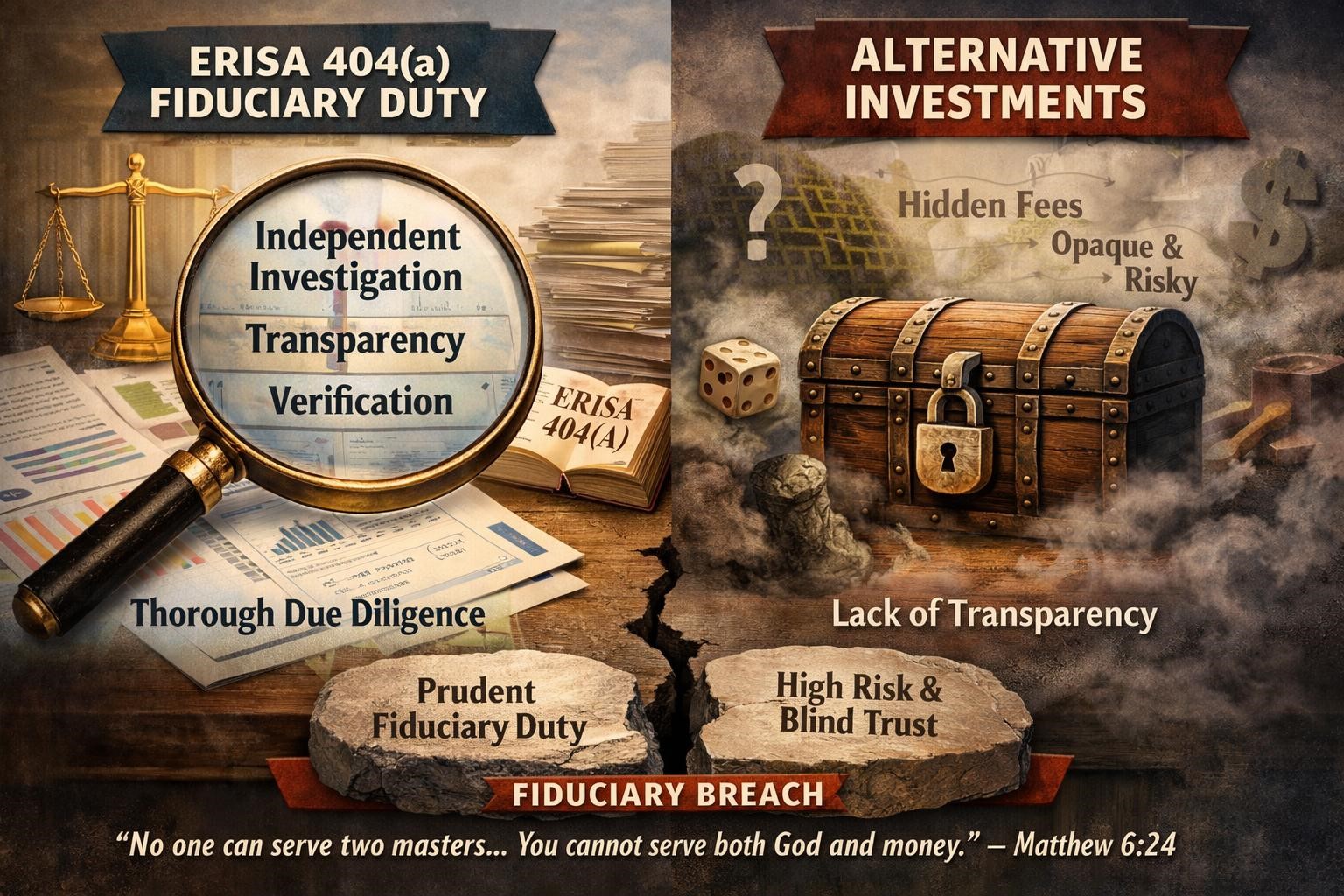
The Department of Labor’s Proposed Rule Impermissibly Dilutes ERISA § 404(a)’s Core Requirement of Independent Investigation
The Department of Labor’s proposed rule concerning the inclusion of alternative investments in defined contribution plans fails to grapple with a foundational requirement of fiduciary prudence under ERISA: the duty to conduct an independent investigation and evaluation of each investment option prior to its selection. This obligation, embedded in ERISA § 404(a)(1)(B), is not aspirational—it is mandatory, and it has been consistently reinforced by the courts as a substantive component of fiduciary prudence.
At its core, ERISA fiduciary law—grounded in trust law—requires more than procedural formalities. It requires that fiduciaries know what they are doing, based on a reasoned and independent evaluation of the merits and risks of each investment. This duty cannot be satisfied where the investment itself resists meaningful scrutiny.
Alternative investments, by their very design, frequently lack transparency. They often involve opaque valuation methodologies, limited disclosure, illiquidity, and reliance on sponsor-provided data that cannot be independently verified. These characteristics create an inherent structural barrier to the very investigation ERISA requires. A fiduciary cannot prudently evaluate what it cannot adequately see, test, or verify.
The Department’s proposed rule attempts to reconcile this irreconcilable tension by implicitly lowering the bar—suggesting that procedural steps or generalized due diligence may suffice even where substantive verification is not possible. But this approach conflicts with the governing statutory standard. ERISA does not permit fiduciaries to substitute trust in representations for independent judgment grounded in verifiable information.
The principle at issue can be captured succinctly: a fiduciary cannot simultaneously satisfy the duty of independent investigation while relying on investment structures that preclude such investigation. As a matter of logic and law, these obligations are mutually exclusive.
This tension is aptly illustrated by the well-known admonition: “No one can serve two masters… You cannot serve both God and money.” (Matthew 6:24). While not a source of legal authority, the analogy is instructive. Under Aronowiz’s leadership, a valid argument can be made that everything the EBSA has done has been been to impermissibly promote and protect the best interests of plan sponosrs and the insurance industry, at the expense of plan particiapnts and their beneficiaries. This is clearly inconsistent with ERISA’s stated goals and purpoaes and the DOL’s mission statement.
Just as divided loyalties are untenable in that context, so too is the attempt to reconcile ERISA’s demand for independent fiduciary judgment with investment vehicles that inherently depend on blind reliance. A fiduciary cannot serve both the statutory mandate of independent evaluation and the practical reality of opaque, unverifiable investment products.
The Department’s rule effectively invites fiduciaries to attempt precisely that—placing them in an untenable position where compliance with ERISA § 404(a) is, in practice, compromised. Courts have repeatedly rejected such dilution of fiduciary duty, emphasizing that prudence requires both a thorough investigation and a reasoned determination based on that investigation. Where the investigation itself is constrained by opacity, the resulting decision cannot be deemed prudent.
Accordingly, the proposed rule is not merely incomplete; it is fundamentally inconsistent with ERISA’s fiduciary framework. By failing to account for the incompatibility between alternative investments’ lack of transparency and the statutory requirement of independent investigation and evaluation, the Department has advanced a standard that cannot be reconciled with established law. It also sets up plan sponsors for litigation for a fiduciary breach, the EBSA’s preferred ruse du jour.
American workers deserve an, by law, are entitled to better protection. In a March 26, 2026, New York Times article described various reports by current and former DOL employees and describing the current DOL environment as “chaos.” As a result, Senator Grassley, a member of the HELP committee (Health, Education, Labor and Pensions )has reportedly requested documents and is considering requesting oversight hearings into the current issues at the DOL. Hopefully, the HELP committee will also consider expanding any Congressional oversight hearings to address the EBSA’s continual disregard for relevant legal precedent and ERISA’s stated purposes.
© Copyright 2026 InvestSense, LLC. All rights reserved
This article is for informational purposes only and is neither designed nor intended to provide legal, investment, or other professional advice since such advice always requires consideration of individual circumstances. If legal, investment, or other professional assistance is needed, the services of an attorney or other professional advisor should be sought.


 The Prudent Investment Fiduciary Rules
You must be logged in to post a comment.